An API proxy is a middleware layer between a client and a backend service that gives you one control point for security, routing, transformations, logging, and traffic policies while keeping clients decoupled from backend changes. In practice, it's the layer that lets you stabilize messy integrations without rewriting every backend API.
If you're building eCommerce integrations, you've probably felt the pain already. One cart expects one auth pattern, another returns slightly different order fields, a third changes behavior between versions, and suddenly your “simple” connector turns into a maintenance trap. The question behind “what is API proxy” usually isn't academic. It's operational. You want fewer brittle direct integrations, cleaner request handling, and a safer place to enforce rules before bad traffic reaches the systems that matter.
For integration developers, the proxy pattern matters because it solves the exact problems that show up once an app talks to more than one backend. It gives you a stable contract on the outside, even when the systems behind it are inconsistent, legacy, or moving.
What Is an API Proxy and Why Do Developers Use It
Most developers first reach for a proxy after direct integrations start breaking too often.
You connect your app to a backend API. Then product asks for another store platform. Then another region. Then a partner account with custom authentication. Before long, your client code knows too much about backend quirks, and every change ripples outward. That's when an API proxy stops being infrastructure jargon and starts being useful.
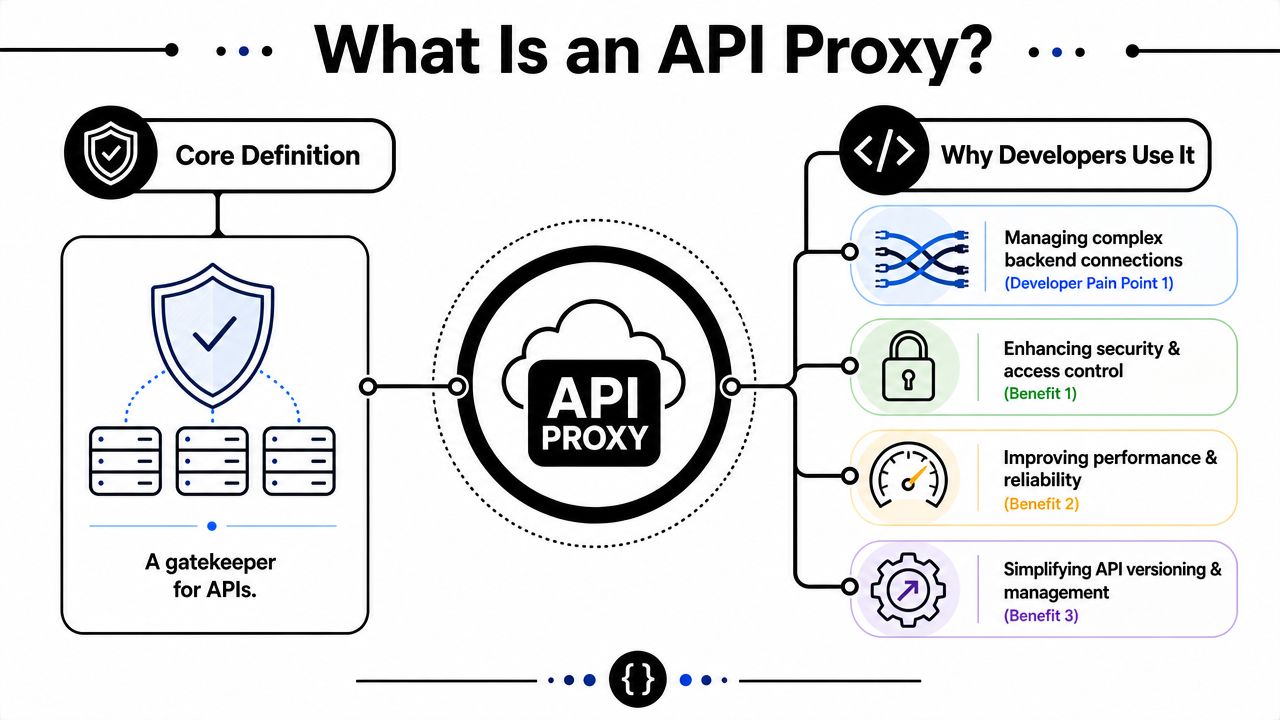
An API proxy is a middleware layer that sits between a client and a backend API, giving teams a single entry point where they can enforce security, caching, rate limiting, logging, and request or response transformation without changing the backend itself. It can also validate credentials such as API keys or OAuth access tokens before forwarding traffic, as explained in Kong's overview of API proxies.
Think of it like a sorting center
A useful analogy is a mail sorting center.
Clients don't need to know which exact warehouse, office, or department handles the package. They send the request to one address. The sorting center checks the label, applies routing rules, rejects invalid deliveries, and forwards the request correctly. That's what a proxy does for API traffic.
It separates what your client calls from how the backend works. Your mobile app, admin dashboard, or integration service can keep using the same public endpoint while you change internal services, add validation, or rewrite payloads behind the scenes.
Why developers keep using this pattern
Developers don't add proxies because they're fashionable. They add them because direct coupling causes recurring problems:
- Backend changes leak into clients: A path change, auth update, or payload tweak forces client updates.
- Cross-cutting logic gets duplicated: Every service starts handling the same auth, logging, and throttling concerns.
- Multi-system integrations become inconsistent: Different backends return similar data in different shapes.
Practical rule: If several clients need a stable interface but the backend keeps changing, put the stability burden in the proxy layer, not in every client.
For eCommerce work, that's often the difference between a manageable integration surface and a support queue full of edge cases. If you want a practical companion read focused on the proxy server angle, API2Cart's article on an API proxy server is a useful extension of the concept.
Understanding the API Proxy Architecture and Workflow
At runtime, a proxy is simpler than it sounds. It's just a controlled hop in the request path.
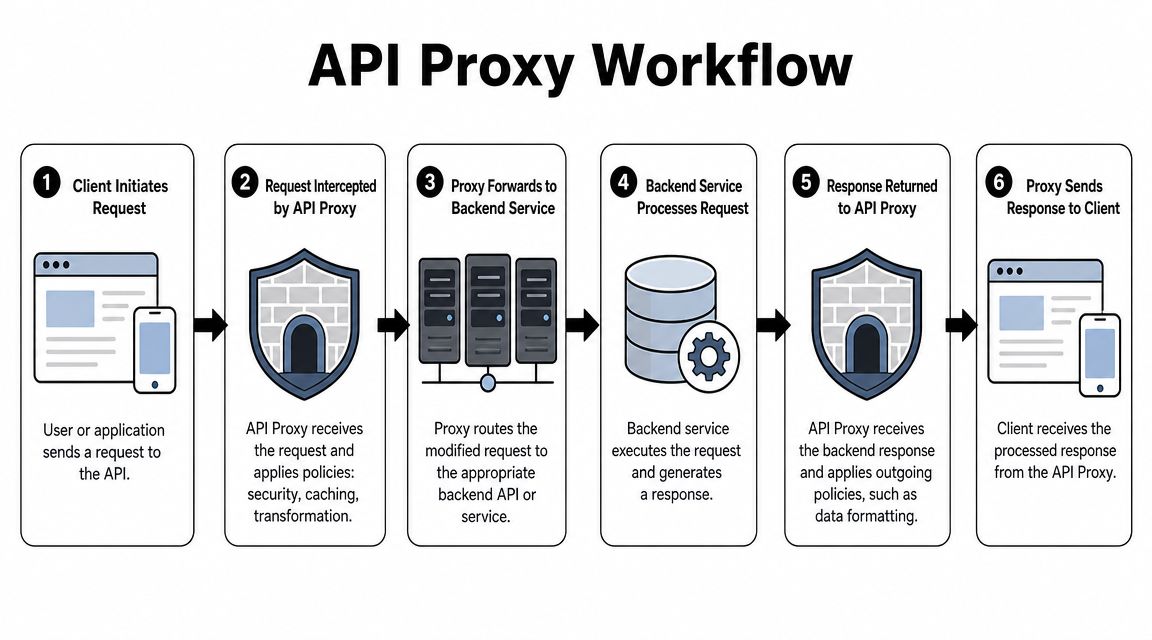
The client doesn't call the backend service directly. It calls the proxy endpoint. The proxy inspects the request, applies policies, forwards it to the correct backend, receives the response, optionally transforms that response, and returns it to the client. That separation lets teams change backend code or services without forcing client changes, as described in Cyclr's explanation of how an API proxy works.
What happens on each request
A typical request flow looks like this:
Client sends a request to the proxy
The app targets the proxy URL, not the backend service address.The proxy applies inbound policies
The proxy can check credentials, reject malformed requests, enforce usage rules, or normalize headers.The proxy routes to a backend
Based on path, environment, or request rules, it forwards traffic to the appropriate service.The backend handles business logic
The service processes the request and returns a response.The proxy applies outbound policies
It can reshape payloads, remove sensitive fields, or standardize error formats.The client gets the public-facing response
The client sees the contract exposed by the proxy, not every internal backend detail.
Why this workflow matters in integration projects
For integration developers, the key value isn't just forwarding. It's control without backend rewrites.
Suppose your order ingestion service talks to one backend that returns order_total, another that returns totalAmount, and another that nests totals inside a summary object. A proxy can normalize that difference at the edge so your consuming application handles one contract, not three. The same goes for header formats, auth token placement, or minor version inconsistencies.
A good proxy doesn't hide architecture problems forever. It buys you a stable interface while you fix them on a safer timeline.
That same mindset shows up in broader infrastructure work. If your team is modernizing surrounding systems as well, this enterprise playbook for cloud migration success is worth reading because proxy strategy often becomes part of a larger migration plan, especially when old services move slower than client-facing releases.
If you want the management view of this pattern, API2Cart's crash course in API management helps connect the request flow to governance and lifecycle concerns.
API Proxy vs API Gateway vs Reverse Proxy
These three terms get mixed together all the time because all three sit in the middle of traffic. But they solve different problems.
The distinction that matters most in day-to-day architecture is scope. A simple API proxy usually fronts a specific backend API and handles localized concerns. An API gateway goes wider. It often adds centralized authentication, advanced rate limiting, request orchestration, and deeper observability beyond what a simple proxy for a single backend typically provides, as outlined in Tyk's API proxy vs API gateway guide.
The practical difference
If you're deciding what to put in front of a service, use this mental model:
- Reverse proxy handles traffic management in front of servers or apps.
- API proxy stabilizes and controls access to a backend API.
- API gateway becomes the front door for a broader API estate.
For reverse proxy mechanics at the server layer, this guide to ARPHost reverse proxy configuration is useful background.
API Proxy vs API Gateway vs Reverse Proxy
| Aspect | API Proxy | API Gateway | Reverse Proxy |
|---|---|---|---|
| Primary scope | Usually one backend API or a narrow integration surface | Multiple APIs or services under centralized management | General traffic in front of web apps or servers |
| Main job | Decouple clients from backend details and apply API policies | Provide broader API management and coordination | Forward requests, often for routing, caching, or shielding origins |
| Policy depth | Focused and local | Broader and more operationally rich | Usually infrastructure-focused |
| Typical use | Add auth checks, transformations, and stable public endpoints | Govern many APIs with shared controls | Protect or route traffic to upstream servers |
| Good fit | One service with integration headaches | Growing API programs with shared standards | Web delivery and server exposure control |
When to stop at a proxy
Use a proxy when you need a thin control layer in front of a specific backend and you don't need platform-wide orchestration.
Move to a gateway when teams need shared policy enforcement across many services, deeper operational visibility, or one managed front door for a broader architecture. A lot of teams wait too long to make that distinction. They keep stuffing more logic into a simple proxy until it starts behaving like an underpowered gateway.
Key Benefits and Limitations for Developers
A proxy can clean up a messy integration architecture fast. It can also become one more thing to operate badly if you treat it like a dumping ground for random logic.
That trade-off is the essential conversation.
What works well
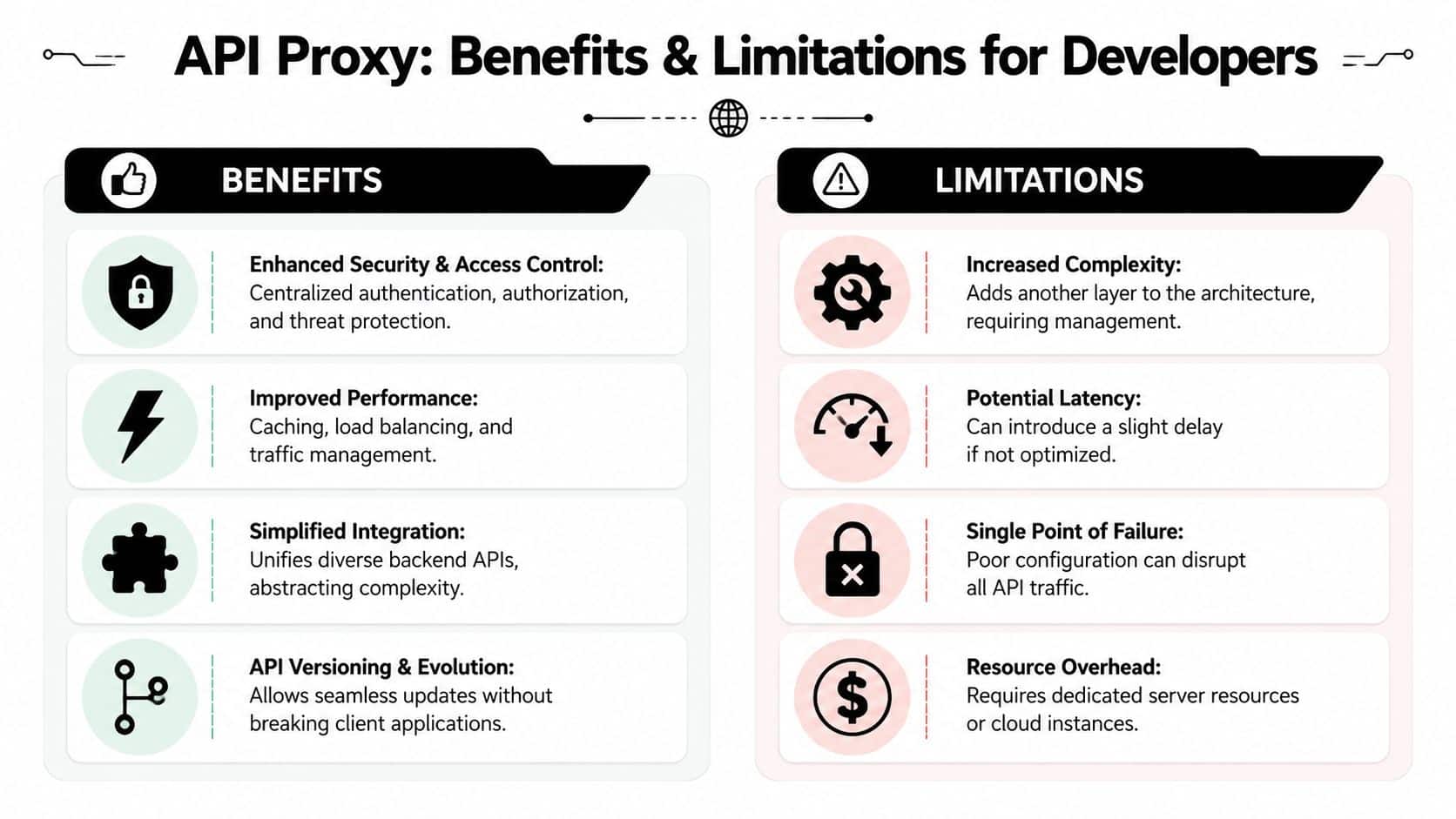
The biggest developer benefit is separation of concerns. Client applications can focus on business workflows while the proxy handles cross-cutting rules at the edge.
A proxy is especially useful when you need to modernize older services without touching them immediately. You can put a cleaner REST or JSON-facing contract in front of a backend that still has awkward field names, inconsistent headers, or legacy assumptions. That gives frontend teams and integration consumers something stable to build against.
Other practical advantages tend to show up quickly:
- Security centralization: One place to validate credentials and enforce access rules before requests hit backend code.
- Contract stability: You can evolve backend services while keeping a steady public interface.
- Cleaner transformations: You can normalize request and response shapes where mismatch happens.
- Operational consistency: Logging and policy enforcement happen in one layer instead of being duplicated across services.
The best proxy logic is boring. It's predictable, narrow, and easy to reason about.
Where teams get into trouble
The limitations are just as real. Adding a proxy adds another layer in the request path, which means performance trade-offs and more operational surface area. The maintenance burden of managing policy logic also grows as the number of APIs grows, as noted in Apigee's discussion of understanding APIs and API proxies.
A few failure modes show up repeatedly:
- Too much business logic in the proxy: The proxy becomes hard to test and harder to replace.
- Policy sprawl: Different teams add rules ad hoc, and nobody knows which policy owns what behavior.
- Weak observability: The proxy fails without clear indication, so every outage turns into guesswork.
- Single-point sensitivity: If the proxy is misconfigured, every downstream integration can feel it.
The practical line
Use the proxy for control, normalization, and protection. Don't use it as a substitute for service design.
If your proxy starts orchestrating complex workflows, storing application state, or compensating for every backend flaw forever, you've crossed from useful abstraction into architectural debt.
API Proxy Use Cases in eCommerce Integration
eCommerce integration is where the proxy idea becomes very concrete.
A SaaS product that connects to online stores rarely deals with one neat backend. It deals with many store APIs, many authentication patterns, many webhook behaviors, many order schemas, and many edge cases around products, shipments, inventory, and customers. Even when two platforms expose similar business objects, they often model them differently enough to create mapping work in every connector.

Where a proxy helps in real integration work
For an eCommerce integration developer, a proxy can sit between your application and the store platforms to handle recurring problems:
- Authentication differences: One platform expects one token flow, another uses a different credential pattern, and your app shouldn't need custom auth code everywhere.
- Payload normalization: Product, order, and customer records can be remapped into a format your core app understands.
- Error handling: Instead of exposing every platform's error shape directly, the proxy can standardize failure responses.
- Version insulation: If a backend changes field names or endpoint structure, the proxy can preserve the client contract while you adapt upstream logic.
That pattern is especially useful for systems like OMS, PIM, ERP, shipping, and inventory software. Those products don't win by becoming experts in every cart's API oddities. They win by moving business data reliably between systems.
The build problem most teams underestimate
The hard part isn't creating one connector. It's operating many of them over time.
A team can build a custom integration for one platform and feel productive. Then product wants broader coverage. Every additional cart creates more work in auth, mapping, testing, retries, support, and change management. At that point, building your own proxy layer for each platform can become a parallel product of its own.
A unified API can function like a pre-built proxy layer for eCommerce. API2Cart is one example. According to the publisher information provided for this article, it gives B2B software vendors one API to connect with 80+ shopping carts and marketplaces and exposes 100+ API methods for orders, products, customers, shipments, inventory, and catalog data through a unified interface. For an integration developer, that means the proxy-style work of routing, normalization, and connector maintenance is moved into a managed layer instead of being rebuilt per platform.
If your roadmap depends on supporting many commerce backends, the proxy decision becomes a build-versus-buy decision very quickly.
Concrete eCommerce scenarios
A few use cases fit the proxy model especially well:
- Order import pipelines: Normalize incoming order data before it hits your internal processing service.
- Inventory synchronization: Translate stock updates between your internal schema and each store's expected payload.
- Catalog sync: Map product variants, images, and metadata into one predictable model.
- Customer data ingestion: Apply consistent validation and field shaping before customer records enter your CRM or analytics pipeline.
If you operate across markets, platform diversity gets even messier. This South African eCommerce platform comparison is a good reminder that regional platform choices can shift the integration target set, which makes a unified interface more attractive than a stack of one-off connectors.
Security and Performance Considerations
Security is one of the most practical reasons to put a proxy in front of an API.
Instead of pushing authentication and traffic rules into every backend service, you can enforce those checks at the proxy layer. That gives you one consistent point to validate credentials, reject malformed requests, and apply rate controls before requests consume backend resources. It also reduces the number of places where security-critical logic can drift.
Security controls that belong at the edge
For integration teams, the proxy is a good place to handle:
- Credential validation: Check API keys or access tokens before forwarding traffic.
- Request filtering: Reject requests that don't meet required structure or policy.
- Usage protection: Apply throttling and rate limits so one client can't monopolize shared capacity.
- Response shaping: Strip fields a client shouldn't see, even if the backend returns them.
That doesn't remove the need for backend security. It creates a first line of enforcement where inbound traffic is most visible. API2Cart's guide to API security best practices is a useful companion if you're reviewing how those controls should fit into integration design.
Performance is more than speed
A proxy can improve perceived performance when it caches repeatable responses or reduces unnecessary backend load. But it can also become a bottleneck if you overload it with transformations, excessive logging, or poorly designed policies.
Operationally, you need to watch the proxy like a product component, not a passive relay. Proxy platforms are built for scale and often aggregate proxy statistics every 1 hour for monitoring and optimization. They also collect custom metrics from requests and responses for analytics over defined time ranges, which is why observability is a core part of effective proxy operations, as shown in Webshare's proxy statistics documentation.
Monitor the proxy for saturation, policy failures, and backend-specific error patterns. If you only watch the backend, you'll miss where requests are actually being shaped or rejected.
For eCommerce integrations, this matters when traffic spikes around promotions, bulk catalog updates, or scheduled order syncs. Performance issues often come from policy design and traffic shaping, not just raw backend speed.
Best Practices for Adopting API Proxies
Teams usually succeed with proxies when they keep the scope tight and the ownership clear.
They struggle when the proxy starts as a small convenience layer and slowly accumulates every unresolved architectural issue in the stack.
Start with one hard problem
Don't begin by putting every service behind a proxy at once. Start with a backend that already causes friction, such as a service with unstable contracts, duplicated auth handling, or painful payload differences across clients.
That gives you a real test case. You can measure whether the proxy reduces client complexity, improves control, and stays understandable under change.
Keep the proxy contract stable
Treat the proxy like a public API product, even if it's internal.
A few habits help:
- Define ownership: One team should own policy decisions, versioning, and release discipline.
- Log by default: Capture request and response metadata that helps debug failures without exposing sensitive data.
- Version deliberately: If the proxy contract changes, clients need a clear path to adopt it safely.
- Document transformations: If you rename or reshape fields, make that behavior explicit.
Don't turn the proxy into your application
At this point, experienced teams draw the line.
Use the proxy for authentication checks, routing, payload shaping, and traffic governance. Keep core business rules in services that are easier to test, deploy, and reason about. Once the proxy starts making domain decisions, you get hidden coupling and confusing failures.
Make the build versus buy call early
If your need is narrow, building a small proxy can be reasonable. If your roadmap includes many APIs, many clients, or many eCommerce backends, buying or adopting a managed layer often makes more sense than creating your own integration platform by accident.
A simple rule helps:
- Build when the proxy logic is narrow, specific, and unlikely to multiply.
- Buy or adopt a managed layer when connector maintenance, normalization, and policy management will become ongoing product work.
The best implementations stay boring. Clear ownership, clear contracts, strong monitoring, and a hard limit on proxy responsibilities usually beat cleverness.
If you're building software that needs to connect with many commerce platforms, API2Cart is worth evaluating as a unified API layer instead of building and maintaining separate cart connectors yourself. It fits teams that need one integration surface for store data and want to reduce the amount of proxy-style normalization, routing, and connector upkeep they own internally.