Think of an API proxy server as a dedicated middleman for an integration developer. It sits between your application and all the different backend APIs you need to connect with. For you, this means you can code against a single, reliable endpoint instead of juggling dozens of unique, ever-changing ones. It acts as a gateway that simplifies messy integrations by handling security, traffic, and data transformations all in one place.
What Is an API Proxy Server and Why Do Developers Need One?
If you're an integration developer, you know the grind of connecting your software to multiple third-party services. It's a constant battle with complexity. Every single API has its own authentication quirks, data structures, and rate limits. This chaos forces you to write, test, and maintain fragile, custom code for every connection you build.
This is exactly where an API proxy server comes in to clean things up. It creates a neat layer of abstraction that shields your application from all that backend mess.
Instead of your app making direct calls to countless different APIs, it makes just one call—to the proxy. The proxy takes it from there, intelligently routing, securing, and even reshaping the request before sending it on to the right destination. This strategy effectively decouples your core application logic from the wild west of external integrations.
The Developer's Pain Points
The daily frustrations of managing direct API integrations are real, and they burn a lot of time. Developers constantly find themselves stuck in a loop of repetitive, error-prone tasks. An API proxy server is specifically designed to break that cycle.
When developers have to integrate directly with multiple APIs, they're often bogged down by a common set of challenges that a proxy server is built to solve. Let's look at the "before and after."
Direct API Integration vs API Proxy Server Approach
| Challenge | Direct API Integration | API Proxy Server Solution |
|---|---|---|
| Constant Code Maintenance | When a third-party API changes—and they always do—your integration breaks. Developers have to drop everything to patch the code. | The proxy abstracts the backend APIs. If an API changes, only the proxy configuration needs an update; your application code remains untouched. |
| Inconsistent Data Formats | One platform returns product data in XML, another uses a weird JSON structure. You end up writing unique data mapping logic for every single endpoint. | The proxy acts as a universal translator, transforming all incoming data into one consistent format before it ever reaches your application. |
| Complex Security Management | Juggling dozens of unique API keys, OAuth tokens, and authentication protocols directly inside your application is a security nightmare and adds huge complexity. | All authentication is centralized at the proxy. Your application only needs to authenticate once, and the proxy handles the credentials for each backend service securely. |
At its core, the proxy server approach lets your development team focus on building features, not on the tedious and never-ending task of maintaining fragile connections.
An API proxy acts as your integration's bodyguard and universal translator. It handles the messy, inconsistent details of external APIs so your application code can stay clean, secure, and focused on its core job.
For an integration developer, a unified API service like API2Cart is a powerful, pre-built API proxy designed specifically for eCommerce. Instead of you building and maintaining a proxy, API2Cart provides a single, consistent API to connect with over 60 different shopping platforms. This instantly solves all those integration headaches and drastically cuts down development time. For example, instead of writing separate code to fetch product lists from Shopify, Magento, and BigCommerce, you make a single product.list call to the API2Cart proxy and get normalized data back, regardless of the source platform. This lets you get back to delivering features for your customers instead of getting lost in infrastructure maintenance.
Understanding Core API Proxy Architecture Patterns
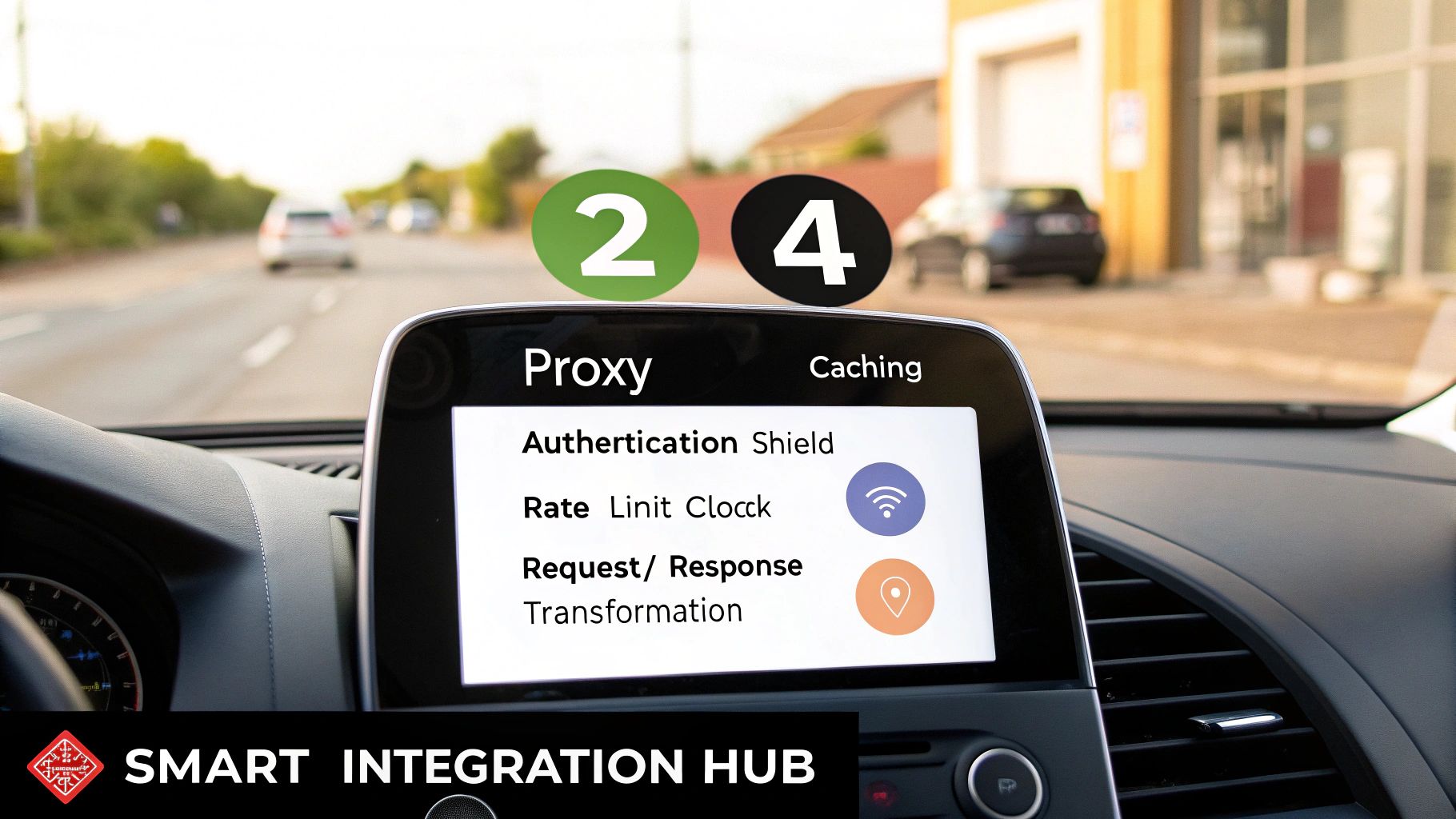
An API proxy server isn't just a simple traffic cop waving requests through. Think of it more like an intelligent hub where you can implement powerful strategies—or architectural patterns—that turn a basic pass-through into a massive asset for managing integrations. Getting these patterns right is how you build systems that are resilient, secure, and genuinely efficient.
This kind of intelligence is no longer a "nice-to-have." As businesses lean more on automated operations and intricate data flows, the need for smarter integrations is exploding. The global proxy server market, currently valued at around USD 1 billion, is on track to nearly double by 2033, driven by this exact demand. You can dig deeper into these trends and what's fueling them in recent proxy server market research.
For any developer working on integrations, mastering these patterns is the key to stamping out problems before they ever disrupt your application. Let's break down the ones that matter most.
Caching for Speed and Efficiency
Imagine you need to pull a product catalog that only gets updated once a day. Hitting the source API every single time a user needs that data is a huge waste of resources and time. Caching solves this problem by storing a temporary copy of the API response right on the proxy server.
The next time a request for that same data comes in, the proxy just serves it up from its cache instead of bugging the backend API again. The benefits are immediate:
- Reduced Latency: Users get their data almost instantly.
- Lower API Costs: You're making far fewer calls to third-party services that might charge per request.
- Decreased Load: Your own backend systems are shielded from thousands of repetitive, unnecessary requests.
Centralized Authentication and Security
Trying to manage dozens of API keys, OAuth tokens, and other credentials inside your main application isn't just messy—it's a security nightmare waiting to happen. A proxy lets you offload all of that by implementing centralized authentication.
Your application only needs to authenticate with the proxy. From there, the proxy takes over, securely managing and injecting the right credentials for each downstream service it calls. This brilliant move keeps sensitive keys out of your client-side code and dramatically simplifies your core application logic.
Rate Limiting to Prevent Overload
Let's be real: third-party APIs almost always have rate limits. If you exceed them, you risk getting your access blocked entirely. An API proxy acts as a protective shield by enforcing rate limiting on your behalf.
By setting rules at the proxy layer, you can control the frequency of outgoing requests. This ensures your application stays within the allowed usage limits of every connected service, preventing service disruptions and ensuring fair usage for all clients.
Request and Response Transformation
This is easily one of the most powerful patterns an API proxy can handle for an integration developer. It’s rare that an API gives you data in the exact format your application needs. You might get XML from one service and a deeply nested JSON object from another.
An API proxy server can act as a universal translator. It intercepts requests and responses to:
- Normalize Data: Convert all incoming data into a single, consistent format your application understands.
- Filter Unnecessary Fields: Strip out bloated or irrelevant data to shrink the payload size and speed things up.
- Add or Rename Headers: Tweak request headers on the fly to meet the unique requirements of a backend service.
For developers integrating with multiple eCommerce platforms, this pattern is an absolute lifesaver. A service like API2Cart is essentially a pre-built API proxy that has already mastered transformation. It takes the chaotic, inconsistent data from over 60 different shopping carts and delivers it through one clean, unified API. This means as a developer, you never have to build custom data mappers for each platform—the hard work is already done.
API Proxy vs. API Gateway vs. Reverse Proxy: A Developer's Guide
For integration developers, the terms API proxy, API gateway, and reverse proxy often get tossed around interchangeably, which can muddy the waters quite a bit. While they all play a role in directing traffic, their specific jobs and capabilities are worlds apart. Nailing down these differences is the key to picking the right tool for your architecture.
Let's use an analogy. Think of your entire backend system as a large, multi-tenant office building. In this scenario, each of these tools plays a distinct role in managing who gets in and what they can do.
The Front Desk: Reverse Proxy
A Reverse Proxy is the simplest of the three. It’s like the building's main front desk. Its primary job is to greet all incoming traffic (visitors) and point them to the right server (the correct floor or office) on the internal network. It’s a generalist, focused on things like load balancing, SSL termination, and basic traffic routing for web servers—not just APIs.
The Building Manager: API Gateway
An API Gateway is more like the building manager. It’s responsible for the entire building, providing shared services and enforcing rules for all the tenants (your microservices). It deals with the big-picture concerns that apply to all your APIs.
- Global Rate Limiting: Setting overall traffic caps for the entire API ecosystem.
- Authentication: Verifying the identity of every single user trying to access any API.
- Orchestration: Bundling calls to multiple microservices into a single, neat API response.
The gateway’s scope is massive. It manages your whole fleet of APIs as a single, cohesive product. It's the front door for your entire backend, not just a specific service.
The Specialist Concierge: API Proxy Server
This brings us to the API Proxy Server. In our analogy, this is the specialist concierge hired to serve a specific group of high-value tenants. While the building manager handles general security for everyone, the concierge provides custom, value-added services tailored to the needs of its particular clients.
An API proxy server focuses on mediating the relationship between a client application and a specific backend API or a small group of related APIs. Its goal is to simplify and beef up that particular interaction.
For an integration developer, this is where the magic really happens. An API proxy tackles specialized tasks like transforming messy data from a legacy system into clean JSON, caching responses from a slow third-party API, or adding an extra security layer to an otherwise unprotected endpoint.
Solutions like API2Cart act as a sophisticated, pre-built API proxy for eCommerce. Instead of just routing traffic, it offers a highly specialized service: it takes requests for over 60 different shopping cart APIs and transforms their unique, often messy data structures into one unified, predictable format. This lets you code against a single, clean endpoint while API2Cart handles the complex "concierge" work of talking to each individual platform behind the scenes.
If you want to zoom out and see the bigger picture, you can learn more about comprehensive API management strategies.
Feature Comparison: Proxy vs. Gateway vs. Reverse Proxy
To make the distinctions even clearer, let's break down how these three tools stack up against each other feature by feature. Each has its own lane, and knowing which one to choose depends entirely on the problem you're trying to solve.
| Feature | API Proxy Server | API Gateway | Reverse Proxy |
|---|---|---|---|
| Primary Focus | Mediating a specific API or group of APIs | Managing the entire API ecosystem | Routing traffic for web servers |
| Scope | Narrow and specific | Broad and comprehensive | General purpose |
| Core Function | Transformation, caching, security for one API | Orchestration, authentication, global policies | Load balancing, SSL termination |
| Ideal Use Case | Simplifying a legacy or third-party API | Exposing and managing all microservices | Protecting and scaling a web application |
As you can see, while they might seem similar at first glance, their purposes are fundamentally different. A reverse proxy is a traffic cop, an API gateway is a central command center, and an API proxy is a specialist that makes a difficult API easy to work with.
How an API Proxy Streamlines eCommerce Integrations
If you're a developer building software for the eCommerce world—like for order management, shipping, or marketing automation—you know the integration battle all too well. Connecting to dozens of shopping carts like Shopify, Magento, or BigCommerce means wrestling with a chaotic mix of unique data structures, proprietary authentication flows, and wildly different rate limits. This complexity forces you to build and maintain a mountain of fragile, custom code for each platform.
This is precisely where a specialized api proxy server becomes a game-changer. It acts as an intelligent intermediary, absorbing all that backend complexity so your application only has to talk to a single, consistent endpoint. It’s a fundamental shift that lets you focus on building valuable features instead of tedious maintenance.
The growth of these tools reflects a much bigger trend. The proxy server industry has ballooned into an estimated market size of USD 5.42 billion globally. This explosion is fueled by the critical need for solutions that can tame complex data interactions, especially in sectors like eCommerce.
From Chaos to Cohesion The API2Cart Approach
Imagine your task is to build a feature that syncs inventory levels across 40 different shopping platforms. Going direct would mean writing 40 separate integration modules, each with its own logic for authentication, data mapping, and error handling. It's an inefficient, unscalable nightmare for any developer.
A unified API platform like API2Cart functions as a powerful, pre-built API proxy tailored specifically for eCommerce. It abstracts away the unique headaches of each shopping cart, presenting them all through one clean, well-documented set of API methods.
This diagram shows how different proxy types fit into a hierarchy, with the API Proxy offering the most specialized, application-specific services.
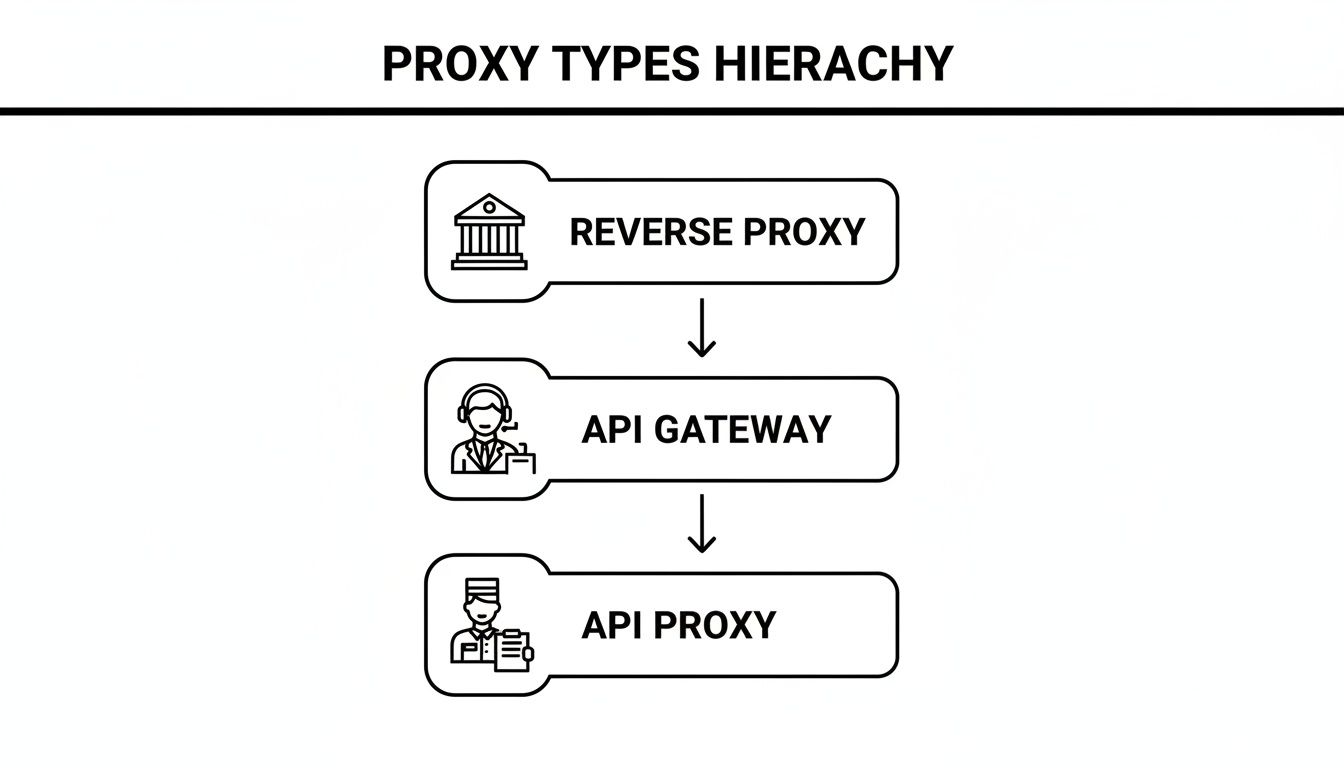
The visualization clarifies that while a reverse proxy handles general traffic and an API gateway manages an entire ecosystem, an API proxy provides tailored, concierge-like services for specific integrations. This means you can stop worrying about the intricate details of each platform and focus on the data itself.
Key Integration Challenges Solved
A service like API2Cart doesn't just pass requests along; it actively solves the biggest headaches that integration developers face daily. It provides a robust layer of intelligence that shields your application from backend chaos.
- Data Normalization: API2Cart transforms the varied data structures from every shopping cart into a single, unified format. A product object looks the same whether it comes from WooCommerce or BigCommerce, saving you from writing endless data mapping functions.
- Unified Authentication: Instead of managing dozens of different API keys and OAuth flows, you authenticate once with API2Cart. It securely handles the credentials for each individual store connection on your behalf, simplifying your codebase.
- Rate Limit Shielding: Every platform enforces its own API call limits. API2Cart manages these complexities, helping to prevent your application from being throttled or blocked due to excessive requests.
By leveraging a unified API proxy, your team is freed from the endless cycle of building and patching individual connectors. You get to market faster, reduce development costs, and deliver a more reliable product to your customers.
The core benefit is clear: one integration to rule them all. That's the power of using a specialized API proxy in this context. For a deeper dive into the mechanics, explore our guide on using a unified API for eCommerce integration.
Best Practices for Building a Secure and Scalable Proxy
Building a custom api proxy server isn't just about forwarding traffic. Think of it as constructing both a fortress and a superhighway for your integrations. A solid proxy needs to be resilient enough to fend off threats while also being able to handle a growing flood of traffic without breaking a sweat. If you get this wrong from the start, a poorly designed proxy can quickly become a single, catastrophic point of failure.
This means developers need to walk two parallel tracks at all times: security and scalability. Security is what keeps your data and your users safe. Scalability is what guarantees a smooth, responsive experience as your application takes off. If you drop the ball on either one, you risk service outages, data breaches, and a permanent loss of user trust. These principles are non-negotiable for custom builds, and they also highlight why managed solutions that have already solved these thorny problems are so valuable.
Fortifying Your Proxy Against Threats
Security isn't something you can just bolt on at the end; it has to be woven into the very fabric of your proxy's design. When you’re thinking about a secure API proxy, you have to get familiar with securing the application layer of your API proxy. This is all about creating a defense-in-depth strategy to protect every single part of the data flow.
Here are a few key security measures you can't skip:
- Robust API Key Management: All downstream API keys need to be centralized and encrypted. Your application should only ever have to talk to the proxy, which then takes on the job of securely managing credentials for all the backend services.
- Input Validation and Sanitization: Never, ever trust incoming data. You need to implement strict validation rules to shut down common threats like SQL injection and cross-site scripting (XSS) before they even get a chance to sniff your internal systems.
- Securing the Proxy Itself: Because it sits in the middle, the proxy is a very attractive target for attackers. Harden its operating environment, lock down administrative access, and keep all its dependencies patched to shrink the attack surface.
For a deeper dive into protecting your endpoints, our guide on API security best practices covers even more strategies.
Designing for Performance and Scale
A scalable API proxy is one that can handle a spike in traffic gracefully. The golden rule here is to build a stateless architecture. This simply means the proxy doesn't hold onto any session-specific data between requests. By doing this, you can easily spin up more instances behind a load balancer whenever traffic surges, which is the secret sauce to high availability and fault tolerance.
But performance isn't just about throwing more server power at the problem. The datacenter proxy market, currently valued at USD 1.41 billion and growing at a CAGR of 9.1%, is booming for a reason—high-performance proxies are absolutely essential for modern applications.
To build a proxy that flies, you'll want to focus on a few key things: intelligent caching to slash latency, efficient load balancing to spread requests out evenly, and geo-distribution to serve users from a location that’s physically closer to them. When you bring these strategies together, you create an integration layer that’s not just fast and reliable, but truly scalable.
Accelerating Your Roadmap with a Unified API
Let’s be honest: building and maintaining a custom API proxy layer is a massive engineering project. You're not just writing code; you're architecting for security, planning for unpredictable scale, and committing to a future of constantly chasing third-party API changes. This is the exact moment a unified API solution stops being a nice-to-have and becomes a powerful strategic move for any integration developer.
Instead of spending months building your own proxy from scratch, a service like API2Cart hands you all of this critical functionality right out of the box. Think of it as a pre-built, fully managed api proxy server designed specifically to handle the messy reality of eCommerce integrations. This approach lets your team completely sidestep the heavy lifting of infrastructure development and jump straight to creating value for your customers.
From Months to Days
The real impact here is how dramatically it speeds up your product roadmap. Just think about the typical development cycle for a single shopping cart integration. You have to research the platform, wrestle with its unique authentication, map all the data fields, test everything, and finally deploy. That’s a process that can easily swallow weeks or even months of a developer's time.
Now, multiply that headache by every platform your customers are asking for. The timeline doesn't just grow; it explodes, eating up engineering resources that should be focused on innovation. A unified API collapses this entire tangled mess into a single, manageable integration.
- Slash Development Time: Forget building dozens of individual connectors. You connect to over 60 eCommerce platforms through one consistent, well-documented API.
- Drastically Reduce Maintenance: When a platform like Shopify changes its API (and they always do), API2Cart handles it. Your application code stays stable and you don't have to scramble to put out fires.
- Get to Market Faster: You can launch new features and support for more platforms in a fraction of the time, giving you a serious advantage over the competition.
This isn't just about writing less code. It’s a strategic choice to reallocate your most precious resource—your developers' time—away from tedious plumbing and back to building the features that define your core product.
A unified API proxy acts as a development accelerator. It frees your team from the plumbing of integration and allows them to focus on innovation and driving business growth.
This approach is also incredibly effective for modernizing how you connect to existing systems. An API proxy can serve as a clean, modern interface for older, clunky platforms. This helps you move your roadmap forward by tackling technical debt head-on, a key challenge highlighted in recent thinking on strategies for managing legacy code. By hiding all that backend complexity, you can build new features without being chained to old infrastructure. It’s about building for what’s next, not constantly patching the past.
Ready to stop building individual integrations and start shipping features faster? API2Cart provides a unified API to connect with 60+ shopping platforms, saving you thousands of development hours. Start your free 14-day trial and see how quickly you can expand your market reach.