
At its core, marketplace integration is the digital plumbing that connects specialized SaaS applications—like order management or warehouse systems—to eCommerce giants like Amazon, eBay, and Walmart. For an integration developer, it’s about engineering a resilient, high-performance data pipeline.
This pipeline synchronizes orders, inventory levels, and product information in near real-time, preventing the kind of operational chaos that sinks online retailers, like overselling popular products or creating massive fulfillment delays. It's essentially a universal translator, making sure completely different software systems can speak the same language fluently through their APIs.
Understanding Marketplace Integration Fundamentals
For an integration developer, this isn't just about linking point A to point B. It's about engineering a resilient, automated bridge that allows data to flow seamlessly between a B2B SaaS application and the sprawling, complex ecosystem of an online marketplace.
This digital bridge is what replaces tedious manual data entry and messy spreadsheets with a smooth, programmatic flow of information. For any eCommerce business serious about scaling, this isn't a nice-to-have; it's completely non-negotiable.
Without a solid integration strategy, your clients are stuck trying to manage a tangled mess of disconnected systems. This inevitably leads to expensive errors, frustrated customers, and an inability to make smart, data-driven decisions. The entire goal is to make separate software systems operate as one cohesive unit.
The Strategic Value For SaaS Developers
As a SaaS vendor, offering robust marketplace connections is a massive competitive advantage. It elevates your product from just another standalone tool into an essential, indispensable hub in your customer's tech stack.
The power to instantly pull order data from multiple channels or push inventory updates back out is a fundamental need for any modern eCommerce merchant. Seeing how agencies pull off large-scale, successful product launches on marketplaces really drives home how critical these tight integrations are in the real world.
Marketplace integration is the foundational layer upon which scalable eCommerce operations are built. For developers, it's about engineering reliability and speed, enabling businesses to manage thousands of orders across multiple channels without failure.
For instance, a developer at an inventory management software company can leverage marketplace integration to empower their users to:
- Synchronize stock levels across Amazon, eBay, and their own website all at once.
- Automate order retrieval from every sales channel into a single, clean dashboard.
- Update product listings—including prices, images, and descriptions—across all platforms from one central system.
To give you a clearer picture, here’s a breakdown of what effective marketplace integration really unlocks for a business.
Core Functions Unlocked By Marketplace Integration
This table summarizes the essential business operations that are automated and scaled through a well-executed integration.
| Function | Description | Business Impact |
|---|---|---|
| Order Management | Automatically pulls new orders from marketplaces into a central system for processing and fulfillment. | Reduces manual entry errors, speeds up fulfillment times, and improves the overall customer experience. |
| Inventory Sync | Pushes real-time stock level updates from a central database to all connected marketplace listings. | Prevents overselling, eliminates stockouts, and ensures accurate inventory counts across all channels. |
| Product Information | Manages and updates product details like prices, descriptions, and images across multiple marketplaces from one place. | Ensures brand consistency, saves countless hours of manual work, and allows for rapid pricing adjustments. |
| Shipping & Fulfillment | Sends tracking information and fulfillment status updates back to the marketplace once an order is shipped. | Keeps customers informed, reduces "Where is my order?" inquiries, and helps meet marketplace performance metrics. |
Ultimately, each of these functions moves a merchant from reactive problem-solving to proactive, automated management, which is the key to scaling an eCommerce business.
While APIs are the technical engines powering these capabilities, building and maintaining a separate connection for each marketplace is a monumental task for any development team. This is where unified solutions change the game. For example, API2Cart provides a single, unified API to connect with over 60+ platforms, drastically reducing development time. Instead of grappling with dozens of unique API documents and authentication flows, your team codes once to manage data across a huge network of marketplaces. You can learn more about connecting to marketplaces with a unified API to see how it can fast-track your project timelines. This approach transforms a daunting architectural challenge into a much more manageable and efficient development process.
Comparing Marketplace Integration Approaches
For any integration developer, deciding how to build connections is just as critical as deciding what to connect. This choice will fundamentally shape your project's timeline, budget, and long-term maintenance burden. The path you take for your marketplace integration strategy isn't a minor detail—it has lasting consequences on your team's agility and your product's ability to scale.
You can think of the main approaches like different ways to travel. Each gets you to your destination, but the cost, speed, and effort involved are worlds apart. Let's break down the three primary options your development team will be looking at.
The Direct API Connection Path
Building direct, one-to-one integrations using each marketplace's native API is the most granular, hands-on approach. It’s like constructing a custom-built car for a single, specific road trip. You get a perfectly tailored vehicle, but the process is incredibly slow, expensive, and doesn't scale.
For developers, this means digging into the unique API documentation for Amazon, then starting all over again for eBay, then doing it all a third time for Walmart. Each platform has its own authentication methods, quirky data structures, and strict rate limits. The engineering overhead to build—and more importantly, maintain—these individual connections balloons with every new marketplace you add to the list.
This flowchart shows the essential data points your SaaS application needs to sync, which is the foundation of any integration, regardless of the method you choose.
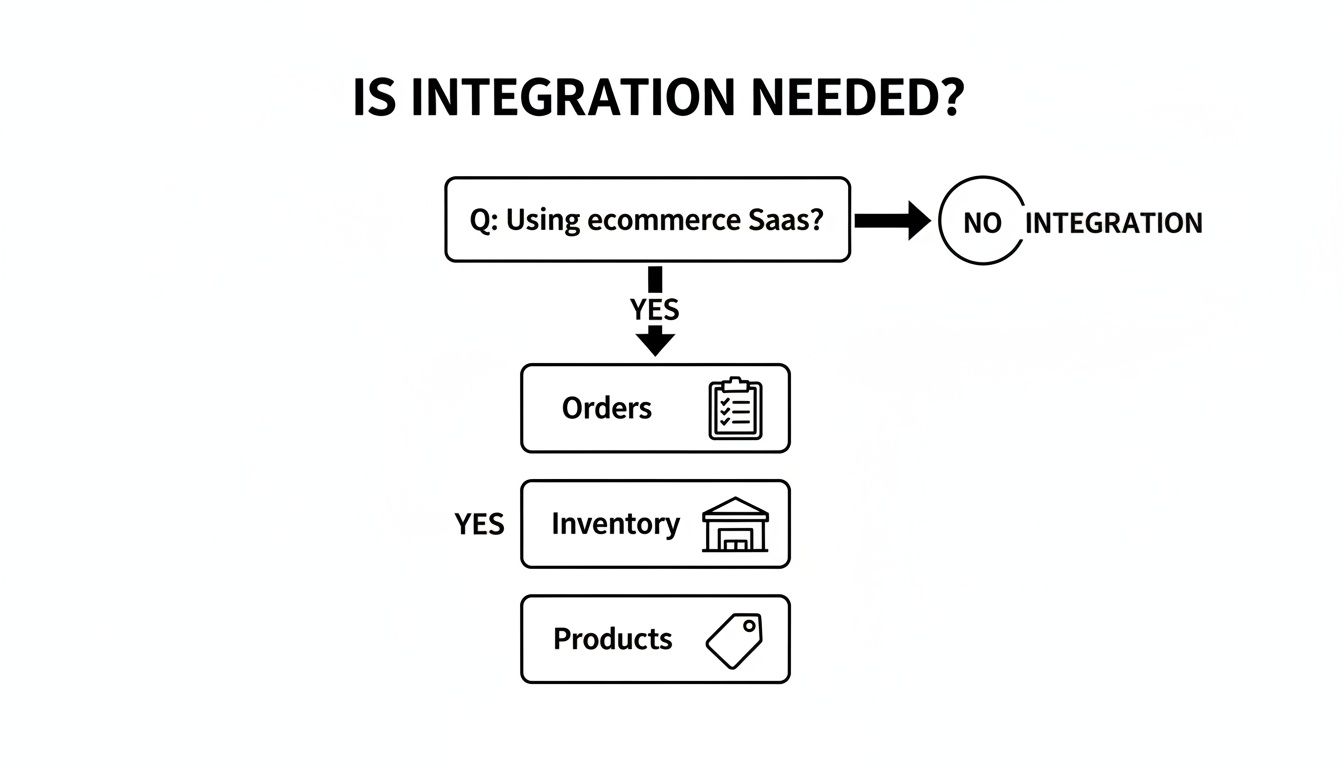
Whether you're managing orders, inventory, or products, each function requires a dedicated, from-scratch development effort for every single platform when you go the direct API route.
The Middleware and iPaaS Route
Next up, we have middleware, often packaged as an Integration Platform as a Service (iPaaS). This approach is like having a versatile toolkit filled with various adapters and converters. It offers pre-built components that can speed things up compared to the direct method, but it often introduces its own layer of complexity and can create performance bottlenecks.
These platforms are powerful, but they often require significant configuration and might not be optimized for the specific nuances of eCommerce data. The global iPaaS market is projected to skyrocket by 32.3% to reach USD 71.35 billion by 2030, which shows just how high the demand is for integration solutions.
This growth highlights the industry's shift toward real-time data exchange, which is vital for managing orders and shipments across the 60+ shopping carts and marketplaces that modern B2B SaaS tools need to support. While iPaaS can reduce initial build times, developers often find themselves wrestling with complex workflows and managing a middleman that adds another potential point of failure.
The Unified API Advantage
Finally, there's the unified API model—the high-speed rail network of integration. With this approach, you connect to a single, standardized API that has already built the tracks to every destination you need. A service like API2Cart is a perfect example of this model in action.
A unified API abstracts away the immense complexity of individual marketplace connections. Instead of managing dozens of unique authentication flows and data schemas, your developers interact with one consistent API, dramatically simplifying the codebase and reducing maintenance.
For a developer, this is a total game-changer. You write the code to retrieve orders, update products, or sync inventory just once. API2Cart handles the translation to and from each of the 60+ supported platforms behind the scenes.
Here’s a quick rundown of how this approach directly speeds up development for key use cases:
- Rapid Onboarding: Instead of spending months building a single connection, your team can integrate with the entire API2Cart network in weeks, gaining instant access to millions of potential customers.
- Simplified Data Management: API2Cart provides over 100 API methods with a standardized data format. An "order" object has the same structure whether it comes from Shopify, Magento, or Amazon, which gets rid of all the tedious data mapping.
- Zero Maintenance Overhead: When a marketplace updates its API (which happens all the time), the API2Cart team handles it. Your developers are freed from the endless cycle of monitoring changelogs and patching broken connections.
To help you weigh the options, here’s a direct comparison of the three strategies from a developer's perspective.
Comparing Integration Methods For Developers
| Metric | Direct API Integration | Middleware (iPaaS) | Unified API (e.g., API2Cart) |
|---|---|---|---|
| Development Time | Very High (months per integration) | Moderate (weeks to configure) | Low (days to weeks for multiple platforms) |
| Upfront Cost | High (heavy engineering investment) | Moderate (licensing + setup fees) | Low (predictable subscription fee) |
| Ongoing Maintenance | Extremely High (constant monitoring and fixes) | High (platform management and updates) | Zero (handled by the API provider) |
| Scalability | Low (each new platform is a major project) | Moderate (depends on platform's connectors) | High (instantly connect to dozens of platforms) |
| Data Consistency | Low (requires manual data mapping) | Moderate (mapping tools available) | High (standardized data models out-of-the-box) |
| Developer Focus | Building and maintaining integrations | Configuring workflows and managing iPaaS | Building core product features |
As you can see, the choice has a massive impact on your team's resources and focus.
This unified approach allows your engineering team to stay focused on what they do best: building and improving your core product features, not getting bogged down in the complex and repetitive work of API maintenance. To dig deeper into the architectural styles that power these connections, check out our guide comparing REST API vs GraphQL. Ultimately, a unified API provides the fastest, most scalable, and most cost-effective path to robust marketplace integration.
Designing A Resilient Integration Architecture
Building the technical backbone for a solid marketplace integration is about more than just connecting two points. It’s about designing a system that can handle the constant, high-volume flow of data between your app and various marketplaces without breaking a sweat. It needs to be resilient, scalable, and easy to maintain.
A truly robust system is made of core components working in harmony. Think API gateways to manage requests, data transformation layers to make sense of all the information, and tough authentication handlers for protocols like OAuth and simple API keys. Without these, your system becomes fragile and will likely fail as you add more connections or as data volume explodes. Building all of this from scratch is a massive undertaking for any dev team.

Mastering Asynchronous Operations With Webhooks
Webhook management is a critical piece of any resilient architecture. You can think of webhooks as the nervous system of modern eCommerce, delivering real-time data updates without the need for constant, inefficient checks.
Imagine a new order comes in on Amazon. Instead of your app having to ask, "Is there a new order yet?" every minute, the marketplace proactively sends a notification—a webhook—to your system the moment it happens. This event-driven approach is the secret to building scalable integrations. Your system can then process this webhook "asynchronously," meaning it handles the task in the background without blocking the main application from doing its job.
Here’s how it works with that Amazon order:
- Acknowledge Receipt: Your system immediately tells Amazon, "Got it," and puts the task into a queue.
- Process in the Background: A separate worker process grabs the task from the queue.
- Update Systems: The worker then updates inventory in your client's Warehouse Management System (WMS) and pings the fulfillment team.
This model is absolutely essential for handling the massive data volumes that come with successful eCommerce without completely overwhelming your servers.
The Challenge Of Diverse Data And Authentication
While the idea is simple enough, the reality is messy. Every single marketplace has its own unique way of structuring data. An "order" object from eBay looks totally different from one you’d get from Walmart. Your architecture needs a smart data transformation layer to map and normalize these varied structures into one clean, consistent format your app can actually use.
Authentication is another major headache. Some platforms use OAuth 2.0, which requires a complex, multi-step authorization flow. Others just use simple API keys. Building, securing, and maintaining separate handlers for each of these authentication methods across dozens of marketplaces is a huge and never-ending engineering chore.
A unified API solution like API2Cart abstracts this entire mess away. Instead of battling dozens of authentication flows and data schemas, your developers work with a single, consistent API. This drastically simplifies the codebase and cuts down on potential points of failure.
Accelerating Development With A Unified API
Using a unified API service is like plugging into a pre-built, industrial-strength integration architecture. API2Cart has already done the heavy lifting of building and maintaining these core components, so your team doesn't have to sweat the low-level details of each marketplace connection.
Instead of writing custom code for Amazon's authentication and then starting all over again for Shopify, your developers use one well-documented authentication process from API2Cart. The same goes for data. A product is a product, and an order is an order, no matter where it came from. API2Cart serves up all data in a standardized format, completely removing the need for a complicated in-house transformation layer.
To get a better sense of how this can shield your primary servers, it's worth exploring the role of an API proxy server in managing requests. This approach offloads an enormous amount of complexity, freeing up your developers to build features that customers actually care about instead of just maintaining the plumbing.
A Practical Integration Checklist For Developers
Kicking off a new marketplace integration can feel like building a complex engine piece by piece. You need a clear plan—a roadmap that tells you what to build and in what order. This checklist breaks the entire process into manageable phases, giving your development team a structured path to follow.
Think of this as your project's blueprint. Following these steps helps you sidestep common mistakes, make sure every critical piece is in place, and build a more stable, scalable connection.
Phase 1: Discovery and Scoping
Before you write a single line of code, you have to define exactly what you're building. This first phase is all about understanding the data you need to move and the business rules that govern it. Without this clarity, projects quickly get derailed by scope creep and unexpected technical headaches.
Start by mapping out the core data points your application needs to function. Typically, this means answering a few key questions:
- Product Data: What information do you need to create, read, update, and delete product listings? (CRUD operations)
- Order Information: Which order details are non-negotiable for your system, like customer info, items purchased, and shipping addresses?
- Inventory Levels: How will you keep stock levels perfectly synced between the marketplace and your application?
- Shipping and Fulfillment: What data is required to update an order's status and push tracking information back to the marketplace?
Phase 2: Secure Authentication and Data Mapping
Once you know what data you need, the next step is to establish a secure handshake. Every marketplace handles authentication differently, from complex OAuth 2.0 flows to simple API keys. Your system has to manage these credentials securely to get authorized access.
After you’re connected, the real fun begins: data mapping. Marketplace A might call a field "product_title," while Marketplace B calls it "item_name." Your job is to build a translation layer that maps all these unique fields to your application's own standard data model. Honestly, this is often one of the most tedious parts of building an integration from scratch.
Phase 3: Building Core Logic and Error Handling
Now it's time to build the engine—the core logic for the CRUD operations you mapped out in phase one. This is where you write the code that actually calls the marketplace APIs to pull orders, update inventory, and manage product listings.
At the same time, you need to build bulletproof error handling. APIs will fail. Rate limits will be hit. Unexpected data formats will appear. Your integration has to be resilient enough to handle these bumps, log what happened for debugging, and ideally, have automated retry logic like exponential backoff.
A unified API service like API2Cart can dramatically cut down the time spent on these first few phases. Its standardized data format across over 100 API methods all but eliminates the painful data mapping step, while its SDKs and solid documentation get you building from day one.
The need for these connections is exploding. The global data integration market—the backbone of eCommerce—is set to jump from USD 15.24 billion to a staggering USD 47.60 billion by 2034. This growth is fueled by thousands of SaaS companies that need to connect to marketplaces to break down the data silos that hold businesses back. You can explore more on integration trends to get a feel for just how big this market is.
Phase 4: Rigorous Testing and Deployment
The final hurdle before going live is testing, and it needs to be tough. This isn't just about making sure the code runs; it's about throwing real-world chaos at it. Your testing plan should include:
- Unit Testing: Verify that each individual function or component works exactly as it should.
- Integration Testing: Make sure your application can talk to the live marketplace API correctly, usually in a sandbox environment.
- Stress Testing: Hammer your integration with high volumes of data to see how it holds up under pressure.
Once your tests are passed with flying colors, you can move to a staged deployment. Start with a small group of beta users to catch any last-minute issues before rolling it out to everyone. While this whole process is thorough, it’s also long and expensive. A service like API2Cart abstracts away most of this complexity, turning what could be a multi-month marathon into a much shorter sprint.
Navigating Common Integration Challenges
Any developer who's built an integration knows that the initial connection is just the starting line. The real test comes when you have to keep that connection alive and healthy in the wild. Even the best-laid plans run into trouble, and how you prepare for that chaos is what separates a brittle integration from a resilient one.
Developers tend to run into the same brick walls over and over again. These aren’t rare edge cases; they're the guaranteed headaches that come with connecting to multiple, independent marketplaces. Each problem requires its own custom fix, piling on complexity and a massive maintenance burden.
The Most Common Developer Headaches
When you're juggling dozens of API connections, certain issues are bound to pop up repeatedly. If you don't have a solid strategy, your team will spend more time putting out fires than shipping features that actually matter to your customers.
Let's break down the usual suspects:
- Aggressive API Rate Limiting: Marketplaces are very protective of their resources, so they put strict caps on how many API calls you can make. Go over the limit, and they'll cut you off, bringing your entire data sync to a screeching halt. The typical fix involves building complicated error handlers with exponential backoff logic—another piece of code to maintain for every single integration.
- Inconsistent Data Formats: An "order" from Amazon looks completely different from an "order" from eBay. This means your team is on the hook for writing and maintaining a flexible data transformation layer that can make sense of dozens of unique schemas and translate them into a single, clean format your app can use.
- Sudden API Version Changes: Marketplaces are always tweaking their APIs, and sometimes those tweaks break everything. A deprecated endpoint or a changed data field can shatter your integration overnight, leaving you scrambling to patch it before your customers start calling.
- Data Synchronization Loops: A tiny bug can trigger a developer's worst nightmare: an infinite update loop. Your app updates a product's price, which fires a webhook, which tells your app to update the price again... and again. Hunting down these bugs across multiple platforms is a huge drain on engineering time.
How a Unified API Solves These Problems
This is where a unified API steps in as a developer's best friend. Instead of duct-taping custom solutions for each of these challenges across every single platform, you can just hand off the entire maintenance headache. A service like API2Cart is built from the ground up to solve these exact problems at scale.
API2Cart’s entire infrastructure is designed to manage the unique rate limits, data formats, and API versions of every platform it supports. It abstracts away the most tedious, error-prone parts of the job, turning constant maintenance into a solved problem.
For a developer, the practical impact is huge. You don't have to sweat the low-level mechanics of each individual connection anymore. The API2Cart team takes on the never-ending task of keeping up with API updates from over 60 different platforms.
Here’s a direct look at how API2Cart tackles those common pain points:
| Challenge | The Manual "Build-It-Yourself" Solution | The API2Cart Solution |
|---|---|---|
| Rate Limiting | Implement custom exponential backoff logic for each marketplace API. | API2Cart's infrastructure automatically handles and respects each platform's rate limits for you. |
| Data Inconsistency | Build and maintain a complex data transformation layer to normalize dozens of schemas. | All data arrives in a single, standardized format, so you can skip the manual data mapping entirely. |
| API Updates | Constantly monitor changelogs and burn engineering hours patching broken connections. | The API2Cart team handles all API maintenance and updates, keeping your integration stable. |
| Sync Logic | Write intricate, stateful code to prevent data loops and manage syncs across different systems. | You interact with a single, stable API endpoint, which dramatically simplifies your application logic. |
Ultimately, this approach liberates your development team from defensive, reactive work. Instead of spending their sprints fixing things that broke, they can focus on what they do best: building the core features that push your business forward.
Security And Performance Best Practices
When you're dealing with sensitive order and customer data, a marketplace integration demands an ironclad approach to security and performance. For any integration developer, these aren't just extra features; they're the bedrock of a trustworthy system. Building and maintaining the infrastructure to protect data and guarantee speed is a serious undertaking.
On the security side, some things are simply non-negotiable. You have to implement secure storage for API keys and tokens, use end-to-end data encryption with protocols like TLS, and live by the principle of least privilege. Only grant the access your application absolutely needs to do its job.
Performance requires a proactive strategy, too. The best practices here involve caching static data that rarely changes, using webhooks for near-instant updates, and designing smart data polling routines that use date filters to avoid pulling the same information over and over.

Fortifying Your Integration Security
A single security breach can shatter customer trust in a heartbeat. Your architecture must be designed from day one to block unauthorized access and protect data integrity, whether it's in transit or sitting in a database.
Here are the critical security layers developers absolutely must build:
- Robust Authentication and Authorization: You need a rock-solid way to manage API keys and OAuth tokens for every single store, making sure credentials are never exposed in client-side code.
- End-to-End Encryption: All communication zipping back and forth between your application and marketplace APIs has to be encrypted using Transport Layer Security (TLS). This is your primary defense against man-in-the-middle attacks.
- Principle of Least Privilege: When you request API access, only ask for the scopes essential to your app's function. If your app only needs to read orders, don't ask for permission to modify products. It's that simple.
Optimizing For Speed And Scale
A sluggish integration can be just as harmful as a security flaw. It leads to outdated inventory, delayed order processing, and a user base that's tearing its hair out. The mission is to build a system that's both fast and efficient, able to handle data from one store or a thousand without breaking a sweat.
To get there, developers usually zero in on these performance-boosting tactics:
- Efficient Polling with Filters: When you have to poll for data, always use parameters like
created_fromormodified_from. This fetches only new or updated records. Pulling an entire product catalog every hour is a fast track to hitting rate limits and crashing your system. - Leveraging Webhooks: For anything that needs to be real-time, webhooks are king. They push updates to your application the second an event happens, which means you can stop the constant, resource-draining polling.
- Strategic Caching: Caching data that doesn't change often—think product categories or shipping methods—slashes the number of API calls you have to make and dramatically speeds up response times.
Building this level of security and performance infrastructure from scratch for every single marketplace is a massive drain on resources. This is a huge reason why developers turn to unified API solutions.
Services like API2Cart deliver these best practices right out of the box. Their secure infrastructure is already built to handle authentication and encryption across over 60 platforms. Better yet, their flexible API methods, like list methods with built-in filters, give developers the tools to build high-performance integrations without reinventing the wheel. This pre-built foundation lets you support thousands of stores without ever compromising on security or speed.
This focus on robust integration is fueling massive market growth. By 2026, the data integration market is projected to hit USD 15.18 billion, a figure expected to double by 2030. This boom highlights the critical role of marketplace integration in helping SaaS vendors tame the data chaos their customers face across platforms like WooCommerce, Walmart, and eBay. As businesses wrestle with data silos, unified APIs are turning a major headache into a strategic advantage. You can discover more insights about data integration growth rates and see how this trend is reshaping the eCommerce landscape.
Frequently Asked Questions
When you're deep in the code, tackling marketplace integration, a few common questions always seem to pop up. Let's clear the air on some of the big ones—getting these answers straight can save you a ton of time and prevent some serious headaches later on.
How Long Does Building A Single Marketplace Integration Take?
Honestly, building one production-ready integration to a platform like Amazon or Shopify is a much bigger job than most people think. A dedicated dev team will typically spend 4 to 8 weeks just getting the first one live. That timeline covers everything from digging through API docs and figuring out authentication to the actual coding, testing, and deployment.
And here's the kicker: that doesn't even touch on the ongoing maintenance needed to keep the connection from breaking. In contrast, using a unified API like API2Cart can take that initial development work from a couple of months down to just a few days. It's a completely different ballgame.
What Is The Biggest Challenge In Maintaining Integrations?
Without a doubt, the single biggest headache is keeping up with constant API changes from each marketplace. Every platform—Amazon, eBay, Walmart, you name it—operates on its own schedule. An endpoint can change, or a data field can be deprecated with little to no warning, and suddenly your integration is broken.
Trying to stay on top of these changes across dozens of different platforms is a massive drain on engineering resources. It's a reactive, frustrating cycle. This is exactly the problem unified platforms are built to solve. For instance, the API2Cart team's entire job is to handle that maintenance for you, making sure your connections stay stable so your team doesn't have to.
How Does A Unified API Handle Different Data Structures?
Think of a unified API as a universal translator for eCommerce data. It creates a single, standardized data model that works across every platform you connect to. It takes in all the different data formats—every marketplace has its own unique way of structuring products, orders, and customers—and maps everything to one consistent, predictable format.
This means your team only has to write the code to fetch an 'order' one time. Behind the scenes, the unified API—in our case, API2Cart—deals with all the messy complexity of pulling and normalizing that order data, whether it came from Walmart, eBay, or Magento. It completely removes the tedious and bug-prone task of manually mapping data for every single connection.
Ready to stop building integrations one by one and start focusing on your core product? With API2Cart, you can connect to over 60 marketplaces and shopping carts through a single API, saving up to 9x on integration costs and launching months faster. Explore our full capabilities and start your free trial.