
Let's get the most important question out of the way first: as of 2026, Temu does not offer an official, public API for third-party developers. If you're an integration developer building a SaaS product for the eCommerce space, this is a major hurdle. This guide will give you a realistic, battle-tested playbook for connecting your software to the platform anyway.
The Real Status of the Temu API for Developers

For a platform growing as fast as Temu, keeping the Temu API private isn't an oversight—it's a deliberate strategy. This approach allows the company to keep tight control over its ecosystem, protect system stability while scaling at a breakneck pace, and prevent its proprietary data from being scraped.
By prioritizing a closed garden, Temu ensures a consistent user experience and platform security, but it leaves third-party developers out in the cold. However, a missing official API doesn't mean integration is impossible. It just means developers need to get smarter and more creative with their strategy.
Navigating the Integration Landscape for Developers
With no documented endpoints to call, you're at a crossroads. The absence of a public API forces you to pivot from a straightforward integration to alternative—and often more complex—methods. This isn't a new problem; it's a classic scenario for developers dealing with fast-growing, walled-off platforms.
To help you see the options clearly, here’s a quick summary of the viable paths forward from a developer's perspective.
Temu API Status and Viable Integration Paths
This table gives a high-level look at the current state of Temu API access and the primary ways you can connect your software to the platform.
| Integration Method | Official Support | Key Challenge for Developers | Best For |
|---|---|---|---|
| Official Public API | No | Does not exist; no endpoints to code against. | N/A |
| Unofficial Methods | No | Brittle, requires constant maintenance, and violates ToS. | Not recommended for commercial software |
| Unified API Providers | Yes (via partner) | Requires a subscription but eliminates development & maintenance overhead. | B2B SaaS needing stable, scalable, and maintained integrations |
As you can see, the path you choose depends entirely on your tolerance for technical risk and your need for a stable, professional-grade connection.
For a B2B software vendor, relying on unstable or unsanctioned integration methods is a direct risk to your product's credibility and your customers' trust. The goal is to find a professional-grade path that delivers stability without the maintenance burden.
Fortunately, proven solutions like API2Cart exist that bypass the need for an official API entirely. These pathways are built specifically for developers who need to deliver commercial-grade integrations for platforms that lack public developer tools. The right approach transforms this integration challenge from a technical dead end into a strategic advantage, allowing you to connect to Temu's massive user base securely and efficiently.
Why Integrating With Temu Is a Business Imperative for SaaS Developers
Even without an official, public Temu API, the pressure for SaaS vendors to connect with the platform is immense. This isn't just about adding another sales channel; it's about plugging into a massive market shift. The platform’s explosive growth is simply too big to sideline.
For developers and product managers, this growth isn't just an abstract trend—it's a direct pipeline to tangible business opportunities. Every new shopper on Temu is a potential customer for the merchants your software serves. Every order they place is a data point your system could be managing, syncing, or fulfilling.
The Scale of the Opportunity
The numbers behind Temu's rise are staggering and paint a crystal-clear picture of why integration is a strategic necessity. The platform’s growth is off the charts, surging from 23.4 million monthly active users (MAUs) globally in Q1 2023 to an incredible 416.5 million MAUs by Q2 2025.
This hyper-growth isn't just a flash in the pan. By October 2025, cumulative app downloads blew past the 1.2 billion mark as the platform expanded into 79 countries. You can dig deeper into these trends over at Backlinko's Temu statistics page. For any B2B software provider, these metrics represent a massive, untapped river of commerce.
Ignoring Temu is no longer a passive choice. It's an active decision to wall off your software from one of the largest and fastest-growing segments of the global eCommerce market.
Translating Growth Into SaaS Value
So, what does this massive user base actually mean for your specific software? Let's break it down into practical use cases for developers:
- For Order Management Systems (OMS): This user base generates a colossal volume of orders. A solid integration allows your system to become the central nervous system for merchants on Temu, processing millions of transactions that they'd otherwise manage by hand. Your software can handle order import, status updates, and fulfillment tracking.
- For Shipping & Fulfillment Platforms: Every single order needs to be shipped. Connecting to Temu opens a vast new pipeline of shipments for your platform to process, print labels for, and track—directly boosting your transaction volume and value proposition.
- For Inventory Management Software (IMS): With the high sales velocity on Temu, real-time inventory sync is critical. An integration prevents overselling, a killer pain point for merchants. Your software can automatically update stock levels across all channels, providing a mission-critical service.
The bottom line is clear: failing to offer a reliable Temu integration means you are willingly leaving money on the table. It puts your software at a serious competitive disadvantage and makes the hunt for a stable integration method—like a unified API—a top-tier strategic priority.
Exploring Unofficial and Professional Integration Paths
So, with no official Temu API to work with, where does that leave developers? You're essentially at a fork in the road. One path is a high-risk, unofficial scramble for data, while the other is a stable, professional approach. The choice you make here will directly impact your software's reliability, scalability, and even its legal standing.
Before you write a single line of code, it’s crucial to understand what’s at stake. This decision tree lays out the core choice for developers: do you chase massive user growth through a Temu integration, or do you accept a huge missed opportunity?
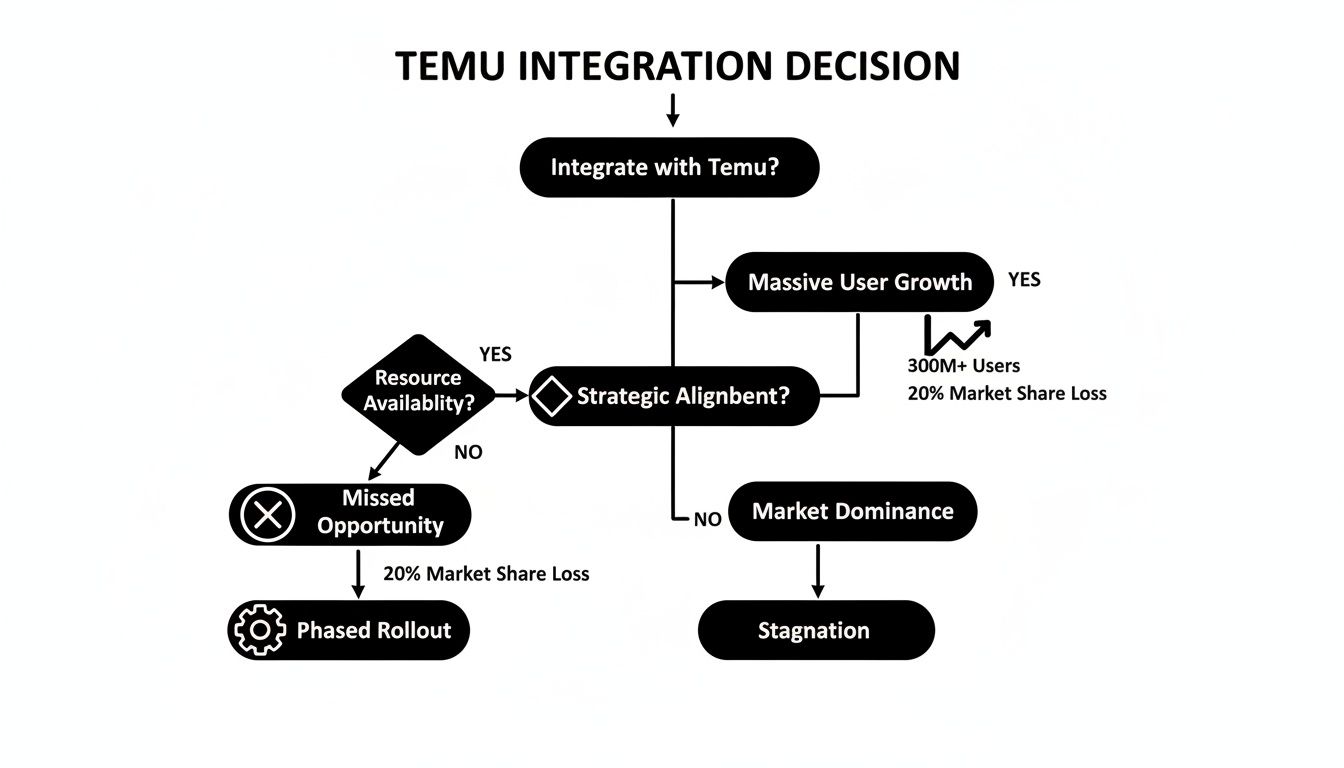
As you can see, pursuing an integration is the only real path to growth. But how you build it is what will ultimately determine your success or failure.
The Unofficial, High-Risk Path
The first route involves trying to get data without the platform's permission. These techniques are often the first thing that comes to mind for a determined developer, but they carry significant, often business-ending, drawbacks.
- Web Scraping: This is where you program a bot to crawl Temu's website and rip data straight from the HTML. It’s incredibly brittle. One minor UI tweak from Temu’s frontend team can instantly break your entire integration, sending you into a frantic cycle of constant maintenance.
- Reverse-Engineering Private APIs: A more sophisticated approach is to spy on the network traffic of Temu's mobile or web app to figure out the private, undocumented API endpoints it uses internally. This is almost always a direct violation of a platform’s Terms of Service and is even more fragile than web scraping.
Both of these methods are fundamentally unreliable and unsustainable for any commercial SaaS product. They put your application, your reputation, and your customers' data at serious risk. When exploring any integration, especially unofficial ones, using robust API security tools is non-negotiable for protecting data and maintaining system integrity.
Choosing an unofficial path is like building a house on a foundation of sand. It might stand for a little while, but it's destined to collapse when the environment changes, leaving your customers stranded.
The Professional-Grade Solution
The smart, sustainable alternative is to use a professional-grade, third-party unified API. Think of it as a pre-built, hardened bridge connecting you not just to Temu but to dozens of other eCommerce platforms. Companies like API2Cart specialize in building and maintaining these complex connections so your development team doesn't have to.
This approach gives you a powerful abstraction layer. Instead of fighting with a fragile, reverse-engineered connection, you work with a clean, stable, and fully documented API. The provider handles all the messy backend complexity of talking to Temu, including managing updates and ensuring the connection remains stable.
For a developer, this is a game-changer. It means you can get back to what you do best: building valuable features for your users. You get all the benefits of a Temu API connection—access to products, orders, and inventory—without any of the technical debt or legal headaches.
How to Accelerate Temu Integration With API2Cart
Trying to piece together a Temu API connection with risky workarounds is a massive time-sink for any B2B SaaS developer. Instead of building a fragile, custom integration that’s guaranteed to break, you can sidestep the entire problem with a unified API. API2Cart offers a professional, reliable way to connect your software not just to Temu, but to over 60 other eCommerce platforms through one API.
This approach shifts the heavy lifting of integration from your team to ours. You no longer have to sweat the details of how the connection is built or kept alive. Your developers get to focus on building features for your product, not putting out integration fires.
The image here gets to the heart of it: we turn the puzzle of Temu integration into a straightforward, fast connection for your software.
Write Once, Connect Everywhere: The Unified API Advantage
The real magic of a unified API is that it abstracts away all the platform-specific chaos. API2Cart gives you a standard library of API methods that work the same way across every platform we support, including Temu. This means your developers write the integration logic once, and it works everywhere else.
For example, a single call to product.list pulls product data from a Temu store using the exact same structure as it would for a store on Shopify or WooCommerce. This standardization brings huge wins for development teams:
- Slash Development Time: A project that would take months of a developer's time for a single platform can now be done in weeks, dramatically accelerating your time-to-market.
- Keep Costs Predictable: You avoid the runaway costs of building in-house and the even bigger costs of maintaining dozens of unique APIs.
- Forget Maintenance Headaches: Our team handles every API update, breaking change, and bug fix. Your integration stays stable and reliable without you tasking developers to do a thing.
With one set of commands, you can instantly expand your connectivity across the entire eCommerce market. If you want to dig deeper into the mechanics, you can learn more about how a unified API simplifies complex integrations.
With API2Cart, you stop building dozens of individual integrations. You build one integration to our unified API, and we give you immediate access to the entire market. It’s the smart play for a robust, scalable, and maintainable Temu integration.
A Focus on the Developer Experience
We built API2Cart for developers, by developers. We give you all the tools you need to get up and running fast, including comprehensive documentation, SDKs in multiple programming languages, and responsive technical support from people who actually know what they're talking about.
Instead of trying to find your way through the messy, unsupported world of unofficial connection methods, your team gets to work with a clean, well-documented, professional API. This doesn’t just get your product to market faster—it ensures your SaaS application stays strong and competitive, ready to serve merchants no matter which platform they’re on.
Working With Essential Temu Data Models via a Unified API
A solid integration is all about understanding how the data flows. Since you can’t plug directly into a Temu API, you'll be tapping into Temu's data using a unified API provider like API2Cart. What this means for a developer is you get to work with standardized data models that represent core eCommerce objects, giving you a predictable structure for every single platform you connect to.
This approach gives you a clear roadmap for building out crucial features like order import, inventory sync, and product management inside your own app. It turns what could be a chaotic, platform-specific mess into a structured and manageable workflow.
The Product Model
For any eCommerce app, products are the foundation. It's how you handle everything from what's being sold to how much it costs. By using a unified API, you can work with Temu's product data without ever needing to know the private, internal structure Temu uses.
API2Cart’s product model lets your software:
- List and retrieve products: Use the
product.listmethod to pull all products from a seller's store, complete with their descriptions, images, and prices. - Update product information: Push changes to product details with
product.update, whether you're modifying a name, tweaking a description, or swapping out an image. - Manage variants: Easily handle products that come in different sizes, colors, or styles through standardized variant fields already built into the product object.
The Order Model
Once you have products listed, the orders will start coming in. The order model is your ticket to managing the entire post-purchase journey. It's the data structure that holds everything your software needs to process a sale. This is where an order management or shipping platform really shines.
Through API2Cart, you can get a handle on Temu orders by:
- Retrieving order details: Use
order.infoto grab all the data for a specific order, including items purchased, shipping address, and total cost. - Fetching lists of orders: Call
order.listto get a complete history of all orders, which is absolutely essential for any kind of reporting or analytics. - Updating order statuses: Keep sellers and their customers in the loop by using methods that update an order's fulfillment status as it moves from "paid" to "shipped."
By using a standardized order model, your application can process a Temu order using the exact same logic it uses for a Shopify or Amazon order. This dramatically simplifies your codebase and accelerates development.
Customer and Inventory Models
Finally, we have the customer and inventory models, which complete the core data picture. The customer model holds all the buyer information tied to an order, like their name and shipping address—details that are mission-critical for fulfillment and support.
The inventory model is what keeps you from overselling, which is a huge deal on a high-velocity marketplace like Temu. With methods like product.update, you can adjust stock levels in near real-time. When a product sells on another channel, your software can instantly tell Temu to decrement the count, keeping your data accurate. These unified data models are the building blocks for creating a truly robust, multi-channel SaaS application.
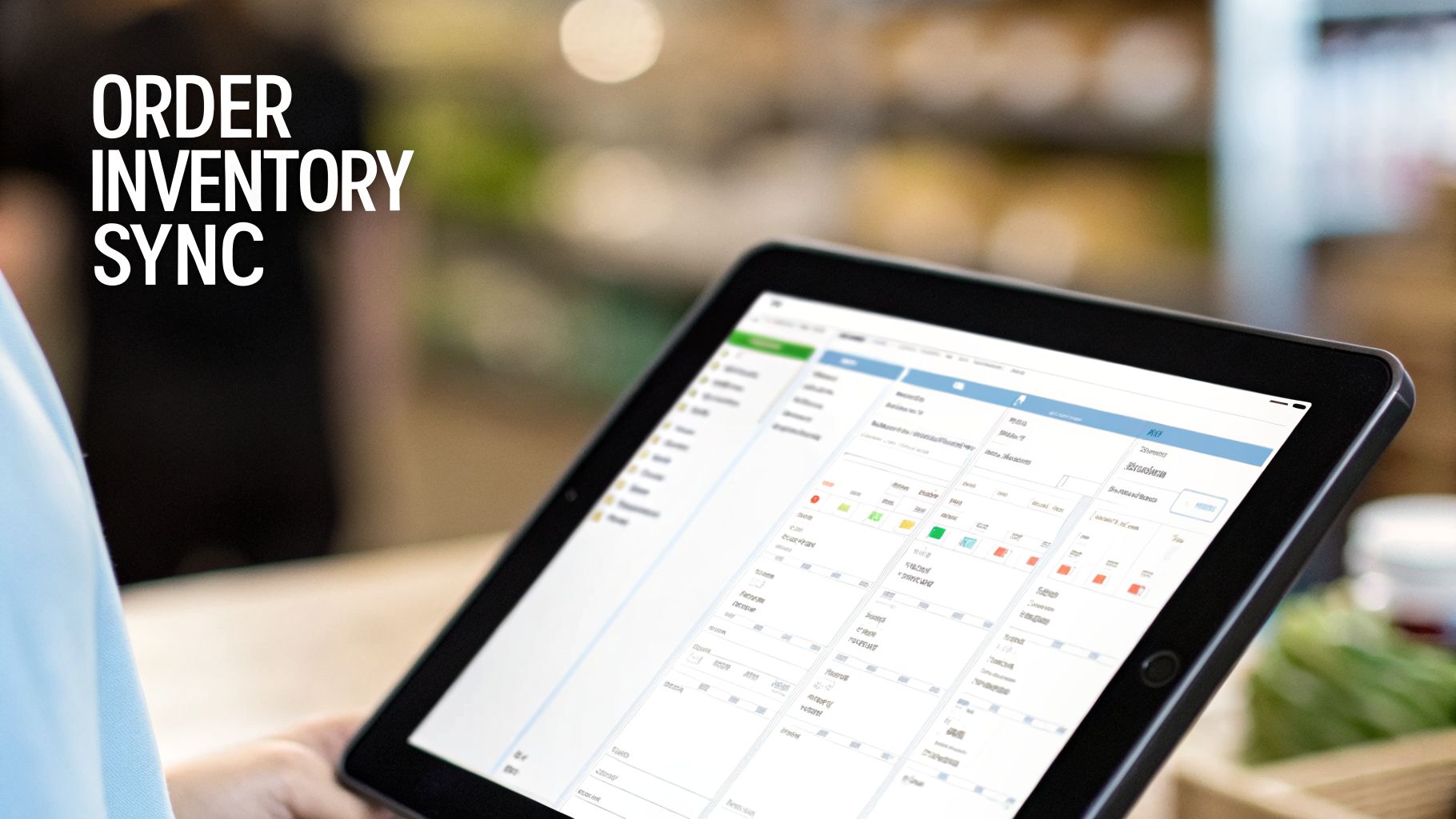
These are the real-world use cases that show why a single, unified integration is so powerful. You're not just connecting; you're enabling the exact functionality merchants are looking for. For any SaaS looking to get an edge, understanding how AI improves data integration workflows can be a game-changer when implementing these very features.
Use Case: Automating Order Import
An Order Management System (OMS) is only as good as its ability to pull in new orders without manual intervention. With API2Cart, you can set up a simple polling mechanism to grab all new orders from a merchant's Temu store.
Just use the order.list method and include the created_from parameter. This tells the API to fetch only the orders that have come in since your last check, which keeps you from reprocessing old data and ensures your system stays fast and efficient. Your OMS can then pull these new orders in, making them instantly available for fulfillment and reporting.
Use Case: Real-Time Inventory Synchronization
For any inventory management system, preventing overselling is priority number one. This is especially true on a high-traffic marketplace like Temu. API2Cart gives you the tools to build a rock-solid inventory sync. When an item sells on another channel—say, a Shopify store or in a physical retail location—your system can immediately push that update to Temu.
You can do this with the product.update method, just by passing the product ID and the new stock count. For even quicker, near-instant updates, webhooks are the way to go. You can learn more by reading our guide on what a webhook is and how they facilitate real-time data exchange.
Use Case: Managing Product Listings
If you run a Product Information Management (PIM) system, you know how crucial it is to push updates across every channel at once. A unified API makes this surprisingly simple for Temu. Whether a merchant is tweaking prices, rewriting descriptions, or swapping out images, your software can handle it all.
- Price Updates: Use
product.updateto change thepricefor specific product variants. - Description Changes: Modify the
descriptionfield to keep product info compelling and up-to-date. - Image Management: Easily add or remove images from a listing to match new product photography.
The scale of Temu is hard to ignore. Recent data shows 565.2 million site visits, with revenue blowing past $3 billion in just the first half of 2023. This kind of massive traffic demands automated data workflows, which is exactly what a unified Temu API connection delivers.
These workflows are the bread and butter of any valuable eCommerce SaaS. By leaning on a unified API, you can roll them out for Temu quickly and reliably. This frees up your developers to focus on innovation instead of getting bogged down maintaining brittle, one-off connections.
Frequently Asked Questions About Temu Integration
When it comes to integrating with Temu, a few questions pop up again and again, especially since there’s no official Temu API. Let's clear up the most common points of confusion for developers.
Is There an Official Temu API in 2026?
No. As of 2026, Temu has not released a public, official API for third-party developers. This seems to be a deliberate choice by the platform to keep tight control over its ecosystem. Because of this, building a professional, commercial-grade integration means you'll need to rely on a trusted third-party unified API service.
Can I Use Web Scraping to Get Data From Temu?
While you technically can scrape data from Temu's website, we strongly advise against it for any serious software application.
- It's Unstable: Web scrapers are notoriously brittle. They break with the slightest change to the website's front-end code, which means you're signing up for constant, frustrating maintenance.
- It's Risky: This practice is a clear violation of Temu's Terms of Service. It's a fast way to get your IP address permanently banned from the platform.
- It's Unreliable: Scraping is just not a viable or scalable strategy for a commercial product that depends on a stable, predictable data connection.
How Does API2Cart Connect to Temu Without a Public API?
API2Cart solves the Temu integration challenge by providing a unified API that handles the connection behind the scenes. Our expert team has developed a robust, proprietary method to access Temu's data, and we actively maintain it to ensure stability. This saves your development team from the impossible task of building and maintaining a fragile, unofficial integration.
You get to work with a clean, fully documented, and unified API. We take on the hard part of maintaining the actual connection to Temu, ensuring your integration stays stable and functional no matter what changes on their end.
What Data Can I Access From Temu With API2Cart?
Our unified API lets you access all the essential eCommerce data you need from your customers' Temu stores. You can find detailed information on the various API authentication methods in our docs. The core data you can manage includes:
- Retrieving and managing orders.
- Creating and updating product listings.
- Synchronizing inventory levels to prevent overselling.
- Accessing customer information tied to orders.
This comprehensive data access gives your developers everything needed to build a full suite of valuable integration features for your SaaS application.
Ready to build a reliable Temu integration without the headaches? API2Cart provides a single, unified API to connect to Temu and over 60 other platforms. Sign up for a free 14-day trial and start building today.