For any eCommerce SaaS vendor, from order management systems to shipping software, the goal is simple: serve as many online merchants as possible. But the reality for your integration developers is a chaotic maze of fragmented platforms like Shopify, Magento, WooCommerce, and countless marketplaces. Each has a unique, complex API that requires a dedicated integration, draining time and resources. This is where a unified API offers a strategic escape from this complexity, acting as a single, consistent point of integration to connect with dozens of systems at once and dramatically speed up your time-to-market.
What is a Unified API?
A unified API is a layer of abstraction that sits between your SaaS application and multiple third-party APIs. Think of it as a universal translator for your developers. Instead of building and maintaining dozens of separate, custom connectors for each eCommerce platform, your team integrates with just one well-documented API. This single endpoint then communicates with all the different platforms on your behalf, translating your requests into their native languages and standardizing their diverse data formats into one clean, predictable structure.
For an integration developer, the advantages are immediate and significant:
- Streamlined Integration: You write code once to connect with an entire ecosystem. A single API call to fetch orders works across Shopify, WooCommerce, BigCommerce, and others, eliminating redundant work.
- Reduced Development Time: The development lifecycle for launching a new integration shrinks from months to days. This allows your team to focus on building core product features that your customers value, rather than on maintaining complex integration plumbing.
- Faster Time-to-Market: With the integration bottleneck removed, your SaaS product can support new eCommerce platforms almost instantly, giving you a powerful competitive edge and allowing you to capture new market segments faster.
In essence, a unified API takes on the immense complexity of the fragmented eCommerce landscape, allowing your development team to operate with greater speed, efficiency, and focus.
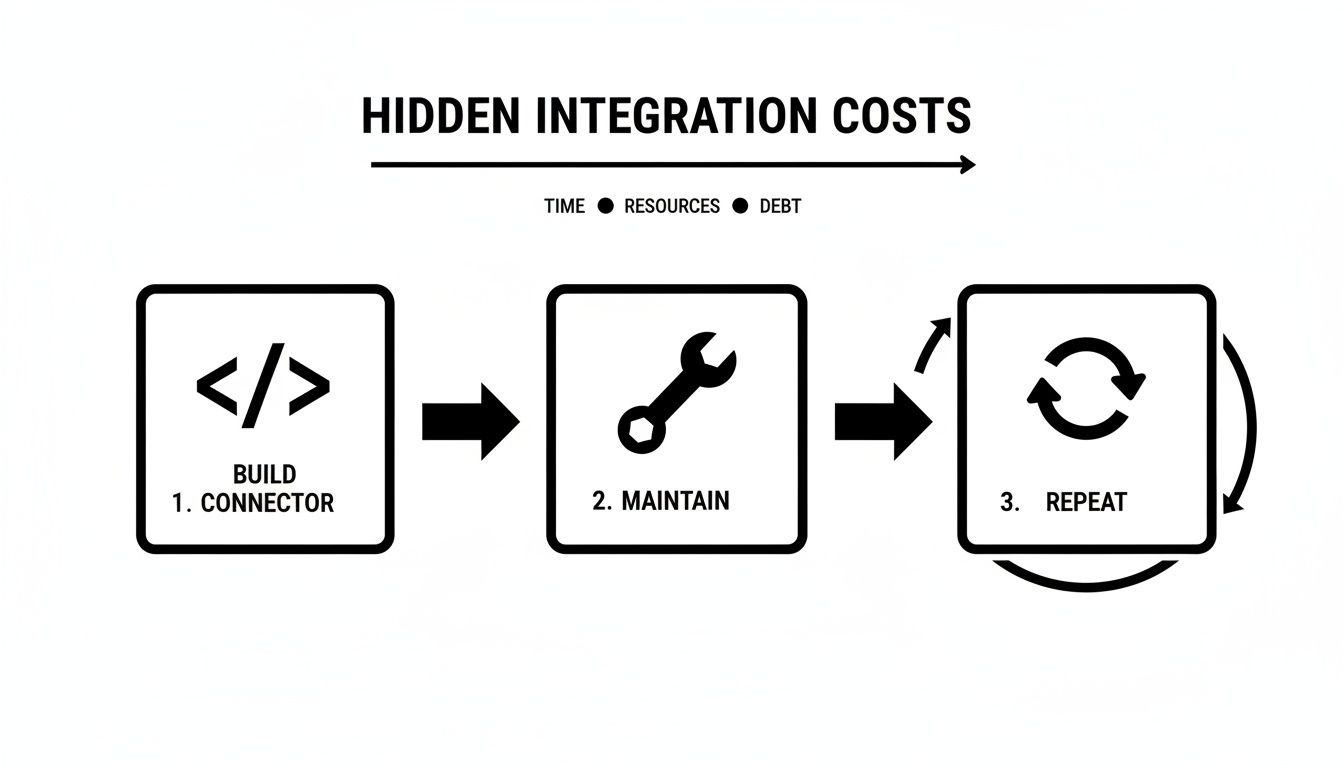
The Importance of Unified API for SaaS Products
The core problem for eCommerce SaaS vendors—whether you're an order management system, a shipping software provider, a PIM, or a multi-channel solution—is connectivity. Your software is only valuable if it can seamlessly access and manipulate data from the platforms your customers use, like Shopify, Magento (Adobe Commerce), or WooCommerce. Building these connections one by one is a developer's nightmare. Each platform has a different API architecture, unique data models, and constantly changing authentication protocols. This leads to a slow, expensive, and never-ending development cycle.
The solution is a unified API integration. It completely changes the game for integration developers. Instead of getting bogged down in the specifics of each platform's API, they can work with a single, consistent interface. This means using the same API methods to get, add, update, and sync data like orders, products, customers, and shipments, regardless of the underlying platform. A unified API helps you avoid common integration challenges like constant maintenance due to API updates, complex data mapping, and security vulnerabilities. By abstracting away this complexity, it dramatically reduces development costs and allows your SaaS business to scale its integration capabilities effortlessly and affordably. To avoid these traps, it's helpful to understand the critical ERP integration steps—a process that unified APIs make infinitely simpler.
Why API2Cart is the Best Unified API Integration Solution
When it comes to a real-world, battle-tested solution, API2Cart emerges as the key unified API integration provider for eCommerce SaaS vendors. It is designed specifically to solve the integration headaches that developers and product managers face daily, turning connectivity from a liability into a strategic asset.
Here’s why API2Cart stands out for integration developers:
- One Unified API for 60+ Platforms: With a single integration, you gain immediate access to over 60 leading eCommerce platforms and marketplaces, including Shopify, Magento (Adobe Commerce), WooCommerce, BigCommerce, and Etsy. This instantly expands your total addressable market without months of development work.
- Comprehensive Data Management: API2Cart provides over 100 API methods to get, add, update, and sync all critical store data. Whether you need to import orders, sync inventory levels, update product listings, or manage customer data, you can do it all through a consistent and predictable interface.
- Developer-Friendly Tools and Documentation: We prioritize the developer experience. Our robust documentation is clear and detailed, and we provide SDKs in multiple programming languages to accelerate the integration process and reduce boilerplate code.
- Significant Time and Cost Efficiency: By eliminating the need to build and maintain individual connectors, API2Cart dramatically reduces development and operational costs. Your engineering team is freed from the endless cycle of API maintenance and can focus on building core product value.
- Dedicated Customer Support: Our expert support team acts as an extension of your own, providing dedicated assistance throughout the integration process and beyond to ensure a seamless and reliable connection for your customers.
API2Cart's competitive edge lies in its specialization and maturity. While other solutions may offer broader but shallower capabilities, API2Cart is purpose-built for the deep, complex needs of eCommerce, ensuring high reliability and rich functionality. If you're weighing your options, our detailed comparison of a unified API vs. embedded iPaaS can help clarify which model best fits your product roadmap.
Use Cases of Unified API in Real-World SaaS Solutions
The true power of API2Cart's unified API becomes clear when you see it in action. For integration developers at SaaS companies, it transforms complex, multi-step processes into simple, automated workflows.
One example of API2Cart’s impact is a shipping software that integrated with 60+ eCommerce platforms using the unified API. Before API2Cart, their developers had to build and maintain fragile, custom connectors for each platform, a process that was slow and prone to breaking. After integrating with API2Cart, the shipping software was able to retrieve all new orders from every connected store with a single API call (order.list). This allowed them to manage orders from multiple platforms through a single API, reducing manual input and improving order fulfillment times. Once an order was shipped, another single call updated the tracking information back to the original store, automating a critical step in the customer experience.
Similarly, a Product Information Management (PIM) system uses API2Cart to sync product catalogs across dozens of storefronts. Instead of writing platform-specific code to handle the unique data structures of Shopify, Magento, and Etsy, their developers use a single product.update method. This ensures that product descriptions, prices, and inventory levels are consistent everywhere, eliminating costly errors and saving countless hours of manual work. This centralized control, powered by a unified API, directly boosts operational efficiency and enables scalable business growth. For a deeper dive, see our guide on how to update tracking details on e-stores via a unified API.
Conclusion
In the fast-evolving eCommerce landscape, building and maintaining dozens of separate API integrations is no longer a viable strategy for ambitious SaaS companies. It’s an inefficient, expensive, and outdated model that drains engineering resources and stifles innovation. The future of SaaS integration is unified. A unified API is the modern, intelligent path forward, turning integration from a painful cost center into a powerful competitive advantage.
API2Cart stands out as the premier unified API integration solution for eCommerce software vendors. It provides a proven, reliable, and cost-effective path to comprehensive connectivity, allowing you to connect to over 60 platforms through a single API. By partnering with API2Cart, you can slash development time, reduce maintenance costs, and accelerate your time-to-market. Stop burning valuable engineering resources on integration headaches. It’s time to focus on what truly matters—building an exceptional product and scaling your business.
See the power of a unified API firsthand. Sign up for free.