API2Cart allows you to work with imported orders from CS-Cart in the following way:
- Receive notifications when a new order is placed on any e-store
- Filter orders by their parameters like ids, store id, customer id, customer email, order status, order ids, financial status, fulfillment status, shipping provider, and time parameters
- Get a list of products from different online stores

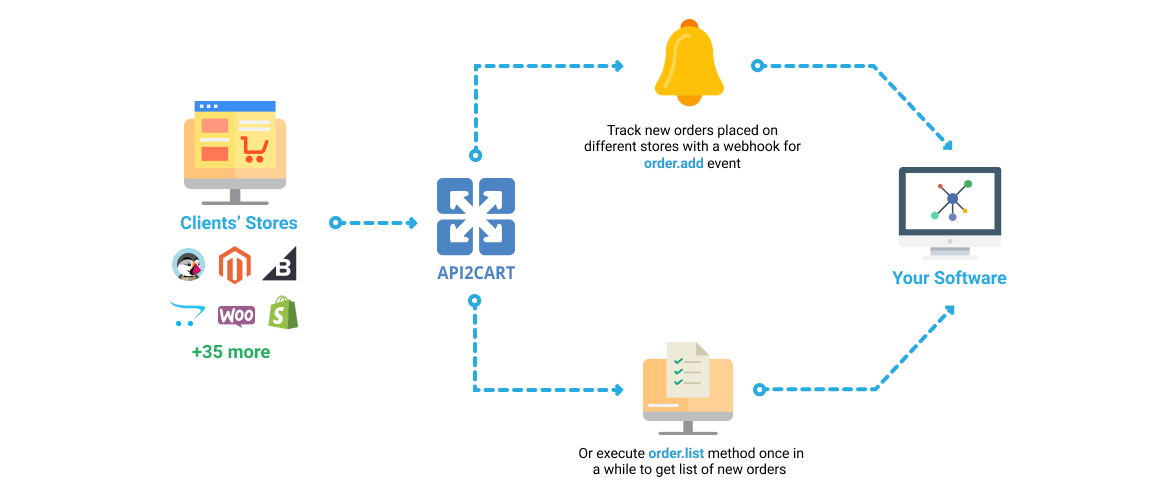
Import order automation workflow
Importing orders from merchants' online stores is one of the primary needs of ERP, order and inventory, warehouse, and shipping management software providers for providing their functions. API2Cart's order.list method and webhook for order.add event makes it possible to do it quickly and effectively
CS-Cart Store Data You Can Work With


The main benefits of a unified shopping cart integration for your business
Unified shopping cart integration can help you to:
- Save up to 80% of your developers' time on the integration processes
- Minimize TCO. In-house IT costs on integration with multiple shopping carts are up to 9 times more expensive than integration via API2Cart
- Win new customers. Power up the value proposition with 80+ shopping platforms, that equals 1+ million of e-stores as your potential customers
- Use all needed API methods for abandoned cart recovery

What our customers say

We LOVE you guys, thanks for everything your support team has been doing for us!!!

We use Api2Cart for our customer integrations and have found them to be very helpful and responsive to any issues we have faced. Integration across so many variants and versions of shopping carts gets complicated very quickly and their expertise has helped us smooth over this process. I would recommend them to anyone looking to simplify their integrations.

Consistently Amazing - …the API and the infrastructure we use for shopping carts is built by a solid software engineering team we've known for years. Salesorder.com is a mission-critical order management platform for wholesalers. Our due diligence selected API2Cart as the best in its class. They’ve connected over 50 carts. It’s how they earn their living, and they’re probably best there is on Earth at cart integration and supporting a critical part of your business.

I have been using API2Cart since beginning of 2014 for our new webstores product. We have successfully integrated close to 100 stores and are currently doing 5 new stores every week. We started with the standard plan (shared hosting) and in 2015 we upgraded to a dedicated server to increase the number of monthly and concurrent API requests. As an ecommerce company with more than 20,000 online sellers security is very important for us. During the time that we have used API2Cart we have not had any problems related to security. The support that API2Cart provide us with is excellent. Communication is quick and the expertise from their engineers have helped us to successfully integrate API2Cart with our own platform.

We use API2CART now for more then a year. Several customers of our application are succesfully connected to this platform. So far we are very happy with the product and the service as well! Keep up the good work!

We have been working with you now for nearly 2 years now and your support is fantastic, one of the best I have worked with plus we have never had any security issues with you.

An API connection to shopping carts is the best way to work with merchants. Managing all those connections is a lot of work and requires a lot of knowledge. By using API2Cart we don't need to spend the time and effort to create and maintain all these connections.

Cooperation with API2Cart is a great opportunity for UniSender to become more accessible for e-commerce platforms users. For us it’s fast and profitable since API2Cart supports integration with dozens of shopping carts thus providing secure and reliable integration. For our users it’s even more opportunities to quickly and securely transfer their client’s contact information from the most popular platforms into UniSender and start an e-mail marketing campaign immediately.

Thank you, API2Cart. Your API has helped us integrate with a new platform. You are a big part of our success.

So far API2Cart has been great! Simple and functional. I really liked the collector class from the code sample. It’s so easy to call the functions I want through that.

At AppsBuilder we have been using API2Cart for over a year and so far over 100 of our clients have successfully used it to connect to the eCommerce provider of their choice. We have found the security of API2Cart to be excellent, and are confident that our clients' data and that of their customers in turn is more than adequately protected. We have certainly not encountered any problems of a security nature and nor do we expect to.

API2Cart enables us to support synchronization to any of the e-Commerce carts that our customers use. This means we can focus on what we do best, enabling turnkey mobile commerce applications.

We are delighted to be working with API2Cart and be able to offer our mCommerce solution to hundreds of thousands of eCommerce store owners looking to go mobile. Being invited as part of the API2Cart network means any eCommerce store owner can easily synchronise their store with MobiCart.

We have finally succeeded in getting our first client adding the store to API2Cart. And the API worked! Pure magic. I simply press the button and receive all the necessary information. This thing is really awesome.
FAQs
How can I quickly start importing orders from CS-Cart into my software?
To begin with, you can follow the setup steps and endpoint references in the CS-Cart order methods documentation. Then, once your store is connected, you can consistently pull order data into your app for processing, reporting, or automation. As a result, you reduce manual exports and keep operations aligned across systems.
What order data can I sync when automating the import flow?
Typically, you can sync core order entities such as order statuses, totals, customer details, and line items. Moreover, by using the dedicated order endpoints from the CS-Cart order API reference, you can standardize how your platform ingests and updates order records. Consequently, your team can scale the import pipeline without rebuilding logic for every store.