
Think of an Amazon API (Application Programming Interface) as the digital bridge that connects your software directly to an Amazon seller's store. For any B2B SaaS company, this isn't just a technical tool; it's the fundamental handshake that allows your application to programmatically access and manage data. For an integration developer, whether you're building an order management system, an inventory syncing tool, or a shipping platform, this API is how you talk to Amazon.
Connecting to the World’s Largest Marketplace
For SaaS developers, integrating with Amazon isn't just another feature on the roadmap—it's a critical gateway to millions of sellers and an almost unimaginable volume of eCommerce activity. Your software’s ability to pull order data, push inventory updates, or manage product listings hinges entirely on this connection. It’s what transforms your app from a standalone tool into an essential part of a seller's daily workflow.
But building this bridge means understanding Amazon's API landscape, which has a past and a future. Developers today have to navigate a major transition between two distinct generations of their API.
MWS vs SP-API: The Generational Shift
The world of Amazon integration is really a tale of two APIs:
- Marketplace Web Service (MWS): This is the old guard, the legacy API that powered Amazon integrations for years. While it got the job done, it's built on older protocols and is officially being phased out.
- Selling Partner API (SP-API): This is the modern, REST-based replacement. SP-API is a huge step up, offering better security with OAuth 2.0, a more logical structure, and access to newer features you can't get with MWS.
This move from MWS to SP-API isn't optional; it's a mandatory shift for every developer in the ecosystem. Hanging onto MWS is no longer a viable long-term strategy, and all new development should be squarely focused on the SP-API. This migration, however, comes with its own set of headaches for development teams.
To make this transition clearer, here’s a quick breakdown of the key differences between the two.
Amazon API at a Glance: MWS vs SP-API
This table gives you a high-level look at how the legacy MWS stacks up against the modern SP-API, helping you see why the migration is so important.
| Feature | Marketplace Web Service (MWS) | Selling Partner API (SP-API) |
|---|---|---|
| Architecture | SOAP & Query-based | RESTful (JSON-based) |
| Authentication | MWS Auth Token (Static Keys) | OAuth 2.0 & LWA (Dynamic) |
| Data Access | Granular, but less secure | More secure and token-based |
| Developer Support | Deprecated, no new features | Actively maintained & updated |
| Future Viability | Being fully decommissioned | The current and future standard |
As you can see, SP-API represents a complete modernization of how developers interact with Amazon. It’s more secure, more standardized, and built for the future of eCommerce.
For developers, the real challenge isn't just making a single API call. It's building a resilient, scalable system that can handle complex authentication, strict rate limits, and constant API updates from Amazon.
This is where the true complexity kicks in. The initial setup, the ongoing maintenance, and the sheer overhead of managing connections for thousands of individual sellers can quickly drain your engineering resources. A unified API like API2Cart is designed to solve these problems from day one. For instance, instead of spending weeks building out the SP-API's OAuth flow, your team can use API2Cart to establish a connection in a fraction of the time, allowing you to focus on building core features instead of wrestling with authentication. You can learn more about this streamlined process in our guide on how to connect to Amazon.
Navigating the Selling Partner API Architecture
The Selling Partner API, or SP-API, isn't just an update—it's a whole new foundation for building on Amazon. Think of it like swapping out an old, proprietary electrical system in a house for a modern, standardized one. The SP-API is a REST-based architecture, which means it uses the same web standards that power most of the modern internet. For developers, this is a huge step up.
Instead of the clunky, rigid protocols of the past, the SP-API uses familiar HTTP methods and speaks in JSON (JavaScript Object Notation). This makes the data lightweight and dead simple for any modern programming language to understand. For an integration developer, this means you spend less time trying to figure out weird data formats and more time actually building features.
The whole process of connecting your app to Amazon's data follows a clear, secure flow. This diagram gives you the high-level picture of how it all works.
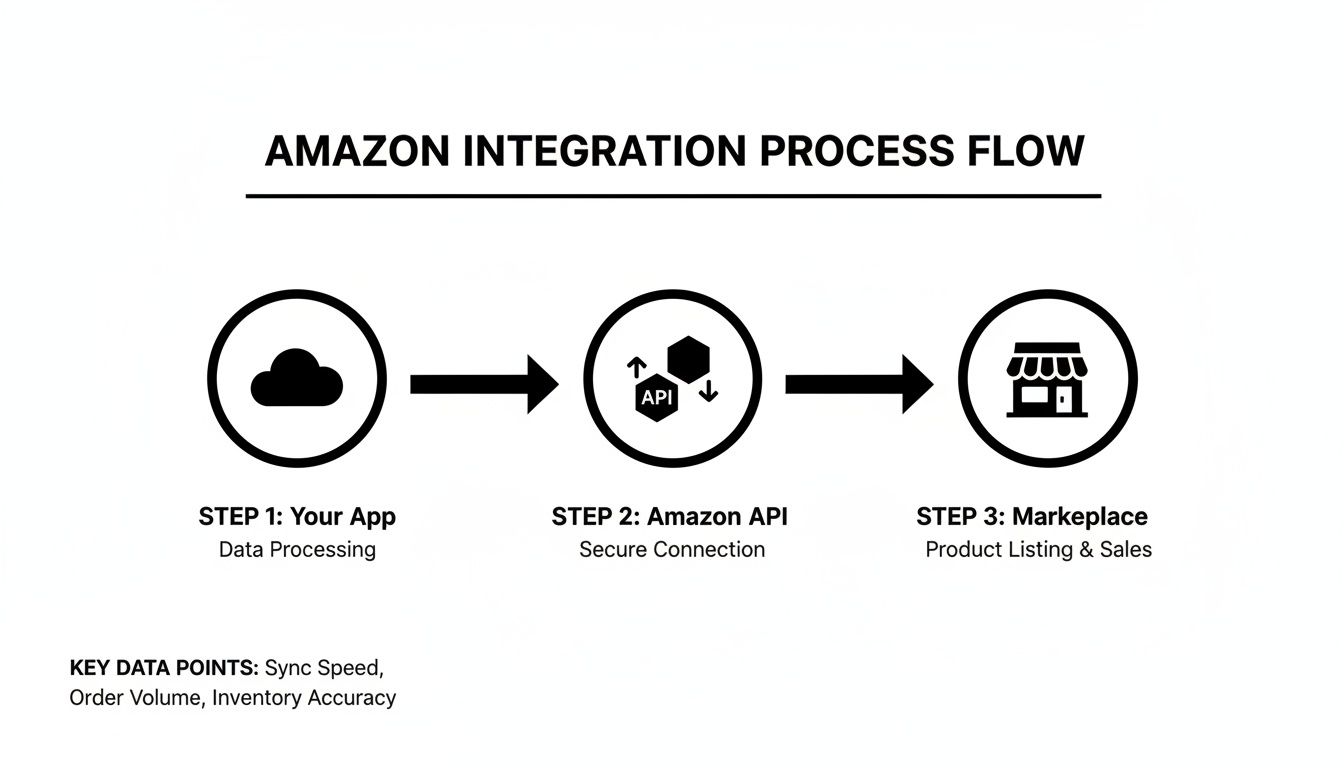
As you can see, it’s a three-part journey: your application makes a secure request, it passes through Amazon’s API gateway, and then it accesses the seller's marketplace data.
Demystifying SP-API Authentication
Let's be honest, one of the biggest headaches for developers is authentication. The SP-API uses OAuth 2.0 and Login with Amazon (LWA), which is the gold standard for secure authorization today. While it’s a massive security improvement over old-school static keys, it definitely has a learning curve. Developers have to manage a multi-step dance to get credentials, ask for permissions, and keep track of access tokens that expire.
Here’s what that dance looks like:
- Registering Your Application: First, you have to register your app with Amazon to get your unique developer credentials. No skipping this step.
- Seller Authorization: The seller has to explicitly grant your application permission to access their data through a consent screen.
- Token Exchange: Your app then swaps an authorization grant for an access token. This token is your key to making authenticated API calls.
This workflow makes sure access is always secure and can be shut off at any time, but it demands careful coding to manage the tokens properly.
API Roles and Data Access
With the SP-API, you can’t just grab all the data at once. Your application has to request specific roles that match the API sections it needs to access, like "Orders" or "Inventory Management." This granular permission model is fantastic for security but adds another layer of setup work. If you're really diving into the technical guts, looking into resources on leveraging Amazon Web Services (AWS) can offer some great insights into the kind of infrastructure that powers these systems.
For B2B SaaS developers, this architecture is a double-edged sword. The power you get is immense, but the initial setup and the constant need to manage tokens require a serious amount of development effort.
A common pain point for developers isn't just the initial OAuth 2.0 setup, but the recurring logic needed to refresh access tokens. A failure here can bring data synchronization to a halt, directly impacting your customers.
This is exactly where a service like API2Cart becomes a lifesaver for developers. It completely handles the messy parts of SP-API authentication and token management. A key use case is saving engineering time: instead of building and maintaining a complex token refresh mechanism yourself, you just connect to API2Cart's single, unified API. This lets your team skip the steep learning curve and focus on building your app's core features, which dramatically speeds up your time to market.
Mastering Core Endpoints and API Throttling
A solid Amazon API integration isn’t just about making a connection; it’s about having a meaningful conversation without getting cut off. For any B2B SaaS developer, that means mastering two things: the key data endpoints and Amazon’s notoriously strict API throttling rules. If you don't get both right, you'll end up with an unreliable app that can't scale with high-volume sellers.
The lifeblood of any eCommerce operation flows through orders, products, and inventory. Naturally, these are the most critical SP-API endpoints your software will be hitting constantly.

Key SP-API Endpoints for SaaS Developers
Let's break down the most common endpoints and what they're actually used for in the real world:
- Orders API: This is usually ground zero. A warehouse management system (WMS) will use this to pull in new sales from Amazon as they happen. A shipping platform will grab order details to generate labels. Want a deeper dive? Check out our guide on how to get orders via the Amazon API.
- Catalog Items API: This one lets your app pull detailed product information directly from Amazon’s massive catalog. It's an absolute must for product information management (PIM) systems or any kind of repricing tool.
- Inventory API: For any software that syncs inventory, this is the holy grail. Your application can push stock level updates from a seller's ERP or warehouse straight to their Amazon listings, which is crucial for preventing overselling.
Making calls to these endpoints is simple enough. But doing it at scale introduces a huge hurdle: API rate limiting, also known as throttling.
Navigating Amazon API Throttling
Amazon relies on a rate-limiting algorithm called the "leaky bucket" to keep its infrastructure from crumbling under pressure.
Imagine a bucket with a tiny hole in the bottom. Your API requests are the water you pour in. The hole is the "restore rate"—the speed at which Amazon processes requests. If you pour water in faster than it can leak out, the bucket overflows. That's when Amazon starts rejecting your requests.
This forces developers to build some seriously sophisticated logic just to manage how often they make API calls. Without it, your application will constantly slam into rate limits, causing data sync failures and leaving you with very frustrated users. The scale here is mind-boggling; during a recent Prime Day, Amazon API Gateway handled over 1 trillion internal service requests. That’s the kind of load your integration needs to be ready for.
A smart integration doesn't just make API calls; it orchestrates them. This means implementing exponential backoff logic, prioritizing critical requests, and designing a system that can gracefully handle throttling during peak seasons like Black Friday.
On top of the technical API limits, sellers also have to deal with Amazon's own business-level restrictions, like Amazon's seller velocity limits, which can affect everything from inventory to sales planning.
For developers, juggling these complexities for just one seller is tough. For hundreds or thousands? It’s a recurring nightmare. A unified API like API2Cart is a game-changer here. It handles all the messy, complex rate-limiting logic behind the scenes, ensuring your application communicates efficiently without triggering throttling errors. This allows your development team to focus on building features, not a fragile throttling system that needs constant babysitting.
Avoiding Common Amazon Integration Pitfalls
Building a direct integration with the Amazon API seems like a straightforward engineering task on the surface. But ask any team that’s gone down that road, and they’ll tell you it’s a journey filled with hidden complexities that can stall projects and balloon budgets. The initial connection is just the tip of the iceberg; the real challenges lurk beneath, creating significant technical debt and a maintenance nightmare.
One of the first walls you'll hit is data inconsistency. A product's data structure isn't the same in the US marketplace as it is in Germany or Japan. This forces your developers to write and maintain brittle, complex logic just to normalize data from different global regions. Suddenly, a simple task like fetching product details becomes a tangled mess of conditional code.
This screenshot from API2Cart's homepage shows just how many platforms a unified API can connect to, with Amazon being a critical piece of that puzzle.
The image drives home the point that Amazon is just one channel in a much larger eCommerce ecosystem. This really reinforces the need for a solution that can handle multiple platforms without forcing you to build a new custom integration for each one.
The Relentless Cycle of Maintenance
Another huge headache is the constant upkeep needed to stay in sync with Amazon's API updates. Amazon is always changing things—deprecating old endpoints, rolling out new ones, and tweaking authentication protocols. Each time they push an update, your development team has to drop what they're doing, dig into the new requirements, and refactor code just to keep your integration from breaking. It's a reactive, never-ending cycle that eats up engineering hours that should be spent on your core product.
The real cost of an in-house Amazon integration isn't the initial build. It’s the perpetual engineering tax you pay to maintain it, the support tickets you field when it inevitably breaks, and the lost opportunities from a product roadmap that’s constantly being derailed.
The Nightmare of Scaling
Perhaps the biggest challenge of all is scaling. Supporting one or two sellers is manageable, sure. But what happens when you need to support thousands? Each seller comes with their own unique data loads, different API usage patterns, and their own peak seasons. Your architecture has to be built to handle this massive variability without hitting rate limits or, even worse, crashing.
And the scale of this challenge is enormous. The AWS API ecosystem supported 4.19 million businesses in 2025, which is a massive 357% surge since 2020. This explosive growth is being driven by small and medium-sized businesses, making the need for a scalable, reliable integration solution more critical than ever. You can dig into more data on this expanding market in the full AWS market report.
This is exactly where API2Cart offers a clear path for integration developers. Instead of your team getting bogged down building custom solutions for data normalization, maintenance, and scaling, API2Cart handles all of that heavy lifting. A common use case is for PIM software developers who need to sync product data across Amazon and Shopify. With API2Cart, they build one integration to a unified data model, and API2Cart handles the translation to both platforms’ specific formats, saving months of redundant work.
How a Unified API Accelerates Your Roadmap
After wrestling with the Amazon SP-API, it becomes pretty clear that building a direct integration in-house is a massive drain on your engineering team. The constant maintenance, tricky authentication, and messy data formats create a technical drag that slows your whole product roadmap to a crawl.
This is exactly where a unified API comes in as a strategic shortcut.
Think of a service like API2Cart as a universal adapter for eCommerce. It plugs into the complex Amazon SP-API on one end and gives your application a clean, simple, and consistent API on the other. Instead of your developers losing sleep over SP-API's specific protocols, they get to work with a single, predictable set of methods. The best part? Those methods stay the same whether you're connecting to Amazon, Shopify, or Walmart.

This approach immediately sidesteps all the common pitfalls we've talked about. All the platform-specific headaches—like managing OAuth 2.0 token refreshes, building custom rate-limiting logic, and normalizing data structures—are handled for you.
From Complex to Cohesive
A unified API basically acts as a translator. When your app needs to pull order data, you make one standard call, like order.list. Behind the scenes, API2Cart translates that simple request into the exact format Amazon requires, deals with the authentication, respects the rate limits, and hands the data back to you in a standardized JSON format.
What does this mean for your code? It stays clean and focused on your application's core logic, not on the weird quirks of a single marketplace's API.
The core benefit for a development team is radical efficiency. You write your integration logic once and instantly gain access to the entire eCommerce ecosystem, allowing you to focus on building features instead of managing connections.
The business impact is real. Development costs drop, and the time it takes to launch multi-channel support for your customers shrinks dramatically.
Unlocking Speed and Scalability
With a unified API, scaling your integrations is no longer a source of technical debt. Onboarding a new customer who sells on a different platform doesn't kick off a new, custom-built connector project. It's as simple as adding new credentials. In the fast-moving eCommerce software world, that kind of agility is a game-changer. For example, an order management system can use API2Cart to onboard a new Amazon seller in minutes. This speed is a significant competitive advantage, allowing the software company to grow its user base faster without a proportional increase in development overhead.
Direct Amazon API Integration vs Unified API (API2Cart)
| Aspect | Direct SP-API Integration | API2Cart Unified API |
|---|---|---|
| Development Time | Months of dedicated engineering | Days to a few weeks |
| Maintenance | Constant updates and bug fixes | Fully managed and maintained |
| New Platforms | Requires a new, costly project | Supported out-of-the-box |
| Data Structure | Inconsistent, requires normalization | Standardized and predictable |
| Scalability | Complex, requires robust architecture | Built-in and ready to scale |
By offloading the integration grunt work, you free up your developers to innovate on your core product, speed up your roadmap, and gain a serious competitive edge. For a closer look at this approach, you can explore our in-depth article on how Amazon API integration increases software efficiency.
Frequently Asked Questions About Amazon API Integration
Diving into the Amazon API world for the first time? You've probably got questions. Let's tackle some of the most common ones developers ask when they're getting their bearings.
What Is the Main Difference Between MWS and SP-API?
Think of it this way: Marketplace Web Service (MWS) is the old guard, and the Selling Partner API (SP-API) is the modern replacement. MWS is the legacy API, and while it served its purpose, it's being phased out.
SP-API is the future. It's built on a modern REST architecture, uses the much more secure OAuth 2.0 for authentication, and has a far more logical structure. More importantly, all new features and updates from Amazon will only be available through SP-API. For any new development, you absolutely have to use SP-API.
How Does Amazon API Rate Limiting Actually Work?
Amazon uses a clever system called the "leaky bucket" algorithm to keep its API stable. Imagine your app has a bucket that can hold a certain number of API requests. Every time you make a call, you add a drop to the bucket. At the same time, the bucket has a small hole, letting requests "leak" out at a steady rate—this is your restore rate.
If you make requests faster than they leak out, the bucket fills up. Once it's full, any new requests will overflow and be rejected, or "throttled." Building a successful integration means you can't just fire off requests whenever you want; you need smart logic to manage this flow, especially if you're working with high-volume sellers.
How Does a Unified API Help My SaaS Business Scale?
A unified API like API2Cart acts as a universal adapter for your software. Instead of your team spending months building—and then constantly maintaining—a complex, bespoke integration for the Amazon API, you just write code once against a single, standardized API. API2Cart handles all the messy, platform-specific details in the background, from authentication quirks to rate limiting and data mapping.
For developers, this approach is a game-changer:
- Slash Your Development Time: Connect to Amazon and over 60 other platforms without writing unique code for every single one. That's a massive shortcut.
- Forget About Maintenance Headaches: When Amazon updates its API (and it will), API2Cart manages the changes. Your engineers can stay focused on your product, not on putting out integration fires.
- Scale at the Push of a Button: Want to add support for a new marketplace? With a unified API, you can flip a switch and instantly expand your reach without kicking off a massive, six-month development project.
Simply put, using a unified API lets your team build the features your customers actually care about instead of getting lost in the weeds of eCommerce platform plumbing.
Ready to skip the complexity and accelerate your integration roadmap? API2Cart provides a single, unified API to connect with Amazon and over 60 other eCommerce platforms. Start your free 30-day trial and see just how fast you can expand your software's reach.