Let's be honest: for an integration developer, API integration tools are the digital glue that holds modern software together. They're the platforms that allow different applications to talk, share data, and kick off automated workflows through their APIs.
For anyone building B2B SaaS for eCommerce, these tools aren't just a nice-to-have. They are a core part of your strategy for connecting into a messy, fragmented world of shopping carts and marketplaces—and your key to scaling services without losing your mind.
Why API Integration Tools Are Mission-Critical for SaaS
The eCommerce world is a tangled web of applications. If you're a B2B SaaS vendor in this space—whether you offer an Order Management System (OMS), a Warehouse Management System (WMS), or shipping software—smooth connectivity isn't just another feature on the list. It's the price of entry.
The fundamental challenge is obvious: your clients are everywhere, running their stores on dozens of different platforms like Shopify, Magento, and Amazon. To serve them, you have to integrate with every single one. Trying to build and maintain these connections one by one is a slow, expensive, and unscalable nightmare for any development team.
This is precisely where API integration tools come in and save the day. A specialized tool like API2Cart offers a strategic fix for developers who need to:
- Crush Time-to-Market: Instead of spending months building individual connectors, you can plug into multiple platforms almost immediately, accelerating your go-to-market timeline.
- Slash Engineering Overhead: A single integration point means you stop playing whack-a-mole with dozens of separate, constantly changing APIs. With API2Cart, your team can build once and connect to over 40 platforms, freeing up valuable developer resources.
- Unlock New Customers: You can easily expand your service to merchants on platforms you don’t support yet, blowing your addressable market wide open.
This intense need for connectivity is what's lighting a fire under the market. The API integration platform market is set to explode from $15.63 billion in 2025 to a mind-boggling $78.28 billion by 2032, all thanks to a 25.9% compound annual growth rate. This boom isn't just hype; it reflects the reality that businesses are desperate to connect their sprawling software stacks, where the average company now juggles over 100 apps. You can explore the fastest-growing API integration platforms and market trends to see just how big this shift is.
For a SaaS developer, this isn't just some trend to watch. It's a clear mandate. If you can't offer broad, reliable integrations, you're leaving money on the table and letting competitors who connect faster and more efficiently eat your lunch.
How Do API Integration Tools Actually Work
Think of a unified API as a universal power adapter for global travel. Instead of juggling a dozen different plugs for every country, you carry one adapter that just works everywhere. For a SaaS developer, a unified API like API2Cart plays the same role in the world of eCommerce APIs.
You stop building and maintaining fragile, one-off connections to each platform’s native API. Instead, you write your code just once against a single, standardized API.
The Abstraction and Transformation Layer
So what's happening behind the curtain? The unified API is doing all the heavy lifting. When your application sends a single request—say, to fetch a list of recent orders—the tool translates it into the specific language each target platform understands, whether that’s Shopify, Magento, or Amazon. This is all handled by a sophisticated data transformation layer.
This layer is the real magic. It takes all the inconsistent data structures from different platforms and normalizes them into a single, predictable format. An order from WooCommerce looks completely different from an order from BigCommerce in its raw state, but the unified API presents both to your application in the exact same way. It also handles the messy authentication protocols for each platform, boiling down secure connections to a single API key.
The diagram below shows this exact challenge for SaaS vendors and how a unified API cuts through the complexity.
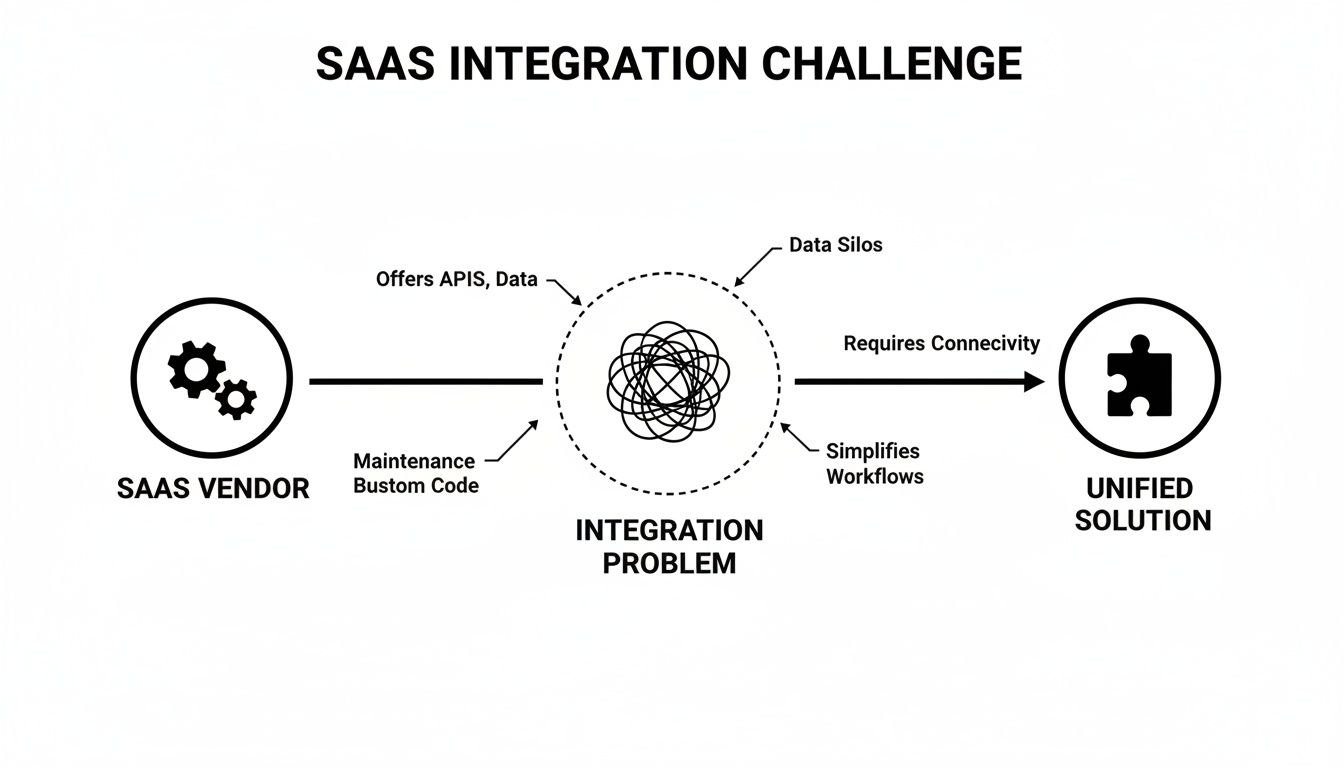
As you can see, the unified API acts as a central hub, untangling the otherwise messy web of point-to-point connections.
Specialized Unified APIs vs. Generalist iPaaS
As a developer, it's crucial to understand the difference between the two main types of api integration tools available:
- iPaaS (Integration Platform as a Service): These are massive, enterprise-focused platforms built to connect a company's internal systems, like their ERP and CRM. They're designed for orchestrating complex business workflows and are typically managed by large IT departments.
- Specialized Unified APIs: These are developer-first tools like API2Cart, built specifically for productized integrations. They focus on a single vertical, like eCommerce, and provide deep, reliable connections to a family of similar applications (e.g., shopping carts and marketplaces).
For any B2B SaaS product that needs to embed integrations for its customers, a specialized unified API is almost always the right choice. It’s purpose-built to help you scale your product’s connectivity without getting bogged down in maintenance. Understanding how these tools work in practice, like with a Conversion API integration for marketing, shows just how powerful this approach can be.
This strategy lets your team get back to building your core product instead of wrestling with third-party connectors. To dive deeper, check out our guide on everything you need to know about API integration software.
Evaluating the Top API Integration Tools for Developers
Picking the right API integration tool can feel like a make-or-break decision for your B2B SaaS. As a developer, the "best" choice is rarely a one-size-fits-all answer. It comes down to your project's architecture, your business goals, and the specific needs of your customers. The options are all over the map, from no-code platforms designed for simple automations to highly specialized unified APIs built for software products like yours.
We’re going to cut through the marketing noise and focus on what really matters to a development team. We'll look at the top tools based on their core strengths, the kind of developer they’re built for, and the technical details that actually determine success. This means digging into their API architecture, the quality of their SDKs, and whether they support event-driven webhooks or just old-school data polling.
Comparing Generalist Platforms and Specialized Solutions
Not all API integration tools are built for the same job. On one side, you have the big iPaaS (Integration Platform as a Service) players like MuleSoft or the low-code automators like Zapier. These platforms are fantastic for connecting a company's internal systems—think linking a CRM to a marketing tool—or for creating simple "if-this-then-that" workflows. They have huge connector libraries for almost every business app imaginable.
On the other side, you'll find specialized unified APIs.
A unified API is a developer-first tool designed to be embedded directly into a B2B SaaS product. It focuses on a specific vertical—like eCommerce—and provides deep, reliable connectivity to a family of similar applications.
For an integration developer building a feature for an Order Management System or shipping software, this difference is everything. A generalist platform might give you a surface-level connection to an eCommerce cart, but a specialized tool like API2Cart provides the granular access you need to manage products, orders, and inventory at scale.
The diagram above really says it all. A single point of integration is how you tame a fragmented ecosystem of shopping carts and marketplaces without building dozens of separate connectors.
API Integration Tools At A Glance
To give you a quick lay of the land, here’s a high-level look at some of the most common tools developers encounter. This table breaks down their primary function and intended user, which is often the most important starting point.
| Tool Name | Primary Use Case | eCommerce Focus | Target Developer |
|---|---|---|---|
| API2Cart | Unified eCommerce API | Very High (Products, Orders, Inventory, etc.) | B2B SaaS Developers (e.g., OMS, WMS, PIM) |
| MuleSoft | Enterprise iPaaS | Medium (General connectors for major platforms) | Enterprise & System Integration Architects |
| Workato | Enterprise Automation (iPaaS) | Medium (Connectors for business apps, including carts) | Business Technologists & Integration Specialists |
| Zapier | No-Code/Low-Code Automation | Low (Simple triggers and actions for popular apps) | Non-technical Users & Citizen Developers |
| Make | Visual Workflow Automation | Low-to-Medium (More complex than Zapier, but similar) | Business Users & Marketing/Ops Teams |
| Tray.io | Low-Code Automation & iPaaS | Medium (Connects cloud stacks, including eCommerce) | Integration Specialists & Revenue Ops |
| Boomi | Enterprise iPaaS & Data Management | Medium (Broad enterprise connectivity) | Enterprise IT & Integration Developers |
| Celigo | iPaaS for Business Process Automation | High (Strong focus on ERP and eCommerce integration) | IT Professionals & System Integrators |
| Paragon | Embedded iPaaS for SaaS | Medium (Provides SDK for embedding integrations) | SaaS Developers (General purpose) |
| Finch | Unified API for HR & Payroll | None (Vertical-specific for employment systems) | B2B SaaS Developers (e.g., HR Tech, FinTech) |
As you can see, the choice between a tool like API2Cart and a generalist platform depends entirely on whether you're connecting internal apps for one business or building a scalable integration feature for thousands of your own customers.
Key Evaluation Criteria for Developers
When you’re building a shortlist, a few technical criteria should be at the top of your list. These are the things that will determine how fast you can build, how reliable your integrations are, and how much of a headache they'll be to maintain down the road.
1. Connector Depth and eCommerce Focus
Does the tool just scratch the surface, or does it give you deep access to the data that matters? For eCommerce, that means more than just a "new order" trigger. You need comprehensive support for managing orders, syncing inventory levels, updating product listings, and handling customer data across platforms like Shopify, Magento, and Amazon. API2Cart, for instance, shines here by offering over 100 API methods built specifically for these tasks, allowing developers to implement robust functionalities for their users.
2. API Architecture and Documentation
Is the API actually a pleasure to work with? High-quality, interactive documentation with copy-paste code samples isn't a "nice to have"—it's a requirement. Look for a clean REST API with predictable data structures, clear error codes, and helpful resources like Postman collections that let you test calls in minutes, not hours.
3. SDK Availability
Software Development Kits (SDKs) in languages your team already uses—like PHP, Python, or .NET—can dramatically cut down development time. Instead of writing boilerplate code to handle HTTP requests, authentication, and response parsing, you can work with native objects and methods. API2Cart provides these SDKs, making the integration process much faster and far less prone to errors for your development team.
4. Data Syncing Methods (Webhooks vs. Polling)
A top-tier tool has to support both real-time updates and scheduled data pulls. Webhooks are crucial for event-driven workflows, like instantly getting a notification when a new order is placed. At the same time, you need flexible polling capabilities for batch updates or for connecting to older platforms that don't even offer webhooks. Finding the right best API integration platform for your software often comes down to this exact flexibility in how you can sync data.
Unified APIs vs Custom Integrations: The Developer's Dilemma
Every software team eventually hits the classic build-vs-buy crossroads when it comes to integrations. For developers, this choice is more than just a line item on a budget; it's a strategic trade-off between having total control upfront and achieving long-term agility. Getting this decision right directly shapes your product roadmap, how you allocate engineering resources, and ultimately, your ability to outpace the competition.
On the surface, the "build" route—crafting custom, one-off integrations from scratch—can seem tempting. It promises complete ownership and control over the code. But this path is often paved with hidden costs and a mountain of technical debt that can slow you down for years.

The Punishing Reality of Custom Builds
Building each connector yourself is a massive time sink. A single, seemingly simple integration can take months just to get a basic version live. And that’s before the real pain begins: the never-ending maintenance.
- Constant API Chasing: Shopping cart APIs are always in flux. You’re suddenly on the hook for tracking every update, deprecation, and breaking change across dozens of platforms you don’t control.
- Massive Engineering Overhead: Your most valuable engineers—the ones who should be building your core product—get stuck fixing brittle connectors and patching up outdated code.
- Slow Time-to-Market: While you're burning six months to build a perfect Shopify integration, your competitor who chose a different path has already launched support for ten platforms and is capturing market share.
The Strategic Advantage of a Unified API
This is exactly where the "buy" option—using a unified API—proves its worth. A specialized tool like API2Cart abstracts away all the platform-specific headaches. Instead of building and maintaining dozens of unique connectors, your team builds just one. This single point of maintenance is a total game-changer for any developer tasked with integrations.
The market trend confirms this shift. API-first strategies are no longer a niche; they're dominating how modern software gets built. In 2024, 74% of organizations declared themselves API-first, a huge jump from 62% in 2022. This approach has been shown to deliver 53% faster integration times, turning APIs from mere technical plumbing into powerful strategic assets. You can see the full research on enterprise integration trends and explore how this mindset is reshaping development.
By using a unified API like API2Cart, a multi-month integration headache can transform into a project completed in a matter of days. This frees up developer resources and drastically accelerates your go-to-market strategy.
For any SaaS provider, the benefits are clear and easy to quantify. A unified API can slash integration costs by up to 90% simply by removing the need for dedicated in-house maintenance teams. For a developer, it means you get to spend your time building real value, not just connecting pipes. You can learn more about unified API technology and see how it empowers developers to build scalable integrations at speed.
Ultimately, the choice is between owning a liability or adopting a strategic asset.
Real-World eCommerce Use Cases Solved by Unified APIs
Okay, enough theory. Let's talk about what unified api integration tools actually do. These aren't just abstract architectural diagrams; they are the engines that solve real, everyday problems for B2B eCommerce software vendors.
By creating a single connection point to a messy, fragmented market, they open up features that would otherwise demand a huge amount of development work. A tool like API2Cart handles the heavy lifting, letting your developers get back to building your core product instead of wrestling with dozens of fragile, custom connectors.
Automating Order and Shipping Management
Think about an Order Management System (OMS) or Shipping Software. Your entire value proposition is helping merchants bring orders from all their sales channels into one dashboard. Without a unified API, that means your team is stuck building one-off integrations for Shopify, then WooCommerce, then Amazon, and so on, just to pull in order data. It’s slow, expensive, and breaks constantly.
A unified API changes the game. Your application makes a single call to an endpoint like order.list and gets all new orders from every connected store at once. With API2Cart, when an order is shipped, you use the order.update method to send the tracking number back to the original sales channel, automatically keeping the end customer in the loop.
- Order Import: Use one API method to fetch new orders from dozens of platforms, complete with all the customer details and items purchased.
- Real-time Tracking: Use webhooks for instant notifications, or call update methods to sync shipping statuses and tracking numbers back to the source platform.
Synchronizing Inventory and Product Listings
If you provide Inventory Management or Product Information Management (PIM) software, your top priorities are preventing overselling and keeping data accurate. We all know that manually updating stock levels across multiple storefronts is a complete nightmare for merchants.
A unified API makes this problem disappear by offering methods to manage inventory and product data across every channel.
By using API calls to read and write stock levels, your software can maintain perfectly synchronized inventory across a merchant's entire online presence. A single sale on their website can instantly trigger an inventory update on their Amazon and eBay listings with API2Cart.
You can use methods like product.update to change stock counts or product.list to pull current inventory levels for every item. This makes sure that what customers see online is what’s actually in the warehouse, preventing lost sales and angry support tickets. For a deeper dive into how unified APIs fuel business growth, understanding the full scope of e-commerce automation is key.
Simplifying Multi-Channel Listing
For any software that helps merchants sell on multiple marketplaces, efficiency is everything. A unified API gives you the tools to list products everywhere without having to reinvent the wheel for each platform.
With a method like product.add from API2Cart, your software can create new product listings across multiple marketplaces from a single interface—pushing out images, descriptions, and pricing all at once. This transforms a tedious, manual task into a simple, automated workflow and gives your users a serious edge over their competition.
Getting Started with a Unified API in Minutes
Let's be honest—the thought of starting a new API integration project usually brings to mind long development cycles and complex project plans. But what if you could go from signing up to making a successful API call in just a few minutes? With the right api integration tools, that's not just a possibility; it's the new standard. Here’s how straightforward it is using a unified API like API2Cart.
It all starts with a developer-friendly free trial. Once you register, you’ll find your unique API key waiting in your account dashboard. That key is all you need to authenticate and start making calls.

Adding a Store and Making Your First Call
With your API key ready, the next move is to add a client’s store. API2Cart makes it simple to connect with major platforms like Shopify or WooCommerce. As soon as a store is linked, you’re all set to pull real data.
You can use a tool like Postman or one of API2Cart’s Software Development Kits (SDKs) for languages like PHP, Python, and .NET. A quick call to the product.list or order.list method will instantly pull structured data from the store, proving the connection works from end to end.
Getting tangible results this fast isn't just a nice-to-have; it's a huge competitive advantage. The real-time data integration sector is expected to rocket from $15.18 billion in 2026 to $30.27 billion by 2030. For B2B eCommerce software, speed to market is everything. You can discover more about real-time data integration growth rates to see just how fast this space is moving.
Exploring Developer-Centric Resources
A solid unified API doesn’t just stop at the first successful call. It should come packed with resources that help you build with confidence, like interactive documentation, a detailed API changelog, and fast technical support. This developer-first focus is what turns a quick test into a powerful, production-ready feature for your SaaS product.
Frequently Asked Questions About API Integration Tools
When you're evaluating api integration tools, it’s natural to have questions. You want to know how they work under the hood, how they handle security, and what the real impact will be on your development cycle. Let's get straight to the answers for some of the most common queries we hear from developers and product managers.
What Is the Difference Between a Unified API and an iPaaS?
This is a great question because they solve different problems. Think of an iPaaS (Integration Platform as a Service) like MuleSoft as a tool for massive, internal enterprise workflows. It’s built to connect huge, disparate systems inside a company, like linking Salesforce with SAP.
A Unified API like API2Cart is a developer-first tool built specifically for B2B SaaS companies. Instead of connecting internal systems, its job is to help you embed integrations directly into your product. It gives you one API to connect to dozens of similar platforms (like 40+ shopping carts), which dramatically speeds up product development for your SaaS.
How Do These Tools Handle Data Security?
Security is non-negotiable, and any reputable API integration tool builds on a multi-layered approach. At a minimum, this means using HTTPS for all data in transit and robust authentication using unique API keys for every connection.
For a service like API2Cart that handles sensitive store data, it goes much deeper. This includes full compliance with privacy regulations like GDPR and operating on secure, regularly audited infrastructure. Before you choose any provider, make it a habit to review their security documentation and certifications.
How Is API Versioning Handled Across Platforms?
Honestly, this is one of the biggest reasons for an integration developer to use a unified API. The provider takes on the full responsibility of monitoring every platform—like Shopify or BigCommerce—for API updates and breaking changes.
When a platform rolls out a new version, the unified API provider updates their connector behind the scenes. Your code, which only talks to the stable, unified API, is completely shielded from this chaos.
This means you get the benefit of up-to-date connectivity without the engineering overhead. Your team is free to focus on building core features, not chasing third-party API changes.
What Is the Typical Cost of Using a Unified API?
Pricing models almost always scale with your usage. They are typically subscription-based and tied to metrics like the number of connected stores or the volume of API calls you make per month.
While it is a recurring cost, the total cost of ownership is significantly lower than building and maintaining all those integrations in-house. Once you factor in developer salaries, server costs, and the never-ending maintenance cycle, a unified API provides a much more predictable and cost-effective way to scale your product's integration capabilities.
Ready to stop wrestling with individual eCommerce integrations? With API2Cart, you can connect to over 40 shopping carts and marketplaces through one unified API. Try our 14-day free trial and see how quickly you can expand your market reach.