For any integration developer building eCommerce software, connecting to external systems is a constant headache. The process is a familiar grind: you learn one platform's API, figure out its unique authentication, wrestle with its data formats, and then repeat the entire cycle for the next one. It feels like building a custom bridge for every single island you need to reach—it's slow, expensive, and incredibly fragile for your development team.
An API integrations platform completely flips that model on its head.
What Is an API Integrations Platform

Think of an API integrations platform as a universal adapter or a massive highway interchange for your code. Instead of building dozens of brittle, point-to-point connections, your team builds just one solid connection to the platform. The platform then takes on all the messy, complicated work of talking to each individual service on your behalf.
This abstraction layer is where the magic happens for a developer. It takes all the different API protocols and data structures and translates them into a single, standardized format. Suddenly, you can interact with an entire category of software—like shopping carts or marketplaces—through one clean, consistent interface.
The market's explosive growth, valued at USD 6.34 billion in 2024 and projected to hit USD 24.69 billion by 2032, tells you everything you need to know. Businesses are betting big on these platforms to connect their systems and deliver the seamless experiences customers now expect.
The Developer's Core Advantage
The biggest win for any integration developer is getting rid of repetitive, low-value work. Instead of spending months on "plumbing"—the tedious chore of building and maintaining integrations—you can finally focus on what actually matters: shipping innovative features for your users.
This shift completely changes project timelines and team efficiency. An API integrations platform directly solves some of the most common developer pain points:
- Authentication Hell: Forget implementing and managing dozens of different auth schemes like OAuth 1.0, OAuth 2.0, or custom API keys for every service. The platform handles it.
- Inconsistent Data Models: The platform normalizes the data for you. An "order" object looks the same whether it’s coming from Shopify, BigCommerce, or Magento. No more custom mapping for each connection.
- Constant API Maintenance: When an external service updates its API (and it will), the platform provider deals with the changes. Your application is shielded from breaking.
- Scalability Concerns: A good platform is built from the ground up to handle high volumes of API calls, preventing bottlenecks as your user base grows.
For an integration developer building eCommerce software, a service like API2Cart can slash integration development time from months per platform to just a few weeks for over 40 platforms simultaneously.
Ultimately, an API integrations platform empowers your development team to deliver more value, faster. It turns the integration process from a major engineering bottleneck into a powerful strategic asset. To dig deeper into what makes these tools tick, check out this comprehensive guide to modern API integration platforms.
When you're evaluating an API integrations platform, you have to look past the marketing fluff and get straight to the technical guts. What capabilities will actually make a difference in your day-to-day workflow as a developer? Not all platforms are built the same, and picking the right one is the difference between a smooth, fast deployment and a project drowning in technical debt.
This isn't a niche market anymore. The Integration Platform as a Service (iPaaS) space was valued at USD 12.87 billion in 2024 and is expected to rocket to USD 78.28 billion by 2032. Why? Because the results speak for themselves. Teams using an API-first strategy are seeing up to 53% faster integration times. This is your checklist for finding a platform that's robust, scalable, and built for developers.
The Power of a Unified API
First and foremost, a unified API is the foundation. It's an abstraction layer that takes dozens of messy, inconsistent APIs and presents them as a single, predictable interface for you to code against.
Think about it from an eCommerce perspective. Instead of wrestling with the unique data structures for orders on Shopify, Magento, and BigCommerce, you work with just one standardized order object. This single change drastically cuts down the learning curve and means you don't have to write custom mapping logic for every new shopping cart you need to support.
A platform like API2Cart lets you write your business logic once. A single call to an endpoint like
order.listcan pull orders from over 40 different platforms, all returned in the exact same format.
This singular, consistent data model is the secret to building integrations that can scale without becoming a maintenance nightmare. You’re no longer stuck in the endless loop of managing individual connections; you're free to actually build valuable features.
Real-Time Data Sync With Webhooks
In today's world, especially in eCommerce, waiting for batch updates just doesn't cut it. Your software needs to know what's happening right now. That's where webhooks become absolutely essential for a developer. Any serious API integrations platform must offer rock-solid support for them.
Webhooks flip the script. Instead of your app constantly polling an API asking, "Is there a new order yet?," a webhook automatically pushes a notification to your system the second an order is created. It's an event-driven approach that's far more efficient and delivers the immediate data sync required for modern tools like:
- Order Management Systems (OMS): Instantly grab new orders the moment they're placed on any sales channel.
- Warehouse Management Systems (WMS): Get immediate alerts for new orders so the fulfillment process can kick off without a single delay.
- Shipping Software: Trigger shipping workflows the instant an order is paid for and confirmed.
This real-time capability means your application can react to critical events as they happen, which is key to delivering a great user experience.
Comprehensive API Methods and Scalability
A unified API is only as good as the methods it exposes. As a developer, you need deep, granular control over key data objects. The platform you choose must offer a rich set of API methods for core eCommerce entities like products, orders, customers, and categories.
This means going beyond just reading data (.list, .info). You need the ability to create (.add), update (.update), and delete (.delete) entities. This depth is what allows you to build full-featured, two-way integrations, not just simple data-sync tools.
Scalability is the other side of this coin. As your application and user base grow, so will your data volume. The platform's architecture has to handle that increased throughput without hitting annoying rate limits or slowing to a crawl. This isn't a "nice-to-have"; it's a fundamental requirement for building enterprise-ready software.
Enterprise-Grade Security and Compliance
Last but certainly not least, security is non-negotiable. As a developer, you have to be confident that the platform handles authentication and data with the highest possible standards. This starts with robust support for modern protocols that protect sensitive API keys and user credentials. To really dive into this, you can explore various API authentication methods and see how they stack up.
Beyond that, the platform must be compliant with major data privacy regulations like GDPR and CCPA. This is more than just a legal box to check—it’s about building trust with your users. Make sure any platform you consider has a transparent security posture and a clear commitment to protecting customer data.
Speeding Up Development With a Unified API
Theory is great, but let's be honest—for a developer, the rubber meets the road when you solve a problem with code. The true power of an API integrations platform becomes clear when you stop talking about abstract concepts and start looking at concrete use cases. It’s the difference between admiring architectural blueprints and actually pouring the foundation for a skyscraper in a fraction of the time.
Picture this: you’ve been tasked with building a new Order Management System (OMS). Your first major roadblock is connecting to the big three eCommerce platforms: Shopify, Magento, and BigCommerce. If you tackle this manually, you’re not managing one project; you’re wrestling with three separate, resource-draining integration builds. Each one means a deep dive into unique documentation, different authentication methods, and entirely separate codebases that your team is now on the hook to maintain forever.
The Unified API in Action
This is exactly where a unified API solution like API2Cart flips the script. Instead of painstakingly building three different bridges, you build one superhighway. You write your core business logic just once, and the platform handles all the tricky translation work to communicate with each shopping cart in its native language.
This model shows how a platform's core features—the unified API, webhooks, and scalability—all work in concert to create a seriously powerful development environment.
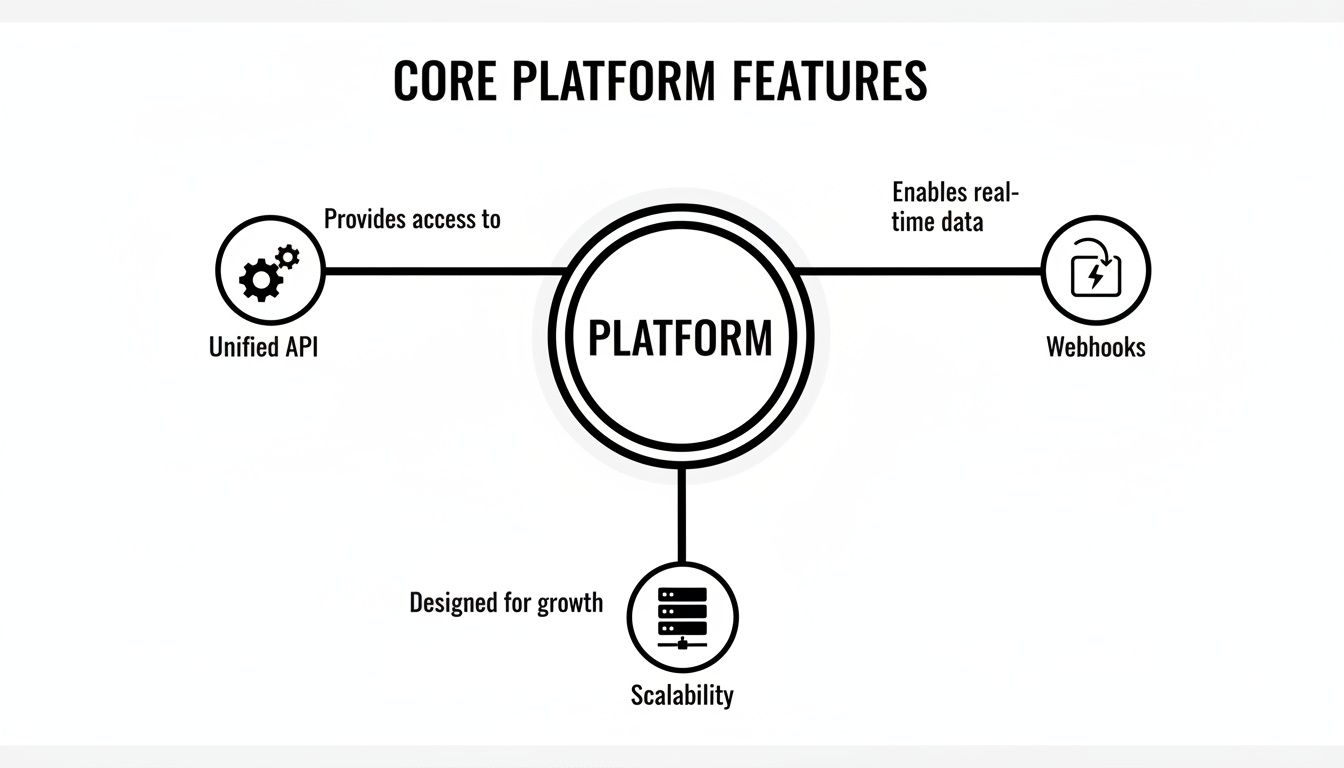
As you can see, the unified API isn't just one feature among many. It’s the central hub that makes everything else, from real-time data flow to high-volume performance, possible.
Let's get practical. To pull a list of orders, your code doesn't need to know the first thing about Shopify's GraphQL API versus Magento's REST API. You just make one simple, standardized call to API2Cart.
Instead of writing custom logic for each platform, you make a single, clean API call like
order.list. The platform intelligently routes this request, fetches the data from Shopify, Magento, or any of the 40+ supported carts, and returns it to you in a perfectly standardized JSON format.
This single, predictable structure cuts out thousands of lines of redundant code and shrinks development timelines from months down to weeks. The complexity is absorbed by the platform, freeing up your engineering team to focus on what matters. For a deeper dive into how this stacks up against other methods, check out our comparison of a unified API vs embedded iPaaS.
Building Robust Features Faster
This accelerated development model applies to every feature your software needs. Whether you're building a Warehouse Management System (WMS), a Product Information Management (PIM) tool, or advanced shipping software, a solid API integrations platform gives you the endpoints you need right out of the box.
Think about these common developer tasks and how much simpler they become with API2Cart:
- For a WMS: Keeping inventory levels in sync is everything. With API2Cart, one
product.updatecall can push stock level changes to dozens of storefronts at once. This prevents overselling and keeps data accurate across every channel. - For a PIM: When the marketing team updates product descriptions or swaps out images, those changes have to go everywhere. A standardized
product.updatemethod handles this without a hitch, no custom code needed for each platform. - For Shipping Software: To print a shipping label, you first need the complete order details. The
order.infomethod pulls all the necessary customer and product data in a consistent format, making the entire fulfillment workflow a breeze.
By providing comprehensive and standardized methods for products, orders, customers, and shipments, API2Cart equips developers with the precise tools for the job. You spend less time wrestling with quirky external APIs and more time building the valuable, user-facing features that make your product a success. This is how you gain a real competitive edge and get your product to market faster than ever before.
Real-World Use Cases for Integration Developers
An api integrations platform isn't some abstract architectural idea; it's a real-world tool that lets you build and ship software fast. For developers, this means you can stop wrestling with one-off integration projects and start delivering the powerful, connected features your customers are asking for. Let's look at how this actually works for building modern eCommerce software.
The pressure to connect systems is everywhere, and the market numbers back it up. The global API Management market, which is tightly linked to integration platforms, was already worth USD 6.63 billion in 2024. Projections show it rocketing to USD 51.11 billion by 2033, a huge jump driven by demand from retail and IT. You can explore detailed market analysis on imarcgroup.com to see the full picture. This explosive growth tells us one thing: developers who can build integrated tools are in high demand.
Building a Smarter Order Management System
Imagine you're building an Order Management System (OMS). The core promise to merchants is simple: a single dashboard to see and manage orders from every channel—Shopify, Amazon, WooCommerce, you name it.
Doing this manually is a beast of a project. You’d have to build, authenticate, and maintain a separate connection for every single platform. But with an API integrations platform like API2Cart, that entire headache goes away. Instead of juggling dozens of separate projects, you have just one.
You make a single call to the
order.listmethod. API2Cart then goes out, fetches orders from all connected storefronts, and hands them back to you in a clean, standardized format. Now you can build your unified dashboard logic once, saving yourself hundreds of hours.
When an order status changes in your OMS, a single order.update call pushes that new status back out to the original sales channel. Everything stays perfectly in sync. This takes a massively complex, multi-API challenge and turns it into a smooth, manageable workflow.
Powering Warehouse and Inventory Management
For any Warehouse Management System (WMS), nothing is more important than real-time inventory sync. Overselling is a merchant's absolute worst nightmare, and trying to update stock levels by hand is just asking for trouble.
An API integrations platform provides the live data feed needed to stop these problems before they start. By using webhooks, your WMS gets an instant notification the moment a new order is placed on any connected store, kicking off the fulfillment process right away.
API2Cart makes this two-way data flow simple, allowing you to:
- Update Inventory: When a new shipment arrives at the warehouse, a single call to API2Cart's
product.updatemethod pushes the new quantity to every single online store. - Sync Price Changes: If a price changes in your system, that same
product.updatecall can synchronize the new price across all listings. - Add New Products: When a new item is ready to sell, the
product.addmethod creates the listing on multiple platforms at once.
This constant, two-way data flow is the foundation of a reliable WMS, and a unified API makes it happen without writing custom code for every single shopping cart.
Streamlining Product Information Management
Product Information Management (PIM) software is designed to be the single source of truth for all product data—descriptions, images, specs, pricing, and more. The biggest challenge is making sure that data stays consistent everywhere it appears.
A unified API is the perfect tool for the job. When a marketer updates a product description in the PIM, the system can use the product.update method to instantly push that change to every connected eCommerce platform and marketplace. This locks in brand consistency and data accuracy without anyone lifting a finger.
For developers working with modern systems, understanding microservices architecture is a big piece of the puzzle, and integration platforms often act as the glue holding these distributed services together. By using a platform, you get to deliver these critical features faster and move on to building the next great thing.
How to Choose the Right Integration Platform
Choosing an API integrations platform is a foundational architectural decision, not just another line item in your budget. For any developer, this choice dictates your daily workflow, your product’s stability, and how fast your team can actually ship new features. The goal is to cut through the marketing noise and evaluate these platforms based on the technical merits that will make or break your product down the line.
This isn't about picking the platform with the flashiest website; it's about finding one with the engineering muscle to back up its promises. You have to look at the total cost of ownership, weighing a subscription fee against the massive internal resources needed to build—and, more importantly, maintain—dozens of integrations yourself.
Assess the Depth and Quality of Integrations
The first and most important test is the actual depth of the integrations. A platform might boast support for 40 different shopping carts, but that number is totally meaningless if the connections are just surface-level. As a developer, you have to dig in and verify that the platform supports the specific API endpoints and data fields your application needs to function properly.
For anyone building eCommerce software, this means asking some tough questions:
- Does the platform support custom product attributes? Countless merchants depend on custom fields. If your integration can’t see them, it’s a deal-breaker.
- Can you handle complex order data? This goes beyond the basics to include line-item properties, detailed tax info, and split shipments.
- How robust are the customer data endpoints? You need more than a name and email. Access to a customer's full order history and any assigned customer groups is often essential.
A platform like API2Cart is built around providing this kind of depth. It offers comprehensive methods for working with orders, products, customers, and shipments that go way beyond simple data syncing, ensuring you can build the powerful features your users are paying for.
Prioritize the Developer Experience
A great developer experience (DX) is a massive force multiplier. It’s the difference between a smooth, intuitive build and weeks of banging your head against the wall debugging. When you’re evaluating an API integrations platform, put its developer-facing resources under a microscope.
The quality of the documentation is a direct reflection of a platform's commitment to its developers. If the docs are unclear, outdated, or lack interactive examples, it's a major red flag for the quality of the underlying product.
Look for clear, interactive documentation with code samples in multiple languages. Solid SDKs are also non-negotiable, as they handle all the boilerplate code like authentication and request formatting, freeing you up to focus on your app's core logic. A responsive, knowledgeable technical support team is the final piece of the puzzle. When you inevitably hit a weird edge case, you need access to experts who can help you solve it fast, not a generic support agent reading from a script.
For a more detailed checklist on this, you can learn more about how to choose the best API integration platform for your software.
Evaluate Scalability and Technical Support
Finally, you have to plan for success. Ask yourself: can this platform handle our data load not just today, but a year from now when our user base has tripled? You need to investigate the platform’s architecture. Ask them about their rate-limiting policies, what their infrastructure looks like, and how they perform under peak load—like during a Black Friday weekend.
A truly scalable platform should grow with you without forcing you to constantly re-architect your own system. This technical horsepower must be backed by accessible, expert support. Your goal isn't just to find a vendor for the next quarter; it's to find a long-term partner. A strong support team becomes an extension of your own, providing the specialized integration expertise you need to navigate the messy, complex world of the eCommerce ecosystem.
Your Implementation Roadmap to Get Started

Alright, moving from evaluating an API integrations platform to actually building with one is where things get interesting. For any developer, this is the point where all the theoretical benefits turn into tangible code that solves a real-world problem. The secret to a smooth implementation isn't just about writing code; it's about having a clear, methodical plan that proves the platform's value and sets your project up for the long haul.
This roadmap is designed to be a focused, actionable guide for developers. It’s built to take you from the first setup to a full-scale rollout, making sure you build confidence and momentum with every step.
Step 1: Define a Focused Scope
Before you write a single line of code, stop. The most critical step is to define a tight, achievable scope for your very first integration. If you try to do everything at once, you’ll get bogged down in delays. Instead, zoom in on the single most important workflow your software needs to handle.
Ask yourself a couple of core questions:
- Which data entities are absolutely essential? Start with the non-negotiables, like
ordersandproducts. You can always circle back to addcustomersorshipmentslater. - What's the primary data flow? For an OMS, this might be as simple as retrieving new orders (
order.list) and then updating their status (order.update). Define that minimum viable workflow and stick to it.
This laser focus is your best defense against scope creep. It ensures your first build delivers immediate, measurable value right out of the gate.
Step 2: Get Your Credentials and Explore the Docs
With your scope locked in, it’s time to get your hands dirty. Your first practical move is to set up a developer account and grab your API credentials. This is your key to the kingdom.
Once you have your key, head straight for the interactive documentation. A solid platform will let you make live test calls directly from the browser, which is the fastest way for a developer to really understand the data models firsthand. Use this time to see exactly how an order object from Shopify is standardized to look just like one from BigCommerce. This is where you validate the platform’s core promise for yourself.
Step 3: Build a Proof of Concept
Now for the fun part. Build a small but fully functional proof-of-concept (POC). The goal here isn't to build your final, polished product; it's to prove that the platform can execute your core workflow and do it well.
A strong POC targets just one eCommerce platform (like Shopify) and one key workflow (like retrieving the last 10 orders). This focused test confirms that authentication works, the data format is what you expect, and the performance meets your standards.
A successful POC gives you the technical green light to move forward with confidence. With a platform like API2Cart, you can often get this done in a matter of hours, not weeks.
Step 4: Plan Your Scalable Rollout
Once your POC is validated, you can start strategizing a broader rollout. Because you’ve built all your logic against a unified API, expanding to other platforms is surprisingly straightforward. You're not starting from scratch. Plan to enable additional shopping carts in logical phases, testing each one as you go.
Ready to see just how fast you can build? Start a free 30-day trial with API2Cart to explore the API and test out your core workflows. When you're ready to architect your full solution, schedule a call with an integration expert who can help you map out the perfect implementation plan.
Frequently Asked Questions
Jumping into the world of API integration platforms can bring up a few questions, especially for developers trying to figure out the best architectural path forward. Here are some straight answers to the most common queries we hear.
What Is the Difference Between a Unified API and an iPaaS
While they both help connect different software, they’re built for very different jobs. Think of an iPaaS (Integration Platform as a Service) as a massive, general-purpose toolbox, often with a visual drag-and-drop interface. It’s designed to build custom workflows connecting all sorts of applications, like linking a CRM to an ERP system.
A unified API platform like API2Cart, on the other hand, is a specialist built for developers. It focuses intensely on one vertical—in our case, eCommerce. It gives developers a single, consistent API to plug into every major platform in that ecosystem. This specialization delivers much deeper and more reliable functionality for specific use cases, which radically cuts down development time for any eCommerce software.
How Does a Unified API Handle Platform-Specific Differences
At its core, a unified API platform acts as a smart translation layer. Its main job is to wrestle with the unique authentication methods, quirky data structures, and specific API endpoints for every single platform it supports. All of that backend complexity gets mapped to the platform's own clean, standardized data model.
For an integration developer, this is a game-changer. When you make a single
product.updatecall through API2Cart, the platform intelligently translates that command into the precise, native API requests required by Shopify, Magento, or any other shopping cart. You get a predictable result without ever having to touch the messy, inconsistent native APIs yourself.
How Secure Is a Third-Party Integration Platform
Security isn't just a feature; it's the absolute foundation for any reputable API integration platform. These services use industry-standard TLS encryption for all data moving back and forth, and they make sure sensitive information is encrypted when stored.
More importantly, platforms like API2Cart don't store raw store credentials like usernames or passwords. Instead, they rely on secure, revocable access tokens (like OAuth) provided directly by the eCommerce platforms. This means store owners grant access securely, can revoke it at any time, and your integration stays compliant with privacy rules like GDPR without ever exposing highly sensitive login details.
Ready to stop building integrations one by one and start shipping features your customers actually want? API2Cart provides a unified API to connect with over 40 eCommerce platforms, saving you months of development time. Start your free 14-day trial and make your first API call today.