An API marketplace is best understood as an app store, but built specifically for integration developers. Instead of buying a finished application, you're acquiring the code—the building blocks—to add powerful features like payment processing, shipping logic, or data analytics directly into your own software.
Decoding the API Marketplace Ecosystem

For an integration developer, a good marketplace is a massive time-saver. It’s a central hub where you can discover and implement new functionalities without having to build every single feature from the ground up. This allows you to focus on your core product logic instead of reinventing the wheel for common functionalities.
The whole ecosystem really boils down to a two-sided model:
- API Providers: These are the companies that built a specific service (like a fraud detection tool or a currency conversion engine) and want to sell access to it. They list their API on the marketplace, providing all the necessary documentation, pricing tiers, and access keys for others to use.
- API Consumers: This is you—the integration developers and software companies who need that functionality. You use the marketplace to browse for solutions, compare different APIs, and subscribe to the ones that fit your project's technical and business needs.
To help you get a clearer picture, here’s a breakdown of the key parts that make up a typical API marketplace.
Core Components of an API Marketplace
This table breaks down the key functions and components that define a typical API marketplace, helping developers quickly understand its structure and value.
| Component | Function for Developers (API Consumers) | Function for API Providers |
|---|---|---|
| Developer Portal | The main interface for browsing APIs, reading documentation, and managing subscriptions. It’s your front door to the ecosystem. | The platform used to publish API documentation, define pricing plans, and manage API versions. |
| API Catalog | A searchable and categorized directory of all available APIs, making it easy to discover solutions for specific use cases. | The public listing for an API, designed to attract developers and showcase its capabilities. |
| Testing & Sandbox | Environments to safely test an API with sample requests and see how it behaves before committing to a paid plan. | Tools for providing a sandboxed environment where potential customers can evaluate the API without risk. |
| Billing & Analytics | A dashboard to track API usage, monitor costs, manage payment methods, and view invoices. | The system that handles subscription management, metered billing, revenue tracking, and payout processing. |
| API Gateway | The technical layer that handles requests, enforces rate limits, manages authentication, and routes traffic to the correct service. | The infrastructure that secures the API, controls access, and monitors performance and uptime. |
Together, these components create a self-service platform where developers can find, evaluate, and integrate third-party services with minimal friction.
The Developer's Workflow in a Marketplace
The journey for a developer is pretty straightforward. First, you search or browse categories to find APIs that solve your problem. From there, you dig into the documentation to understand its endpoints, data formats, and how authentication works.
To make sure an API actually does what it claims, developers often use a dedicated API Tester tool to send sample requests and inspect the live responses. This is a crucial step before you write any code.
Once you’re confident it’s the right fit, you subscribe to a plan, grab your API keys, and start integrating it into your application. This approach lets you assemble complex software by plugging together specialized services from different providers.
However, for B2B SaaS vendors in the eCommerce world, this model has a major catch. Juggling dozens of separate integrations for different shopping carts—each with its own API logic and maintenance schedule—quickly becomes a huge technical headache. This is exactly where a unified solution like API2Cart provides a better way forward, consolidating access to over 60 platforms through a single, consistent API and sidestepping the complexity of the marketplace model entirely.
Choosing an API is more than just a technical decision—it's a financial one. As an integration developer building B2B SaaS, you have to look past the endpoints and documentation and figure out how you're actually going to pay for access. The wrong financial model can sneak up on you, bloating your budget with unexpected costs that throw your growth plans off track.
The API marketplace scene is booming, and for good reason. It's the engine room of modern software development. Valued at over $21 billion by 2026, the market is on a trajectory to hit nearly $50 billion by 2030. This isn't just a trend; it's a massive shift driven by businesses everywhere needing powerful, scalable ways to connect their systems. You can dig into more of this data on Grand View Research.
Common Pricing Models Explained
Most marketplaces boil down to one of three business models. Each one directly impacts your development costs, how easily you can scale, and what your final return on investment looks like.
- Freemium: This is the "try before you buy" model. You get a free tier with basic features or a cap on API calls. It's perfect for prototyping or testing an idea without opening your wallet. But once your app gains traction and you need more power or higher limits, you’ll have to upgrade to a paid plan.
- Pay-As-You-Go (PAYG): You're billed only for what you consume. This model is incredibly flexible and can be a lifesaver for apps with spiky, unpredictable traffic. The main challenge? Forecasting your expenses. A sudden surge in usage can lead to a surprisingly high bill.
- Tiered Subscriptions: This is the most predictable option. You pick a package with a set number of API calls and features for a flat monthly or annual fee. It makes budgeting a breeze. The downside is you might end up paying for capacity you don't use or get hit with overage charges if you unexpectedly spike past your tier's limits.
For developers, the ideal model depends entirely on the use case. A startup testing a new feature might prefer a Freemium plan, while an established enterprise system with steady traffic could benefit from a predictable Tiered Subscription.
Public vs. Private Marketplaces
It’s also crucial for an integration developer to know the difference between public and private marketplaces.
Public marketplaces, like RapidAPI or Postman, are the big, open bazaars of the API world. They bring together thousands of APIs from countless providers, designed for easy discovery and broad use.
Private marketplaces, however, are walled gardens. These are internal hubs built by large companies to manage and share their own APIs between departments or with select partners. You won't be browsing them publicly, but they're a huge part of the overall API economy.
Understanding how these different models work is foundational, and you can learn more about the API economy business model in our detailed guide. For B2B eCommerce developers, trying to piece together functionality from public marketplaces often means juggling a messy web of different subscriptions and billing cycles. This is exactly why so many turn to a unified API provider like API2Cart—it cuts through the noise, consolidating all that financial and technical complexity into one simple, predictable partnership.
The Benefits and Risks for B2B eCommerce Software

For any integration developer on a B2B eCommerce software team, an API marketplace can look like a perfect shortcut. It promises a quick way to bolt on new features and expand the number of platforms you support.
While marketplaces definitely have their upsides, they also bring some very real risks to the table that you have to think through. Making the right call means looking at both sides of the coin. On one hand, you can accelerate your roadmap. On the other, you might be creating dependencies that become a headache down the road.
The Clear Advantages of Using a Marketplace
The biggest, most obvious win here is speed. Instead of tying up your engineers for months to build a new integration from the ground up, your team can subscribe to an API and get a connection working in a matter of days. This lets you react to market demands a lot faster and get your solution in front of more users, sooner.
Marketplaces also give you access to specialized, innovative tools without the massive R&D budget. Need a complex tax calculation engine or a niche payment gateway? A marketplace can serve up dozens of options almost instantly. This frees up your team to focus on what makes your own product unique.
It really boils down to a classic "buy versus build" decision. For a single, non-essential feature, buying access through an API can be a savvy move to save time and upfront cost.
The Hidden Risks Developers Must Consider
That convenience, however, doesn't come for free. The most serious risk for an integration developer is vendor lock-in. Once your software is deeply intertwined with a specific third-party API, switching to a new one can be just as expensive and painful as building it yourself in the first place.
Another huge issue is dependency. Your application's performance, uptime, and security are now directly chained to another company's. If their service goes down or suffers a security breach, your customers are the ones who feel it, and there's very little you can do about it. Juggling different security models can also get messy; if you want to go deeper, you might find these API authentication methods in our article helpful.
Finally, unpredictable costs can sneak up on you as your business grows. A pay-as-you-go model might seem cheap when you have 100 customers, but it can balloon into an unsustainable expense when you hit 10,000. These fluctuating costs make it incredibly difficult to forecast your budget long-term.
Weighing the Pros and Cons of Using an API Marketplace
| Factor | Potential Benefits | Potential Risks |
|---|---|---|
| Development Speed | Go from concept to a working integration in days, not months. React to market needs quickly. | Initial speed can be offset by long-term maintenance if the API changes or is deprecated. |
| Cost | Lower upfront investment compared to in-house development. Predictable costs for low-volume usage. | Pay-as-you-go models become extremely expensive at scale, making financial planning difficult. |
| Innovation | Instantly access specialized functions (e.g., tax, shipping) without costly R&D. | Limited to the features offered by the API provider; no ability to customize beyond what's available. |
| Control & Reliability | Offload maintenance, uptime, and security to the API provider. | Your app's stability is tied to a third party. Their downtime becomes your downtime. |
| Flexibility | Quickly test and integrate new features to see what sticks with your customers. | High cost of switching providers creates vendor lock-in, reducing your long-term flexibility. |
This table makes the strategic choice for an integration developer clearer. While an API marketplace offers a tempting shortcut for a specific problem, the long-term stability and predictability of a unified API solution often pave a much more sustainable path for growth.
Choosing Your Integration Strategy: Marketplace vs. Unified API
Sooner or later, every eCommerce software vendor hits a fork in the road. Do you build out your integration roadmap one API at a time, picking connections from various marketplaces? Or do you go all-in on a single, unified solution? This choice pits the "a la carte" marketplace model against the "all-in-one" power of a unified API.
The marketplace path looks simple enough on the surface. You need a Shopify connection, so you build for the Shopify API. Next, you need Magento, so you find that API and start again. But this approach quickly spirals into a massive maintenance headache for any development team tasked with keeping it all running.
The Marketplace Maze for Developers
When you source APIs individually from a marketplace, you're not just building a connection; you're signing up for a long list of technical headaches. Each API has its own ecosystem, forcing your team to become experts in multiple, often conflicting, systems.
- Disparate Data Models: The way Shopify structures product data is completely different from how Magento or Amazon does. This forces your development team to write custom data-mapping logic for every single integration, adding layers of complexity and more potential points of failure.
- Varied Authentication Methods: One API might use OAuth 2.0, another might just need a simple API key, and a third could demand a custom token-based system. Your application has to handle all of them securely and correctly.
- Inconsistent Documentation: Let's be honest, the quality and clarity of API documentation can be all over the place. Your developers will burn hours deciphering poorly written guides for one platform while breezing through another, making development timelines completely unpredictable.
This piecemeal approach turns your engineering team into professional jugglers, constantly trying to keep multiple, dissimilar integrations up in the air. The maintenance overhead alone can eat up a huge chunk of your development budget, pulling focus away from building the features your customers actually pay for.
The Unified API as a Strategic Alternative
This is where a unified API like API2Cart flips the script. Instead of building a patchwork of fragile connections, a unified API acts as a universal translator for the entire eCommerce world.
It gives you a single, consistent endpoint to connect with over 60 different eCommerce platforms and marketplaces. This means your developers only need to learn one set of API methods and work with one standardized data format. Period.
This screenshot shows the unified dashboard that simplifies managing multiple platform connections.
The interface demonstrates how a single point of control allows for streamlined oversight of numerous integrations.
The demand for this kind of simplification is massive. The United States API market alone, valued at over $6 billion in 2026, is on track to hit nearly $29 billion by 2035. This growth reflects a deep dependency on robust integrations, creating a huge opportunity for SaaS vendors who can easily connect to the tools their customers use. You can dive into the numbers in this insightful report on the API market.
By abstracting away the unique complexities of each platform's API, a unified solution transforms difficult tasks like multi-platform order management or inventory synchronization into streamlined, repeatable processes.
This strategic shift frees your development team from the endless cycle of building and maintaining individual integrations. They can finally focus their talent on innovation and making your core application better. A unified API isn't just a technical tool; it’s a business accelerator that helps you scale your integration capabilities efficiently and predictably. If you're curious about the mechanics, check out our guide on how a unified API works.
How a Unified API Accelerates Your Development Workflow
Let's move past the theory and get practical. For an integration developer, the real magic of a unified API isn't just a concept—it's how it solves day-to-day headaches. Instead of grappling with an api marketplace, where every new connection is a separate, resource-draining project, a unified approach gives you one clean path to connectivity. This completely flips the script on your development timeline, turning a months-long marathon into a quick sprint.
Imagine your team is building an Order Management System. To be valuable, your customers need it to connect with dozens of shopping carts—from giants like Shopify and BigCommerce to smaller, niche platforms. The old way would mean building, testing, and maintaining a separate integration for each one. That’s a massive undertaking that could easily soak up a year or more of your roadmap.
With a unified solution like API2Cart, you only integrate once. Your developers work with a single, consistent set of API methods—like order.list and order.update—to pull and manage order data from over 60 different platforms. A single development effort connects your software to the entire eCommerce ecosystem, slashing your time-to-market from many months down to just a few weeks.
From Complex to Cohesive
This same logic applies across different software categories. Think about a shipping automation platform. Its entire purpose hinges on retrieving order details from a merchant's store and then pushing tracking information back once a shipping label is generated.
Instead of your team writing custom code to navigate the unique order structures and authentication hoops for Amazon, eBay, and Magento, API2Cart gives you a standardized data format. Your system makes one call to our unified API, and we do all the tricky translation work to each platform’s native language behind the scenes.
This abstraction layer is the secret sauce. It frees your team from needing to become experts on every platform's quirky API. You can finally focus on building killer shipping features instead of maintaining a brittle, tangled web of connections.
This flowchart helps visualize the decision. It simplifies when to choose a unified API versus building point-to-point integrations.
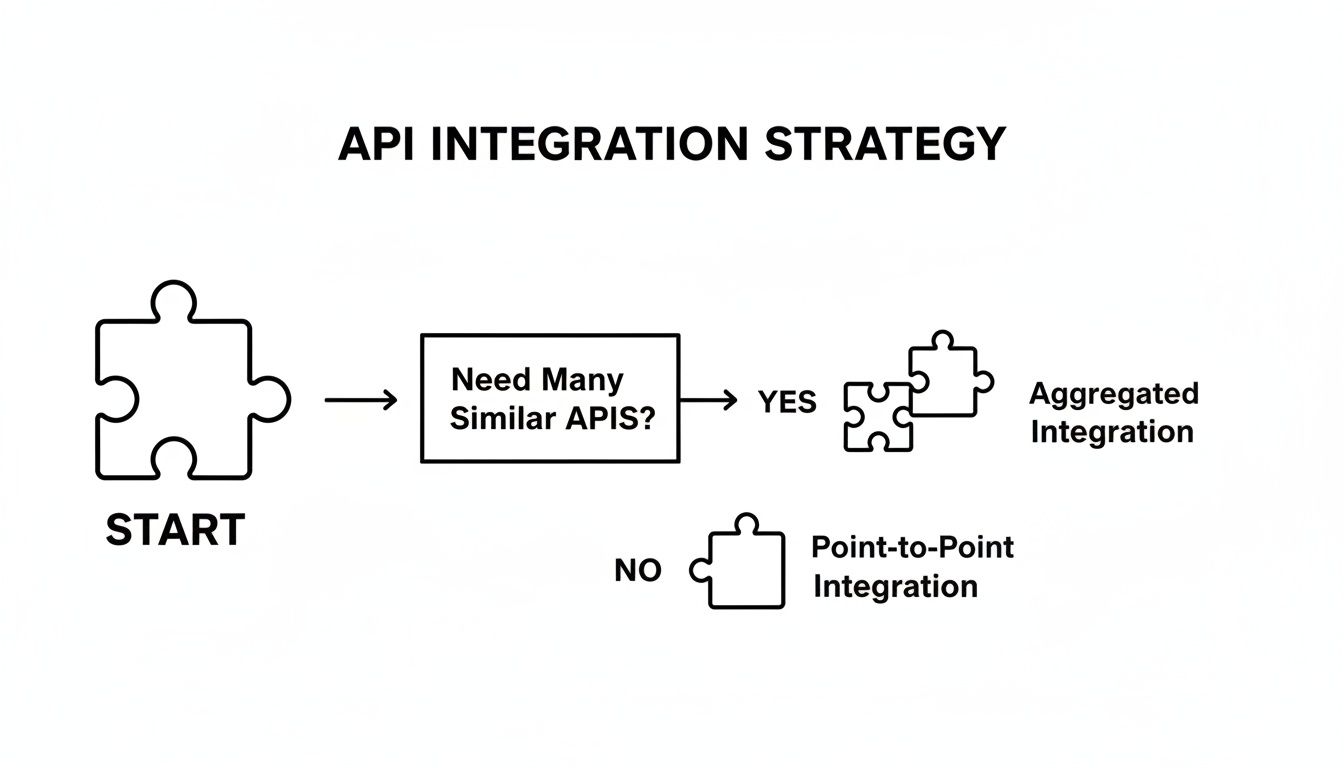
The main takeaway is simple: if your software needs to talk to many similar APIs (like dozens of shopping carts), an aggregated, unified approach is vastly more scalable and cost-effective than building each connection from scratch.
Beyond the Initial Build
The speed boost doesn't stop after the first build, either. A unified API also takes the pain out of long-term maintenance. eCommerce platforms update their APIs all the time—it's a constant reality. When they do, API2Cart's team handles all the required changes.
Your integration remains stable and works without interruption. This saves your engineers from the endless cycle of putting out fires and lets them get back to building things that actually grow your business. This model delivers a powerful return on investment by directly targeting the biggest pain points: cost, time, and the never-ending headache of maintenance. For any integration developer building for the eCommerce world, it’s a smarter, more predictable way to scale.
Frequently Asked Questions for Integration Developers
When you're weighing integration options, a few key questions always seem to pop up. Let's tackle the common ones that developers and product managers ask when comparing API marketplaces to a unified approach.
We've gathered some of the most common questions developers have when choosing between these two integration strategies. Here are the direct answers to help you decide.
| question | answer |
|---|---|
| What is the main difference between an API marketplace and a unified API for a developer? | An API marketplace is a platform offering many individual APIs from different providers, like an app store. A unified API, like API2Cart, bundles multiple similar APIs (e.g., for 60+ eCommerce platforms) into a single, consistent API, saving developers from building and maintaining each connection separately. |
| Are API marketplaces secure for enterprise applications? | Security varies by provider. While marketplaces often have vetting processes, you are ultimately reliant on the security standards of each individual API vendor you use. This can create complex security management overhead compared to a single, vetted unified API provider. |
| How does pricing compare between marketplace APIs and a unified API? | Marketplaces often use pay-as-you-go or tiered models per API, which can become unpredictable and costly at scale. A unified API typically offers a more predictable subscription model that covers access to all its integrated platforms, simplifying budgeting and often providing better value for extensive integration needs. |
| As a developer, when should I choose a marketplace over a unified API? | An API marketplace can be a good choice if you only need one or two simple, distinct integrations and are not focused on a specific vertical like eCommerce. For complex systems requiring connections to many similar platforms (e.g., multiple shopping carts), a unified API is almost always more efficient and scalable. |
Hopefully, these quick answers clarify the core differences and help frame your decision-making process.
When Should I Choose a Marketplace Over a Unified API
An api marketplace is a practical choice if your needs are simple and diverse. For instance, if you just need to connect to a single payment gateway and a separate weather data service, a marketplace gets the job done without extra complexity.
However, a unified API becomes the clear winner for systems needing deep connections within a specific vertical. If your software must talk to dozens of shopping carts, shipping carriers, or accounting platforms, the unified model saves you from building the same type of integration over and over again.
Integration developers are always on the lookout for ways to build connections more efficiently. Digging into resources like an integration toolkit can offer great insights into smarter and faster connection methods.
Ready to bypass the complexity of an api marketplace and accelerate your eCommerce integrations? API2Cart provides a single, unified API to connect with over 60 shopping carts and marketplaces. Start your free 14-day trial and see how quickly you can expand your software's reach.