For any integration developer, getting to grips with the core difference between REST API and SOAP API is non-negotiable. To put it simply, REST is a flexible architectural style that uses standard HTTP for building lightweight, scalable web services, making it a natural fit for modern web and mobile apps. SOAP, on the other hand, is a more rigid, protocol-based system designed for structured information exchange, often mandated in enterprise environments with strict security and transactional demands.
REST vs SOAP: A Quick Comparison for Integration Developers
When you're building integrations, the API approach you choose directly impacts development speed, long-term maintainability, and overall performance. REST (Representational State Transfer) and SOAP (Simple Object Access Protocol) represent two completely different philosophies for getting software systems to talk to each other. For integration developers connecting to multiple platforms, especially in eCommerce, this isn't just a technical debate—it has real-world consequences for project timelines and complexity.
REST is all about leveraging the existing infrastructure of the web. It uses standard HTTP methods you already know, like GET, POST, and PUT. This approach is generally simpler, more flexible, and leads to better performance due to its lightweight nature and support for modern formats like JSON. If you want to dive deeper into the nuts and bolts, you can learn more about what a REST API really is in our detailed guide.
SOAP is a different beast entirely. It’s a formal protocol with a strict set of standards. It relies exclusively on XML for its message format and comes with its own built-in specifications for heavy-duty security (WS-Security) and transactions. While this rigidity can feel cumbersome, it also provides a level of consistency and reliability that’s essential for enterprise-grade applications handling sensitive data.
High-Level Comparison: REST vs SOAP
Before diving into the nitty-gritty, this table offers a quick, high-level summary of the fundamental differences between REST and SOAP. Think of it as a cheat sheet to get your bearings.
| Attribute | REST (Representational State Transfer) | SOAP (Simple Object Access Protocol) |
|---|---|---|
| Type | Architectural Style | Protocol |
| Data Format | Flexible (JSON, XML, HTML, plain text) | Strictly XML |
| Transport Protocol | Primarily uses HTTP/HTTPS | Transport-independent (HTTP, SMTP, TCP, etc.) |
| Statefulness | Stateless (each request is independent) | Can be stateful or stateless |
| Performance | Generally faster and more lightweight | Slower due to larger XML payloads and processing |
| Security | Relies on transport-level security (e.g., HTTPS, JWT) | Comprehensive built-in standards (WS-Security) |
| Caching | Natively supports HTTP caching | Requires custom implementation |
| Best For | Public APIs, web services, mobile applications | Enterprise-level applications, legacy systems |
This table gives you the basics, but the real-world implications become clear when you're tasked with building multiple integrations at once.
Key Differentiators at a Glance
For an integration developer, the real headache begins when a project requires connecting to dozens of different shopping platforms. One platform might offer a modern REST API, while another relies on a legacy SOAP API, and many have quirky, non-standard implementations of both. This forces you to master two different paradigms and write custom code for every single connection—a process that’s both painfully slow and incredibly error-prone.
This is precisely the problem API2Cart was built to solve. By providing a unified API, API2Cart abstracts away the underlying architectural differences of over 40 eCommerce platforms. Instead of wrestling with individual SOAP or REST endpoints, you use a single, consistent interface to manage data, drastically cutting down development time and future maintenance.
Understanding Core Architectural Philosophies
To really get the difference between REST API and SOAP API, you have to look past the syntax and dive into their core philosophies. These fundamentals are what drive their behavior, define their strengths, and ultimately determine which one is the right tool for the job. At its heart, this isn't just a technical comparison; it's a clash between a flexible architectural style and a rigid, standardized protocol.
REST, which stands for Representational State Transfer, isn't a protocol at all. It’s a set of guiding principles for building web services that work the way the web already does. When Roy Fielding laid out these principles back in 2000, the idea was to lean into the proven infrastructure of HTTP. This philosophy champions simplicity and performance, which is exactly why it took over the web and mobile world.
SOAP, or Simple Object Access Protocol, comes from a different era. It was born in the late 1990s to solve complex problems in distributed enterprise systems. It's a formal, highly structured protocol governed by the World Wide Web Consortium (W3C). SOAP's entire philosophy is built on consistency, ironclad security, and transactional integrity, making it a heavyweight but incredibly reliable choice for certain high-stakes scenarios.
REST: The Style of the Web
The central concept behind REST is beautifully simple: treat everything on the server as a resource. You can create, read, update, or delete these resources using standard HTTP methods. This is all held together by a few key constraints:
- Client-Server Separation: This is a big one. It keeps the user interface (the client) completely separate from the data storage (the server). This allows both sides to evolve independently, which is a must-have for any modern application that needs to support a web front-end, a mobile app, and third-party tools from a single backend.
- Statelessness: Every single request from a client has to contain all the information the server needs to fulfill it. The server doesn't remember anything about the client from one request to the next. This sounds simple, but it’s a game-changer for scalability because it makes server design so much cleaner.
- Uniform Interface: This is probably the most defining rule of REST. It creates a predictable, consistent way to interact with resources, which makes the API much easier for developers to pick up and use without a dense manual.
This web-native approach is precisely why REST became so dominant. You can see it in the market numbers: roughly 70% of public APIs today are RESTful. SOAP, on the other hand, has been relegated to legacy systems or niche use cases that demand its strict standards. This isn't just a trend; it's a fundamental shift in how we build applications for the modern web.
SOAP: The Protocol for Enterprise Precision
SOAP's philosophy is a world away from REST's. It was designed for complex, multi-step operations that needed to work flawlessly across different corporate systems. Think of it less as a set of friendly guidelines and more like a legally binding contract.
For an integration developer, this means SOAP enforces a strict message structure using XML. Its built-in specifications for advanced security (WS-Security) and transactions (WS-AtomicTransaction) provide a level of out-of-the-box reliability that REST cannot match without additional layers.
This protocol-first approach guarantees that the client and server agree on every last detail of the communication, from data types down to the security methods. Sure, this makes SOAP verbose and slower, but for complex B2B workflows or financial transactions, that guaranteed integrity is non-negotiable.
To see how these API philosophies fit into the bigger picture of system design, it's worth exploring the different microservices architecture design patterns that often depend on them. For a developer trying to connect software to multiple shopping carts, running into a mix of REST and SOAP APIs is a common headache. This is a primary use case where a unified solution like API2Cart can speed up development by handling the differences automatically.
A Detailed Technical Breakdown for Integration Developers
For any integration developer, the textbook differences between REST and SOAP stop being theoretical the moment you write your first line of code. This choice ripples through your entire project, affecting everything from payload size to how you implement security. Let's break down the core technical distinctions that really matter when you're connecting systems, especially in the fast-paced world of eCommerce.
Message Formats JSON vs XML
One of the first and most obvious differences you'll run into is the message format. SOAP is completely rigid here—it uses XML (Extensible Markup Language) for everything. Every request and response gets wrapped in a bulky SOAP envelope, which adds structure but also a ton of overhead.
REST, on the other hand, doesn’t care about the format. While you can use XML with REST, modern development almost universally defaults to JSON (JavaScript Object Notation). JSON isn't just lighter and less wordy than XML; its key-value structure maps almost perfectly to objects in most programming languages, which makes parsing a breeze. The performance boost from smaller, faster-to-process JSON payloads is a huge reason why REST is so dominant today. For a deeper look, you can check out the specifics of JSON vs. XML for API data interaction.
As an integration developer, this format difference directly impacts your day-to-day work. Parsing a SOAP XML response means pulling in specific libraries and writing more complex code just to navigate the nested envelope and body. With a RESTful JSON response, it’s often a single command to deserialize it into a native object you can start using immediately.
Transport Protocols HTTP vs Independence
Another key split is how each architectural style handles transport protocols. REST is built on and almost exclusively tied to HTTP/HTTPS. It was designed from the ground up to use the existing web infrastructure, treating standard HTTP methods like GET, POST, PUT, and DELETE as its language for interacting with resources. This makes it incredibly intuitive for web developers and dead simple to test with a browser or a basic command-line tool.
SOAP, however, was designed to be transport-independent. While it often uses HTTP/HTTPS, it’s just as capable of running over other protocols like SMTP (Simple Mail Transfer Protocol) or TCP (Transmission Control Protocol). This was a big deal in enterprise environments where systems needed to talk outside the web's standard request-response model. For developers tackling unique integration hurdles, a solid grasp of custom API integration concepts beyond just REST and SOAP becomes crucial.
For most modern eCommerce integrations, this distinction doesn't matter much since HTTP/HTTPS is king. But if you're ever tasked with connecting to older, legacy enterprise systems, you might just find a SOAP service running over something other than HTTP, adding a layer of complexity REST APIs just don't have.
Performance and Caching
In eCommerce, performance isn't just a feature—it's everything. Speed directly impacts user experience and sales. In this arena, REST has a significant edge for a few key reasons:
- Lightweight Payloads: As we covered, JSON is way smaller than the equivalent XML used in SOAP, which means less data flying over the network.
- Reduced Processing Overhead: Both servers and clients can parse simple JSON much faster than the complex, nested XML structure of a SOAP envelope.
- Native Caching: REST was built to leverage standard HTTP caching. A
GETrequest, for example, can be cached by browsers, proxies, and CDNs, which dramatically cuts down response times for data that doesn't change often.
SOAP doesn't really have a built-in caching story. Its messages are almost always sent via HTTP POST, which isn't cacheable by default. If you want to cache a SOAP service, you have to build custom logic at the application level, adding more work for your team. The constant overhead of parsing XML and validating the strict contract slows down every single call.
Security Models Transport vs Message Level
Security is non-negotiable for any integration, but REST and SOAP come at it from two different angles. This is a fundamental difference between REST API and SOAP API that often dictates which one gets chosen in highly regulated industries.
REST typically leans on transport-level security. It secures the pipe the messages travel through, primarily using HTTPS (SSL/TLS) to encrypt all data in transit. For authentication and authorization, it uses standards like OAuth 2.0, JWT (JSON Web Tokens), or simple API keys passed in the request headers.
SOAP brings a more comprehensive, though much more complex, message-level security model with the WS-Security (Web Services Security) standard. This specification gives you a way to bake security directly into the SOAP message itself.
This unlocks some powerful, granular features:
- Message Encryption: You can encrypt just the message body while leaving the headers in plain text for routing purposes.
- Digital Signatures: This ensures message integrity and non-repudiation, proving who sent the message and confirming it hasn't been altered along the way.
While WS-Security is incredibly robust, it adds a mountain of overhead and complexity. For the vast majority of eCommerce integrations, the transport-level security of REST over HTTPS is more than enough. But for high-stakes financial or B2B transactions that need end-to-end integrity checks, SOAP's built-in model is a potent, if cumbersome, option. When you’re integrating with dozens of platforms, these technical differences create massive overhead. This is where API2Cart speeds up development by providing a single, unified API that normalizes these architectural variations, letting you focus on your application's logic instead of protocol-specific quirks.
Choosing the Right API for eCommerce Integration
Connecting the theory of REST vs. SOAP APIs to the day-to-day reality of eCommerce integration is where things get interesting for developers. In this world, your choice of API directly hits your performance, development timelines, and ability to scale. The "right" decision really just depends on the specific problem you're trying to solve.
For example, if your team is building a snappy mobile app for warehouse staff to check stock levels, a REST API is the clear winner. Its lightweight JSON payloads, simple HTTP methods, and caching features deliver the speed and responsiveness mobile users demand. The whole exchange is meant to be simple, stateless, and focused on getting data back fast.
Now, picture a completely different scenario: a complex, multi-step B2B transaction. This could involve an enterprise ERP system syncing a huge purchase order with a supplier's ancient inventory platform. Here, SOAP's strict contract, built-in reliability, and advanced WS-Security features might be non-negotiable to guarantee the transaction goes through perfectly.
The Challenge of Multi-Platform Integration
This is where the real headaches begin for an integration developer. The eCommerce landscape is anything but standard. While modern platforms like Shopify offer slick REST APIs, you will absolutely run into older, established systems or enterprise-grade platforms that still run on SOAP. Some even offer bizarre, non-standard versions of both.
This fragmentation puts development teams in a tough spot. To connect your software to a wide range of shopping carts, you suddenly have to:
- Become an expert in two completely different architectural styles.
- Write and maintain separate, custom codebases for each API type.
- Deal with unique authentication flows, error codes, and data models for dozens of individual platforms.
This approach sends development costs and project timelines through the roof, turning what should be a straightforward integration into a long-term maintenance nightmare. This problem is a key use case for a unified API solution. Instead of developers spending months learning the intricacies of each platform's SOAP or REST API, they can integrate once and be done.
Abstracting Complexity with a Unified API
Instead of fighting with each platform's unique SOAP or quirky REST API, integration developers can use a unified API to sidestep this mess entirely. This is exactly where a solution like API2Cart becomes so valuable.
API2Cart acts as an abstraction layer, shielding your application from the architectural chaos of the eCommerce world. It handles the individual connections to over 40 different shopping platforms, normalizing their disparate APIs into a single, consistent RESTful interface.
This means your team only needs to write code once. You can use API2Cart’s unified methods to manage orders, products, customers, and inventory across every platform you need to support. Whether the underlying platform uses REST, SOAP, or something else entirely, your application interacts with it through one predictable, well-documented API. For developers looking to understand the broader landscape of API technologies, our guide on when to use REST, GraphQL, Webhooks, or gRPC offers valuable context.
This approach gives you some serious advantages:
- Drastically Reduced Development Time: By getting rid of the need to build and maintain dozens of individual connectors, you can slash development hours from months down to weeks.
- Lower Maintenance Overhead: API2Cart manages the updates, endpoint changes, and versioning for all supported platforms, freeing your team from this constant burden.
- Faster Time-to-Market: You can launch new integrations and expand your market reach far more quickly, giving you a real competitive edge.
For any software vendor serving the eCommerce industry, choosing to build integrations one by one means taking on massive technical debt. A unified solution like API2Cart lets your development team focus on building core application features instead of getting bogged down in the nuanced differences between REST and SOAP across a fractured ecosystem.
A Decision Framework for Your Integration Project
Picking between REST and SOAP isn't just a technical detail—it's a strategic move that directly impacts your development speed, long-term maintenance costs, and how easily you can adapt down the road. For any integration developer, getting the core difference between rest api and soap api right is fundamental to building a system that scales without headaches. The best choice always comes down to the specific needs of your project.
Modern development, especially in the world of microservices and cloud-native apps, leans heavily on REST. Its lightweight, stateless design is a perfect fit for building fast, decoupled services that can grow independently. If you're building a public-facing API, a mobile app, or anything where performance and flexibility are the name of the game, REST is almost always your go-to.
But that doesn't mean SOAP is obsolete. It still has a solid—though shrinking—foothold in specific enterprise settings. When a project demands rigid, non-negotiable contracts, stateful operations, or advanced message-level security, SOAP’s structured nature provides a level of reliability that REST just doesn't offer out of the box. Think complex B2B transactions or plugging into old-school financial systems.
This decision tree helps visualize that thought process, guiding you from a project's core need to the right API style.
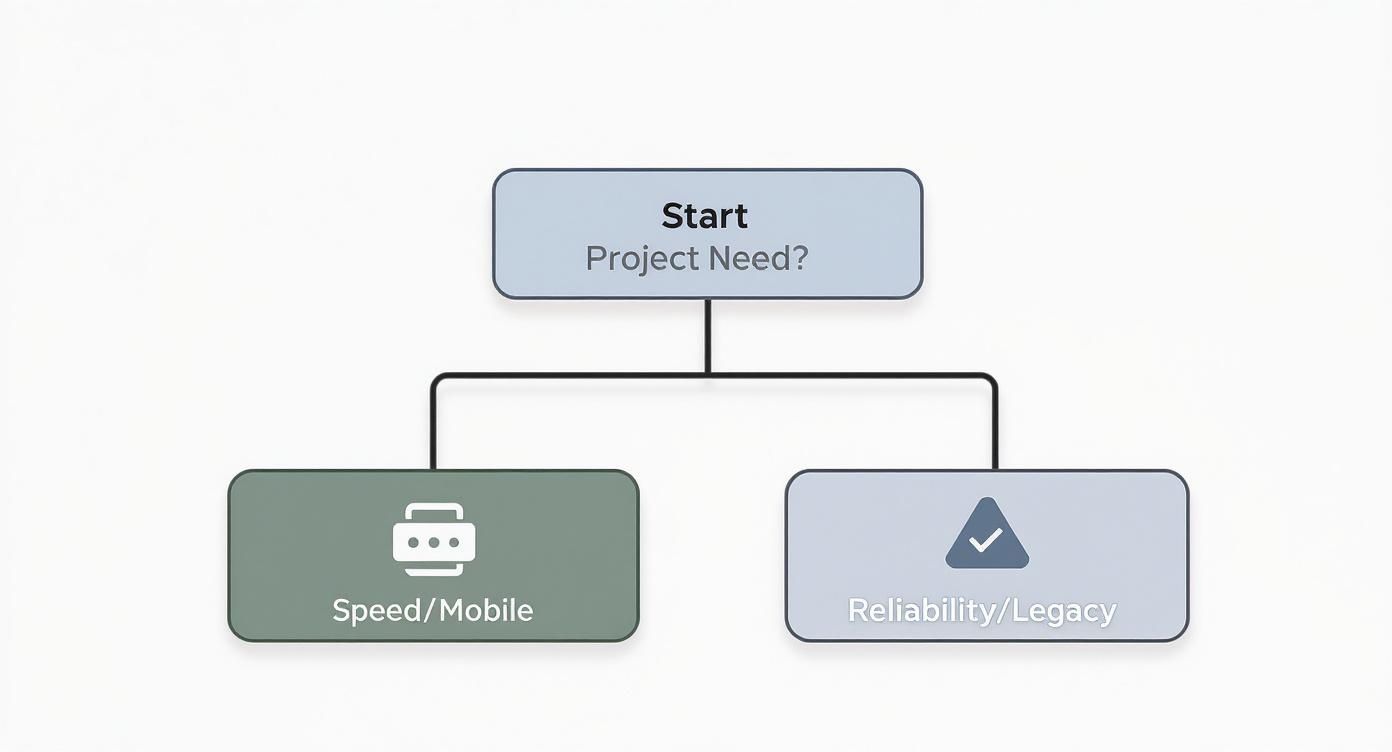
As the flowchart shows, if speed, mobile support, and scalability are your priorities, the path leads to REST. If you're dealing with strict reliability needs and legacy systems, you're looking at SOAP.
Strategic Implications for eCommerce Developers
In eCommerce, this choice gets even more critical because developers have to connect with a huge variety of shopping platforms. The market trend is undeniable: large enterprises, making up 65% of the API management market, are overwhelmingly choosing REST. This is because REST plays so well with the microservices and cloud strategies that are essential in finance and banking. Even with robust features like WS-Security, SOAP's complexity and overhead make it a tough sell for new projects.
The API management market is expected to rocket from roughly $6.85 billion in 2025 to over $32 billion by 2032, and that growth is almost entirely driven by REST-based strategies. To get a better sense of these market dynamics, you can explore more findings on enterprise API adoption.
For integration developers, this fragmented landscape is a huge headache. You might need to connect a modern REST-based app to an older platform that only offers a SOAP API, forcing you to build and maintain both. This is where the real cost of integration bites.
How API2Cart Accelerates Your Decision
Instead of sinking development time into mastering and maintaining separate connectors for REST and SOAP APIs, a unified API solution is a much smarter path. API2Cart abstracts away all those underlying architectural differences, giving you a single, consistent RESTful API to connect with over 40 eCommerce platforms.
This approach gives you a few major wins:
- Speed Up Development: Your team writes code once against the API2Cart interface and instantly gets access to dozens of platforms, without ever having to think about their individual API styles.
- Eliminate Maintenance Overhead: We handle all the messy parts of each platform's API, including updates and version changes, so your team can focus on building features, not fixing connectors.
- Future-Proof Your Integrations: When new platforms pop up or old ones change their APIs, your integration stays stable and consistent through our unified layer.
By using API2Cart, you essentially get to sidestep the entire REST vs. SOAP debate on a platform-by-platform basis. Your decision-making shifts from, "Which API style do I need for this connection?" to "How can I connect to all the platforms at once?" It's a move that dramatically cuts complexity and gets you to market faster.
Diving Deeper: Your REST vs. SOAP Questions Answered
Even after you've got a handle on the technical difference between REST API and SOAP API, some practical questions always pop up when you're actually building something. Let's tackle a few of the most common ones that developers run into.
Can REST Be as Secure as SOAP?
This question comes up all the time, and the short answer is a definite yes—but the approach is completely different. SOAP was built with security in mind from day one, offering its own heavyweight standard called WS-Security. This handles things like encrypting parts of a message and using digital signatures right out of the box, which is why it became a favorite in enterprise settings where that level of message integrity was a must.
REST, on the other hand, doesn't try to reinvent the wheel. It leans on the security of the transport layer itself. By running everything over HTTPS (SSL/TLS), you get powerful encryption for all data in flight, shielding it from anyone trying to listen in. For controlling access, RESTful services typically use battle-tested standards like OAuth 2.0 for authorization and JWT (JSON Web Tokens) for authenticating requests.
Honestly, for the vast majority of web and mobile apps out there, a solid HTTPS setup combined with token-based authentication is more than enough. SOAP's message-level security is often overkill unless you're operating in a heavily regulated space like finance or healthcare, where specific compliance rules demand it.
Is SOAP Completely Obsolete for New Development?
You'll hear a lot of people call SOAP "obsolete," but that's a bit of an exaggeration. While REST is overwhelmingly the first choice for new projects today, SOAP still has a few tricks up its sleeve and holds its ground in specific enterprise corners. Its biggest strengths are its rigid contract (laid out in a WSDL file), built-in standards for reliable messaging and transactions, and the fact that it isn't tied to HTTP.
Think about these scenarios where SOAP still makes a lot of sense:
- Legacy System Integration: Many large companies have mission-critical systems humming along on SOAP. Tearing them out and replacing them is often too risky or expensive.
- Complex B2B Transactions: When you have multi-step, stateful processes between different corporate systems—like a complex order fulfillment workflow—SOAP’s native support for transactions offers a reliability that’s tricky to replicate cleanly with REST.
- High-Security Environments: As we just covered, if your project absolutely requires advanced message-level security, SOAP’s WS-Security standard is a powerful, ready-made solution.
So, would you pick SOAP for a new public-facing API or a mobile app backend? Probably not. But for certain enterprise integration puzzles, it remains a solid, and sometimes necessary, tool.
How Does GraphQL Compare to REST and SOAP?
GraphQL often feels like the next step in the API evolution, designed specifically to fix some of REST's most common headaches. Unlike REST, which gives you a bunch of different endpoints for different resources (like /users and /orders), GraphQL gives you a single endpoint. Clients can then send a query specifying exactly the data they need, all in one go.
This brilliantly solves two big problems you often hit with REST APIs:
- Over-fetching: A REST endpoint might return a user object with 20 fields when the client only needed to display their name.
- Under-fetching: You might need to make one call to get a user, then a second call to get their recent orders, and maybe a third for their shipping addresses.
GraphQL is strongly typed and built around a schema, giving you some of the contractual certainty of SOAP but with the flexibility and modern tooling you'd expect from the REST ecosystem. It's not a silver bullet for every situation, though. For integration developers, this is one of those complexities that a unified API like API2Cart simply smooths over. We give you a consistent RESTful interface to manage data, regardless of whether the platform's native API is REST, SOAP, or even GraphQL.
What Is the Biggest Migration Challenge from SOAP to REST?
Moving from a SOAP-based system to a RESTful one involves a lot more than just swapping out XML for JSON. The single biggest hurdle is the fundamental shift in thinking. You have to move from a procedural, function-first mindset (SOAP) to a resource-oriented one (REST).
It forces developers to completely rethink how the client and server talk to each other. Instead of making a remote procedure call like getProductDetails(), you have to start identifying your resources (like /products/{id}) and mapping actions to standard HTTP methods (GET, POST, DELETE). This usually means a significant rewrite of the backend logic. It gets especially tricky when you have stateful operations that were simple in SOAP but require careful state management in a stateless REST world.
For any developer building integrations with dozens of eCommerce platforms, wrestling with these architectural differences for every single connection is a huge drain on time and resources. API2Cart solves this by providing a unified REST API that plugs you into over 40 shopping platforms and marketplaces. You get to skip the pain of building and maintaining all those individual connectors. Learn how to speed up your integration development with a free trial.