At its core, the difference between open-source and closed-source software comes down to one thing for an integration developer: access to the source code. Open-source software (OSS) throws the doors wide open, letting anyone view, modify, and distribute the code. On the flip side, closed-source, or proprietary, software keeps its code under lock and key, with the vendor holding exclusive control over its API and functionality.
Understanding the Fundamental Models
For an integration developer at an eCommerce SaaS company, this isn't just a technical footnote. It's a strategic fork in the road that directly impacts development speed, customization depth, long-term maintenance, and ultimately, the total cost of ownership. The model an eCommerce platform is built on dictates how you'll interact with its API, the real control you have over an integration, and the kind of support you can (or can't) expect.

A Tale of Two Platforms
Let's look at the practical differences by comparing two eCommerce giants: Magento (open source) and Shopify (closed source).
With Magento, a developer can pop the hood and dive right into the platform's core code. This means you can build deep, truly custom integrations that go far beyond what a standard API might offer. The flexibility is immense, but it also puts the full weight of maintenance, updates, and security squarely on your team's shoulders.
With Shopify, your world is its API. Developers are limited to the functionality exposed through its well-documented but rigid interface. This approach makes development faster and more predictable, but it also means you can't build bespoke solutions that the vendor hasn't already planned for.
This tension between raw flexibility and guided simplicity is the central theme of the open vs. closed source debate. As we explore in our guide, choosing an iPaaS open source model versus a proprietary one has huge implications for your product roadmap. For a growing software provider, the real challenge is managing these disparate environments without letting integration overhead grind your core development to a halt.
This is where a unified API service like API2Cart comes in. It acts as a universal translator, giving you a single, consistent interface to connect with both open-source platforms like WooCommerce and closed-source systems like BigCommerce. Instead of wrestling with each platform's unique source model and API quirks, your developers build once to the API2Cart specification and can instantly deploy features across dozens of ecosystems. This dramatically slashes time-to-market and frees up your team to focus on innovation.
Open Source vs Closed Source at a Glance
When you're in the trenches building integrations, a few key differences really stand out. This table breaks down what matters most to a developer evaluating open-source and closed-source platforms.
| Attribute | Open Source Software (OSS) | Closed Source Software (Proprietary) |
|---|---|---|
| Source Code Access | Publicly available for inspection and modification | Kept private and controlled by the vendor |
| Customization | High; developers can alter the core code | Limited to what the vendor's API allows |
| Initial Cost | Typically no licensing fees | Often involves subscription or licensing fees |
| Support Model | Community-driven (forums, documentation) | Dedicated, vendor-provided support (tiered plans) |
| Development Speed | Slower initial setup due to complexity | Faster initial setup with a structured API |
| Security | Responsibility falls on the user to apply patches | Vendor manages security updates and protocols |
| Vendor Lock-In | Low; high portability and control | High; dependent on the vendor's ecosystem and roadmap |
Each model presents its own trade-offs, and the "right" choice often depends on your specific integration goals, team expertise, and long-term strategy.
Analyzing the True Cost of Ownership
The idea that open-source software is “free” is one of the most stubborn myths in the development world. While you might not pay a licensing fee upfront, the Total Cost of Ownership (TCO) often tells a very different story—especially for an integration developer. The real cost isn't measured in subscription fees but in engineering hours, infrastructure management, and lost opportunities.
When you're building integrations for eCommerce, the differences between open-source and closed-source cost structures become painfully clear. Every connection you build to a platform like Magento or WooCommerce becomes a long-term liability you have to service.

Unpacking the Hidden Costs of Open Source
With open-source solutions, the initial cost is zero, but the expenses pile up fast across the entire development lifecycle. These are the costs that never show up on an invoice but can absolutely wreck your budget and roadmap.
An integration developer has to factor in:
Implementation Overhead: Setting up, configuring, and deploying an open-source connector is a serious initial lift. This isn’t a simple plug-and-play scenario; it’s a full-blown project that requires deep technical knowledge of that specific platform’s architecture.
Ongoing Maintenance: eCommerce platforms are always updating their APIs, rolling out security patches, and launching new versions. Every single change means your team has to go back to test, fix, and redeploy every open-source connector you’ve built.
Specialized Talent: Finding developers who are experts in the specific quirks of dozens of different platform APIs is not just hard; it's expensive. Your team's payroll quickly becomes the biggest part of your TCO.
Infrastructure Management: You’re on the hook for hosting, scaling, and securing the entire infrastructure that runs your integrations. As your customer base grows, so does the operational headache.
For a B2B SaaS provider, building and maintaining these connections one by one is a constant resource drain. It pulls your best engineers away from your core product. The cost isn't just financial—it's the strategic cost of slowing down your own innovation.
Analyzing the Explicit Costs of Closed Source
Closed-source software flips the script with a more straightforward, though less flexible, cost model. The expenses here are explicit and predictable, which is a huge plus for anyone trying to manage a budget.
The main costs a developer's team will see are:
Licensing and Subscription Fees: This is the most direct cost, usually billed monthly or annually. It’s what gets you access to the software and its API.
Tiered Support Plans: If you need guaranteed response times or a dedicated engineer to call, you'll almost certainly have to pay for a premium support package.
Usage-Based Costs: Many proprietary platforms will charge you based on API call volume, the number of connected stores, or the amount of data you're pushing. As your business scales, these fees scale right along with it.
While these costs are transparent, they can add up, and you're essentially locked into whatever pricing the vendor decides on. The trade-off is that the vendor handles all the maintenance, security, and infrastructure, which lifts a massive operational burden off your team.
For an integration developer, the choice isn't just between free and paid. It's between the unpredictable, ongoing operational expense of maintaining dozens of unique open-source connectors and the predictable subscription cost of a managed, unified solution.
A Strategic Approach to Integration Costs
The real challenge for an eCommerce software provider is managing the costs of integrating with dozens of platforms, each with its own model. Building every connector yourself, whether it’s open or closed source, creates a massive and unpredictable financial hole.
This is where a unified API service like API2Cart offers a strategic way out. Instead of juggling the chaotic TCO of numerous individual integrations, you get a stable, predictable subscription. API2Cart absorbs the complexity and cost of building and maintaining over 40 connections. Your development team works with one consistent API, which lets you control engineering resources and accelerate time-to-market. This approach turns integration from a painful cost center into a scalable engine for growth.
Evaluating Customization Freedom and Vendor Lock-In
The conversation around customization versus vendor lock-in really gets to the core of what separates open-source and closed-source software. For an integration developer, this isn't just a philosophical debate. It’s a practical choice that dictates what your product can do and defines its long-term independence. You’re essentially trading ultimate flexibility for streamlined, ready-to-go functionality.
The Unmatched Flexibility of Open Source
The biggest draw of open source is its radical customizability. When you’re working with an open-source eCommerce platform, you have direct access to the source code. You can modify it however you see fit.
This means you can build truly bespoke features that a standard API could never touch. Think custom webhook listeners for unique, real-time inventory updates or specialized data sync workflows designed perfectly for your app's logic. That level of control is powerful.
But this freedom comes with a hefty price. Every change you make creates a "fork" from the main codebase, and your team is now responsible for maintaining it. When the platform pushes a security patch or a major update, your custom code is likely to break, demanding dedicated engineering time to diagnose, fix, and redeploy.
The Polished Constraints of Closed Source
Closed-source systems flip the script. They offer a polished, predictable experience but lock down any modifications to what the vendor allows through their predefined API endpoints. You can't touch the core logic, but you get a stable, well-documented environment where the vendor handles all the maintenance and updates for you.
The big risk here is vendor lock-in. When you build your entire integration strategy around a single proprietary system, your product’s future becomes tethered to that vendor’s roadmap, pricing, and business health. If they decide to deprecate a critical API endpoint or hike their prices, your options are limited and almost always painful. This is a massive concern for any SaaS provider trying to build for long-term scale and independence. For anyone prioritizing control, understanding how to choose a tech stack becomes critical, as it directly shapes your exposure to vendor lock-in.
For a SaaS provider, vendor lock-in isn't just a technical problem—it's a business risk. It limits your ability to pivot, adapt to market changes, and control your own destiny.
The industry is already shifting. In 2023, enterprise surveys showed a massive 80-90% closed-source dominance for LLMs. Yet, projections point to a 50/50 split by 2024, driven by the customizability and data security advantages of open source. This trend is a big deal for B2B eCommerce developers, where the flexibility of open source often beats the high fees of closed-source alternatives.
Mitigating Risk with an Abstraction Layer
So, the challenge for a developer is clear: how do you tap into the massive market of both open and closed-source platforms without getting trapped by either the maintenance nightmare of open-source forks or the strategic risk of vendor lock-in? The answer is to use a strategic abstraction layer.
API2Cart acts as this vital go-between. It offers a single, consistent API to connect to over 40 different eCommerce platforms, making the underlying source model irrelevant. Your team codes to one unified interface, whether you're integrating with an open-source powerhouse like Magento or a closed-source leader like Shopify. This provides broad market access without shackling your product to any single vendor's fate. If you're weighing different deployment models, it's worth checking out the enterprise on-premise and SaaS plans of API2Cart to see how a unified API can fit your strategy.
By using API2Cart, you effectively decouple your software from the platforms you integrate with. This frees up your development team to focus on building your core features, not on managing a tangled mess of disparate integrations. You get the best of both worlds: widespread connectivity and complete strategic freedom.
Comparing Security Models and Support Systems
For any integration developer, two things are make-or-break: the security of the data passing through your system and getting reliable help when an API inevitably goes sideways. The way open-source and closed-source software handle these two areas is worlds apart, and understanding the difference directly impacts your daily workflow and long-term stability.
It’s a common myth that open-source is inherently less secure. The reality is that the security philosophies are just different. Open-source security is built on transparency, famously summed up by the phrase, "many eyes make all bugs shallow."
Because the source code is out in the open, a global community of developers can pick it apart, looking for vulnerabilities. They often spot and flag issues faster than any single, private team ever could. The catch? The responsibility to apply patches and configure the system correctly falls squarely on your team's shoulders.
Accountability in Security
Closed-source software flips the script, offering a single point of accountability. The vendor owns the responsibility for finding threats, creating patches, and rolling out updates.
For a dev team that doesn't have dedicated security experts on staff, this is a huge plus. It takes a massive weight off your shoulders, letting you trust that the vendor is managing the security of the platform you're building on. This trade-off is the core of the differences between open-source and closed-source security.
You can see this trust playing out in market trends. The global open-source services market is projected to hit a staggering USD 83.87 billion by 2030, largely because it's so cost-effective. With over 70% of enterprises now using open-source in critical systems, it’s clear the community-vetted security model is gaining widespread confidence. You can dig into the numbers in the full open-source market research report.
The support systems are just as different, and this is something integration developers feel acutely when they’re trying to troubleshoot a problem.
Open-Source Support: This is a community game. When you run into a bizarre API quirk, you’re heading to forums, public docs, and community Slack channels. The collective knowledge is immense, but there’s zero guarantee you'll get a timely—or even correct—answer.
Closed-Source Support: Here, you get dedicated support teams, often with paid plans and guaranteed Service Level Agreements (SLAs). When an integration fails and customer data is at risk, you can log a ticket and know an expert who understands their system inside and out will get back to you within a set timeframe.
For a developer under pressure, the choice is stark: post a question on a public forum and hope for the best, or contact a dedicated support engineer with a guaranteed response time.
The API2Cart Advantage: A Hybrid Approach
This is where a unified API service becomes a game-changer. If you integrate with dozens of platforms manually, you inherit the support model of every single one—a messy mix of community forums and different paid support desks. A problem with a WooCommerce (open-source) connection needs a completely different approach than one with BigCommerce (closed-source).
API2Cart cuts through that chaos by giving you a single, expert support system for every integration. Your developers have one point of contact, not the support desks of over 40 different platforms. When an urgent integration issue pops up, you don't waste time figuring out who to call or waiting on a forum response. You get a guaranteed, professional answer from a team that knows the ins and outs of every platform's API, regardless of its source model. This approach solves problems faster, cuts down on downtime, and frees up your team to build features instead of chasing support tickets. To get ahead of issues, make sure your integrations are solid from the start by following these API security best practices.
Choosing the Right Model for Your B2B SaaS
Making the final call between open-source and closed-source dependencies is a huge strategic decision for any B2B SaaS provider. This choice goes way beyond a simple technical preference—it shapes your product roadmap, defines your operational workload, and dictates how fast you can get to market. The key for integration developers and their managers is to move past generic pros and cons and ask sharp, strategic questions that fit your business reality.
For an integration developer, the choice isn't just about accessing code. It's a constant balancing act between ambition and bandwidth. You have to weigh the raw power of open source against the managed reliability of closed source, especially when your goal is scalable, multi-platform connectivity.
Framing Your Integration Strategy
Before you commit your team's valuable time to a development path, your leadership needs to tackle a few critical questions. The answers will point you toward the most logical and efficient route for your integration goals.
What is your team's technical bandwidth? Do you have dedicated engineers with the expertise to not only build but also meticulously maintain dozens of unique, open-source API connectors? Or would their time be better spent building core features for your own product?
What’s your budget for maintenance vs. the initial build? Open source might seem cheaper upfront, but its long-term maintenance can quickly become a significant, unpredictable drain on your resources. A managed solution like API2Cart involves a subscription but provides predictable, stable costs.
How critical is speed-to-market? If your business goal is to quickly support a wide array of eCommerce platforms to grab market share, building each integration from scratch is a non-starter. A solution that accelerates this process is essential.
Is deep customization a core requirement? Does your software need to perform highly specific, custom functions that go beyond a platform's standard API capabilities? Or is a reliable, standardized set of data points enough to power your features?
This decision tree shows the path for choosing a technical support model, which hinges on whether your team has in-house experts or needs vendor assistance.
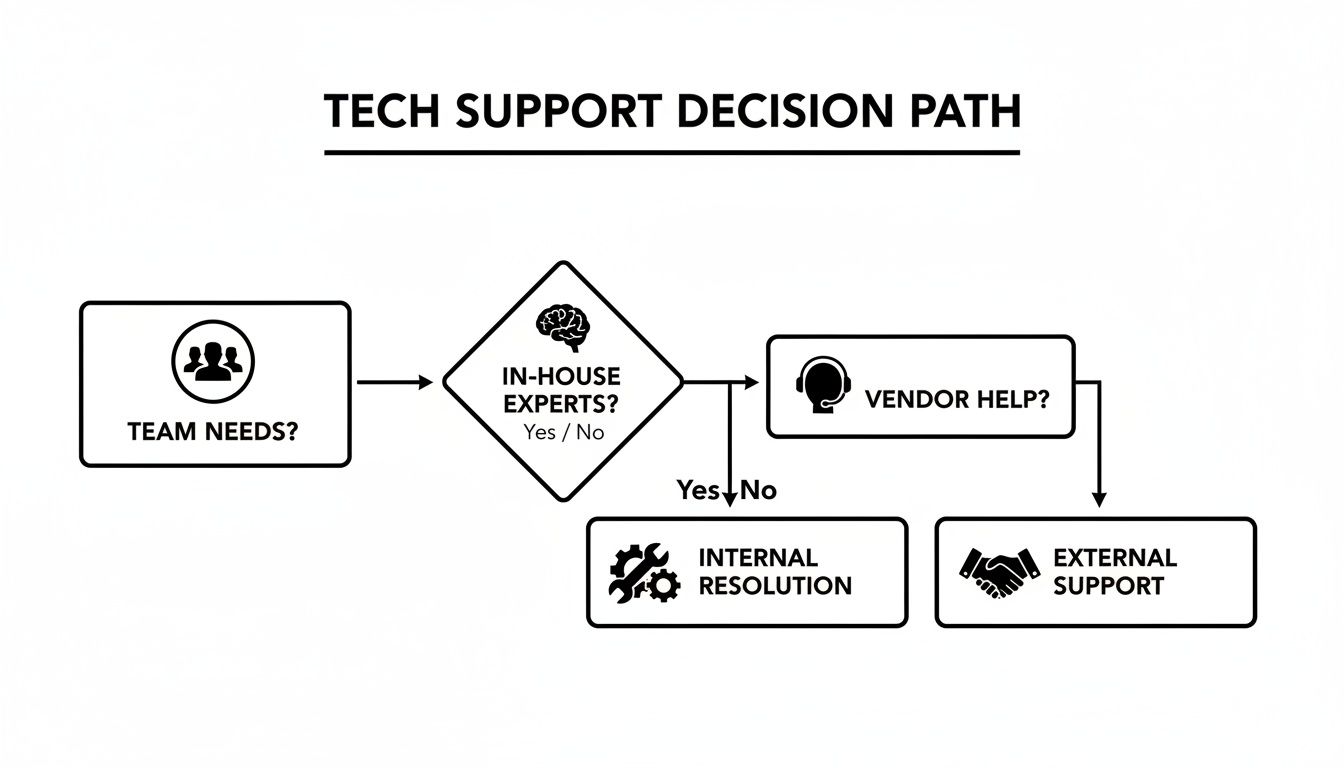
This flowchart really highlights a key trade-off: self-reliance versus guaranteed support. That’s a central theme in the whole open vs. closed source debate.
Real-World Scenarios for Integration Developers
Let’s apply this framework to a common scenario. Imagine a startup order management system (OMS) that needs to integrate with 15+ shopping platforms immediately just to be competitive. Building and maintaining each connection individually—regardless of their source model—would demand a massive team and years of work. The maintenance burden alone would be crippling.
In this situation, the strategic choice for the development team is clear. Using a unified API solution is far more realistic. It abstracts away the complexity of whether a platform is open or closed source, allowing the startup to achieve broad market coverage in a fraction of the time and cost.
This mirrors trends we see in other tech sectors. In the LLM market, a striking 90% of test and production environments relied on closed-source models in 2024, favored for being reliable, vendor-supported, and quick to deploy. However, with 41% of enterprise AI leaders planning to increase open-source usage, a shift is happening. This highlights the crucial choice for OMS or PIM tool managers: balancing the immediate speed of closed-source systems against the growing flexibility of open-source. You can find more insights on the market share of closed and open source AI models here.
The Strategic Accelerator for Market Coverage
Ultimately, for a software provider, the choice isn't just about the differences between open-source and closed-source software. It's about resource allocation and strategic focus. The biggest risk is pulling engineering talent away from core product innovation just to manage integration complexity.
This is where API2Cart serves as a strategic accelerator. By providing a single, unified API for over 40 platforms, we eliminate the need for your team to become experts in the unique architecture of each one. You don't have to worry if Magento is open source or Shopify is closed source; you simply code to our consistent set of API methods. This approach allows your team to achieve broad market coverage without the immense technical and financial overhead of managing individual integrations, enabling you to innovate faster and scale efficiently.
Frequently Asked Questions
When you're weighing open source against closed source as a developer, a lot of questions come up. Here are some straight answers to the most common ones we hear from our clients.
Is Open Source Software Really Free?
While you might not pay a license fee upfront, open source is far from "free" for a business. The real cost is hidden in the Total Cost of Ownership (TCO). Think about the engineering hours spent on implementation, customization, and especially ongoing maintenance. You also have to factor in infrastructure scaling and the premium you'll pay to hire developers with niche expertise.
For a B2B SaaS company, this means your "cost" isn't a line item on an invoice. It's the countless developer hours needed to support, patch, and update every single open-source integration. This is a world away from the predictable subscription fee of a managed service like API2Cart that handles all that work for you.
Which Model Is More Secure?
Neither model wins on security by default; they just handle it differently. It's crucial for developers to understand these differences between open-source and closed-source security approaches to properly assess risk.
Closed-source security is straightforward: the vendor is responsible for everything. You have a single point of contact and clear accountability for patches and vulnerability fixes.
Open-source security is built on community transparency. With enough eyes on the code, vulnerabilities can be spotted and fixed incredibly fast by a global pool of developers.
The catch with open source? The responsibility ultimately falls on your team. You have to be diligent about applying patches and following security best practices to stay protected.
Can I Use Open Source Software in Commercial Products?
Absolutely, but you have to pay close attention to the license. This is a critical legal detail that can trip up even experienced development teams if they're not careful.
Some licenses, like MIT and Apache, are permissive. They let you use the code in your own proprietary products with very few strings attached. On the other hand, "copyleft" licenses like the GNU General Public License (GPL) are much more restrictive. If you use a GPL-licensed component in a product you distribute, you're required to make your own source code open as well. Auditing the license of every dependency isn't just good practice—it's essential to avoid serious legal and IP headaches.
How Does a Unified API Handle Different Source Models?
A unified API, like the one we've built at API2Cart, acts as a universal adapter. It gives you one consistent set of API methods to talk to over 40 different eCommerce platforms—whether they're open source like Magento and WooCommerce or closed source like Shopify and BigCommerce.
This abstraction layer saves your dev team from the massive headache of learning the unique architecture, authentication, and data models for each platform's native API. We handle all that underlying complexity for you. It lets your team skip the open vs. closed source debate entirely and focus on building your core features, which means you get to market faster with less overhead.
Ready to stop worrying about the complexities of individual open and closed-source integrations? With API2Cart, you can connect to over 60 eCommerce platforms through a single, unified API. Start your free 14-day trial and see just how quickly you can expand your market reach.