As an integration developer, you're tasked with pulling Etsy orders into your software. You have two primary paths: building a direct integration using Etsy's native API, or leveraging a unified API service like API2Cart to abstract away the complexity. The choice you make directly impacts development speed, scalability, and long-term maintenance costs.
Going direct means you're on the hook for handling Etsy's specific OAuth 2.0 flow, learning their unique endpoints, respecting their rate limits, and writing custom parsers for their JSON structure. For a developer, this translates to significant time spent on boilerplate code for a single platform. The unified API route, on the other hand, provides a standardized interface, allowing you to write integration logic once and apply it across dozens of platforms, including Etsy.
Your Blueprint for a Scalable Etsy Order Integration
For any order management, shipping, or inventory SaaS, a robust Etsy integration is a critical feature, not a nice-to-have. Tapping into this marketplace unlocks a massive user base. This guide provides a technical roadmap for developers, covering everything from authenticating a merchant's store to synchronizing orders in real-time, with a focus on accelerating the development lifecycle.
Let's first analyze the core technical challenges of building a direct connection. This path requires your engineering team to wrestle with Etsy's specific OAuth 2.0 implementation, master a new set of API endpoints, implement rate-limiting logic, and commit to ongoing maintenance every time Etsy pushes an API update. This is a significant engineering investment for just one platform, diverting resources from core product development.
A More Efficient Path to Integration
A far more efficient alternative is using a unified API. This approach abstracts away platform-specific complexities, allowing your developers to focus on your application's core logic instead of the tedious mechanics of integration maintenance.
With a unified API from API2Cart, you write your integration logic once. Whether an order originates from Etsy, Shopify, or Amazon, the data structure your application receives is consistent and predictable. This dramatically reduces development overhead and accelerates your time-to-market.
This method allows you to scale your integrations efficiently. Instead of becoming an expert on 60+ different API schemas, you master one unified model, freeing up engineering resources to build value-added features for your customers.
Direct Etsy API vs Unified API (API2Cart) for Order Imports
When planning your integration strategy, a side-by-side comparison of the development workload is essential. Building a direct integration requires a significant upfront and ongoing investment, whereas a unified API handles much of the heavy lifting, accelerating the entire process.
| Development Task | Direct Etsy API Integration | Unified API via API2Cart |
|---|---|---|
| Authentication | Implement Etsy's specific OAuth 2.0 flow, including token management. | Handle a single, simplified authentication method (store_key). |
| API Endpoints | Learn and code for Etsy’s unique endpoints (getShopReceipts, etc.). |
Use standardized methods like order.list across all platforms. |
| Data Mapping | Manually map Etsy's JSON response fields to your internal data model. | Receive data in a consistent, pre-mapped format. |
| Rate Limiting | Build custom logic to handle Etsy's specific rate limits and retry policies. | Rate limit management is handled by the unified API provider. |
| Error Handling | Write code to interpret and manage Etsy-specific error codes. | Handle standardized error responses across all integrations. |
| Ongoing Maintenance | Dedicate engineering resources to monitor and adapt to Etsy API updates. | API2Cart manages all platform-specific updates behind the scenes. |
| Scaling to New Platforms | Repeat the entire development process for each new marketplace. | Add support for a new platform with minimal to no new code. |
As the table illustrates, the unified API approach offloads the most time-consuming and repetitive engineering tasks. For a developer, this means less boilerplate code and more time spent on building features that solve customer problems.
What This Guide Covers
Throughout this guide, we'll provide the technical context and code-level examples you need to build a reliable and scalable solution. We’ll walk through:
- Authentication and Permissions: Navigating Etsy’s OAuth 2.0 flow versus the simplified
store_keyapproach. - Fetching Order Data: Making API requests and mapping the raw JSON response to your own data model.
- Handling Edge Cases: Managing tricky scenarios like product variants, refunds, and cancellations.
- Real-Time Synchronization: Using webhooks and scheduled syncs to keep data perfectly current.
- Scaling and Error Handling: Building a resilient integration that can manage rate limits and API errors without breaking a sweat.
This blueprint will give you everything you need to make an informed decision, whether you brave the direct path or take the unified API route with a service like API2Cart.
Securing API Access and Handling Permissions

Before your application can import orders, it must obtain the merchant's permission to access their Etsy store data. This is the first critical step for any integration developer. The standard method is navigating Etsy’s OAuth 2.0 flow, a process notorious for its complexity and potential points of failure.
The process begins in the Etsy Developers portal, where you register your app to get a unique Keystring (API key) and configure redirect URIs. A simple typo here can break the entire authorization sequence. You must also request the correct permission scopes. For reading order data, the transactions_r scope is required. Requesting insufficient scopes renders your app non-functional, while requesting excessive scopes can deter merchants from granting access.
The Direct OAuth 2.0 Implementation
Choosing to build a direct integration against the Etsy API means your team is responsible for the entire multi-step OAuth 2.0 dance:
- Redirecting the User: Constructing the specific URL to send the merchant to Etsy for authorization.
- Handling the Callback: Processing the temporary authorization code returned to your redirect URI.
- Exchanging the Code for a Token: Making a secure backend call to swap the code for an access token and a refresh token.
- Storing and Refreshing Tokens: Securely storing these tokens and building logic to use the refresh token to obtain a new access token before expiration.
This entire sequence demands robust error handling and secure token management, adding significant complexity to what should be a simple "connect store" function.
A Streamlined Path with Unified APIs
A unified API service like API2Cart abstracts away the platform-specific challenges of OAuth 2.0, saving your development team weeks of work and ongoing maintenance. Instead of building the flow from scratch, you rely on a single, straightforward method. With API2Cart, merchants are directed to a pre-built authorization form for each platform. The service handles the entire OAuth sequence, token storage, and refresh logic behind the scenes.
For the developer, the process is reduced to a single API call. Once the merchant authorizes the connection, you receive a secure
store_key. This key is all that's required to begin making API calls to their store, dramatically speeding up the integration process.
This approach not only simplifies the initial build but also future-proofs your integration. When Etsy updates its authentication protocols, API2Cart manages the changes. Your integration remains stable without requiring your team to scramble and deploy emergency patches. You can see more on how this works in our guide on the Etsy Developer API.
By offloading the complexities of authentication, you free up your engineering resources to focus on building core application features rather than integration plumbing.
Pulling and Making Sense of Etsy Order Data
Once authenticated, the core task is fetching order data. When building directly against Etsy's API, the getShopReceipts endpoint is your primary tool. Extracting the necessary information, however, requires a deep understanding of its parameters and response structure.
A successful implementation must account for scale. For shops with high order volumes, you must implement pagination using the limit and offset parameters to pull orders in manageable chunks without overwhelming the API. You will also rely heavily on date filters to retrieve historical data or sync new orders since the last check.
Wrestling with Raw Etsy JSON
The response from getShopReceipts is not a clean, simple list. The raw JSON from Etsy is notoriously nested and complex. A single order receipt contains multiple objects, from buyer details and shipping info to arrays of transactions for each line item. This is where a significant engineering bottleneck occurs.
Your application has its own standardized data model for an "order," which will not align with Etsy's unique structure. This forces your developers to write custom parsing and mapping logic for every field. You'll be digging into receipt.name for the customer's full name and looping through the receipt.Transactions array to extract products, quantities, and prices. This mapping code is brittle, time-consuming to write, and requires constant maintenance.
The fundamental challenge is that every eCommerce platform has a different data schema. Building a custom translator for each one is a massive drain on development resources. You're not just mapping fields; you're reverse-engineering the business logic of each platform.
This is where the value of a unified API becomes clear. Instead of writing platform-specific parsing code, you use a single, consistent method that handles the translation for you.
The API2Cart Advantage: A Unified Order Structure
With a solution like API2Cart, the entire data retrieval process is streamlined. You no longer need to deal with the quirks of the getShopReceipts endpoint or write custom parsing logic for Etsy. You simply make a single, straightforward call to the order.list method.
This method returns a clean, predictable, and normalized JSON structure. Fields like order status, totals, shipping addresses, and customer info are already mapped to a standard model. What required dozens of lines of custom code to parse from Etsy's raw response now arrives perfectly structured and ready for your application to use. For a deeper look, check out our guide on how this simplifies getting an Etsy order status and other key data points.
Consider the difference in data structure:
Raw Etsy API Response (Simplified Snippet)
{
  "receipt_id": 12345,
  "name": "Jane Doe",
  "first_line": "123 Main St",
  "grandtotal": {
    "amount": 5500,
    "divisor": 100,
    "currency_code": "USD"
  },
  "Transactions": [
    {
      "title": "Handmade Scarf",
      "quantity": 1,
      "price": {
        "amount": 5000,
        "divisor": 100
      }
    }
  ]
}
API2Cart order.list Response (Simplified Snippet)
{
  "id": "12345",
  "status": {
    "id": "Completed"
  },
  "customer": {
    "first_name": "Jane",
    "last_name": "Doe"
  },
  "shipping_address": {
    "address1": "123 Main St"
  },
  "total": {
    "price_inc_tax": 55.00
  },
  "order_products": [
    {
      "name": "Handmade Scarf",
      "quantity": 1,
      "price": 50.00
    }
  ]
}
The API2Cart response is immediately consumable. The total is a simple float, the customer's name is pre-parsed, and product details are in a clear array. This abstraction layer eliminates platform-specific code, resulting in faster development and significantly reduced maintenance overhead for your engineering team.
Handling the Messy Reality of Order Data
When you import orders from Etsy, you quickly discover that real-world data is complex. An order is not just a product list and a price; it includes product variations, refunds, and cancellations. If your integration fails to handle these edge cases, it will cause significant accounting and inventory issues for your users.
Building directly against the Etsy API places the burden of handling this complexity on your developers. For instance, product variations like size or color are not provided in discrete fields. Your team must parse a variations array within the transactions object and map these properties to your system's logic. Similarly, identifying a refunded order requires checking specific status fields within the receipt object and triggering the appropriate workflow in your app.
A Unified Approach to Complex Data
This is where a unified API demonstrates its power. Instead of writing custom parsers for Etsy’s unique data structures, your developers can rely on a standardized model that has already performed this normalization.
API2Cart normalizes these complex data points before they reach your application. Product variants are structured consistently, and order statuses are mapped to a universal set of values like 'Refunded' or 'Canceled'.
For your development team, this means you write the logic for handling a refund once. That code works seamlessly whether the order came from Etsy, Shopify, or WooCommerce. This ensures data consistency and reliability across all supported platforms without the need to maintain dozens of platform-specific parsers.
Navigating the Twists and Turns of Global Commerce
Beyond data fields, your integration must account for external factors like international taxes and tariffs. These are not static values; they change with trade policies, adding another layer of complexity.
A prime example is the 2025 U.S. tariff regime, which significantly impacted Etsy import orders. On May 2, 2025, the de minimis exemption—allowing duty-free entry for packages under $800—was suspended for goods from key regions. By August 29, 2025, it was eliminated for all countries, subjecting nearly every international shipment to the U.S. to new taxes. Learn more about these regulatory shifts and their implications for global sellers.
A unified API provider like API2Cart stays on top of these global shifts and updates its platform accordingly, shielding your application from the complexities of international trade laws.
How This Speeds Up Your Development
By abstracting away these edge cases, API2Cart directly shortens your development timeline and reduces long-term maintenance. Your team can stop wrestling with the peculiarities of each platform’s API and focus on building your application's core features.
- Standardized Variants: No more parsing quirky
variationsarrays. API2Cart delivers product options in a clean, consistent format. - Normalized Statuses: Forget mapping dozens of different order states. You receive a clear, universal status that allows for reliable logic.
- Simplified Tax and Fee Handling: Complex financial data is presented in a structured and predictable way.
Ultimately, this approach transforms the task of importing Etsy orders from a continuous battle against edge cases into a straightforward data-handling process. Your integration becomes more robust, easier to maintain, and ready to scale across multiple eCommerce platforms.
Keeping Order Data Synchronized in Real Time
A one-time data import is insufficient for modern SaaS applications. Your system must reflect new orders, updates, and cancellations in real-time. The two primary strategies for achieving this are periodic polling and event-driven webhooks, with significant implications for your system's architecture and resource consumption.
The traditional approach, particularly with direct API integrations, is polling. This involves repeatedly calling an endpoint like getShopReceipts with a timestamp to ask, "What's new?" While straightforward, polling is highly inefficient. It generates constant API traffic even when no new data exists, consuming your rate limit and placing unnecessary load on your servers.
To make polling viable, you must implement logic to avoid duplicate imports and stay within Etsy's API rate limits, which adds complexity to your codebase.
The Power of an Event-Driven Architecture
For a more efficient, scalable, and real-time solution, an event-driven architecture powered by webhooks is superior. Instead of your app constantly asking for updates, webhooks allow Etsy's system to notify you the instant an event occurs. This shifts your integration from a "pull" to a "push" model.
API2Cart excels here by offering webhooks for critical events like order.add and order.update. By subscribing to these, your application receives an instant, automated notification when an order is created or modified. If you're new to the concept, our guide on what a webhook is provides a technical overview.
The primary advantage is the dramatic reduction in API calls. You only process data when there is new information, which is foundational for building a responsive and resource-efficient integration that avoids rate-limiting issues.
Of course, a new order is just one event. The chart below illustrates key edge cases—variations, refunds, and cancellations—that your real-time synchronization must handle.
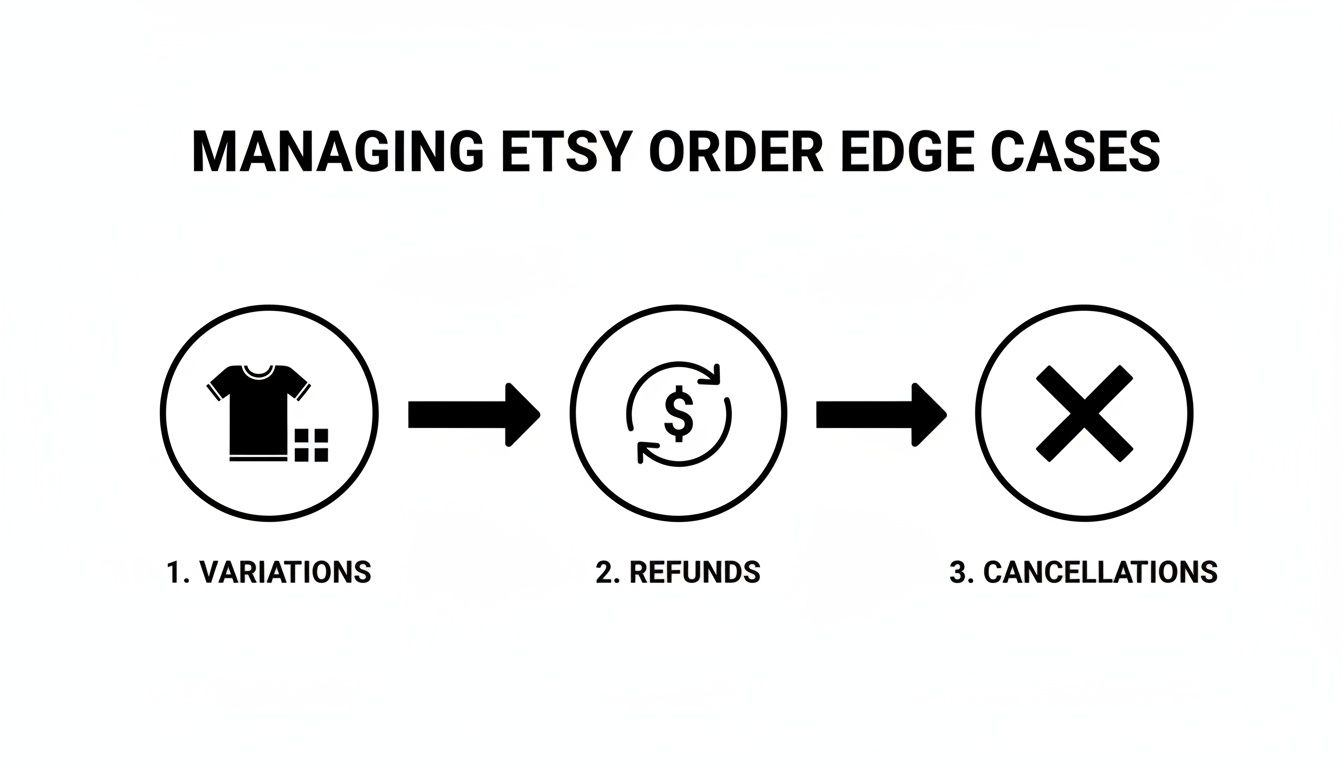
A robust synchronization strategy must account for the entire order lifecycle.
Building a Webhook Listener
To utilize webhooks, you must create a "listener"—a dedicated endpoint in your application designed to receive and process incoming notifications from API2Cart. When a new order is placed on Etsy, API2Cart will send a POST request to your listener URL with a payload containing key order details.
Here’s a simplified example of an order.add webhook payload from API2Cart:
{
  "event_name": "order.add",
  "store_id": "12345",
  "params": {
    "order_id": "etsy-order-67890"
  },
  "entity_id": "67890",
  "callback_id": "a1b2c3d4-e5f6-g7h8-i9j0-k1l2m3n4o5p6"
}
Your listener's responsibility is to parse this payload, extract the order_id, and then make a subsequent call to API2Cart's order.info method. This fetches the complete details for the new order, creating a highly efficient and responsive workflow.
Achieving real-time synchronization is about using the right architectural patterns; for a niche-specific example, see these insights on selecting jewelry inventory management software. By embracing webhooks, you can build a far more efficient and scalable solution to import orders from Etsy.
Building for Scale and Handling API Errors
Building an integration for a few merchants is straightforward. Building one that serves thousands requires engineering for scalability and resilience. When importing orders from a high-volume platform like Etsy, your system must be prepared for significant fluctuations in transaction volume.
Etsy's Gross Merchandise Sales peaked at $13.5 billion in 2021 before stabilizing around $12.5 billion by 2024. This volatility indicates that order volume will not be a steady stream. Your system must be elastic enough to handle these peaks and troughs without performance degradation. You can delve deeper into Etsy’s recent performance trends to better understand the expected load.
Navigating Rate Limits and Common Errors
If you build directly against the Etsy API, you will encounter its rate limits. To prevent service disruptions, you must implement smart retry logic, such as exponential backoff. This strategy involves progressively increasing the delay between retries after a failed request, preventing you from overwhelming their API.
Your code must also handle common HTTP status codes robustly:
401 Unauthorized: Typically indicates an expired access token. Your application should automatically trigger a token refresh process.403 Forbidden: Points to a permissions issue. Best practice is to log the error and notify the merchant to re-authorize the connection, potentially with updated scopes.429 Too Many Requests: You've hit the rate limit. This is the cue for your exponential backoff logic to engage.
This is where a platform like API2Cart provides significant value. It handles this low-level complexity for you. Its infrastructure is designed for high-volume requests, intelligently managing rate limits and retries behind the scenes, so your team doesn't have to write this boilerplate code.
This managed approach ensures your integration remains stable as you scale, preventing data sync failures that can disrupt your users' operations. Tapping into the broader developer community, such as observing Shopify's approach to developer community engagement, can also provide valuable insights.
Ultimately, robust monitoring and logging are essential for identifying and resolving connection issues before they impact your users.
Questions We Hear All The Time
When building a SaaS solution for Etsy sellers, several technical questions frequently arise. Here are answers to common challenges faced by integration developers.
Can I Get a Full Historical Order Import From Etsy?
Yes, you can fetch a store's complete order history. With a direct Etsy API integration, you must implement pagination by making repeated calls to endpoints like getShopReceipts using the offset and limit parameters until all data is retrieved.
A unified API significantly simplifies this process. With a service like API2Cart, the tedious task of managing pagination is handled for you. You can make more straightforward calls to retrieve the full historical dataset, which is a major time-saver during new merchant onboarding.
How Should I Handle Etsy API Rate Limits?
Etsy enforces rate limits to maintain API stability. If you build a direct integration, your code must handle 429 Too Many Requests errors by implementing a robust retry strategy, such as exponential backoff.
This is a primary reason developers choose a service like API2Cart. Our infrastructure is purpose-built for high-volume API calls. We manage rate limiting and smart retries behind the scenes, allowing your application to make requests without the need for complex error-handling logic. This results in better uptime and a more reliable integration as you scale.
Key Takeaway: A unified API abstracts away platform-specific challenges like rate limiting and historical data fetching. This frees up your developers to focus on building core application features instead of the low-level mechanics of a single integration.
What Is the Best Way to Keep Orders Synchronized?
Polling the Etsy API every few minutes is inefficient and quickly consumes your API rate limit. For a scalable and reliable system, webhooks are the superior solution.
API2Cart simplifies this by offering webhooks for critical events like order.add and order.update. By subscribing your application to these events, you receive real-time notifications pushed to your system the moment a change occurs. An event-driven architecture is far more efficient and scalable than constant polling for maintaining accurate, up-to-the-minute order data.
Ready to bypass the complexities of direct Etsy integration and connect to 60+ eCommerce platforms at once? API2Cart provides a unified API that saves development time and accelerates your time to market. Explore our powerful features and start your free 30-day trial today.