When you're building integrations for eCommerce, the REST vs. GraphQL debate isn't just academic—it's a practical choice that shapes your development speed, application performance, and how easily you can scale down the road. For an integration developer, the core difference is straightforward: REST APIs give you multiple, well-defined endpoints for different resources, while GraphQL offers a single endpoint where you can ask for exactly the data you need in one go.
Choosing Your API: An Introduction for eCommerce Developers
For any B2B SaaS company connecting to platforms like Shopify or Magento, this decision has real, long-term consequences. The right answer always comes down to your project's specific needs, from how complex your data is to the skills your team already has on hand.
REST (Representational State Transfer) has been the workhorse of the web for years. It’s built on standard HTTP methods, making it familiar and relatively easy to pick up. For instance, an integration developer might make one call to get customer details, a second to pull their order history, and a third to fetch product info for those orders. It's predictable, but all those separate network requests can add up. If you're new to the concept, you can get a solid primer from our guide on what a REST API really is.
GraphQL flips that model on its head. It’s a more client-driven approach that lets a developer craft a single, precise query to grab all that customer, order, and product data in one trip. This efficiency is a huge win for complex apps, but it introduces a steeper learning curve and new challenges around things like caching.
The decision really boils down to a trade-off. REST brings simplicity and a massive ecosystem of tools. GraphQL delivers surgical precision and performance for complex data needs.
As an integration developer, you have to weigh these architectural philosophies against your use case. Are you building a simple connector for a single platform? Or are you architecting a high-performance system that needs to pull together data from multiple sources at once?
Quick Comparison: REST vs. GraphQL at a Glance
To quickly summarize the key differences, here's a high-level look at how the two approaches stack up.
| Feature | REST API | GraphQL |
|---|---|---|
| Structure | Multiple endpoints per resource | Single endpoint for all operations |
| Data Fetching | The server dictates a fixed data structure | The client specifies the exact data needed |
| Caching | Uses standard HTTP caching mechanisms | Requires custom, client-side caching strategies |
| Network Calls | Often requires multiple calls for related data | Retrieves multiple resources in a single call |
| Best For | Simple integrations, public APIs, CRUD operations | Complex UIs, mobile apps, performance-critical tasks |
This table gives a bird's-eye view, but the real choice depends on the nuance of your specific integration goals.
When a Unified API Is the Answer
For an integration developer, the platform's native API—whether REST or GraphQL—is often a secondary problem. For a SaaS provider trying to connect with dozens of different shopping carts, the real bottleneck is managing each platform's unique API structure, quirks, and maintenance schedule.
This is where a unified API like API2Cart changes the game. It abstracts away the individual complexities of each shopping platform, giving your development team a single, consistent REST API to work with for all your integrations. For an integration developer, this approach helps you:
- Accelerate Development: Write your integration logic just once to connect with over 60 eCommerce platforms. This means you can launch integrations in a fraction of the time it would take to build each one from scratch.
- Slash Maintenance Overhead: Stop worrying about keeping up with every platform's API updates and breaking changes. API2Cart handles this, freeing your developers from reactive maintenance cycles.
- Focus on Your Core Product: Let API2Cart handle the messy integration details so your team can focus on building features that matter to your customers, speeding up your time-to-market.
Ultimately, this strategy lets integration developers bypass the REST vs. GraphQL debate entirely by adopting a solution designed for broad, scalable eCommerce integration from day one.
When you get down to it, the whole REST vs. GraphQL debate boils down to two completely different philosophies on how to structure and ask for data. For an integration developer, these aren't just academic differences—they directly impact how fast you can build, how well your application performs, and how complex your data management becomes, especially in the wild world of eCommerce.
REST (Representational State Transfer) is built around the idea of resources. Every piece of data—a customer, an order, a product—is its own resource, living at a unique URL called an endpoint. You talk to these resources using standard HTTP verbs like GET, POST, and PUT.
This model is predictable and has been the industry standard for over a decade. But its rigidity is also its biggest weakness. It often forces an integration developer to chain multiple API calls together just to build a complete picture of a single transaction, a process that kills performance with added network latency and code complexity.
The REST API Approach: A World of Endpoints
Let's say you're an integration developer who needs to pull the full details for a customer's order from a platform like Magento. A classic RESTful API would likely make you perform a sequence of network requests:
GET /customers/{id}: First, you grab the customer's basic info.GET /orders?customerId={id}: Then, using that customer ID, you fetch their order history.GET /products/{id}: Finally, you have to make more calls for each product inside that order just to get details like images or descriptions.
This pattern, known as under-fetching, forces your application to make multiple round-trips to the server for what feels like a single piece of information. On the flip side, REST APIs often cause over-fetching, where an endpoint like /customers/{id} sends back a huge object with dozens of fields when all you really needed was the customer's name and email.
The core challenge with REST in complex integrations is its server-dictated structure. The client is forced to orchestrate multiple, often bloated, data requests to fulfill a single user-facing function.
As you compare these approaches, it's worth digging into the various essential API design patterns for scalable apps to see how these foundational choices ripple out into long-term maintenance and performance.
The GraphQL Revolution: One Endpoint to Rule Them All
GraphQL throws that entire process out the window. Instead of a maze of endpoints, GraphQL typically gives you a single, powerful endpoint (like /graphql). The client sends a single, detailed query specifying exactly which data fields and related objects it needs.
Sticking with our eCommerce example, an integration developer could get all that customer, order, and product information with one precise GraphQL query. This client-driven approach lets the developer ask for everything they need, all at once. It solves both over-fetching and under-fetching in a single stroke.
This shift in control from the server to the client is a huge reason for GraphQL's rise. It's not a niche technology anymore. By 2025, an estimated 70% of organizations have incorporated GraphQL into their tech stacks, a massive jump from less than 10% in 2021. While REST still holds its ground in many enterprise environments thanks to its simplicity and mature tooling, GraphQL's efficiency with complex data is impossible to ignore.
How This Impacts Your Integration Workflow
For an integration developer building integrations with dozens of shopping carts, this architectural difference has real-world consequences. Making multiple API calls to each platform doesn't just slow your app down—it bloats your codebase and makes error handling a nightmare. Every extra network request is another potential point of failure.
This is where a unified API provider like API2Cart becomes a game-changer for speeding up development. It abstracts away the messy reality of whether the underlying platform uses REST or GraphQL, handling connections to over 60 different eCommerce platforms for you.
- Eliminate Architectural Guesswork: You work with a single, consistent REST API, whether you're talking to Shopify (GraphQL) or WooCommerce (REST).
- Drastically Reduce Development Time: Instead of writing complex logic to chain API calls for each cart, you use one standard method to get complete order data. This allows developers to ship integrations in weeks, not months.
- Simplify Maintenance: API2Cart handles the upkeep for each connection, protecting your application from platform-specific API changes and deprecations.
By using API2Cart, you sidestep the "REST vs. GraphQL" decision at the platform level entirely. Your team can get back to building your core features, knowing the integration layer is optimized, reliable, and ready to scale across the whole eCommerce landscape.
Analyzing Performance Caching and Network Efficiency
For an integration developer building in the high-volume world of eCommerce, performance isn't just a feature—it's the bedrock. The architectural decisions you make in the REST API vs GraphQL debate have a direct line to speed, caching, and network load. These factors decide how fast your app can sync inventory, process orders, and ultimately, deliver a good user experience.
REST's big performance win comes from how naturally it works with standard HTTP caching. Since every resource gets its own unique URL, responses from endpoints like /products/123 are easily cached by browsers, CDNs, and other network layers. This out-of-the-box caching is a huge deal for data that doesn't change often, like product descriptions or customer info.
But this resource-level caching has its limits. It’s an all-or-nothing deal: you cache the whole response or nothing at all. As soon as you’re dealing with dynamic data or personalized content, REST's built-in caching becomes far less useful, forcing you to build custom caching layers to get the speed you need.
Caching Strategies in GraphQL
GraphQL flips the whole caching conversation on its head. Most queries hit a single /graphql endpoint using POST requests, which makes traditional HTTP caching pretty much useless. At first, that sounds like a major step back, but it pushes developers toward much smarter, client-side caching solutions.
Tools like Apollo Client and Relay have become the gold standard in the GraphQL space for a reason. They offer advanced caching that operates on a much finer level than anything REST can do on its own:
- Field-Level Caching: These clients can cache individual fields from a response, not just the entire data blob.
- Normalized Caching: Data is stored in a flat, organized structure. This trick prevents data duplication and keeps everything consistent across your app.
- Automatic UI Updates: When you change data with a mutation, the client-side cache can update automatically, refreshing the UI without another network trip.
This approach definitely takes more setup, but for an integration developer, the control you get over what gets stored and when is invaluable for complex, interactive apps.
Network Efficiency and Data Payload Size
This is where GraphQL really shines for an integration developer. By letting the client ask for only the data fields it needs, it practically kills the over-fetching and under-fetching problems that plague REST APIs. This precision means smaller data payloads—a massive win for mobile apps or any integration working with spotty network connections.
The numbers back this up. Some studies show that GraphQL can cut resource usage by around 30% compared to REST when you're dealing with complex, nested queries. This boost comes from rolling up multiple data fetches into a single request, which cuts down on network round-trips and keeps the data transfer lean. While REST is often faster for simple reads due to its killer caching, GraphQL’s surgical precision gives it a clear advantage in data-heavy applications. You can learn more about these performance findings and their trade-offs.
GraphQL's ability to fetch multiple related resources in a single, precise request is its defining performance feature. It fundamentally changes how developers think about data retrieval, shifting focus from endpoint orchestration to declarative data needs.
How API2Cart Streamlines Integration Performance
Now, imagine you’re an integration developer building for a B2B SaaS that connects with dozens of eCommerce platforms. Managing performance and caching for each unique API becomes a nightmare. Every platform—whether it's on REST, GraphQL, or something proprietary—comes with its own rate limits, data structures, and performance quirks.
This is exactly where a unified API like API2Cart offers a clear advantage and speeds up your workflow. It acts as an intermediary, standardizing all these connections and optimizing the entire process:
- Bypassing Architectural Complexity: Your team works with a single, predictable REST API. Behind the scenes, API2Cart handles the messy work of talking to each platform's native API, whether it's Shopify's GraphQL or Magento's REST, optimizing the calls for you.
- Accelerated Development: Instead of building custom caching and performance-tuning logic for 60+ different shopping carts, you rely on one optimized integration point. This slashes both initial development time and long-term maintenance costs.
- Reduced Network Overhead: API2Cart provides methods to pull comprehensive data in a single call, effectively mimicking GraphQL's efficiency even when talking to REST-based platforms. This saves your application from making a storm of inefficient API calls.
At the end of the day, API2Cart abstracts away the performance headaches of multi-platform integration. It lets your developers focus on building your core features, knowing the underlying data connections are already managed for speed, reliability, and efficiency.
Developer Experience: Tooling and Error Handling
Beyond raw performance, the day-to-day reality for integration developers is shaped by tooling, documentation, and how an API handles errors. These architectural differences between REST and GraphQL create very different workflows, directly impacting how fast you can build and maintain integrations. This is a huge factor when deciding between them.
GraphQL tends to offer a better developer experience right out of the box, mostly because of its strongly-typed schema. Think of the schema as a rock-solid contract between the client and the server. It clearly defines every possible query, mutation, and piece of data you can work with, which gets rid of the guesswork that often plagues API integration.
This self-documenting nature is a massive advantage. Developers don’t have to hunt down external documentation that might be stale. Instead, they can explore the API's capabilities directly using introspection queries, knowing the information is always accurate.
Tooling That Speeds Up Development
The GraphQL ecosystem is full of tools built to take advantage of its schema. The most famous is GraphiQL, an in-browser IDE for writing, validating, and testing GraphQL queries.
This screenshot shows the GraphiQL interface—basically an interactive playground. On the left, a developer writes a query with help from auto-completion and real-time error checking. The results pop up instantly on the right. This kind of interactive environment can drastically shorten the development cycle.
On the other hand, REST developers usually rely on external tools like Postman and documentation standards like the OpenAPI Specification (what used to be called Swagger). These are powerful, but they exist separately from the API itself. Documentation can easily drift out of sync with the actual API implementation, which is a classic source of confusion and bugs. The developer experience really depends on how well that external documentation is maintained.
GraphQL's introspective schema and integrated tools create a tight, immediate feedback loop for developers. REST relies on disciplined documentation practices to achieve the same clarity, which introduces a potential point of failure.
A Different Philosophy on Error Handling
Error handling is another area where the two architectures diverge. REST uses standard HTTP status codes to communicate the result of a request—a system that any web developer will recognize instantly.
- 200 OK: The request worked.
- 404 Not Found: The resource you asked for isn't there.
- 500 Internal Server Error: Something broke on the server.
This approach is binary: the entire request either succeeds or fails. GraphQL, however, handles errors with more nuance. A GraphQL query can partially succeed, returning a 200 OK status code even if some of the fields you asked for couldn't be resolved.
When this happens, the JSON response will contain both a data object with the good information and an errors array detailing what went wrong. This allows an app to show the data it received while gracefully handling the parts that failed, making the system more resilient. The catch is that it requires developers to build client-side logic that always checks for an errors array, which is a shift from standard HTTP error checking.
How API2Cart Unifies the Developer Experience
For integration developers at B2B SaaS companies connecting with dozens of different eCommerce platforms, managing these varied developer experiences is a serious resource drain. You might get a beautifully documented REST API from one platform and a poorly implemented GraphQL API from another. If you want to dive deeper into common patterns, check out our guide on improving the API developer experience.
A unified API from API2Cart solves this by abstracting away the underlying platform’s API architecture and dramatically speeds up development time.
- Standardized Tooling: Your developers work with a single, well-documented REST API. There's no need to learn new tools or schemas for each of the 60+ supported platforms.
- Consistent Error Handling: API2Cart provides uniform error codes and messages across all integrations, which dramatically simplifies your error-handling logic.
- Faster Onboarding: Your team only has to learn one API, which drastically cuts down the time it takes to build and launch new integrations.
By using API2Cart, you standardize the entire developer experience. This lets your team focus on building features for your customers instead of wrestling with the quirks of individual platform APIs.
How a Unified API Changes the Game
The whole REST API vs GraphQL debate, while a fascinating technical discussion, often distracts from a much bigger headache for B2B SaaS integration developers. The real challenge isn't picking the perfect API architecture; it's wrestling with dozens of different eCommerce platforms, each with its own unique API, data schema, and quirks.
Imagine you're an integration developer building an inventory management system. Your team needs to sync stock levels with Shopify (which uses GraphQL), Magento (REST), and WooCommerce (also REST). Suddenly, your developers are forced to become experts in three entirely different API structures, authentication flows, and rate-limiting behaviors. This just doesn't scale. It leads to fragile, expensive codebases where engineers spend more time on tedious integration plumbing than on building your actual product.
The True Pain Point for Integration Developers
Building a separate, custom connector for every shopping cart is a massive drain on resources. It means your development team is constantly bogged down by:
- Learning Multiple Architectures: Juggling both REST and GraphQL, not to mention any weird proprietary systems.
- Mapping Inconsistent Data: A "product" in Shopify looks completely different from a "product" in Magento. Your code has to translate everything.
- Chasing Constant API Updates: Each platform rolls out changes on its own schedule, trapping your team in a never-ending cycle of reactive maintenance.
- Decoding Different Error Codes: Debugging becomes a nightmare of deciphering unique error messages from every single platform.
When you're facing this level of fragmentation, arguing about a clean REST endpoint versus a flexible GraphQL query feels almost trivial. The real bottleneck is the sheer volume of unique integrations you have to build and, more importantly, maintain.
API2Cart: The Pragmatic Way Forward
This is where a unified API provider like API2Cart comes in and offers a powerful layer of abstraction that speeds up development significantly. Instead of tangling with the native APIs of over 60 different eCommerce platforms, your developers learn a single, consistent REST API. This unified gateway makes the underlying platform API—whether it's REST or GraphQL—completely irrelevant to your workflow.
This image perfectly captures the value: one API to rule them all.
By connecting through API2Cart, your development team gets a standardized set of methods for managing products, orders, customers, and everything in between, no matter what the platform's native tech looks like.
With this approach, an integration developer uses one standardized API call to sync inventory across every single connected store. The need to write and maintain dozens of separate connectors disappears, slashing development time from months down to weeks. All the maintenance overhead vanishes, too, since API2Cart handles every platform-specific update behind the scenes.
A unified API shifts your focus from managing technical chaos to delivering real business value. It brings order to the unpredictable world of third-party APIs, letting you build scalable, reliable integrations in a fraction of the time.
To see a practical example of how different APIs can be woven together, check out this TrueLayer and Stripe Demo Application. It shows how orchestrating separate, specialized APIs can create a seamless user experience, much like how a unified API simplifies the entire eCommerce integration landscape.
How API2Cart Accelerates Your Workflow
Adopting a unified API delivers immediate, concrete benefits for any B2B SaaS company in the eCommerce space. The impact is felt most by the integration developers on the front lines, building and scaling these connections.
- One Set of Endpoints: Your developers learn a single API and one set of data models to handle everything from product listings to order fulfillment.
- Normalized Data: API2Cart returns data in a consistent format, saving your team from the headache of writing custom transformation logic for every platform.
- Reduced Complexity: The need to implement platform-specific logic for things like pagination or error handling is gone. API2Cart handles it for you.
- Faster Time-to-Market: You can launch new integrations in a fraction of the time it would take to build them from scratch, helping you serve more customers and enter new markets faster.
Ultimately, API2Cart offers a strategic advantage by solving the integration problem at a higher level. It lets you sidestep the whole REST API vs GraphQL dilemma by giving you a stable, predictable, and scalable foundation for all your eCommerce connectivity needs.
A Decision Framework for Your Next Integration
Picking between REST and GraphQL isn't about a simple pros and cons list. The right answer really depends on your specific integration scenario, what your team already knows, and your long-term roadmap. For an integration developer, the choice boils down to a few practical questions about the data you need and the platforms you’re connecting to.
This flowchart lays out the main decision point for B2B SaaS developers mapping out an integration strategy.
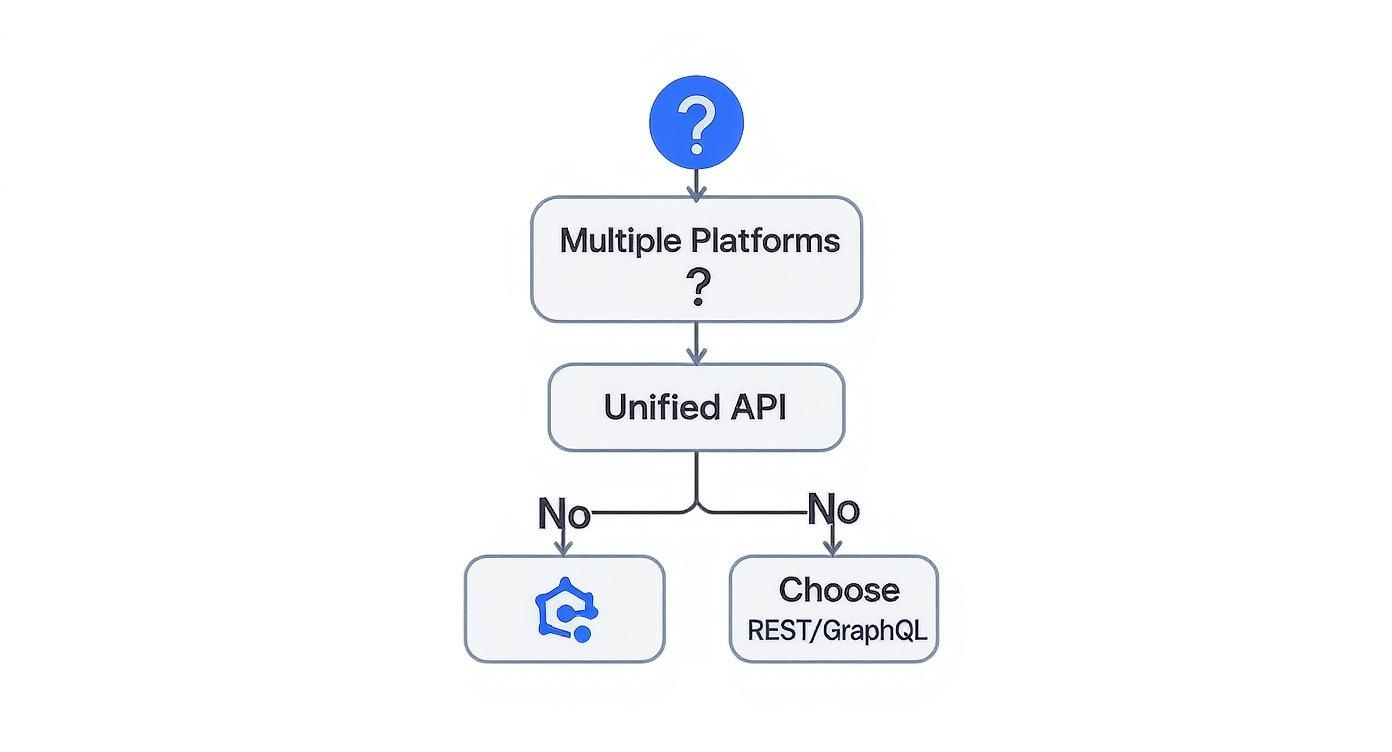
If your SaaS product needs to plug into a whole ecosystem of different eCommerce platforms, the takeaway is clear: a unified API is your most efficient path forward.
Key Questions to Ask Your Team
Before you lock in an architecture, hash out these critical questions:
- How many platforms are you supporting? If it’s more than one, the complexity of managing different API styles (REST, GraphQL, etc.) doesn't just add up—it multiplies.
- How tangled is the data? REST is a breeze for simple, resource-focused tasks, like pulling a single product by its ID. But for complex views that need to mash up customer, order, and inventory data in one go, GraphQL's precision is a huge win.
- What's your team’s expertise? REST is built on familiar HTTP concepts, so the learning curve is pretty gentle. GraphQL, on the other hand, introduces a whole new query language and demands a different way of thinking about data on the client side.
- Do you actually control the backend API? When you’re integrating with third-party platforms, you’re stuck with whatever they give you. You can’t just decide to change their REST endpoints or tweak their GraphQL schema.
A Scenario-Based Guide to Choosing the Right API Approach
To make this decision even more practical, this table breaks down common eCommerce integration scenarios and recommends the best architectural approach for each.
| Scenario | Recommended Approach | Reasoning |
|---|---|---|
| Building a single-platform app (e.g., a Shopify-only analytics tool) | REST or GraphQL | Choose based on the platform's native API. If they offer both, GraphQL is great for complex dashboards, while REST is simpler for basic data syncing. |
| Your SaaS needs to connect to 2-3 specific eCommerce platforms. | Direct Integration (REST/GraphQL) | It's manageable for a dedicated team to build and maintain a small number of custom connectors. You can tailor each one to the platform's strengths. |
| Your SaaS targets a wide market and needs to support 5+ platforms. | Unified API | Building and maintaining this many unique integrations is a massive resource drain. A unified API abstracts the complexity away. |
| You need to display highly customized, nested data from a single source. | GraphQL | Perfect for fetching exactly the data you need (e.g., a customer's last 5 orders and the products within them) in a single request, reducing network overhead. |
| Your app performs simple, CRUD-style operations (create, read, update, delete). | REST | Ideal for straightforward resource management. It's well-understood, widely supported, and has mature tooling for caching and monitoring. |
| You're building an internal tool and control both the client and server. | GraphQL | You can design the perfect schema to meet your front-end needs, giving your team maximum flexibility and efficiency. |
| Your team has deep HTTP/REST experience but is new to modern APIs. | REST | Stick with what your team knows to deliver faster. The learning curve for GraphQL can slow down initial development. |
| Your top priority is minimizing development time and maintenance costs across many platforms. | Unified API | This is the core value proposition. You build the integration logic once and deploy it across dozens of platforms without writing custom code for each. |
This matrix shows that while technical specifics matter, the business goal of scalability often dictates the best path.
When a Unified API Is the Definitive Answer
The whole REST vs GraphQL debate fades into the background when your biggest challenge is scaling across the fragmented eCommerce landscape. For B2B SaaS integration developers, the real bottleneck isn't the API architecture—it's the sheer volume of unique integrations you have to build and support.
A unified API like API2Cart abstracts away the underlying platform complexities. It gives you a single, consistent REST interface, letting you skip the headache of building and maintaining dozens of separate connectors for platforms like Shopify, Magento, or WooCommerce.
This approach delivers a level of speed and standardization that neither REST nor GraphQL can offer on its own when you're dealing with multiple third-party systems. Your team learns one API, writes the integration logic once, and can then scale across more than 60 platforms without getting bogged down in architectural debates.
For a deeper look into picking the right tool for the job, you can check out our guide on when to use REST, GraphQL, webhooks, and gRPC. In the end, a solution like API2Cart lets you get back to focusing on your core product instead of pouring resources into endless integration maintenance.
Got Questions? We've Got Answers
When you're deep in the weeds of API development, the REST vs GraphQL debate always sparks a few key questions. Let's tackle some of the most common ones that pop up for integration developers.
Is GraphQL Going to Replace REST?
Short answer: no. The reality is that GraphQL isn't killing REST. They're just different tools for different jobs, and they often live side-by-side in the same tech stack.
REST is still the undisputed king for simple, resource-driven APIs where predictability and HTTP caching are non-negotiable. Think public-facing APIs for partners. GraphQL, on the other hand, is a game-changer for complex, client-heavy applications where fetching data efficiently is everything. It's common to see companies using both—a public REST API and a private GraphQL API for their own mobile or web apps.
Which One Is More Secure?
Neither. Security isn't a feature you get out of the box with either architecture; it’s all about how you build it.
Both REST and GraphQL demand solid authentication and authorization. A wide-open REST endpoint is just as dangerous as a GraphQL schema that lets anyone query anything. No matter which you choose, you're still responsible for implementing security basics like rate limiting and proper access controls. With GraphQL, you also have to think about things like blocking overly complex queries that could overload your server.
How Does API2Cart Handle All This Cross-Platform Mess?
For any integration developer, one of the biggest headaches is that every single eCommerce platform has its own rules, especially when it comes to things like rate limits and data structures. This is a massive challenge when you need to build reliable integrations quickly.
That’s exactly where a service like API2Cart comes in. It acts as a universal translator and shock absorber. It normalizes data structures and handles the unique rate limits from over 60 different platforms, shielding your app from getting throttled and dramatically simplifying your development and error handling. You just build to one stable API, and it handles the platform-specific chaos for you, letting your developers ship faster.
And if you're thinking about modernizing, you can absolutely put a GraphQL layer on top of an existing REST API. It's a popular strategy that gives your front-end team all the flexibility of GraphQL without forcing you to tear down and rebuild your entire backend.
Wrestling with REST and GraphQL is one thing, but connecting your SaaS to dozens of different eCommerce platforms is a whole other level of complexity. With API2Cart, you can skip the integration nightmare and connect to over 60 shopping carts through a single, unified API. Start your free 14-day trial and see how much faster you can get to market.