When you hear developers talk about REST API vs Web API, the distinction is actually pretty simple: Every REST API is a Web API, but not every Web API is a REST API. Think of "Web API" as the broad category for any API that communicates over HTTP, while a "REST API" is a specific, disciplined type of Web API that plays by a very strict set of architectural rules. For an integration developer, understanding this difference is crucial for estimating project timelines, writing maintainable code, and avoiding integration pitfalls.
Understanding the Core API Distinction
For anyone building integrations, getting this hierarchy right is the first step toward creating efficient, scalable connections. The term Web API just describes an interface that lets two different software systems talk to each other over a network—usually the internet. It’s a general umbrella that covers various architectural styles, including SOAP, RPC, or even completely custom-built interfaces.

A REST (Representational State Transfer) API, on the other hand, is a specific implementation of a Web API that follows a standardized set of constraints. These rules are there for a reason—they ensure the API is predictable, scalable, and easy to work with. For integration developers, this predictability is a massive win, as it dramatically simplifies the process of integrating with new systems. If you want to dive deeper into these foundational rules, you can learn more about what REST is and how it functions.
This isn't just a textbook definition; it has real, practical consequences for developers tasked with connecting disparate eCommerce systems.
The Developer's Perspective
When an integration developer is handed a generic Web API, it can be a rough ride. You could face proprietary data formats, unpredictable endpoint structures, and custom methods for every single action. This lack of standardization blows up development time, adds unnecessary complexity, and increases long-term maintenance costs.
A RESTful API, however, gives you a clear roadmap from the start. You know it will use standard HTTP methods (like GET, POST, PUT, DELETE) and will almost certainly use a common format like JSON for data exchange.
For an integration developer, the difference between a generic Web API and a REST API is like being handed a messy, disorganized toolbox versus a neatly organized one. REST provides the structure needed to build integrations faster and with far fewer surprises.
Here's a quick breakdown of the fundamental differences from a developer's point of view:
| Feature | Web API (General) | REST API (Specific) |
|---|---|---|
| Definition | A broad concept for any API accessible over the web via HTTP. | A specific architectural style for building Web APIs based on a set of constraints. |
| Flexibility | High; can use any data format (XML, plain text) and protocol extensions (like SOAP). | Lower; follows strict architectural rules designed for scalability and predictability. |
| Standardization | Not inherently standardized; each API can have a completely unique design. | Follows a uniform interface, making it predictable and straightforward for developers to use. |
| Use Case Example | Legacy enterprise systems using SOAP for tightly-coupled integrations. | Modern web and mobile applications needing scalable, stateless communication. |
For B2B software providers, this distinction is absolutely critical. Imagine your development team trying to integrate with dozens of shopping carts, each with its own quirky, non-standard API—it's a massive drain on resources. This is exactly where a solution like API2Cart adds immense value for integration developers. It abstracts away the complexity of all those different APIs—both RESTful and non-RESTful—and presents a single, unified REST API.
This approach lets your developers write their code once and connect to over 40 eCommerce platforms, dramatically speeding up development and cutting down on long-term maintenance headaches.
The Architectural Divide: REST vs. Web API
The real difference in the REST API vs. Web API debate comes down to architecture. Think of a generic Web API as a workshop with tools scattered everywhere—it gets the job done, but there’s no underlying system. A REST API, on the other hand, is a meticulously organized workshop where every tool has a specific place and purpose, all governed by a core set of rules.
These rules, or constraints, aren't just arbitrary. They're the principles that make RESTful systems predictable, scalable, and loosely coupled. For any developer building integrations, understanding these six principles is the key to predicting an API's behavior and knowing how it will perform under stress.
The Six Pillars of RESTful Architecture
To be truly considered RESTful, an API must adhere to specific constraints. Let's break down what each one actually means for you as an integration developer.
- Client-Server Separation: This is the foundational rule. The client (your application) and the server (the API provider) are completely independent. Your client only needs the resource URI to function, and the server doesn't care about the client's user interface. This separation is powerful because it lets both sides evolve without breaking each other.
- Statelessness: Every single request from a client must contain all the information the server needs to process it. The server doesn't remember anything about the client from one request to the next. This is crucial for scalability, as any server instance can handle any client request, making load balancing straightforward and effective.
- Cacheability: Server responses have to explicitly state whether they can be cached. When you cache data on the client side, you reduce the number of calls to the server, which boosts performance and cuts down on network traffic. For an eCommerce integration, caching product information can make your application dramatically faster.
A truly RESTful API enforces a uniform interface, meaning it provides a standardized way of interacting with resources. This predictability is what allows developers to build scalable, maintainable integrations without needing to learn a new set of rules for every endpoint.
Uniform Interface and System Layers
Beyond those first three rules, a few more principles cement the RESTful approach and create a far more robust system. These are what really separate a disciplined REST API from a more chaotic, general Web API.
The uniform interface is arguably the most critical constraint, as it simplifies the entire architecture by decoupling the client from the server’s implementation. It’s built on four guiding principles, including resource identification in requests and self-descriptive messages. Our REST API cheat sheet provides a deeper look into how these structural rules are defined.
This standardized approach directly impacts how fast an integration developer can build. In fact, the distinction is so critical that some reports show adopting REST patterns can cut development time by as much as 40%. That’s all thanks to its predictable structure and built-in HTTP caching, which leads to faster launches and much easier long-term maintenance.
Here’s an illustration of how a unified architecture, like the one API2Cart provides, simplifies even the most complex integrations for a developer.
The diagram shows how a single, unified REST API can act as a translator, turning a developer's requests into the specific formats required by dozens of different shopping cart APIs.
Finally, REST architecture also demands a layered system and allows for optional code-on-demand. A layered system means a client doesn't know if it's talking directly to the end server or an intermediary. To better grasp how different architectural choices affect web services, it's helpful to look at the differences between tools like Apache HTTP Server vs Apache Tomcat. This layering principle allows for things like load balancers, caches, and security gateways to be added without ever touching the client or server code.
A Detailed Technical Comparison for Integration Developers
For developers in the trenches building integrations, the academic debate between REST API vs Web API quickly becomes a set of practical, technical hurdles. The success or failure of an integration often comes down to the gritty details: what protocol is it using, what data format do I have to parse, and how is it really using HTTP methods? Getting these answers upfront is the key to building robust connections that don't break.
This diagram offers a great high-level summary of the core difference. REST is built on a strict, predictable set of rules, while the broader "Web API" category is the wild west—it allows for almost anything.
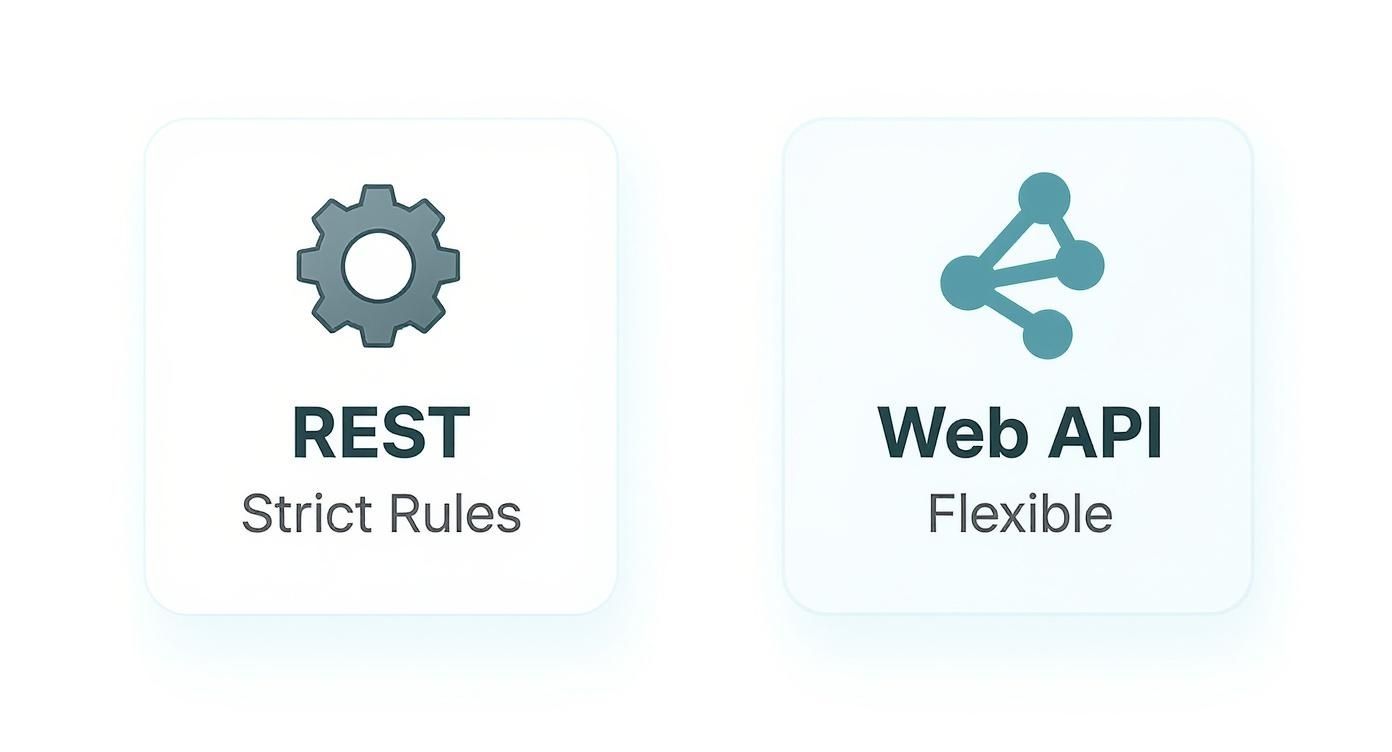
As an integration developer, this visual tells you everything you need to know about the experience. One path is standardized and clear. The other can be a mess of unpredictable behaviors that require a ton of custom code and discovery work just to get started.
REST API vs Web API A Technical Deep Dive
Let's break down the core technical differences that you'll encounter when integrating with these two types of APIs. This table cuts through the noise and gives a direct comparison of the key characteristics that define each.
| Technical Aspect | REST API | Web API (General) |
|---|---|---|
| Architectural Style | A strict architectural style with defined constraints (stateless, cacheable, uniform interface). | A broad category with no single architectural style. Can be RPC, SOAP, or custom. |
| Protocol | Strictly uses HTTP/HTTPS. This is a foundational constraint. | Can use various protocols (HTTP, SMTP, FTP, etc.), though HTTP is the most common. |
| Data Format | Overwhelmingly uses JSON. XML is technically possible but rare in modern implementations. | Highly variable. Can be XML, JSON, plain text, or even proprietary binary formats. |
| HTTP Method Usage | Enforces strict, meaningful use of HTTP verbs (GET, POST, PUT, DELETE) for CRUD operations. | Often tunnels all operations through a single verb, typically POST, especially in SOAP/RPC styles. |
| State Management | Stateless by design. Every request from the client must contain all the information needed to be understood and processed. | Can be stateful or stateless. Stateful APIs often rely on server-side sessions, which can complicate scaling and integrations. |
| Standardization | Highly standardized and predictable. Once you understand one REST API, others feel very familiar. | No inherent standardization. Each Web API can have its own unique structure, methods, and conventions, requiring custom handling. |
Understanding these distinctions is the first step in diagnosing the API you're working with. It helps you anticipate the kind of integration logic you'll need to write before you even make your first API call.
Protocol and Data Format Differences
The most obvious technical divergence for an integration developer is in the choice of protocols and data formats. A REST API is always—without exception—bound to the HTTP/HTTPS protocol. It's a non-negotiable part of the architectural style. As a result, REST gets to leverage the full power of HTTP, including its verbs, status codes, and caching headers.
On the other hand, a general Web API can technically run over different protocols, even though HTTP is the most common today. You might still run into older Web APIs built on SOAP that are designed to work over other transports like SMTP.
Data formats are another area where things get messy. REST has pretty much standardized on JSON (JavaScript Object Notation) because it's lightweight and easy for web clients to parse. You might see XML or plain text, but it's incredibly rare. General Web APIs offer no such comfort. An integration developer could face any of the following:
- XML: Common in older enterprise systems, especially those built around SOAP.
- Plain Text: Sometimes used for very simple, single-purpose data returns.
- Proprietary Formats: Custom binary or text formats that demand specialized parsers.
This lack of consistency is a massive headache. Imagine trying to connect to a dozen different eCommerce platforms, each with its own preferred data format. This is precisely where a unified API like API2Cart becomes a lifesaver. It takes in all that chaotic data and serves it back to you through a single, consistent JSON-based REST API, saving you from writing endless custom parsing logic.
HTTP Semantics and State Management
How an API uses HTTP methods—its semantics—is another dead giveaway of its style. REST enforces a strict and meaningful use of HTTP verbs to represent actions on resources.
- GET: Retrieves a resource.
- POST: Creates a new resource.
- PUT: Replaces an existing resource.
- DELETE: Removes a resource.
This creates a predictable CRUD (Create, Read, Update, Delete) pattern that’s intuitive for developers. A general Web API, especially one following an RPC (Remote Procedure Call) or SOAP style, often throws these conventions out the window. For instance, a SOAP API might funnel every single action—getting data, creating an order, deleting a product—through a POST request, hiding the real operation deep inside an XML body.
For an integration developer, checking how an API uses HTTP verbs is the quickest way to figure out its architectural style. If every call is a POST, you're almost certainly not dealing with a RESTful system, and you’ll need to adjust your strategy.
State management is another core distinction. REST is explicitly stateless, meaning every single request has to contain all the information the server needs to process it. This makes REST APIs more scalable and reliable. Other Web APIs might be stateful, relying on server-side sessions that can complicate integrations, particularly in distributed systems. This choice has real performance implications; for example, some studies show gRPC (a type of Web API) can be up to 7-10 times faster than REST for certain internal communication tasks, thanks to its use of HTTP/2 and binary protocols. To really dig into the pros and cons, it's worth exploring a breakdown of different API technologies like REST, GraphQL, and gRPC.
When you start looking at specific implementations, you'll find that even simple integrations have hidden technical depth. For a great example of this, check out this practical guide on using a company logo API, which details the authentication, caching, and compliance issues developers have to navigate.
Choosing the Right API Approach for eCommerce
For any integration developer, the whole REST API vs Web API debate is purely academic until it hits a real-world project. The choice isn't about personal preference; it's about necessity. The systems you need to connect dictate the approach. Your decision has to factor in scalability, third-party support, system limitations, and the long-term cost of keeping everything running.

Knowing when you're likely to encounter a RESTful system versus a more generic Web API is critical. It helps you plan your integration strategy and give a realistic timeline instead of getting blindsided halfway through.
When REST is the Only Logical Choice
Some eCommerce scenarios are tailor-made for REST. Its core principles—statelessness, cacheability, and a uniform interface—make it the go-to for modern, scalable, and public-facing applications. It’s just built for the job.
As an integration developer, you’ll almost always be working with a REST API in these situations:
- Building Public-Facing Integrations: If you're developing an app for a major marketplace like Shopify or BigCommerce, you’ll be using their REST (or GraphQL) APIs. These platforms need a standardized, predictable, and well-documented interface to support an entire ecosystem of third-party developers.
- Developing Mobile Commerce Apps: Building a mobile app that needs to pull product data, manage user accounts, and process orders? A REST API is your best friend. Its lightweight JSON payloads and stateless design are perfect for the unstable network conditions of mobile devices.
- Connecting to Modern SaaS Platforms: Any modern SaaS tool, whether it's for marketing automation or a shipping solution, will expose a REST API. Their entire business model hinges on making it dead simple for other systems to connect, and REST is the common language for that.
For any project where scalability, interoperability, and developer experience are top priorities, REST isn't just a good choice—it's a fundamental business requirement. Its predictability is what holds the entire eCommerce ecosystem together.
On the flip side, an integration developer will often have no choice but to work with a non-RESTful Web API. This usually happens when you’re dealing with older, proprietary, or highly specialized systems. In these scenarios, your job isn’t to pick an API style but to adapt to whatever you've been given.
Here are a few common examples:
- Integrating with Legacy ERP Systems: Many established enterprise resource planning (ERP) or warehouse management systems (WMS) were built long before REST became the standard. They often expose data through older SOAP or custom RPC-style Web APIs, which typically use XML and tunnel every operation through a POST request.
- Connecting to On-Premise Software: When a client relies on on-premise accounting or inventory software, its API was likely never designed for public consumption. These are often custom-built Web APIs with quirky authentication schemes and unique data structures you have to learn from scratch.
- Working with Specialized Industry Hardware: Interfacing with point-of-sale (POS) terminals or specialized warehouse hardware often means dealing with proprietary protocols wrapped in a Web API that completely ignores RESTful principles.
REST’s dominance isn't a fluke; its design directly solves the problems of modern, distributed systems. By 2025, REST APIs are expected to hold a 93% adoption rate among organizations, cementing their status as the world's most-used API architecture. This isn't just about technical preference—it's about money. With 65% of companies monetizing their APIs, a stable, well-understood architecture is crucial. You can find more insights on these trends and how API strategy is evolving on DevOps Digest.
For developers, this mix-and-match landscape is a minefield. Managing dozens of unique integrations—some RESTful, some not—creates a massive maintenance headache. This is exactly where a unified API solution like API2Cart becomes a lifesaver. It abstracts away the complexity of over 40 different shopping cart and marketplace APIs, handling both modern REST services and older, quirky Web APIs. Instead of building and maintaining a tangled mess of connectors, your team works with a single, consistent REST API. This approach radically speeds up development and saves you from the long-term pain of supporting a fragmented integration ecosystem.
Solving Integration Challenges with a Unified API
If you're an integration developer, you know you rarely get to pick the APIs you work with. The eCommerce world is a chaotic mix of modern RESTful services, clunky old SOAP Web APIs, and more than a few custom-built interfaces that defy categorization. This fragmentation is a massive headache, forcing you to learn and maintain dozens of unique integrations.
Each connection has its own authentication flow, data structure, and bizarre error-handling quirks. This is the reality behind the rest api vs web api debate for developers in the trenches. You're not choosing a clean architectural style; you're stuck adapting to a messy, inconsistent ecosystem.

This is precisely where a unified API solution like API2Cart changes the game for integration developers at B2B software companies. It acts as a powerful abstraction layer, consolidating over 40 different shopping cart and marketplace APIs into a single, predictable REST API.
Accelerating Development with API Abstraction
Instead of fighting with a dozen different Web APIs to manage products, orders, and customers, a developer can interact with one stable interface. This drastically speeds up development for software in key eCommerce sectors.
Here are a few use cases where API2Cart saves hundreds of developer hours:
- Order Management Systems (OMS): Pulling orders from platforms like Shopify, Magento, and Amazon means building unique connectors for each. API2Cart turns this into a single
order.listmethod call, giving you standardized data formats and authentication every time. Your team writes one integration instead of dozens. - Shipping and Fulfillment Solutions: To update tracking numbers and shipment statuses across multiple channels, you'd normally have to learn each platform's specific endpoints and data structures. A unified API provides one set of methods, like
order.shipment.update, that just works everywhere, saving weeks of development and testing. - Marketing Automation Tools: Syncing customer data and order history for campaigns becomes straightforward. Instead of mapping inconsistent data fields from WooCommerce and BigCommerce, you get a clean, predictable customer object from one source via a single API call.
This consolidation lets your team focus on building core product features instead of getting stuck in an endless cycle of building and fixing brittle, one-off integrations. It turns integration from a major engineering bottleneck into a streamlined workflow.
For an integration developer, a unified API means writing code once to connect everywhere. It eliminates the long-term maintenance headaches of patching dozens of individual connectors every time a platform updates its API.
The Strategic Advantage of a Single REST Interface
The overwhelming popularity of REST makes it the perfect standard for a unified API. This architecture is the undisputed king of the public API world, with roughly 70% of public APIs built on REST principles as of 2025. This isn't surprising—REST is simple and flexible, allowing teams to build and deploy integrations quickly. In fact, research shows that 63% of teams can produce a new API in under a week, which speaks to how REST helps accelerate project timelines. You can find more stats on the efficiency of REST API development on amraandelma.com.
By providing a single RESTful entry point, API2Cart lets your development team stick to this familiar, well-documented standard. Your developers work with predictable HTTP methods, consistent JSON payloads, and standardized error codes, no matter how complex the underlying platform's API actually is. This approach slashes the learning curve and minimizes the risk of integration errors, ensuring faster, more reliable connections to the entire eCommerce market.
Common Questions from Developers
Even experienced developers bump into the same questions when they're in the trenches, dealing with the practical side of REST versus other Web APIs. Getting these details right is the difference between a smooth integration and a project full of headaches, especially in the complex world of eCommerce.
Is an API Still RESTful if it Doesn't Use JSON?
Yes, it can be. The REST architectural style doesn't actually care about the data format. While JSON is the undisputed champion for modern REST APIs—thanks to its simple syntax and easy fit with JavaScript—a REST API could technically return XML, HTML, or even plain old text.
The core principle is that the representation of a resource is separate from the resource itself. That said, as an integration developer, you can bet on seeing JSON in over 99% of the RESTful APIs you work with today.
Can One Application Use Both REST and non-REST APIs?
Absolutely, and it happens all the time. It's pretty standard for a single eCommerce application to juggle multiple API styles. It might use its own internal REST APIs for the frontend, call a partner's old-school SOAP API to get shipping rates, and then pull marketing data from a third-party GraphQL API.
The real challenge for an integration developer isn't if you can do it, but how you manage the complexity of all those different protocols and data formats without losing your mind.
This is exactly the kind of mess that unified API platforms like API2Cart were built to clean up. By translating all those different interfaces into a single, predictable RESTful pattern, you can pull data from dozens of sources without writing custom code for every single one.
Imagine this: instead of building one connector for Shopify's modern REST API and another for a legacy shopping cart's quirky, XML-based Web API, you just make one call to API2Cart. This approach drastically cuts down development time and makes maintenance a breeze, letting your app talk to a whole ecosystem of platforms through one clean entry point.
What's the Main Business Reason to Go with REST?
When you boil it all down, the biggest business advantage is reduced friction. For an integration developer, less friction means a faster time-to-market and lower development costs.
Because REST sticks to a set of widely understood standards, it fosters a predictable and interoperable environment. This makes it much simpler for your own team to build new services and for outside developers to integrate with your platform. The standardized approach also simplifies documentation, flattens the learning curve for new hires, and makes it easier to scale your systems down the road.
Tired of the endless cycle of building and maintaining dozens of separate shopping cart integrations? With API2Cart, you can connect your software to over 40 eCommerce platforms through one unified REST API. Start your free 30-day trial and see how quickly you can expand your integration roadmap.