
At its core, the difference between webhooks and APIs is simple: an API waits for you to ask for data (a pull model), while a webhook sends you data automatically when an event happens (a push model). For an integration developer, this choice boils down to a fundamental question: should your application actively poll for updates, or should it passively receive them?
Choosing Your Data Integration Strategy
When you're building e-commerce integrations, the "webhooks vs APIs" debate isn't about which technology is better overall. It's about picking the right tool for the job. These two approaches represent fundamentally different ways for systems to communicate.
A traditional API, especially a REST API, works on a request-response cycle. Your application is the client, and it has to repeatedly send requests to a server just to check if there's any new information. This constant checking is called polling.
Webhooks, on the other hand, flip that model on its head. Instead of your application constantly asking, "Anything new?", the source system proactively sends—or pushes—a notification to your application the very moment a specific event occurs.
Think of it this way: an API is like compulsively checking your mailbox for a package. A webhook is the delivery driver ringing your doorbell the instant it arrives. This single distinction has massive implications for your application's efficiency, speed, and overall architecture.
Deciding Between Pull and Push Models
The choice really comes down to how urgent and frequent your data updates need to be. Polling an API is perfectly fine—and often simpler—for data that doesn't change much or where a small delay is no big deal. For instance, syncing a daily sales report once an hour is a great use case for a polling API.
But for mission-critical events like a new order being placed or an inventory level dropping to zero, waiting for the next polling cycle is a recipe for disaster. You end up with outdated information, which leads to frustrated customers and operational headaches. This is where webhooks shine, delivering near-instant data that powers real-time operations.
This decision tree helps visualize that fundamental choice based on your data needs.
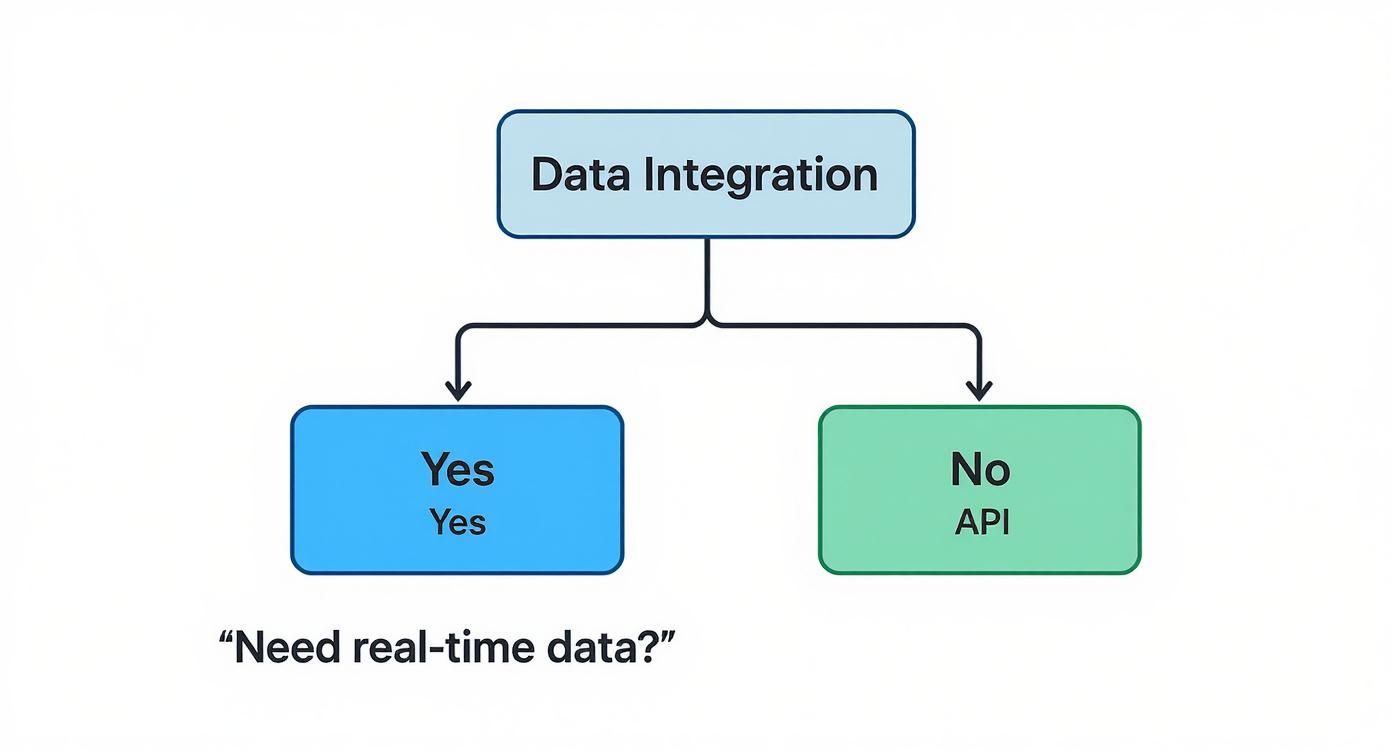
As the flowchart shows, if your integration absolutely needs data now, webhooks are the way to go. If the updates are less time-sensitive, a traditional API is a solid and reliable choice.
At a Glance: APIs vs Webhooks
To make the decision even clearer for an integration developer, here’s a quick breakdown of how the two stack up. For a more technical deep-dive, check out our complete guide on when to use what: REST, GraphQL, webhooks, and gRPC.
| Characteristic | API (Polling) | Webhook (Push) |
|---|---|---|
| Data Flow | Pull model; your application initiates requests. | Push model; the server sends data on an event. |
| Communication | Synchronous | Asynchronous |
| Real-Time | No. Data is only as fresh as the last poll. | Yes. Data is sent the moment an event occurs. |
| Resource Use | High. Constant polling eats up resources. | Low. Resources are only used when an event happens. |
| Setup | Simpler. Just need an endpoint and a key. | More complex. Requires a public-facing endpoint. |
Ultimately, both are powerful tools in a developer's arsenal. The key is knowing which one to grab for the specific integration challenge you're trying to solve.
How APIs and Webhooks Actually Work
To make the right call in the webhooks vs. APIs debate, you first need a solid grasp of how each one works. They aren't just different technologies; they represent two fundamentally different philosophies for how systems should communicate. One is a dialogue, the other is an announcement.
This distinction is critical. It directly shapes your application's architecture, how many resources it consumes, and how quickly you can act on new information. Let's break down the step-by-step process for both.
The API Polling Loop: A "Pull" Model
The traditional API approach, especially with REST APIs, uses a synchronous, client-led "pull" model. Imagine your app needs to know when a new order pops up in an e-commerce store. With this model, your application is entirely responsible for finding out.
This workflow, known as polling, is essentially a repetitive cycle:
- Authentication: Your app authenticates with the server, usually with an API key or an OAuth token.
- Request: It then builds and sends an HTTP request to a specific endpoint, like
/orders, often adding parameters likecreated_sinceto filter for new data. - Wait: Your application then has to sit and wait for the server to process everything and send a response back.
- Process: When the response finally arrives, your app parses it to see if there's anything new.
The problem? Most of the time, the answer is "nothing new." Yet every single one of those requests eats up server resources, network bandwidth, and your API rate limit quotas. It’s like constantly asking "Are we there yet?" on a long road trip—inefficient and resource-heavy.
The Webhook Workflow: A "Push" Model
Webhooks flip the script entirely. They work on an asynchronous "push" model where, instead of your app constantly asking for data, the source system tells you when something happens. This changes everything.
A webhook is basically a notification system for servers. The source system doesn’t wait for you to ask. It proactively sends an HTTP POST request to a URL you've provided the instant an event happens, effectively pushing the data to your application.
Here’s the typical flow for an integration developer setting up a webhook:
- Registration: You give the source application (like a shopping cart) a public URL from your own app. This is your "endpoint" or "callback URL." You then subscribe to specific events, like
order.created. - Event Occurs: A customer places an order on the e-commerce site.
- Data Push: The shopping cart’s server immediately triggers the webhook, bundles up the order details into a payload, and sends it as an HTTP POST request to your registered URL.
- Acknowledge: Your endpoint gets the data and should immediately respond with a
200 OKstatus to confirm it was received. The source system’s job is now done. - Process: Your app can now handle the payload on its own time, maybe by adding it to a queue to be processed for fulfillment.
For building reliable, real-time systems, solid webhook management and event routing is non-negotiable. The core difference is that with webhooks, your application has to be built to listen and react at a moment's notice.
For a deeper dive, check out API2Cart's guide on what webhooks are, which provides more detail on their implementation.
While REST APIs still dominate with 93% adoption, modern integration isn't a one-trick pony. Industry reports show that 50% of organizations are now implementing webhooks to complement traditional APIs, recognizing you need the right tool for the job—especially when real-time data is on the line.
Comparing Performance: Latency, Reliability, and Scalability
When you're building an e-commerce integration, your choice between webhooks and a polling API isn't just a technical detail—it's a core architectural decision that will define your application's performance. For any integration developer, getting a real grip on the trade-offs across latency, reliability, and scalability is critical. These aren't just buzzwords; they directly impact user experience, operational stability, and your bottom line.
The entire debate comes down to how quickly your application gets fresh data and how well it handles growth and the inevitable hiccups along the way.
Analyzing Data Latency
Latency is the time it takes for an event in one system (like a new order) to be recognized by another. In this department, webhooks and polling are playing two completely different sports.
API polling, by its very nature, introduces a delay. The freshness of your data is chained to your polling interval. If you check for new orders every five minutes, your data will be, at best, a few seconds old. At worst? It’ll be four minutes and fifty-nine seconds out of date. You could shorten the interval, but that creates a new headache: a massive spike in server load and API calls, most of which come back empty.
Webhooks, on the other hand, deliver near-zero latency. The data is pushed to your endpoint the instant the event happens. This real-time capability is a must-have for e-commerce, where delays can be costly. Think about instantly updating inventory across multiple channels to prevent overselling an item—polling just can't keep up.
For an integration developer, the choice is clear: if the business process requires an immediate reaction to an event, polling is a non-starter. Webhooks are the only viable path for true real-time data synchronization.
The Reliability Burden
When we talk about reliability, the dynamic of control and responsibility flips entirely.
With API polling, your application is in the driver's seat. If a request fails because of a network glitch or a server timeout, your app knows right away. You can immediately trigger your own retry logic, like an exponential backoff strategy, to try again.
Webhooks reverse this completely. The reliability burden shifts from the sender to you—the receiver. Your webhook endpoint has to be rock-solid and highly available because you have no control over when an event will be sent. If your server is down or throws an error when a webhook fires, that data might be gone for good unless the source platform has a bulletproof retry system.
This means developers have to engineer robust webhook listeners that can handle sudden traffic bursts, process incoming data fast, and manage failures gracefully. This often means adding a queueing system just to process the incoming events without dropping any.
The Impact on Scalability
Scalability is where the brute-force nature of polling really starts to show its cracks.
As you connect more stores or need more frequent updates, the number of API calls you make grows exponentially. Every single polling request eats up resources on both the client and server side, whether there’s new data to fetch or not. This model scales poorly and can quickly become a huge drain on your infrastructure and a fast track to hitting API rate limits.
Webhooks, by contrast, are built to scale. Server resources are only used when something actually happens. This event-driven approach is incredibly efficient, especially for high-volume systems. An application can listen for events from thousands of stores without creating constant background chatter, making it the far superior choice for platforms managing a large number of integrations.
How API2Cart Speeds Up Development
Trying to manage these performance trade-offs across dozens of unique e-commerce platforms is a monumental task. Every platform has its own rate limits, webhook signature quirks, and reliability features. This is where a unified integration platform like API2Cart becomes a massive shortcut for developers.
- Standardized Webhooks: Forget building and maintaining over 40 different webhook listeners. With API2Cart, you subscribe to a single, standardized event like
order.add. It does the hard work of translating each platform's unique implementation into a consistent, reliable data stream for you. This slashes development time and means you don't have to be an expert on every platform's nuances. - Flexible Data Retrieval: For times when polling is good enough—like for an initial data sync or a nightly report—API2Cart offers a unified REST API. You can use its powerful filtering methods to pull exactly the data you need without having to learn 40 different API schemas.
- Built-in Reliability: API2Cart’s infrastructure is built for high availability, taking on much of the reliability burden of receiving webhooks from countless sources. It acts as a resilient buffer, making sure your application gets the critical events it depends on.
By using API2Cart, you get the real-time power of webhooks and the controlled stability of APIs through a single integration point. This hybrid approach lets you focus on building your application's killer features instead of getting lost in the weeds of individual e-commerce platform integrations.
Practical E-commerce Integration Scenarios
Theory is one thing, but for an integration developer, application is everything. Understanding the core mechanics of the "webhooks vs APIs" choice is crucial, but seeing them in action within real e-commerce workflows is where the knowledge really clicks. The right choice directly impacts your application's efficiency, data accuracy, and ultimately, the value it delivers.
Let’s move from the abstract to the practical. We'll dig into specific e-commerce use cases, analyzing when a simple, scheduled API poll is the robust choice and when the real-time power of a webhook is completely non-negotiable.
When API Polling is the Smart Choice
Scheduled, periodic data pulls are often more than enough—and sometimes even better—for certain tasks. The simplicity and client-side control of polling make it a solid option when real-time updates aren't critical to the business function. In these situations, the resource overhead is a worthwhile trade-off for a straightforward implementation and easier error handling.
Consider these common scenarios where polling just makes sense:
- Nightly Product Catalog Syncs: Imagine a warehouse management system (WMS) that needs to update its master product catalog from an e-commerce platform. A full sync can be resource-intensive. Running a scheduled API job every night to pull all product data is efficient, reliable, and avoids clogging up the system with real-time traffic for non-urgent updates.
- Hourly Sales Data Aggregation: An analytics dashboard that provides sales trend analysis doesn't need minute-by-minute updates. Polling an API every hour to fetch sales data, aggregate it, and update performance charts is a perfect use case. It gives stakeholders timely business intelligence without the complexity of a real-time event stream.
- Weekly Customer Data Backups: For creating backups or populating a separate CRM, a weekly API call to retrieve all new customer records is a simple and effective strategy. The process is predictable, easy to manage, and gets the job done without any fuss.
Where Webhooks are Mission-Critical
Now, let's shift to operations where even a few minutes of delay can cause significant problems. For mission-critical, event-driven workflows, webhooks are the only viable solution. They enable the instant reactions that are essential for modern, competitive e-commerce operations.
Here are prime examples where webhooks are indispensable:
- Real-Time Inventory Synchronization: This is perhaps the most classic e-commerce use case. When an item sells on Shopify, a webhook must instantly fire to update inventory levels on Amazon, eBay, and in your central WMS. This prevents overselling—a major cause of negative customer reviews and operational chaos.
- Instant Order Fulfillment: The moment an order is confirmed, a webhook should trigger the entire fulfillment workflow. This could mean sending the order details to a shipping provider, notifying the warehouse, and sending an order confirmation email to the customer, all within seconds.
- Dynamic Price Updates: For businesses using dynamic pricing algorithms, a webhook can push a price change to all sales channels simultaneously. This ensures pricing consistency and lets the business react instantly to market changes or competitor pricing.
The practical implications of using webhooks for these scenarios are huge. For instance, real-time data integration through webhook-enabled systems can reduce customer support resolution times by 60-80% compared to traditional API polling approaches. In customer support, where response time directly impacts satisfaction, this improvement is a game-changer. You can find more details about how companies are implementing API-first approaches in recent API trend analyses.
How API2Cart Accelerates Development
For a developer, implementing and maintaining these integrations across dozens of shopping carts is a huge task. Each platform has its own API schema, authentication methods, and webhook implementation nuances. This is precisely the problem API2Cart solves.
Instead of building separate, fragile connectors for Shopify, Magento, and WooCommerce, API2Cart provides a single, unified API. It acts as an abstraction layer, saving your team from the complexity of platform-specific code.
API2Cart offers a powerful hybrid model that lets you leverage the best of both worlds:
- For Polling: Use API2Cart’s unified REST API methods like
product.listororder.listwith date filters for your scheduled tasks. One integration gives you access to data from over 40 platforms in a consistent format. - For Real-Time Events: Subscribe to standardized webhooks like
order.addorproduct.update. API2Cart manages the individual platform connections, listens for their events, and forwards them to your application as a single, predictable payload.
This approach drastically reduces development time, simplifies maintenance, and lets you focus on building features, not managing a tangled web of integrations.
Taming Integration Chaos with a Hybrid Approach
Anyone who's built and maintained integrations knows the pain. Juggling dozens of distinct e-commerce connections is a massive drain on development resources. The real headache in the "webhooks vs. APIs" debate isn't just picking one over the other; it's managing the sheer complexity of implementing both across a fragmented landscape of platforms like Shopify, Magento, and BigCommerce. Each one has its own API schemas, authentication rules, and webhook quirks.

This is where a unified integration platform like API2Cart really shines. Instead of making you choose, it lets you run a hybrid strategy, combining the raw power of polling APIs with the immediacy of webhooks—all through a single, consistent interface. The result is dramatically faster development and way less maintenance.
One REST API to Rule Them All
The first major hurdle for any integration developer is learning and adapting to the unique API of each shopping cart. API2Cart gets rid of that problem entirely by offering one consistent REST API to access data from over 40 different platforms.
This unified approach is a game-changer for tasks where polling is the smart play. Forget writing custom code to handle different endpoints and data structures for each platform; you can now use standardized methods for everything.
- Initial Data Sync: When you connect a new store, you need to pull its entire product catalog and order history. A polling approach using API2Cart’s
product.listandorder.listmethods is the perfect tool for this kind of bulk data loading. - Scheduled Reporting: Need to generate nightly sales reports or run weekly inventory audits? You can schedule a single API call to fetch all the necessary data across every connected store, without needing the constant chatter of real-time updates.
By abstracting away the complexity of individual APIs, API2Cart lets your team focus on building great application logic, not on the soul-crushing work of maintaining dozens of fragile, one-off connectors.
Making Real-Time Events Simple with Webhooks
While a unified API solves the polling challenge, real-time data sync is a different beast. Managing unique webhook listeners, verifying different signature methods, and normalizing inconsistent data payloads for every platform is a massive engineering burden.
API2Cart acts as a central webhook management hub. It subscribes to events from each platform and translates their unique, often messy, webhook payloads into a single, standardized format that your application can easily digest.
This means you only have to build and secure a single webhook listener. When an event happens—like a new order on any connected platform—API2Cart sends a clean, predictable payload straight to your endpoint.
- Event:
order.add - Action: A customer places a new order on any connected shopping platform.
- Result: API2Cart sends a standardized JSON payload to your webhook URL. It contains all the relevant order info, whether it came from Shopify, WooCommerce, or any other cart.
This hybrid model truly delivers the best of both worlds. You get the control of a polling API for heavy-lifting data operations and the instant, efficient updates of webhooks for everything else. You can learn more about how webhooks perfectly supplement a traditional API in our detailed guide. This approach slashes development time, lowers maintenance overhead, and removes the complexity of managing countless platform-specific listeners.
Building Resilient Integrations and Handling Failures
Great integrations are built for failure. It’s not about just connecting two endpoints; it’s about anticipating what will inevitably go wrong and handling it gracefully. Both API polling and webhooks have their own unique failure points, and a professional-grade integration is architected for resilience from the very beginning.
Without a solid plan for handling failure, a simple network glitch or a brief server hiccup can spiral into lost data, broken workflows, and unhappy customers. This is where we move past basic implementation and start thinking about the architectural patterns that keep your system stable, even when parts of it are not.
Securing and Stabilizing Webhook Endpoints
When you're using webhooks, the ball is in your court. The primary responsibility for reliability falls on the receiver—your endpoint. It needs to be ready for anything, from malicious payloads to unexpected firehoses of traffic. A multi-layered approach is the only way to go.
The absolute first step is signature verification. By validating a signature, usually with HMAC, you confirm that an incoming payload is genuinely from the source you expect and hasn’t been messed with. This is non-negotiable for protecting your system from forged requests.
Next, design your receivers to be idempotent. This is a fancy way of saying that if the source system fires the same event multiple times (which happens a lot with network errors), your application can process the duplicate without corrupting data or triggering unwanted actions.
When you're dealing with high volumes of incoming events, a queueing system like RabbitMQ or SQS isn't a luxury—it's essential. It acts as a buffer, absorbing sudden spikes in webhook traffic so your endpoint doesn't get overwhelmed. This lets you process everything at a pace you can actually handle.
Building Smarter API Polling Logic
With polling APIs, building resilience is all about making your requests smarter and more efficient. Just hammering an API for new data is wasteful and a great way to hit rate limits, which can get your integration temporarily shut down. You have to poll intelligently.
A great technique is to use conditional requests with ETag headers. The first time you fetch data, the server gives you an ETag. On every poll after that, you include this tag in your request. If nothing has changed, the server just sends back a 304 Not Modified status without the heavy data payload, saving everyone bandwidth and processing power.
Another sharp strategy is implementing dynamic polling frequencies. Instead of a rigid interval, you can adjust your polling rate based on historical activity. If you know a store only gets orders during business hours, dial back the frequency overnight. It’s a simple way to conserve resources on both ends.
For truly high-availability systems, you have to think bigger. Advanced strategies like Multi-Provider Failover Reliability become crucial for ensuring continuous operation, especially when network or provider issues pop up. Security is also a huge piece of the puzzle; 51% of developers now see unauthorized agent access as a major security risk. It’s worth checking out the latest API security trends to stay ahead of these threats.
Frequently Asked Questions
When you're digging into webhooks vs. APIs for e-commerce integrations, a few questions always pop up. Here are the straight answers from our experience.
Are Webhooks a Replacement for APIs?
Not at all. Think of them as partners, not rivals. Webhooks don't replace APIs; they complement them perfectly.
An API is your go-to for on-demand actions—the "pull" model. You use it for bulk data retrieval, user-initiated tasks, or anything where you need to fetch information right now. Webhooks handle the "push" side, giving you instant notifications when something specific happens. A solid, mature integration uses both: the API for heavy lifting and webhooks for keeping data in sync without delay.
What Are the Main Security Risks with Webhooks?
The two big ones are malicious payloads and denial-of-service (DoS) attacks. Someone could send you fake data, or they could flood your endpoint until it crashes.
To stop bad data, always verify the payload's signature. Using something like HMAC confirms the webhook came from the legitimate source and wasn't tampered with. To handle DoS attacks, you absolutely need rate limiting on your endpoint. It's also a smart move to process incoming webhooks through a message queue, which can absorb sudden traffic spikes and keep your system stable.
For an integration developer, securing webhook endpoints is not optional. An unverified endpoint is an open door for bad actors, making signature validation a critical first line of defense in your integration architecture.
How Does API2Cart Help with Webhook Integrations?
This is where things get much simpler. API2Cart handles the messy work of managing webhooks across dozens of different e-commerce platforms.
Instead of building, securing, and maintaining separate webhook handlers for Shopify, Magento, BigCommerce, and all the others, you just register one webhook with API2Cart. We take care of translating events from every connected store into a single, standardized payload format.
This approach saves a massive amount of development time. You subscribe to an event like order.add and get the same clean, uniform payload whether the order came from WooCommerce or Squarespace. It lets you focus on your actual application logic instead of wrestling with the quirks of each platform's API, which dramatically speeds up your entire development cycle.
Ready to stop building integrations one by one? With API2Cart, you can connect to over 40 shopping platforms through a single, unified API, leveraging both webhooks and traditional API methods to build powerful e-commerce solutions faster. Start your free 14-day trial today!