Quick definition: An eCommerce API is an interface that lets software exchange data with online stores, marketplaces, payment providers, accounting systems, marketing platforms, and shipping services. These APIs help developers automate workflows for products, orders, customers, inventory, payments, and fulfillment.
APIs are the foundation of modern eCommerce software. They connect storefronts with inventory tools, order management systems, payment services, CRM platforms, accounting applications, and shipping providers. A well-designed integration reduces manual work and gives merchants a consistent flow of data across their technology stack.
However, there is no single API that is best for every project. A payment API solves a different problem from a marketplace API, while a unified commerce API can reduce the effort required to support many shopping platforms. The right choice depends on the data you need, the number of platforms you plan to support, and how much ongoing maintenance your team can handle.
This guide compares 21 of the best eCommerce APIs for developers in 2026. The list covers unified commerce integration, store platforms, marketplaces, payments, accounting, CRM, marketing automation, and shipping. It is not an absolute ranking; use the descriptions and selection criteria below to find the best fit for your product.
How to Choose an eCommerce API
Before committing engineering resources, evaluate each API against the requirements of your application:
- Integration scope: Decide whether you need one platform, several platforms, or a normalized API that covers many commerce systems.
- Data coverage: Confirm that the API supports the products, variants, orders, customers, inventory, shipments, refunds, or other entities your workflow requires.
- Authentication and access: Review OAuth requirements, app approval, scopes, merchant authorization, and access to sensitive customer data.
- Synchronization: Look for webhooks, event subscriptions, incremental updates, bulk operations, and reliable pagination.
- Versioning and limits: Understand release schedules, deprecation policies, rate limits, quotas, and platform-specific restrictions.
- Developer experience: Compare documentation, SDKs, sandboxes, test accounts, error messages, and support options.
- Total cost of ownership: Include not only initial development but also monitoring, upgrades, support, and long-term maintenance.
Quick Comparison of the 21 Best eCommerce APIs
| API | Category | Best for |
|---|---|---|
| API2Cart | Unified commerce | Connecting SaaS products to multiple shopping platforms through one API |
| Shopify Admin API | Store platform | Building apps for Shopify merchants |
| WooCommerce REST API | Store platform | Integrating with WordPress-based stores |
| Adobe Commerce APIs | Store platform | Enterprise and headless commerce integrations |
| BigCommerce APIs | Store platform | Apps, storefronts, and operational integrations |
| PayPal REST APIs | Payments | PayPal checkout, capture, refunds, and subscriptions |
| Stripe API | Payments | Custom payment and billing experiences |
| Square APIs | Payments and POS | Connecting online commerce with Square seller operations |
| Amazon Pay API | Payments | Adding Amazon Pay checkout to a merchant site |
| QuickBooks Online API | Accounting | Syncing commerce transactions with accounting records |
| NetSuite SuiteTalk | ERP | Enterprise record, query, and ERP workflows |
| Amazon SP-API | Marketplace | Automating Amazon seller and vendor operations |
| eBay Sell APIs | Marketplace | Listings, inventory, orders, and fulfillment on eBay |
| Etsy Open API v3 | Marketplace | Tools for Etsy listings, inventory, receipts, and shops |
| Mailchimp Marketing API | Marketing | Audience, campaign, event, and commerce-data sync |
| Klaviyo APIs | Marketing | Event-driven lifecycle marketing and customer profiles |
| HubSpot APIs | CRM | Connecting commerce activity with CRM workflows |
| Mollie API | Payments | European payment flows and hosted checkout |
| Salesforce APIs | CRM | Enterprise customer, sales, and automation workflows |
| Brevo API | Marketing and messaging | Transactional messages, campaigns, contacts, and events |
| Sendcloud API | Shipping | Labels, tracking, returns, and multi-carrier shipping |
21 Best APIs in eCommerce for 2026
1. API2Cart Unified API
Best for: SaaS vendors that need to connect with multiple eCommerce platforms and marketplaces.
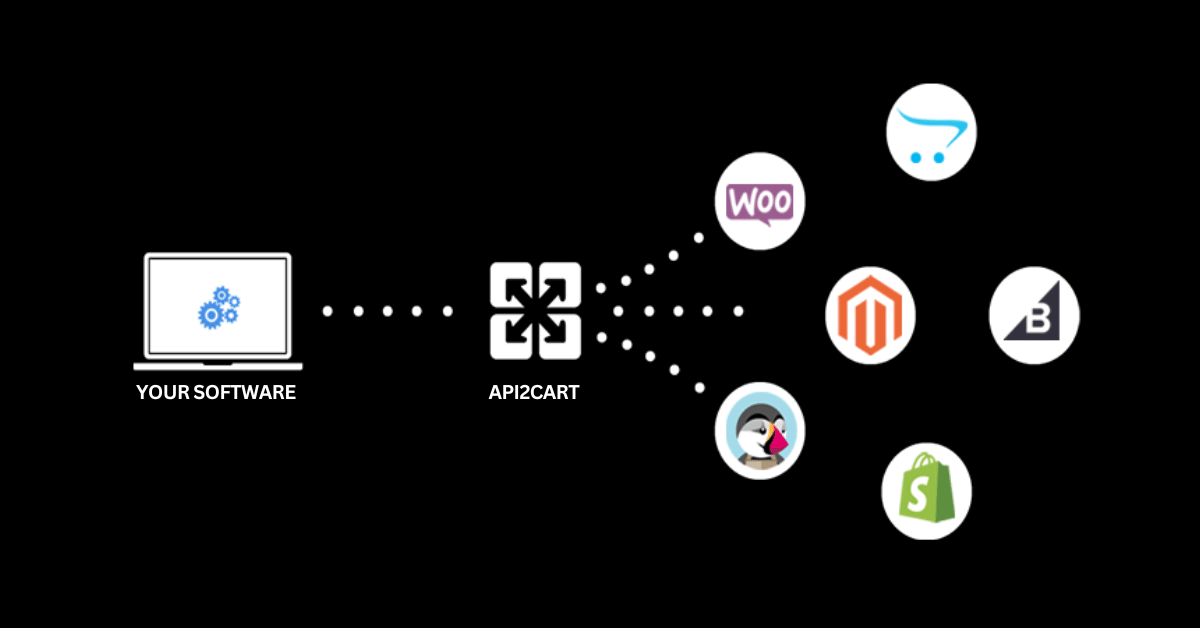
API2Cart provides one normalized API for working with store data across 80+ shopping platforms and marketplaces. Instead of building and maintaining a separate integration for each platform, a software provider can use a consistent set of methods for products, orders, customers, categories, inventory, shipments, and other commerce entities.
This approach is especially useful for multichannel inventory systems, order management software, product information tools, repricing solutions, shipping applications, and other products whose value depends on broad platform coverage. The main advantage is lower integration complexity: API2Cart handles platform-specific differences while the client application works with a common data model. Review the API2Cart documentation and the guide to integrating with multiple eCommerce platforms before planning your data flows.
2. Shopify GraphQL Admin API
Best for: Public and custom apps that extend Shopify administration and merchant workflows.
The Shopify GraphQL Admin API gives applications access to products, orders, customers, inventory, fulfillment, discounts, metafields, and many other Shopify resources. GraphQL lets a client request the fields it needs, which can reduce over-fetching and make complex data relationships easier to query.
For new development, GraphQL is the correct default. Shopify classifies the REST Admin API as legacy, and new public apps have been required to use the GraphQL Admin API since April 2025. Developers should also account for versioned releases, access scopes, query-cost limits, webhooks, and Shopify's app review requirements.
3. WooCommerce REST API
Best for: Applications that integrate with WooCommerce stores running on WordPress.
The WooCommerce REST API supports JSON-based operations for products, orders, customers, coupons, taxes, shipping zones, and related store data. It follows familiar HTTP conventions and works with WooCommerce's WordPress REST API integration.
WooCommerce is self-hosted, so integrations must be prepared for differences in hosting quality, plugin combinations, custom fields, security rules, and store versions. Test pagination, authentication, timeout handling, and webhook delivery across representative merchant environments rather than relying on a single development store.
4. Adobe Commerce and Magento Open Source APIs
Best for: Enterprise integrations, custom back-office workflows, and headless commerce projects.
Adobe Commerce Web APIs include REST and GraphQL interfaces for integrating external systems and building custom storefront experiences. REST endpoints cover a broad set of administrative and commerce operations, while GraphQL is commonly used for storefront queries and headless applications.
Adobe Commerce, Magento Open Source, and Adobe Commerce as a Cloud Service do not have identical endpoint coverage or authentication requirements. Confirm the deployment model first, then design the integration around the APIs available for that edition. Enterprise projects should also plan for custom attributes, store views, asynchronous or bulk operations, and extensions that modify the standard data model.
5. BigCommerce APIs
Best for: Building BigCommerce apps, operational integrations, and headless storefronts.
The BigCommerce developer platform provides APIs for catalog, orders, customers, inventory, pricing, channels, storefront content, and other commerce functions. Developers can combine REST APIs for store operations with GraphQL storefront capabilities for customer-facing experiences.
BigCommerce is a strong option when a project needs both commerce administration and storefront flexibility. Before implementation, map API scopes, rate limits, webhooks, multi-storefront requirements, and product variant rules. Apps intended for many merchants should use OAuth and avoid assumptions based on a single store configuration.

6. PayPal REST APIs
Best for: Adding PayPal checkout, payment authorization, capture, refunds, subscriptions, and related payment workflows.
PayPal REST APIs use OAuth 2.0 access tokens and JSON responses. For checkout integrations, the Orders v2 API supports creating an order, obtaining buyer approval, authorizing or capturing funds, retrieving order details, and adding shipment tracking.
Use current v2 endpoints rather than older v1 examples that may still appear in search results or legacy code. Production integrations should implement idempotency where supported, verify webhook events, distinguish sandbox and live credentials, and keep payment calls on the server rather than exposing secrets in browser code.

Want a Practical API Integration Guide?
Download our free guide to learn the key steps for accessing eCommerce platform APIs and building reliable store data integrations.
7. Stripe API
Best for: Custom payment, billing, subscription, and platform payment experiences.
The Stripe API covers payments, customers, payment methods, refunds, invoices, subscriptions, connected accounts, and many other financial workflows. PaymentIntents provide a stateful way to manage authentication and payment attempts through a transaction lifecycle.
Stripe is attractive to developers because of its documentation, SDKs, test mode, and broad set of products. The breadth also means architecture matters: choose between hosted Checkout and a custom payment flow, keep secret keys server-side, use idempotency keys for safe retries, and treat verified webhook events as an important source of asynchronous status changes.
8. Square APIs
Best for: Applications that connect online commerce with Square payments, point of sale, catalog, and inventory.
Square APIs include Payments, Orders, Catalog, Inventory, Customers, Invoices, Subscriptions, Bookings, and other services. This makes Square particularly relevant for omnichannel applications that need to coordinate online activity with physical seller locations.
Use OAuth when accessing data on behalf of multiple Square sellers. Pay close attention to location IDs, catalog object versions, idempotency, and the relationship between orders and payments. Square versions its API independently from SDK releases, so pin and test the API version used by your application.
9. Amazon Pay API
Best for: Letting customers use Amazon Pay during checkout on a merchant website.
The Amazon Pay API centers on Checkout Session, Charge Permission, Charge, and Refund objects. It supports one-time and recurring payment scenarios and can return the buyer information needed to complete an order.
Amazon Pay should not be confused with the Amazon Selling Partner API. Amazon Pay handles checkout and payment operations on a merchant's site, while SP-API automates selling activity on Amazon marketplaces. New implementations should follow the current Amazon Pay Checkout documentation instead of deprecated legacy integration guides.
10. QuickBooks Online Accounting API
Best for: Synchronizing eCommerce transactions with accounting and financial records in QuickBooks Online.
The QuickBooks Online Accounting API provides access to customers, vendors, invoices, bills, payments, accounts, items, reports, and other accounting entities. It is useful for sending completed commerce transactions into finance workflows and keeping customer or item records aligned.
This entry replaces the outdated 'QuickBooks Commerce API' found in older versions of this article. QuickBooks Online is primarily an accounting platform, not a complete replacement for an eCommerce catalog or order API. Design a clear source-of-truth model for products, taxes, discounts, refunds, and payments before implementing two-way synchronization.
11. Oracle NetSuite SuiteTalk REST Web Services
Best for: Enterprise ERP integrations involving financial, customer, item, order, and operational records.
SuiteTalk REST Web Services provide a REST-based interface for NetSuite records. Supported capabilities include CRUD operations, metadata discovery, record queries, SuiteQL execution, record transformations, and asynchronous request processing.
NetSuite implementations are highly configurable, so integrations often need to handle custom records, custom fields, subsidiaries, roles, and account-specific domains. Use least-privilege permissions and test against the customer's actual NetSuite configuration. For data not exposed through standard REST records, evaluate other SuiteCloud integration options rather than forcing a fragile workaround.

12. Amazon Selling Partner API
Best for: Applications that automate operations for Amazon sellers and vendors.
The Selling Partner API (SP-API) is a collection of REST-based APIs for catalog data, listings, pricing, inventory, orders, reports, feeds, fulfillment, finances, notifications, and other marketplace workflows. It replaces the broad and ambiguous 'Amazon API' label used in many older articles.
SP-API onboarding is more involved than a typical public REST API. Applications may need Amazon approval, specific roles, Login with Amazon authorization, regional endpoints, security controls, and careful treatment of restricted data. Use Notifications where available, and reserve Feeds or Reports for workflows that are intentionally asynchronous or bulk-oriented.
13. eBay Sell APIs
Best for: Managing listings, inventory, orders, fulfillment, finances, and seller operations on eBay.
The eBay Sell APIs are RESTful services that use OAuth, JSON payloads, and eBay-specific headers. The family includes Inventory, Fulfillment, Account, Finances, Marketing, Analytics, and other APIs that together support a complete selling workflow.
Developers should understand how inventory items, offers, locations, business policies, and listings relate to one another. Marketplace rules vary by site and category, and some operations require account configuration before the API call can succeed. Build against the eBay Sandbox, but also plan production validation for policies and data that the sandbox cannot fully reproduce.
14. Etsy Open API v3
Best for: Seller tools that manage Etsy listings, inventory, receipts, and shop operations.
Etsy Open API v3 provides REST endpoints for marketplace and shop data. Applications can work with listings, listing inventory, images, shops, receipts, transactions, shipping profiles, and other resources according to their approved access and OAuth scopes.
A developer must register an Etsy app and follow Etsy's app-access path for the intended use case. Keep listing state, taxonomy, variation rules, and rate limits in mind. If the software serves merchants beyond the developer's own shop, confirm Etsy's commercial access requirements early in the project.
15. Mailchimp Marketing API
Best for: Synchronizing audiences and commerce activity with email marketing campaigns and automations.
The Mailchimp Marketing API provides resources for contacts, audiences, campaigns, templates, events, eCommerce data, reports, tags, automations, and webhooks. A commerce application can send customer, product, order, and behavioral data to support segmentation and more relevant messaging.
Public integrations should use OAuth rather than asking users to paste permanent API keys. Normalize consent status carefully, make contact updates idempotent, and use batch operations for large imports. Webhooks can help keep the external application aligned when a subscriber changes status directly in Mailchimp.
16. Klaviyo APIs
Best for: Event-driven lifecycle marketing, customer profiles, segmentation, and commerce analytics.
Klaviyo APIs let developers work with profiles, events, lists, segments, catalogs, campaigns, metrics, and related marketing data. They are commonly used to stream commerce events such as product views, checkout activity, purchases, and fulfillment updates into automated customer journeys.
Klaviyo uses date-versioned APIs and scoped authentication. Technology partners should evaluate OAuth, while private integrations can use appropriately restricted private keys. Track the API revision sent by your client, validate event identity and timestamps, and avoid generating duplicate events during retries or historical imports.

17. HubSpot APIs
Best for: Connecting commerce data with CRM, sales, service, and marketing workflows.
HubSpot APIs cover CRM objects such as contacts, companies, deals, products, line items, tickets, and custom objects, along with marketing and automation capabilities. Commerce applications can use these resources to give sales and support teams a more complete view of customer activity.
HubSpot introduced date-versioned APIs in 2026, so new integrations should use the latest supported version and monitor migration deadlines. Use OAuth for multi-account apps, request only necessary scopes, and plan how external order or product identifiers map to HubSpot records and associations.
18. Mollie API
Best for: European payment integrations that need hosted checkout and multiple local payment methods.
The Mollie Payments API lets an application create and manage payments. A common flow creates a payment, redirects the customer to Mollie's hosted checkout, and processes a webhook when the payment status changes. Mollie also provides APIs for refunds, customers, mandates, subscriptions, orders, and related financial operations.
Do not treat the browser redirect as final proof of payment. Retrieve the payment after a verified webhook and update the order from the authoritative status. Store your own order reference in metadata, handle asynchronous methods correctly, and use test mode before enabling live credentials.
19. Salesforce APIs
Best for: Enterprise applications that connect customer and commerce activity with Salesforce data and automation.
Salesforce APIs include REST, Bulk, Pub/Sub, GraphQL, and other interfaces for different integration patterns. Developers can work with standard or custom objects, query records, process high-volume data, and trigger workflows across sales, service, and commerce-related processes.
Select the API according to the workload rather than using one interface for everything. REST is suitable for many transactional operations, while Bulk APIs are better for large datasets and event-driven interfaces can reduce polling. Account for organization-specific objects, field-level permissions, governor limits, and API version upgrades.
20. Brevo API
Best for: Transactional messaging, marketing campaigns, contact management, events, and eCommerce data sync.
The Brevo API, formerly known as the Sendinblue API, provides REST endpoints for email, SMS, WhatsApp, contacts, campaigns, events, conversations, CRM data, and eCommerce synchronization. The current documentation uses the Brevo name and a v3 base URL, so old Sendinblue naming should be updated in new interfaces and documentation.
Brevo supports API-key authentication and OAuth for relevant integration scenarios. Separate transactional and marketing consent workflows, protect credentials, and use webhooks to track delivery or engagement events instead of relying only on periodic polling.
21. Sendcloud API
Best for: Automating shipping labels, carrier selection, tracking, returns, and fulfillment workflows.
Sendcloud APIs cover shipping, orders, returns, tracking, service points, and related delivery operations. A shipping integration can create parcels or shipments, choose shipping options, request labels, provide customs data, and send tracking updates back to the commerce system.
Shipping data must be validated more strictly than a typical catalog record. Check addresses, weights, dimensions, customs fields, carrier-specific restrictions, and label-creation outcomes. Use asynchronous shipment creation for production-scale workflows where appropriate, and make retries safe so a network error does not create duplicate labels or shipments.
Direct APIs vs. a Unified eCommerce API
Direct platform APIs offer the deepest access to platform-specific features. They are usually the right choice when your product supports only one platform or depends on capabilities unique to that ecosystem. The trade-off is that every additional direct integration introduces a new authentication flow, data model, rate-limit strategy, webhook implementation, testing matrix, and maintenance schedule.
A unified API is a better fit when broad platform coverage is part of the product's value. It normalizes common commerce entities and reduces the number of separate connectors your team must maintain. The trade-off is that some platform-specific features may still require a direct endpoint or a specialized workflow.
Many mature products use both approaches: a unified API for common product, order, customer, inventory, and shipment workflows, plus direct integrations for a small number of platform-specific features. Base the decision on coverage, time to market, maintenance capacity, and the features customers actually need.
Conclusion
The best eCommerce API is the one that matches your product's scope and data requirements. Shopify, WooCommerce, Adobe Commerce, and BigCommerce APIs are strong choices for platform-specific apps. Amazon SP-API, eBay, and Etsy serve marketplace workflows. Stripe, PayPal, Square, Amazon Pay, and Mollie focus on payments, while QuickBooks Online, NetSuite, HubSpot, and Salesforce connect commerce with accounting, ERP, and CRM processes.
If your SaaS product must support several shopping platforms, compare the lifetime cost of separate integrations with a unified approach. API2Cart lets software vendors access normalized commerce data across 80+ platforms and marketplaces through one integration. You can start a free trial to test the API with your use case.
Frequently Asked Questions
Fill out the form below to get the guide:
How to Access APIs of eCommerce Platforms
Learn how eCommerce platform APIs work and compare the main approaches to building reliable store integrations.