An API to cart connection enables software applications to exchange data with eCommerce platforms and marketplaces. For B2B software vendors, this connectivity is essential for building features that depend on products, orders, customers, inventory, shipments, prices, and other commerce data.
The integration challenge becomes more significant as the eCommerce ecosystem expands. As of August 2026, BuiltWith tracks more than 24 million eCommerce technology detections across the web. The market is also highly fragmented across technologies such as Shopify, WooCommerce, Wix, Magento, PrestaShop, OpenCart, and many others.
For software vendors, this fragmentation creates a scalability problem. An OMS, ERP, WMS, PIM, shipping, inventory, or multichannel solution may need to connect with several shopping platforms to serve its customers. However, every direct integration can introduce different authentication requirements, API structures, data models, and maintenance needs.
A shopping cart API provides the technical layer that allows software to communicate with an eCommerce platform programmatically. Instead of transferring data manually, applications can request supported store information, process it within their own workflows, and send updates back when required.
In this guide, we explain what an API is, how shopping cart APIs work, and what data they can provide. We will also examine how a unified API approach can simplify connections with multiple eCommerce platforms through one integration layer.
What Is an API and How Does It Work?
An application programming interface (API) defines how two software systems can communicate with each other. It specifies how an application can send requests to another system and how that system returns supported data or performs an available action.
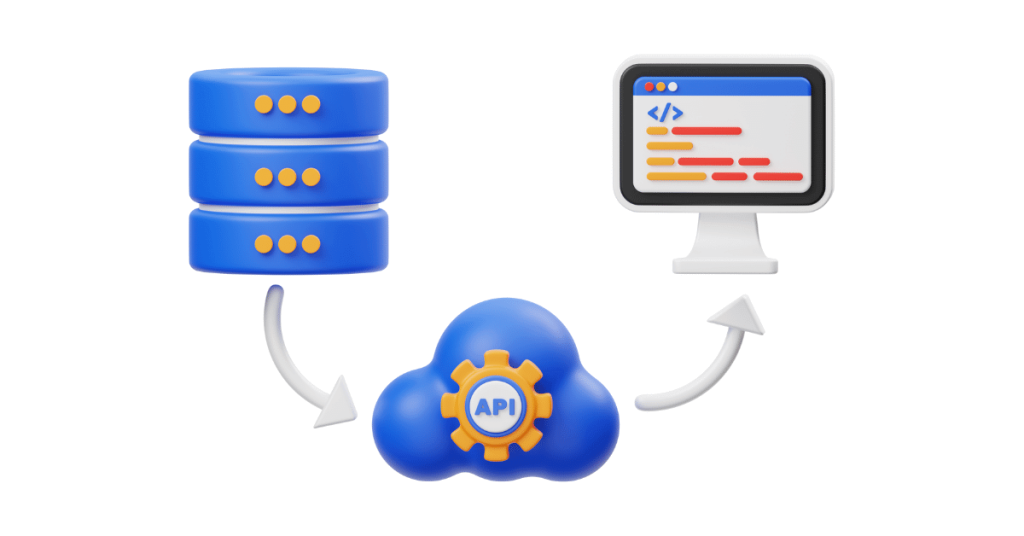
For example, an eCommerce application may send an API request to retrieve a list of orders from an online store. The platform processes that request and returns the available order data in a structured response. As a result, the application can use this information for order management, fulfillment, inventory updates, analytics, or other workflows.
REST APIs
REST (Representational State Transfer) is an architectural approach widely used for web APIs. RESTful APIs typically work with resources and standard HTTP methods such as GET, POST, PUT, and DELETE. Therefore, developers can use them to retrieve, create, update, or delete supported resources through defined endpoints.
SOAP APIs
SOAP (Simple Object Access Protocol) is a protocol for exchanging structured information between systems. SOAP services commonly use XML messages and formal service definitions. Although many modern eCommerce integrations use REST APIs, software vendors may still encounter SOAP in established or enterprise systems.
What Is a Shopping Cart API?
To understand how an API to cart connection works, it is useful to define a shopping cart API first. eCommerce platforms such as Shopify, WooCommerce, and Magento provide APIs that allow external software to interact programmatically with supported store data and functionality.
A shopping cart API acts as an interface between an eCommerce platform and external applications. For example, an OMS may retrieve new orders, an inventory system may synchronize stock quantities, and a PIM solution may update product information. Therefore, API connectivity enables software vendors to automate data exchange instead of relying on manual imports and exports.

How Shopping Cart APIs Exchange Data
Many modern eCommerce APIs use REST principles and standard HTTP methods. However, the exact operations and methods depend on the API provided by each platform. Common HTTP methods include:
- GET — retrieves a supported resource or collection of resources.
- POST — commonly creates a new resource or triggers a supported operation.
- PUT — commonly replaces or updates an existing resource.
- PATCH — can modify selected fields of an existing resource when the API supports it.
- DELETE — removes a supported resource.
The exact implementation varies between platforms. Therefore, developers need to follow the authentication rules, endpoints, request parameters, data models, and rate limits defined by each eCommerce API.
What Can Software Do with a Shopping Cart API?
A shopping cart API can provide access to the commerce data required by OMS, ERP, WMS, PIM, shipping, inventory, multichannel, and other B2B software. The available functionality depends on the platform, permissions, and API endpoint.
Common eCommerce integration workflows include:
- Retrieve product data — access supported product information such as SKUs, prices, descriptions, images, variants, and inventory quantities.
- Work with orders — retrieve new and existing orders and use their data in order management, fulfillment, shipping, or analytics workflows.
- Synchronize inventory — retrieve and update stock information to keep inventory data aligned across connected systems.
- Manage product information — retrieve and manage supported product data required by PIM, ERP, and multichannel applications.
- Access customer data — work with supported customer information when the platform and granted permissions allow it.
- Process shipping and fulfillment data — exchange supported shipment, fulfillment, and tracking information.
As a result, API integration allows B2B software to turn raw eCommerce data into automated workflows for its users.
Examples of Shopping Cart APIs
Major eCommerce platforms provide APIs for developers who need to connect external applications with online stores. However, their architectures, authentication models, available resources, and platform requirements differ.
Magento API
Magento provides REST and GraphQL APIs for working with supported commerce resources. Developers can use these APIs to build integrations around products, customers, orders, inventory, and other eCommerce operations. However, the available functionality depends on the Adobe Commerce or Magento Open Source environment and the API being used.
Shopify API
Shopify provides APIs for developing applications and integrations around store operations. Its Admin API supports access to commerce resources such as products, orders, customers, inventory, and fulfillment data, subject to API scopes and platform requirements. Moreover, developers need to account for Shopify API versioning and lifecycle changes when maintaining integrations.
WooCommerce API
WooCommerce provides a REST API that allows authorized applications to work with supported store resources. Developers can use it for workflows involving products, orders, customers, coupons, and other commerce data. Therefore, it is commonly used when external SaaS applications need to exchange data with WooCommerce stores.
Although these APIs solve similar integration problems, each has its own implementation requirements. Building direct connections to several platforms can therefore increase development and maintenance work. This is where a unified API to cart approach becomes relevant for software vendors that need broader eCommerce platform coverage.
Which Software Industries Need Shopping Cart API Integration?
Many B2B software products depend on eCommerce data to provide their core functionality. A shopping cart API connection gives these systems access to supported products, orders, customers, inventory, shipments, and other store data. The exact use case, however, depends on the type of software.
eCommerce Marketing Automation Software
Marketing automation platforms need shopping cart data to build workflows around customers, products, orders, coupons, and other supported information. For example, they can use store data to trigger product campaigns, personalize offers, track customer activity, or support abandoned cart workflows.
Therefore, reliable eCommerce platform connectivity helps marketing software automate campaigns based on events and data from connected stores.
Multichannel Software
Multichannel systems need to exchange data with several sales channels from one interface. Through shopping cart APIs, these solutions can retrieve products and orders, monitor inventory, process supported updates, and keep commerce data aligned across connected channels.
As the number of supported platforms grows, maintaining separate integrations can become increasingly complex. A unified API to cart approach can reduce this integration overhead by providing a common layer for multiple eCommerce platforms and marketplaces.
Order Management Systems
Order management systems rely heavily on access to order data. They need to retrieve new orders from connected stores and use information such as products, quantities, customer details, addresses, statuses, and shipping data within their workflows.
Moreover, an OMS may need to send supported order or fulfillment updates back to the sales channel. API connectivity therefore plays a central role in automating the order lifecycle across multiple stores.
Inventory Management Software
Inventory management systems use eCommerce APIs to monitor and synchronize stock data. When an order changes available inventory on one channel, the software can recalculate quantities and update supported stock information across other connected systems.
As a result, automated inventory synchronization can help merchants reduce data inconsistencies and lower the risk of overselling.
ERP, PIM, and Warehouse Management Systems
ERP, PIM, and WMS solutions also depend on reliable access to eCommerce data. ERP systems may exchange product, order, customer, and inventory information with online stores. Meanwhile, PIM software focuses primarily on product data, while warehouse systems use order and inventory information to support fulfillment operations.
Although their workflows differ, these systems face the same integration challenge: they may need to communicate with stores built on several different eCommerce platforms.
Shipping and Fulfillment Software
Shipping software needs order and fulfillment data from connected sales channels. For example, it can retrieve shipping addresses and order items, prepare shipments, generate labels through supported carrier workflows, and send tracking or shipment updates back to connected systems.
Consequently, a shopping cart API connection helps shipping solutions automate the flow of data between online stores and fulfillment processes.
eCommerce AI Assistants and Chatbots
AI-powered assistants and eCommerce chatbots can also use store data to provide contextual customer experiences. Depending on the permissions and capabilities of the connected platform, they may retrieve product information, check inventory availability, access supported order details, or provide shipment information.
However, these features require reliable access to current commerce data. Connecting an assistant to multiple shopping cart APIs individually can create additional development and maintenance work, especially when customers use different eCommerce platforms.
What Are the Main Challenges of Shopping Cart API Integration?
For many B2B eCommerce applications, shopping cart API integration is part of the core product infrastructure. Shipping software needs order and fulfillment data. Inventory systems need stock information. Meanwhile, OMS, ERP, PIM, WMS, and multichannel solutions may need access to several types of store data at once.
The challenge grows when software vendors need to support several eCommerce platforms. Each direct connection has its own technical requirements. Therefore, adding another platform means more than simply connecting to another endpoint.
Different APIs and Data Models
eCommerce platforms can represent products, variants, orders, customers, inventory, shipments, and other entities differently. Field names, object structures, identifiers, and supported operations may also vary. As a result, developers need additional mapping and transformation logic to normalize data inside their applications.
Access Requirements and Authentication
Authentication also differs between platforms. Depending on the API, developers may need to handle OAuth flows, access tokens, API credentials, permissions, or platform-specific authorization rules. Moreover, credentials and tokens must be managed securely throughout the integration lifecycle.
API Limits and Platform-Specific Behavior
Another challenge involves API limits and platform-specific rules. Different platforms can apply their own request limits, pagination models, filtering options, supported fields, and error responses. Consequently, integration logic that works for one shopping cart cannot always be reused for another without adaptation.
API Updates and Ongoing Maintenance
Building the initial connection is only part of the integration lifecycle. eCommerce platforms introduce new API versions, deprecate functionality, change requirements, and add new capabilities. Therefore, software vendors need to monitor these changes and maintain their connectors over time.
Scaling an API to Cart Strategy
These challenges become more significant when a software product needs to support many shopping carts and marketplaces. Developing each connection separately increases the amount of platform-specific code that teams need to test, monitor, and maintain.
A unified API to cart integration offers another approach. Instead of building a separate integration layer for every platform, software vendors can connect their applications to API2Cart and work with 80+ supported eCommerce platforms and marketplaces through one unified API.
This architecture reduces the amount of platform-specific integration work required inside the SaaS product. Moreover, it gives development teams a common interface for accessing supported products, orders, customers, inventory, shipments, and other commerce data across connected stores.
How API2Cart Simplifies API to Cart Integration
With API2Cart's unified API, B2B software vendors can connect their applications with 80+ supported eCommerce platforms and marketplaces. Instead of implementing a separate shopping cart API connection for every platform, developers integrate their software with API2Cart once. As a result, they can use a common API interface to work with supported commerce data.
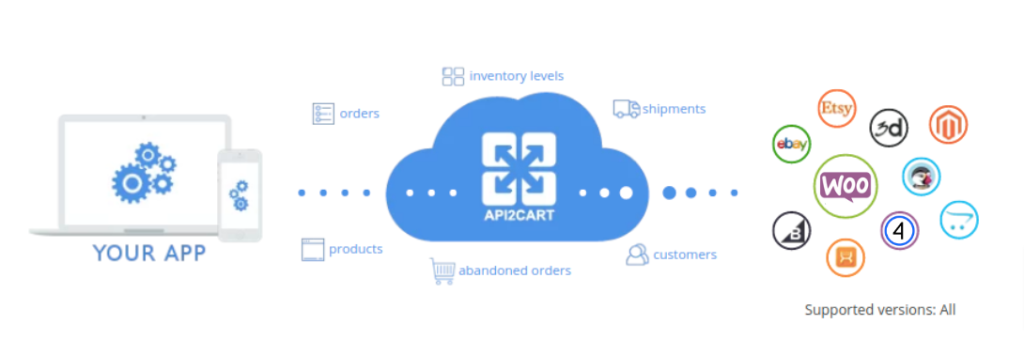
This approach reduces the amount of platform-specific integration logic that development teams need to build. API2Cart handles connections with supported shopping platforms, while your software works with standardized API methods for products, orders, customers, categories, inventory, shipments, and other available data.
Moreover, API2Cart maintains its supported platform integrations as eCommerce APIs evolve. Therefore, software vendors can focus more development resources on their own product functionality instead of maintaining a growing portfolio of individual connectors.
You can learn more about the integration architecture on the API2Cart How It Works page.
Retrieve Orders Through One Unified API
For example, software that provides order management, inventory, shipping, or fulfillment functionality often needs to retrieve orders from its customers' stores. API2Cart provides the order.list method for retrieving a list of orders and supported related information from a connected store.
Instead of implementing a different order retrieval workflow inside your application for every supported shopping platform, your software can send a request through the API2Cart interface.
GET https://api.api2cart.com/v1.1/order.list.json?count=10

Headers:
x-api-key: YOUR_API_KEY
x-connection-key: YOUR_CONNECTION_KEY
A successful response follows a unified structure. For example:
{
  "return_code": 0,
  "return_message": "",
  "result": {
    "orders_count": 2,
    "order": [
      {
        "id": "12345",
        "status": {
          "id": "completed",
          "name": "Completed"
        },
        "total": 149.99,
        "currency": "USD"
      }
    ]
  }
}
Once the order data is returned, your application can use it within its own workflows. For instance, an OMS can process the order, while an inventory system can recalculate stock. Shipping software can also use the available data to prepare the next fulfillment step.
Available response fields depend on the connected platform, request parameters, store data, and supported functionality. For current parameters and response details, see the order.list API documentation.
Conclusion
For software that exchanges data with eCommerce platforms, an API to cart connection can become a core part of the integration infrastructure. However, supporting more shopping carts through separate integrations also means handling different authentication models, data structures, API behavior, updates, and maintenance requirements.
Using a unified API changes this architecture. With API2Cart, software vendors can work with supported commerce data across 80+ eCommerce platforms and marketplaces through one integration layer. As a result, development teams can expand platform coverage without building every shopping cart connection from scratch.
The same integration can support multiple workflows involving orders, products, inventory, shipping, customers, and other available eCommerce data.
Ready to connect your software with multiple eCommerce platforms through one API?
Create your API2Cart account for free and start building your integration.
API to Cart FAQs
What is an API to cart integration?
An API to cart integration connects software with an eCommerce platform to exchange store data programmatically. For example, applications can work with supported orders, products, inventory, customers, and shipments. As a result, software vendors can automate workflows instead of transferring data manually.
What data can a shopping cart API provide?
A shopping cart API can provide access to products, orders, customers, inventory, prices, categories, shipments, and other supported commerce data. Available resources depend on the platform, API permissions, and endpoints. Therefore, developers should verify platform capabilities for each required workflow.
Can one API connect software to multiple shopping carts?
Yes. A unified eCommerce API can provide one integration layer for multiple supported shopping carts and marketplaces. Instead of building every connector separately, software vendors can work through a common API interface. Platform-specific capabilities and requirements may still differ.
How does API2Cart simplify shopping cart API integration?
API2Cart provides one unified API for 80+ supported eCommerce platforms and marketplaces. Software vendors can use common API methods to work with supported products, orders, customers, inventory, shipments, and other data. Moreover, API2Cart maintains its supported platform connections as eCommerce APIs evolve.