Quick Definition: TikTok API provides programming interfaces that allow developers to connect software applications with TikTok services. For eCommerce software vendors, TikTok Shop APIs provide access to supported commerce operations involving products, orders, fulfillment, shops, and other store data. API2Cart simplifies TikTok Shop integration through one unified API for TikTok Shop and 80+ other eCommerce integrations.
TikTok Shop API integration enables eCommerce software vendors to connect their applications with a rapidly expanding social commerce channel. In Europe alone, more than 100,000 businesses have joined TikTok Shop. Moreover, daily GMV across France, Germany, Italy, Spain, and Ireland recorded triple-digit growth between August 2025 and February 2026.
For SaaS vendors, this growth creates demand for software that can connect with TikTok Shop and automate commerce workflows. For example, OMS, ERP, PIM, inventory management, shipping, and multichannel solutions can use supported interfaces to exchange data with connected stores.
However, developers need to account for authorization, access scopes, API versions, request requirements, and platform-specific data structures. The official TikTok API documentation provides current technical requirements, while a unified integration solution can reduce the amount of platform-specific development needed for multi-channel SaaS products.
This guide explains TikTok API integration for eCommerce developers, including available capabilities, authentication, common integration challenges, and practical use cases. In addition, it shows how API2Cart can help SaaS vendors add TikTok Shop support alongside other eCommerce platforms.
What Is the TikTok API and How Does It Work?
TikTok provides several APIs for different developer use cases, while TikTok Shop APIs specifically enable eCommerce applications to work with supported shop, product, order, inventory, and fulfillment data. For software vendors, these interfaces make it possible to connect OMS, ERP, PIM, shipping, inventory management, and other eCommerce systems with TikTok Shop.
TikTok Shop uses authorization and access scopes to control which store data an application can access. For example, available scopes cover product information, order data, fulfillment operations, logistics, and authorized shop information. Therefore, an application must obtain the appropriate permissions before working with protected seller data.
In addition, TikTok Shop uses versioned API endpoints. Because API capabilities and versions evolve over time, developers should regularly check the official TikTok API documentation and changelog when maintaining an integration.
Essential TikTok Shop API Features and Functionality
TikTok Shop APIs support the core commerce workflows that eCommerce software vendors need to connect external systems with TikTok Shop. Depending on the application's approved scopes and use case, developers can work with capabilities such as:
- Product management: create, edit, retrieve, and synchronize product catalog data
- Order management: retrieve order lists and individual order details
- Inventory synchronization: work with product inventory as part of supported catalog workflows
- Fulfillment: process supported fulfillment workflows and provide shipping information
- Logistics: work with supported logistics, warehouse, and tracking information
- Webhooks: receive supported events such as order status and product review updates

For example, an order management system can import TikTok Shop orders and coordinate downstream fulfillment, while a PIM or ERP system can synchronize supported product and inventory data. As a result, these APIs can become part of a broader multi-channel commerce workflow rather than functioning only as social media integrations.
How to Get Started with TikTok Shop API Integration
Getting started with TikTok Shop API integration requires developers to create an application, configure the required access scopes, implement seller authorization, and test API requests before moving to production.
- Create and configure your application: Set up your app in TikTok Shop Partner Center and obtain the required application credentials, including the App Key and App Secret.
- Select the required access scopes: Enable the API scopes your application needs. Depending on the integration, these may cover products, orders, fulfillment, logistics, shop information, and other supported commerce data.
- Implement seller authorization: Allow the seller to authorize access to their TikTok Shop. After authorization, exchange the returned authorization code for the access and refresh tokens required by your application.
- Build authenticated API requests: Use the required access token, application credentials, request signature, timestamp, and other parameters defined for each endpoint.
- Test the integration: Use TikTok Shop development and testing tools to verify authorization, permissions, requests, responses, and error handling before launching the integration.
- Maintain the connection: Monitor API changes, token expiration, authorization status, errors, and version updates to keep the integration working correctly over time.
What Are the Best Practices for TikTok API Integration?
A reliable TikTok Shop integration should account for authorization, API scopes, errors, version changes, and platform-specific requirements from the beginning. This is especially important for SaaS products that need to maintain connections for multiple merchants.
- Request only the API scopes required for your application's functionality.
- Store access and refresh tokens securely and handle token renewal correctly.
- Validate API responses and implement appropriate error handling and retry logic.
- Monitor API version changes and update the integration when TikTok Shop requirements change.
- Test platform-specific workflows before enabling them for production merchants.
- Verify that each required method and data field is supported for your integration scenario.
TikTok Shop Integration via API2Cart
API2Cart provides a unified API for connecting eCommerce software with TikTok Shop and 80+ other eCommerce integrations. Instead of implementing separate data models and methods for every supported platform, SaaS vendors can work with standardized API2Cart methods where the required functionality is supported.
Depending on platform support, API2Cart methods can provide access to commerce data and operations such as:
- Products: retrieve and work with supported product information, variants, images, pricing, and inventory data.
- Orders: retrieve order information and work with supported order operations.
- Customers: access supported customer information associated with commerce workflows.
- Shipping and fulfillment: work with supported shipment, tracking, and fulfillment data.
- Categories: retrieve and work with supported product category information.
TikTok Shop API Example with API2Cart
The following response shows the structure returned by the API2Cart category.list method:
{
  "return_code": 0,
  "return_message": "string",
  "pagination": {
    "previous": "string",
    "next": "string",
    "additional_fields": {},
    "custom_fields": {}
  },
  "result": {
    "categories_count": 0,
    "category": [
      {
        "id": "string",
        "parent_id": "string",
        "created_at": {
          "value": "string",
          "format": "string",
          "additional_fields": {},
          "custom_fields": {}
        },
        "modified_at": {
          "value": "string",
          "format": "string",
          "additional_fields": {},
          "custom_fields": {}
        },
        "name": "string",
        "short_description": "string",
        "description": "string",
        "stores_ids": [
          "string"
        ],
        "keywords": "string",
        "meta_description": "string",
        "meta_title": "string",
        "avail": true,
        "path": "string",
        "seo_url": "string",
        "sort_order": 0,
        "images": [
          {
            "id": "string",
            "http_path": "string",
            "file_name": "string",
            "mime-type": "string",
            "size": 0,
            "create_at": {
              "value": "string",
              "format": "string",
              "additional_fields": {},
              "custom_fields": {}
            },
            "modified_at": {
              "value": "string",
              "format": "string",
              "additional_fields": {},
              "custom_fields": {}
            },
            "alt": "string",
            "avail": true,
            "sort_order": 0,
            "type": "string",
            "additional_fields": {},
            "custom_fields": {}
          }
        ],
        "additional_fields": {},
        "custom_fields": {}
      }
    ],
    "additional_fields": {},
    "custom_fields": {}
  },
  "additional_fields": {},
  "custom_fields": {}
}
According to the TikTok API documentation, method and parameter availability can depend on the connected platform. Therefore, developers should verify TikTok Shop support for each required operation before implementing a workflow.
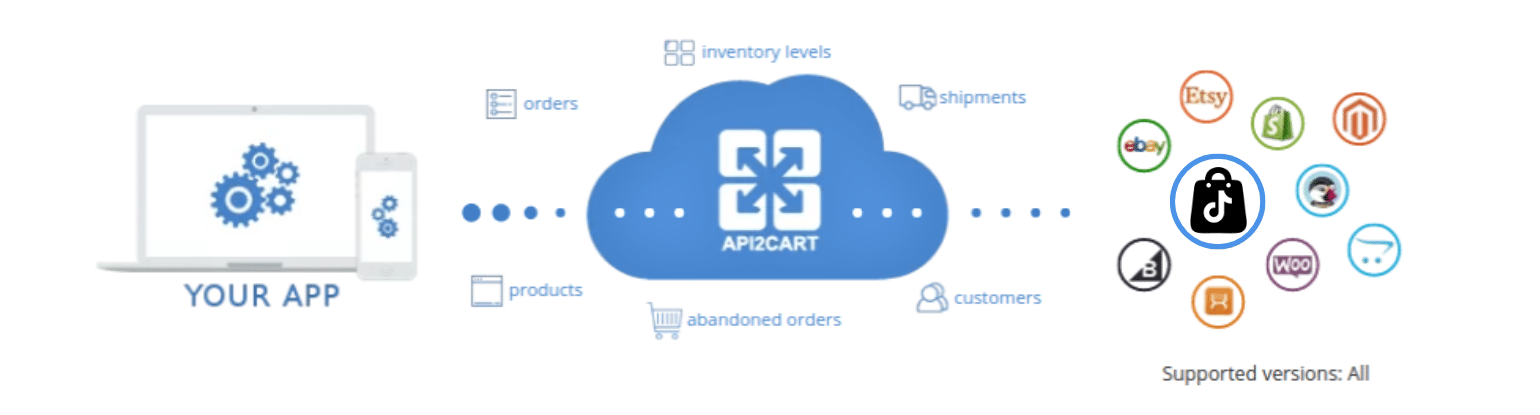
For multi-platform SaaS products, this unified approach can reduce the amount of platform-specific integration logic that development teams need to maintain. Moreover, API2Cart maintains its platform connectors, allowing software vendors to focus more of their development effort on their own product workflows.
To evaluate the integration for your SaaS product, create a free API2Cart account and test the supported TikTok Shop methods.
Conclusion
TikTok Shop integration enables eCommerce software vendors to connect their applications with an important social commerce channel and support product, order, inventory, and fulfillment workflows. However, developers need to account for authorization, API scopes, platform-specific requirements, and ongoing API changes.
For SaaS products that support multiple eCommerce platforms, API2Cart provides a unified API for TikTok Shop and 80+ other eCommerce integrations. As a result, developers can use standardized methods while reducing the amount of platform-specific integration logic they need to maintain.
To evaluate the available TikTok Shop functionality for your software, create a free API2Cart account and test the supported methods.
FAQs
Who is TikTok API integration relevant for?
TikTok Shop integration is relevant for eCommerce SaaS vendors that need to connect their software with an additional commerce channel. This includes OMS, ERP, PIM, inventory management, WMS, shipping, multichannel, and other eCommerce solutions.
For these applications, TikTok Shop can become another source of product, order, inventory, and fulfillment data alongside traditional eCommerce platforms and marketplaces.
What eCommerce data can developers access through TikTok Shop APIs?
Depending on the application's permissions and available API scopes, TikTok Shop APIs support commerce workflows involving products, orders, inventory, fulfillment, logistics, and shop information.
For example, eCommerce software can use supported data to synchronize product catalogs, import orders, update inventory, and coordinate fulfillment. However, developers should verify the scopes and endpoints required for each specific workflow.
How does API2Cart simplify TikTok API integration?
API2Cart provides a unified API for TikTok Shop and 80+ other eCommerce integrations. Therefore, SaaS vendors can use standardized methods across supported platforms instead of developing a completely separate integration layer for each one.
Depending on platform support, developers can work with products, orders, customers, categories, inventory, shipping, and other commerce data. In addition, API2Cart maintains its platform connectors, reducing the amount of platform-specific integration logic SaaS teams need to maintain.
Where can developers find the TikTok API documentation?
The official TikTok API documentation is available through TikTok's developer and TikTok Shop developer resources. Developers should use the current documentation to verify authentication requirements, access scopes, endpoint versions, request parameters, and supported operations.
For integrations built through API2Cart, developers should also check the API2Cart documentation for TikTok Shop to verify which unified methods and parameters are supported for the platform.