Marketplaces have become popular because they connect supply and demand in one place. Buyers can compare products or services, while sellers can reach a wider audience. As a result, many entrepreneurs and software teams now look for ways to build marketplace website projects as a new digital business model.
Marketplace growth also confirms this trend. According to Digital Commerce 360, the Top 100 online marketplaces were projected to reach $3.832 trillion in GMV by the end of 2024. In addition, marketplaces accounted for 83.4% of global GMV in 2025. Therefore, building a marketplace website remains a strong opportunity for companies that want to enter online commerce.
However, before you build an online marketplace, you need to study the market first. Define your target audience, check demand, review your resources, and estimate potential profit. After that, you can plan the core features your marketplace needs.
Below, we outline the key elements to include when you build a marketplace website.
What Is a Marketplace Website?
A marketplace website connects buyers and sellers in one digital space. Sellers can list products or services. Buyers can compare offers, prices, delivery options, and seller terms.
For example, Airbnb connects hosts with travelers, Uber connects drivers with riders, Etsy connects creators with buyers, and Alibaba connects suppliers with business customers. Each model works differently. However, the core idea is the same: the platform manages interactions between two or more user groups.
If you plan to build marketplace website functionality, define the business model first. In addition, plan seller onboarding, product catalog structure, payments, order workflows, and data synchronization. For a deeper look at large-scale B2B models, check our Amazon vs Alibaba B2B eCommerce comparison.
What Are the Benefits When You Build Marketplace Website Projects?
1. Efficient platform for vendors
A marketplace website gives vendors one place to list, manage, and sell products or services. As a result, sellers can reach more customers and run daily operations through one platform.
2. Multiple revenue streams
If you build a marketplace website, you can use several revenue models. For example, you can earn from listing fees, subscriptions, commissions, advertising, premium seller tools, and extra services.
3. Business automation
Marketplace owners often earn revenue from commissions. However, this model works best when core workflows are automated. The platform can manage listings, orders, payments, notifications, and seller activity with less manual work.
4. Value for buyers and sellers
A marketplace creates value for both sides. Buyers get more choice, secure transactions, and a better user experience. At the same time, sellers can reach new customers, lower sales costs, and grow their brand.
5. Scalable business model
A marketplace can grow quickly when supply and demand increase together. More traffic attracts more vendors. In turn, strong vendors attract more buyers. Therefore, this model can support fast two-sided growth.
Now, let’s review the core elements you need before you build a marketplace website.
Basic Elements You Need to Build Marketplace Website Functionality

1. Business model
Start by defining your business model. Decide which customers you want to target, what services you will provide, and which industry you will enter.
You can build a marketplace website based on several models:
- Type of participants: Customer-to-Customer (C2C), Business-to-Customer (B2C), or Business-to-Business (B2B)
- Type of products: goods or services
- Type of interaction: online commerce or online-to-offline
In addition, choose between vertical and horizontal marketplace models.
- Vertical marketplace: a platform focused on one niche, industry, product type, or service category.
- Horizontal marketplace: a platform that offers different goods or services connected by one shared audience or use case.
Whichever model you choose, your marketplace should create clear value for both buyers and sellers.
2. Software platform
The next step is to select marketplace software or a technical platform. This platform will support transactions, seller workflows, product catalog, and marketplace operations.
You have two main options.
- Use an existing platform or ready-made software
This option works well if you need to launch faster. For example, you can use ready-made software or build on platforms such as Magento, Shopify, WooCommerce, or other eCommerce systems.
You can also choose an open-source solution if you need more control. However, this option requires stronger technical resources.
- Build a custom marketplace website
If you need full control over business logic, you can create a custom marketplace from scratch. As a result, your team can design unique workflows, seller tools, buyer features, and admin functionality.
However, custom development usually takes more time and budget. Therefore, plan feature scope, integrations, support, and future maintenance before development starts.
3. Development team
If you decide to build a custom marketplace, you need an experienced development team. This team will turn your idea into a working product.
An in-house team gives you more control over the roadmap, user experience, and technical architecture. In addition, developers can adapt features to your business goals.
At the same time, hiring and managing an in-house team can be expensive. You need to cover salaries, tools, training, infrastructure, and long-term support. Therefore, this model works best when you have enough budget and a clear product strategy.
4. Payment system integration
After setting up the marketplace, you need to integrate payment functionality. This allows buyers to pay sellers and helps your platform manage transactions.
Common payment providers include Stripe, PayPal, Amazon Pay, and regional options. However, the best choice depends on your market, seller location, buyer preferences, and transaction model.
Before choosing a provider, research payment habits in your target market. In addition, check fees, payout rules, supported countries, and fraud protection options. This helps you avoid payment issues after launch.
5. Third-party solution for integration
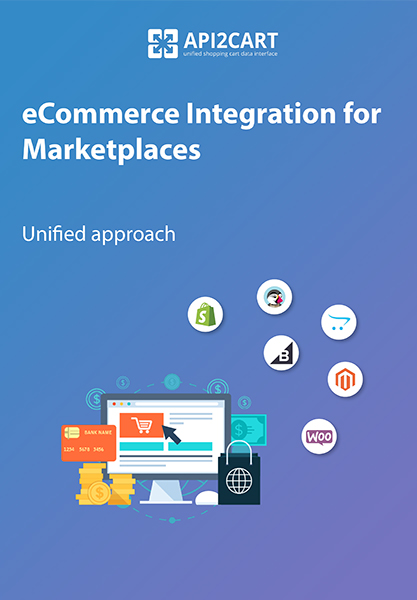
Shopping Platform Integration for Marketplace Websites
Explore how to develop integrations with multiple shopping solutions more easily.
Shopping cart integration is essential when you build marketplace website functionality. It connects your marketplace with sales channels and gives access to product, customer, order, shipment, and inventory data.
However, building separate integrations with many platforms is difficult. Each platform has its own API structure, data logic, limits, and maintenance needs.
For example, your development team may need extra training and more time to support each integration. As a result, the project can become more costly and harder to scale.
A faster option is to use a third-party solution like API2Cart. API2Cart provides a unified shopping cart and marketplace API that helps connect your marketplace with 80+ eCommerce platforms and shopping carts through one integration.
Furthermore, API2Cart helps reduce separate maintenance and updates. Using API2Cart, your marketplace can communicate with stores based on Shopify, Magento, WooCommerce, BigCommerce, eBay, and other platforms.
How API2Cart Helps Solve Marketplace Integration Challenges
When businesses build marketplace website functionality, reliable data synchronization becomes one of the biggest technical challenges. Marketplaces process large volumes of orders, products, and inventory updates across multiple connected platforms.
However, different eCommerce systems handle API pagination in different ways. Some platforms use offset-based pagination, while others rely on cursor-based logic. Inconsistent implementations can lead to duplicate records, missing data, and synchronization failures.
In one real-world integration case, our engineering team discovered an issue where a marketplace API generated endless page cursors. The first request returned valid order data, but each subsequent request delivered the same records repeatedly instead of loading the next page.
This created duplicate processing and prevented accurate marketplace synchronization.
To resolve the issue, API2Cart implemented advanced cursor validation with duplicate-response detection and fallback pagination logic. If two consecutive cursors return identical datasets, the synchronization cycle stops automatically and switches to an alternative retrieval strategy.
As a result, the integration remained stable, duplicate order processing was eliminated, and marketplace data synchronization became significantly more reliable.
This is one example of how API2Cart helps businesses build marketplace website projects faster by handling platform-specific API inconsistencies through one unified integration layer.
Conclusion
To build a marketplace website that supports real business growth, you need more than a basic storefront. You need a clear business model, the right software platform, payment functionality, reliable integrations, and scalable data workflows.
However, connecting your marketplace with multiple eCommerce platforms can quickly become complex. Each platform has its own API logic, data structure, limits, and maintenance requirements.
API2Cart helps simplify this part by providing one unified API for connecting with 70+ eCommerce platforms and marketplaces. As a result, your team can access product, order, customer, shipment, and inventory data without building every integration from scratch.
If you want to reduce development effort while building marketplace functionality, you can start your free API2Cart trial and test how unified integration works for your business.
FAQs
What features should a successful online marketplace have?
A successful online marketplace should combine trust, scalability, and a seamless user experience for both buyers and sellers. First of all, it should provide simple seller onboarding, secure payment processing, efficient order management, and real-time inventory synchronization.
In addition, strong integrations with multiple eCommerce platforms are essential. Therefore, marketplace operators can synchronize products, orders, and customer data automatically, which helps maintain operational efficiency as the platform grows.
How do you build a scalable online marketplace website?
Building a scalable online marketplace starts with defining your niche, audience, and business model, whether B2B, B2C, or C2C. After that, developers typically choose between ready-made marketplace platforms such as Shopify, WooCommerce, Magento, or custom-built solutions.
Moreover, integrating payment gateways and third-party services is critical for long-term scalability. For example, by using API2Cart, software providers can connect with 70+ eCommerce platforms through a single integration and manage products, orders, inventory, shipments, and customer data efficiently.