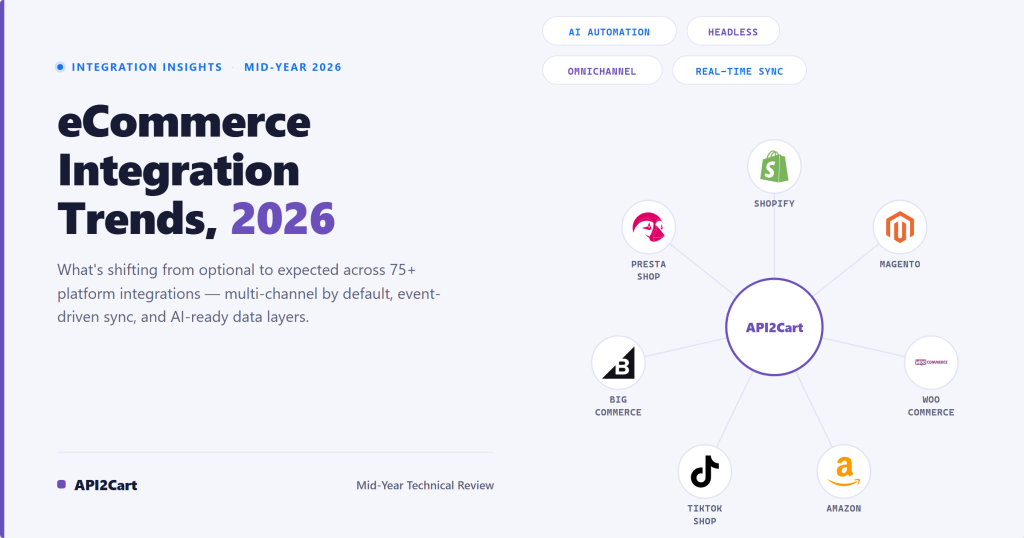
Quick Definition: Temu API is a set of programming interfaces that allows software vendors to connect their applications with Temu and automate product, order, inventory, and fulfillment data exchange. API2Cart helps developers build Temu integrations through one unified API that also supports 80+ eCommerce platforms and marketplaces.
The Temu API helps eCommerce software vendors build reliable Temu integrations for one of the world's fastest-growing online marketplaces. As demand for Temu API integration continues to grow, developers use the Temu Developer API to access marketplace data, while the Temu Product API supports product synchronization, catalog management, and inventory updates across connected applications. According to recent statistics, Temu has 416.5 million monthly active users worldwide. In 2025, the platform reached 133.6 million monthly active users in the United States, 141.6 million in the European Union, and 13.1 million in the United Kingdom.
The Temu API enables software vendors to automate order management, synchronize inventory, manage product catalogs, and streamline shipping workflows. As a result, companies can connect their applications with the marketplace more efficiently.
This guide explains how the Temu API works, the main challenges of direct integration, and how API2Cart helps software companies connect with Temu and 80+ eCommerce platforms and marketplaces through one unified API.
What is the Temu API?
The Temu API is a collection of endpoints that enables software vendors to integrate their applications with the Temu marketplace. Through the Temu Developer API, SaaS providers can automate data exchange, synchronize marketplace information, and deliver valuable features for Temu sellers. As a result, businesses can reduce manual work while improving data accuracy.
Using the official Temu API documentation, developers can:
- Retrieve and update product information, including titles, descriptions, prices, images, and stock levels.
- Access and manage orders, shipment details, tracking information, and order statuses.
- Synchronize inventory across connected systems and sales channels.
- Build reliable Temu API integration for order management, product management, and fulfillment software.
In addition, the Temu Product API allows software vendors to synchronize product data efficiently across multiple applications. Consequently, SaaS solutions can keep catalogs accurate, automate product updates, and reduce maintenance effort as their customers grow.
What Are the Key Benefits of Temu API Integration?
Integrating with the Temu API allows eCommerce software vendors to expand their platform capabilities and support one of the fastest-growing online marketplaces. As a result, SaaS providers can deliver more value to their customers while strengthening their competitive position.
1. Reach More Potential Customers
Supporting Temu enables software vendors to serve a growing community of marketplace sellers across multiple regions. Consequently, SaaS companies can attract new customers without developing a separate product for each market.
2. Expand Multi-Channel Capabilities
For multichannel software, connecting with the Temu marketplace adds another sales channel alongside other popular eCommerce platforms. Therefore, merchants can manage products, orders, and inventory from a single application instead of switching between multiple systems.
3. Strengthen Your Product Offering
Built-in Temu API integration helps differentiate your software from competing solutions. Moreover, it demonstrates that your platform supports modern marketplaces and evolving merchant requirements, making your product more attractive to prospective customers.
4. Support Global Business Growth
As Temu continues to expand internationally, software vendors can reach merchants in new markets through a single integration. This way, SaaS companies can grow their customer base while supporting businesses that sell across multiple regions.
5. Generate New Revenue Opportunities
Adding Temu integration creates opportunities to acquire new customers, increase subscription value, and reduce customer churn. In addition, marketplace integrations can become a valuable differentiator for premium plans and enterprise offerings.
Overall, investing in Temu API integration helps software vendors deliver more complete eCommerce solutions while preparing their products for continued marketplace growth.

Challenges of Temu API Integration
Although the Temu API allows software vendors to build powerful marketplace integrations, direct implementation can present several technical challenges. Therefore, development teams should consider both the initial integration effort and the long-term maintenance required to keep the connection reliable.
1. Evolving API Documentation
As a rapidly growing marketplace, Temu continues to expand its developer ecosystem. Consequently, API documentation, available endpoints, and implementation requirements may evolve over time.Development teams should regularly review documentation and validate their integrations to ensure continued compatibility.
2. Ongoing API Maintenance
Marketplace APIs change as new features, security improvements, and business requirements are introduced. As a result, software vendors must continuously monitor updates, test their integrations, and adapt their applications to avoid service disruptions.
3. Data Mapping Across Systems
Temu uses its own data models for products, orders, inventory, and fulfillment. However, most SaaS platforms store this information differently. Therefore, developers need to build mapping logic that translates marketplace data into their application's internal structure while preserving data accuracy.
4. Scaling Multiple Marketplace Integrations
Many software vendors support more than one marketplace. Instead of maintaining only a Temu connection, they often need integrations with Shopify, WooCommerce, Magento, Amazon, eBay, and other platforms. Consequently, maintaining separate APIs for every platform significantly increases development effort, testing, and ongoing support.
Overall, these challenges can increase development costs and slow product delivery. Therefore, many software companies choose a unified integration approach that reduces maintenance while simplifying marketplace connectivity.
Temu API Documentation: Endpoints, Authentication & Response Reference
The Temu API is available through the Temu Open Platform, where approved partners can access developer resources and marketplace services. The Temu Developer API enables software vendors to connect with the marketplace, while the Temu Product API provides access to product data used for synchronization and catalog management.
For SaaS companies that need reliable Temu API integration without building and maintaining a direct marketplace connection, API2Cart offers a unified REST API. Instead of working with marketplace-specific implementations, developers use one standardized interface to retrieve products, orders, inventory, customers, and other store data across 80+ eCommerce platforms and marketplaces. The endpoint reference below demonstrates the Temu-compatible methods available through API2Cart.
Core API Endpoints for Temu Integration
The following API2Cart endpoints provide access to the most common Temu marketplace resources. Using these methods, developers can retrieve products, orders, inventory, and store information through one standardized REST API.
product.list
GET /product.list.json
Returns a paginated list of products, including SKUs, prices, inventory levels, and variants.
product.info
GET /product.info.json
Returns detailed product information, including attributes, images, categories, and variants.
product.count
GET /product.count.json
Returns the total number of products available in the connected Temu store.
order.list
GET /order.list.json
Returns a paginated list of orders with statuses, customer details, shipping information, and line items.
order.info
GET /order.info.json
Returns complete order information, including fulfillment, payment, customer, and shipping details.
order.statusList
GET /order.statusList.json
Returns all available order statuses for the connected Temu store.
store.info
GET /store.info.json
Returns store information, including the store name, currency, language, and timezone.
Authentication
API2Cart authenticates requests using the X-Api-Key and X-Store-Key HTTP headers. After connecting a Temu store, API2Cart issues a unique store key that identifies the marketplace connection. Therefore, developers do not need to implement OAuth or manage Temu partner credentials directly, because API2Cart handles the authentication workflow behind the scenes.
Temu Seller API: What Sellers Can Access
The Temu Seller API is designed for sellers and the software solutions that support their marketplace operations. Through API2Cart, SaaS applications can access Temu marketplace data and automate common business processes without building a separate marketplace integration.
Using the Temu Seller API, software vendors can:
- Retrieve product listings and synchronize inventory across multiple sales channels.
- Access order details, shipping information, and order status updates.
- Sync customer and order data with CRM, ERP, OMS, and reporting systems.
- Monitor fulfillment workflows to automate logistics and post-purchase processes.
Although the Temu Seller Center provides merchants with a web interface for managing their stores, API access enables software vendors to automate the same operations programmatically. As a result, developers can synchronize Temu data with business applications, build multi-channel workflows, and scale marketplace integrations more efficiently.
Sample Response for the order.list Method
The example below shows a typical response returned by the order.list method for Temu. This method retrieves order information, including customer details, order status, totals, shipping address, and purchased products.
{
  "return_code": 0,
  "return_message": "string",
  "pagination": {
    "previous": "string",
    "next": "string",
    "additional_fields": {},
    "custom_fields": {}
  },
  "result": {
    "orders_count": 0,
    "order": [
      {
        "id": "string",
        "order_id": "string",
        "basket_id": "string",
        "channel_id": "string",
        "customer": {
          "id": "string",
          "email": "string",
          "first_name": "string",
          "last_name": "string",
          "phone": "string",
          "additional_fields": {},
          "custom_fields": {}
        },
        "create_at": {
          "value": "string",
          "format": "string",
          "additional_fields": {},
          "custom_fields": {}
        },
        "currency": {
          "id": "string",
          "name": "string",
          "iso3": "string",
          "symbol_left": "string",
          "symbol_right": "string",
          "rate": 0,
          "avail": true,
          "default": true,
          "additional_fields": {},
          "custom_fields": {}
        },
        "shipping_address": {
          "id": "string",
          "type": "string",
          "first_name": "string",
          "last_name": "string",
          "postcode": "string",
          "address1": "string",
          "address2": "string",
          "phone": "string",
          "phone_mobile": "string",
          "city": "string",
          "country": {
            "code2": "string",
            "code3": "string",
            "name": "string",
            "additional_fields": {},
            "custom_fields": {}
          },
          "state": {
            "code": "string",
            "name": "string",
            "additional_fields": {},
            "custom_fields": {}
          },
          "company": "string",
          "fax": "string",
          "website": "string",
          "gender": "string",
          "region": "string",
          "default": true,
          "tax_id": "string",
          "identification_number": "string",
          "alias": "string",
          "additional_fields": {},
          "custom_fields": {}
        },
        "billing_address": {
          "id": "string",
          "type": "string",
          "first_name": "string",
          "last_name": "string",
          "postcode": "string",
          "address1": "string",
          "address2": "string",
          "phone": "string",
          "phone_mobile": "string",
          "city": "string",
          "country": {
            "code2": "string",
            "code3": "string",
            "name": "string",
            "additional_fields": {},
            "custom_fields": {}
          },
          "state": {
            "code": "string",
            "name": "string",
            "additional_fields": {},
            "custom_fields": {}
          },
          "company": "string",
          "fax": "string",
          "website": "string",
          "gender": "string",
          "region": "string",
          "default": true,
          "tax_id": "string",
          "identification_number": "string",
          "alias": "string",
          "additional_fields": {},
          "custom_fields": {}
        },
        "payment_method": {
          "name": "string",
          "additional_fields": {},
          "custom_fields": {}
        },
        "shipping_method": {
          "name": "string",
          "additional_fields": {},
          "custom_fields": {}
        },
        "shipping_methods": [
          {
            "name": "string",
            "additional_fields": {},
            "custom_fields": {}
          }
        ],
        "status": {
          "id": "string",
          "name": "string",
          "history": [
            {
              "id": "string",
              "name": "string",
              "modified_time": {
                "value": "string",
                "format": "string",
                "additional_fields": {},
                "custom_fields": {}
              },
              "notify": true,
              "comment": "string",
              "additional_fields": {},
              "custom_fields": {}
            }
          ],
          "refund_info": {
            "shipping": 0,
            "fee": 0,
            "tax": 0,
            "total_refunded": 0,
            "time": {
              "value": "string",
              "format": "string",
              "additional_fields": {},
              "custom_fields": {}
            },
            "comment": "string",
            "refunded_items": [
              {
                "product_id": "string",
                "variant_id": "string",
                "order_product_id": "string",
                "qty": 0,
                "refund": 0,
                "additional_fields": {},
                "custom_fields": {}
              }
            ],
            "additional_fields": {},
            "custom_fields": {}
          },
          "additional_fields": {},
          "custom_fields": {}
        },
        "totals": {
          "total": 0,
          "subtotal": 0,
          "shipping": 0,
          "tax": 0,
          "discount": 0,
          "additional_fields": {},
          "custom_fields": {}
        },
        "total": {
          "subtotal_ex_tax": 0,
          "wrapping_ex_tax": 0,
          "shipping_ex_tax": 0,
          "total_discount": 0,
          "total_tax": 0,
          "total": 0,
          "total_paid": 0,
          "additional_fields": {},
          "custom_fields": {}
        },
        "discounts": [
          {
            "code": "string",
            "value": 0,
            "type": "string",
            "additional_fields": {},
            "custom_fields": {}
          }
        ],
        "order_products": [
          {
            "product_id": "string",
            "order_product_id": "string",
            "model": "string",
            "name": "string",
            "price": 0,
            "price_inc_tax": 0,
            "quantity": 0,
            "discount_amount": 0,
            "total_price": 0,
            "tax_percent": 0,
            "tax_value": 0,
            "tax_value_after_discount": 0,
            "options": [
              {
                "option_id": "string",
                "name": "string",
                "value": "string",
                "price": 0,
                "weight": 0,
                "type": "string",
                "product_option_value_id": "string",
                "additional_fields": {},
                "custom_fields": {}
              }
            ],
            "variant_id": "string",
            "weight_unit": "string",
            "weight": 0,
            "barcode": "string",
            "parent_order_product_id": "string",
            "additional_fields": {},
            "custom_fields": {}
          }
        ],
        "bundles": [
          {
            "product_id": "string",
            "order_product_id": "string",
            "model": "string",
            "name": "string",
            "price": 0,
            "price_inc_tax": 0,
            "quantity": 0,
            "discount_amount": 0,
            "total_price": 0,
            "tax_percent": 0,
            "tax_value": 0,
            "tax_value_after_discount": 0,
            "options": [
              {
                "option_id": "string",
                "name": "string",
                "value": "string",
                "price": 0,
                "weight": 0,
                "type": "string",
                "product_option_value_id": "string",
                "additional_fields": {},
                "custom_fields": {}
              }
            ],
            "variant_id": "string",
            "weight_unit": "string",
            "weight": 0,
            "barcode": "string",
            "parent_order_product_id": "string",
            "additional_fields": {},
            "custom_fields": {}
          }
        ],
        "modified_at": {
          "value": "string",
          "format": "string",
          "additional_fields": {},
          "custom_fields": {}
        },
        "finished_time": {
          "value": "string",
          "format": "string",
          "additional_fields": {},
          "custom_fields": {}
        },
        "comment": "string",
        "store_id": "string",
        "warehouses_ids": [
          "string"
        ],
        "refunds": [
          {
            "id": "string",
            "shipping": 0,
            "fee": 0,
            "tax": 0,
            "total": 0,
            "modified_time": {
              "value": "string",
              "format": "string",
              "additional_fields": {},
              "custom_fields": {}
            },
            "comment": "string",
            "items": [
              {
                "product_id": "string",
                "variant_id": "string",
                "order_product_id": "string",
                "qty": 0,
                "refund": 0,
                "additional_fields": {},
                "custom_fields": {}
              }
            ],
            "additional_fields": {},
            "custom_fields": {}
          }
        ],
        "gift_message": "string",
        "order_details_url": "string",
        "additional_fields": {},
        "custom_fields": {}
      }
    ],
    "additional_fields": {},
    "custom_fields": {}
  },
  "additional_fields": {},
  "custom_fields": {}
}
The response includes the order ID, status, creation and modification dates, customer information, order totals, shipping address, and purchased products. For stores with multiple orders, the pagination object provides previous and next values for navigating through the result set.
For a complete list of supported request parameters, filters, and response fields, refer to the order.list API documentation.
How API2Cart Simplifies Temu API Integration
Building a direct Temu API integration requires development resources, platform-specific logic, regular testing, and ongoing maintenance. Moreover, integration complexity increases when software vendors need to support additional marketplaces and eCommerce platforms.
API2Cart simplifies this process by providing one unified REST API for connecting software with Temu and 80+ eCommerce platforms and marketplaces. Instead of building and maintaining separate integrations, developers work with one standardized API and consistent data structures.

Why Use API2Cart for Temu Integration?
One Unified Integration
Connect your software with Temu and 80+ eCommerce platforms and marketplaces through one API.
100+ Unified API Methods
Retrieve and synchronize products, orders, inventory, customers, shipments, and other store data through standardized API methods.
Standardized Data Models
Reuse the same request and response structures across every supported marketplace and shopping cart.
Lower Maintenance Costs
API2Cart handles platform updates and compatibility changes, allowing your team to focus on building product features instead of maintaining integrations.
Standardized Product Data Response
All API2Cart methods follow the same request and response structure, regardless of the connected platform. For example, theproduct.list method returns standardized product data that can be processed using the same integration logic across multiple marketplaces.
Explore the complete Temu API method reference to discover all available endpoints and supported resources.
API2Cart also manages platform-specific API updates and compatibility changes behind the scenes. Consequently, software vendors can maintain reliable integrations while significantly reducing development and long-term maintenance effort.
Build Your Temu Integration Faster
Whether you're building an ERP, PIM, OMS, shipping platform, multichannel solution, or another eCommerce SaaS application, API2Cart helps you launch Temu integration much faster through one unified API. Moreover, the same integration architecture enables your software to connect with dozens of additional platforms without extra development.
To learn more about the supported functionality, visit our Temu integration page, where you'll find supported methods, platform capabilities, and implementation details.
Conclusion
The Temu API enables software vendors to automate product synchronization, inventory management, order processing, and other marketplace operations. However, building and maintaining a direct integration requires continuous development effort, platform-specific expertise, and ongoing adaptation to API changes.
API2Cart simplifies this process by providing one unified REST API that connects your software with Temu and 80+ eCommerce platforms and marketplaces. As a result, developers can integrate faster, reduce maintenance costs, and scale their products without building separate connectors for every platform.
If you're developing an ERP, PIM, OMS, shipping, inventory management, marketplace, or multichannel solution, explore our Temu integration capabilities or learn more about integrating Temu with API2Cart.
Ready to simplify your next integration project? Create a Free API2Cart Account and start connecting your software to Temu and 80+ eCommerce platforms and marketplaces through one unified API.