Quick Definition: AI API integration is the use of artificial intelligence to help developers build, configure, and maintain connections between software systems through APIs. In eCommerce, AI-assisted tools can generate connector code and map data, but production integrations still require testing, monitoring, and ongoing maintenance.
AI API integration is transforming how SaaS developers connect their products to eCommerce platforms. According to the 2025 Stack Overflow Developer Survey, 84% of respondents use or plan to use AI tools in development. As a result, generating API requests, mapping data, and building initial connectors has become more accessible.
However, faster coding does not guarantee production-ready integrations. The same survey found that 66% of developers are frustrated by AI solutions that are almost correct, while 45% report that debugging AI-generated code takes more time. For eCommerce SaaS vendors, such issues can affect order synchronization, inventory updates, and other critical workflows.
Meanwhile, API infrastructure is becoming increasingly important. The 2025 Postman State of the API Report shows that 82% of surveyed organizations have adopted some level of an API-first approach. Therefore, SaaS teams must consider not only how quickly they can build connectors, but also how reliably they can maintain and scale them.
So, should you build eCommerce integrations with AI or use a unified API like API2Cart? This guide compares both approaches, examines the risks and long-term costs of AI-assisted development, and helps you choose the right integration strategy for your SaaS product.
AI-Built Integrations vs. Unified API: What's the Difference?
AI-assisted API integration helps developers generate code for connecting SaaS applications to eCommerce platforms. For example, an AI coding assistant can help create API requests, map order fields, or implement authentication flows. However, the resulting connectors remain separate integrations that your team must test, deploy, and maintain.
A unified API takes a different approach. Instead of developing a connector for every platform, SaaS vendors integrate with one API that provides a consistent interface for supported eCommerce operations.
Building eCommerce Connectors with AI
With AI-assisted development, your team typically creates a dedicated connector for each platform. For example, Shopify, WooCommerce, and Magento have different API structures, authentication requirements, and data models.
AI can accelerate the implementation process. Nevertheless, developers remain responsible for validating API responses, handling platform-specific behavior, and updating each connector when requirements change.
Connecting Through a Unified eCommerce API
With API2Cart, developers connect their SaaS product to a unified interface rather than implementing every supported platform API independently. The service provides standardized methods for working with products, orders, customers, inventory, and other eCommerce data.
API2Cart also maintains the platform-specific integrations behind its API for supported functionality. As a result, SaaS teams can focus more engineering resources on their own product instead of maintaining multiple connectors.
However, a unified API may not expose every platform-specific capability. Therefore, some SaaS products may still need direct integrations for specialized workflows.

What Are the Hidden Costs and Risks of AI-Generated eCommerce Integrations?
AI coding assistants can reduce the effort required to build an initial API connector. However, the real cost of an eCommerce integration goes beyond writing code. SaaS vendors must also consider testing, security, reliability, and long-term maintenance.
These AI-generated code risks become more significant as your product connects to additional eCommerce platforms. Each integration introduces its own technical requirements and potential failure points.
1. Authentication and Platform Access
AI can generate authentication logic, but developers still need valid API credentials, appropriate permissions, and platform-specific access. Some integrations also require application reviews or additional configuration before production use.
Moreover, authentication requirements can change. For example, Shopify maintains versioned APIs and publishes updates to its developer documentation. Consequently, teams must monitor changes that could affect existing integrations.
2. Data Mapping and Platform-Specific Behavior
Different eCommerce platforms represent orders, products, inventory, and customers in different ways. Therefore, developers must normalize data before their SaaS applications can process it consistently.
AI can help generate mapping logic. Nevertheless, it may not account for every edge case, such as custom product attributes, partial fulfillments, or platform-specific order statuses.
3. Testing, Error Handling, and Reliability
A connector that works with sample data may still fail in a production environment. For example, rate limits, expired tokens, timeouts, and unexpected API responses can interrupt data synchronization.
As a result, SaaS teams need automated tests, retry mechanisms, monitoring, and clear error handling. These responsibilities remain important regardless of whether developers write the code manually or generate it with AI.
4. Ongoing API Changes and Maintenance
eCommerce platforms regularly update their APIs, introduce new features, and retire older functionality. Shopify, for instance, follows an API versioning schedule, while Amazon previously migrated sellers and developers from Marketplace Web Service (MWS) to Selling Partner API (SP-API).
Consequently, every custom connector requires ongoing attention. Although AI-assisted development can speed up some updates, engineers must still validate compatibility and prevent disruptions to customer workflows.
5. The Total Cost of Ownership
When evaluating build vs. buy API integration, development time is only one part of the calculation. The total cost also includes infrastructure, quality assurance, maintenance, support, and engineering resources.
Furthermore, these costs can grow as a SaaS product expands to new platforms. To estimate the financial impact of maintaining custom integrations, use the API2Cart TCO Calculator.
The key takeaway: AI can accelerate connector development, but it does not remove the operational responsibility of running integrations at scale.
Why Do SaaS Vendors Choose a Unified API?
For SaaS vendors, the main advantage of a unified API is not simply faster integration development. It is the ability to expand platform coverage without building and maintaining a separate connector for every eCommerce system.
API2Cart provides a unified interface for accessing supported eCommerce data and operations. Therefore, development teams can spend less time managing platform-specific differences and more time improving their SaaS products.
Expand Platform Coverage Without Rebuilding Integrations
Adding a new eCommerce platform through direct integration often requires additional development, testing, and maintenance. In contrast, API2Cart allows SaaS applications to connect to multiple supported platforms through the same API interface.
This approach is particularly useful for order management, shipping, inventory management, and other SaaS products serving merchants across different eCommerce ecosystems.
Work with Consistent Data Structures
eCommerce platforms use different field names, data structures, and API conventions. Consequently, SaaS developers often need custom mapping logic for each connector.
API2Cart provides standardized methods for supported operations, including retrieving products, orders, customers, and inventory data. As a result, teams can work with a more consistent integration layer while accounting for platform-specific limitations when necessary.
Reduce Platform-Specific Maintenance
Maintaining custom connectors requires developers to monitor API changes, investigate failures, and update integration logic. Moreover, each additional platform increases the number of components the team must support.
API2Cart manages the underlying platform integrations for its supported functionality. Although SaaS vendors still need to monitor their own applications and integration workflows, they do not have to maintain every platform connector independently.
Use AI Where It Adds the Most Value
Choosing a unified API does not mean abandoning AI-assisted development. Instead, developers can use AI coding tools to build application logic, generate API requests, and automate workflows on top of API2Cart.
This combination allows SaaS teams to benefit from AI-assisted API integration while relying on an established integration layer for supported eCommerce operations.
For teams comparing development approaches, the eCommerce API comparison provides additional context on integration options and capabilities.
When Should SaaS Vendors Build Instead of Buy eCommerce Integrations?
The build vs buy eCommerce integration decision depends on your product requirements, platform coverage, and engineering resources. Although a unified API can simplify multi-platform connectivity, custom development remains a practical choice for certain SaaS products.
When Does Building Custom Integrations Make Sense?
Before deciding whether to build or buy API integration capabilities, consider the following scenarios:
- You support only one or two platforms. If your SaaS product targets a small, stable set of eCommerce systems, maintaining direct connectors may be manageable.
- You need specialized API functionality. Some workflows require platform-specific endpoints, data fields, or features that a unified API does not support.
- Integrations are your core product. If proprietary connectors are a key competitive advantage, your team may benefit from controlling the entire integration architecture.
- You have dedicated engineering resources. Teams with sufficient expertise and capacity may prefer to manage development, testing, monitoring, and API updates internally.
However, these advantages come with responsibility for connector reliability and long-term maintenance. Therefore, the initial development effort should not be the only factor in the decision.
When Is a Unified API the Better Choice?
For SaaS vendors supporting several eCommerce platforms, the in-house vs unified API comparison often comes down to scalability and engineering priorities.
A unified API may be a better fit when your team needs to expand platform coverage, standardize common eCommerce operations, or reduce the maintenance burden of separate connectors.
For example, an order management or shipping SaaS product may need access to orders and shipments across Shopify, WooCommerce, Magento, and other platforms. In this case, using API2Cart for supported operations can be more practical than maintaining every connector independently.
Can SaaS Vendors Combine Custom Connectors with API2Cart?
Yes. The custom vs unified eCommerce API decision does not have to be all-or-nothing. SaaS vendors can use API2Cart for standardized operations while keeping direct integrations for specialized features.
This hybrid approach can also support AI-built integrations. Developers may use AI coding assistants to implement custom workflows while relying on API2Cart for supported eCommerce data access.
Ultimately, an eCommerce integration build vs buy evaluation should consider both current requirements and future platform expansion. The right architecture is the one your team can maintain reliably as your SaaS product grows.
How Can AI Agents Work with API2Cart?
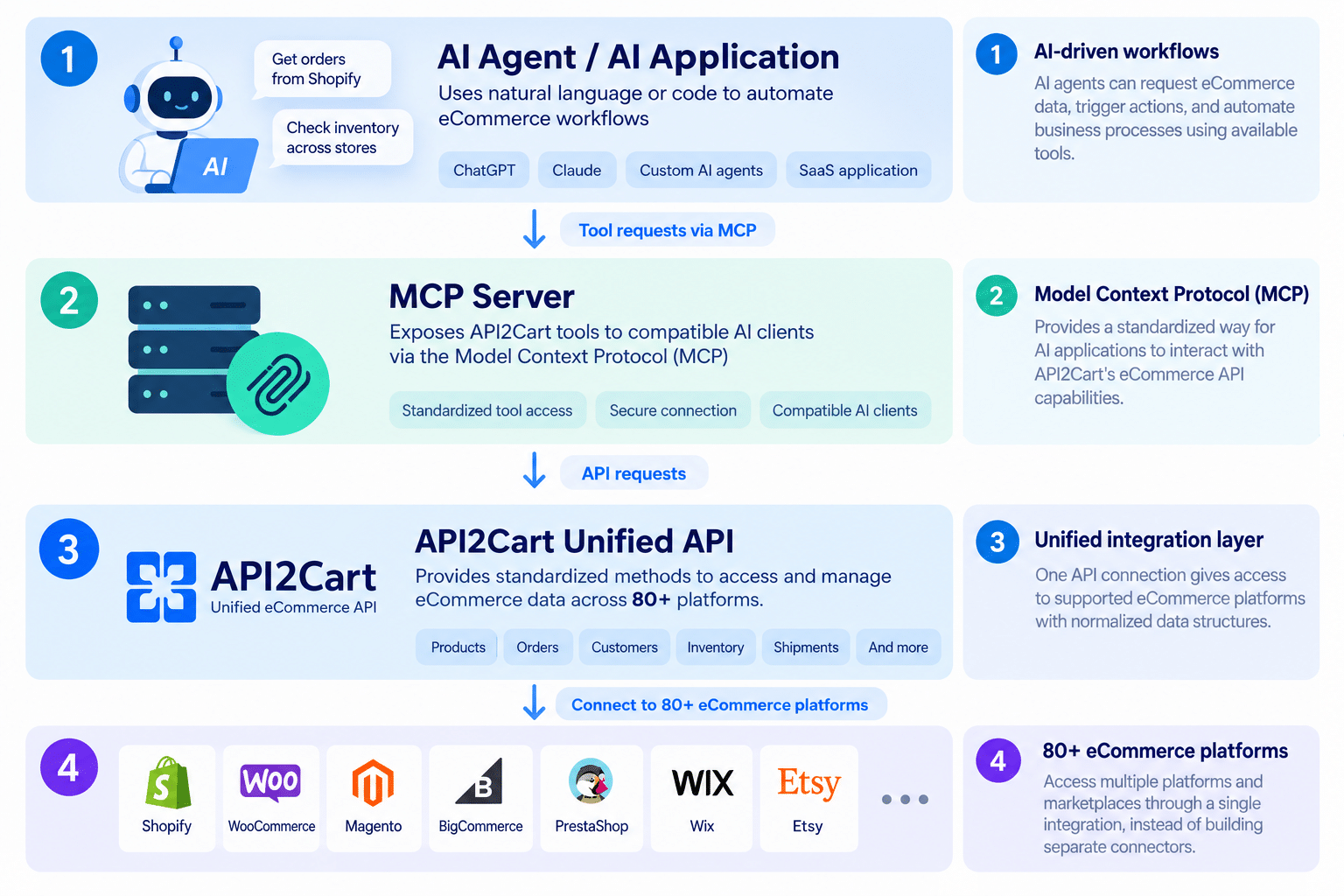
AI-powered API integration is not limited to generating separate connectors. Developers can also use AI assistants to build applications and workflows on top of an existing unified API. This approach combines AI-assisted development with standardized access to supported eCommerce platforms.
Connect AI Agents Through the API2Cart MCP Server
API2Cart offers an MCP server designed to help compatible AI clients interact with its eCommerce API capabilities. The Model Context Protocol (MCP) provides a standardized way for AI applications to access external tools and services.
Instead of implementing every platform connection independently, developers can use the API2Cart integration layer for supported operations. However, production workflows still require appropriate credentials, access controls, testing, and validation.
Use AI to Build eCommerce Workflows
For example, a SaaS developer could build an AI-assisted workflow that retrieves orders, checks inventory information, or prepares data for a shipping application. API2Cart provides supported eCommerce operations, while the application handles business logic and any required approvals.
Moreover, developers can use AI coding tools to generate requests, implement data processing, and create automated tests. This can reduce repetitive coding without requiring a separate connector for every supported platform.
When Are AI-Generated API Connectors Still Useful?
AI-generated API connectors can still be valuable when a SaaS product needs functionality outside a unified API's supported scope. For example, developers may build a targeted direct integration for a specialized platform feature while using API2Cart for common eCommerce operations.
Therefore, AI-assisted API integration and a unified API are complementary approaches rather than mutually exclusive alternatives.
Developers interested in this architecture can explore the API2Cart MCP integration and its public GitHub repository for implementation details.
Conclusion: Build Smarter, Not Just Faster
AI API integration can accelerate eCommerce connector development, but generating code is only the beginning. SaaS vendors must also manage authentication, data accuracy, testing, platform updates, and long-term reliability.
Therefore, the right build vs buy API integration strategy depends on your product's requirements. Custom connectors offer greater control over specialized features, while a unified API can simplify multi-platform connectivity and reduce platform-specific maintenance for supported operations.
However, these approaches do not have to compete. By combining AI-assisted development with API2Cart, SaaS teams can focus on product functionality instead of rebuilding common eCommerce integrations.
Ready to simplify your eCommerce integrations? Connect your SaaS product to supported eCommerce platforms through one unified API.
FAQs About AI API Integration and Build vs. Buy Decisions
What are the main AI-generated code risks in eCommerce integrations?
The main AI generated code risks include incorrect data mapping, incomplete error handling, authentication issues, and unreliable synchronization. These problems can affect orders, products, and inventory data.
Moreover, the risks of AI-generated integrations increase when connectors must support different platform versions and real-world edge cases. To reduce these AI coding risks, developers should review generated code, automate testing, and monitor production workflows.
How should SaaS vendors approach a build vs buy API integration decision?
A build vs buy API integration decision should consider platform coverage, engineering capacity, required functionality, and long-term maintenance. Direct development can make sense for a limited number of platforms or specialized features.
However, when teams evaluate whether to build or buy API integration capabilities, they should also consider future expansion. The in-house vs unified API comparison is especially important for SaaS products supporting multiple eCommerce platforms.
What matters most in a build vs buy eCommerce integration comparison?
The build vs buy ecommerce integration decision depends on how many platforms a SaaS product needs to support, which operations it requires, and how much maintenance its engineering team can handle.
For an eCommerce integration build vs buy evaluation, compare the full lifecycle costs rather than initial development alone. A custom vs unified eCommerce API approach can also be hybrid: use API2Cart for supported operations and direct connectors for specialized functionality.
Can AI-assisted API integration work with a unified API?
Yes. AI assisted API integration can help developers generate requests, implement business logic, and automate tests while using a unified API for supported eCommerce operations.
For example, AI-built integrations may combine API2Cart with targeted custom functionality. Likewise, AI-generated API connectors can complement a unified API when a SaaS product needs features outside its supported scope.

SEO Content Specialist with 7+ years of experience in SEO content creation and 14+ years in marketing. Expertise includes SEO copywriting, keyword research, search intent analysis, and content strategy. Experienced in creating content for B2B SaaS, technology, fintech, and eCommerce companies. Focused on developing content that aligns user needs, business goals, and search engine requirements.