Quick Definition: BigCommerce API is a set of programming interfaces that allows software systems to connect with BigCommerce and manage store data such as products, orders, customers, categories, inventory, and shipments. For a BigCommerce API developer, these interfaces provide the foundation for building store integrations and automated eCommerce workflows. This guide also includes practical BigCommerce API examples and explains how API2Cart simplifies BigCommerce API integration through one unified API for BigCommerce and 80+ other eCommerce integrations.
The BigCommerce API gives eCommerce software teams access to the store data and operations needed to automate workflows and build scalable integrations. Understanding how the platform structures and exposes this data is essential for building reliable software connections.
BigCommerce provides REST-based interfaces for working with products, orders, customers, inventory, categories, shipments, and other store resources. Therefore, SaaS vendors can use these capabilities to connect order management systems, ERP software, PIM solutions, shipping tools, and other eCommerce applications with BigCommerce.
This guide explains the core integration capabilities, authentication, endpoints, customer data, and practical examples developers need when building connections with the platform. In addition, it covers common development challenges and shows how API2Cart can simplify multi-platform integration for eCommerce SaaS products. For complete platform-specific technical specifications, see the official BigCommerce developer documentation.
What Is BigCommerce?
BigCommerce is a SaaS eCommerce platform for building and managing online stores and digital commerce experiences. It provides capabilities for product catalog management, checkout, payments, shipping, customer management, and other core commerce operations.
In addition, BigCommerce supports B2B, multi-storefront, and headless commerce scenarios. Its developer tools and APIs allow external software to connect with store data and extend platform functionality, which makes BigCommerce relevant for SaaS vendors building eCommerce integrations.

Overview of the BigCommerce API
The BigCommerce API provides developers with programmatic access to commerce data and operations across products, categories, customers, orders, inventory, shipments, carts, channels, and other store resources. BigCommerce primarily provides REST-based management interfaces, while GraphQL is available for specific storefront, account, and other use cases.
For complete specifications, available resources, and current endpoint requirements, refer to the official BigCommerce developer documentation.
- REST APIs for managing core commerce resources
- Standard HTTP methods such as
GET,POST,PUT, andDELETE - API tokens and OAuth 2.0, depending on the integration type
- JSON-based request and response data
- GraphQL interfaces for supported use cases
- Rate limits that applications need to account for when sending requests
In addition, integrations should handle standard HTTP response codes correctly. Successful requests typically return 2xx responses, while 4xx responses indicate client-side issues and 5xx responses indicate server-side failures.
Therefore, production integrations should account for authentication, request limits, validation errors, and temporary failures rather than assuming every request will succeed.
Why BigCommerce API Integration Matters
BigCommerce API integration allows eCommerce software vendors to connect their applications with merchant stores, automate data exchange, and support workflows that depend on up-to-date commerce data. This is particularly important for SaaS products that need to work with orders, products, inventory, customers, shipping, or other store resources.
For example, an integration can support:
- Synchronization of products, inventory, categories, orders, and customer data
- Automated order import and processing
- Inventory and product updates between connected systems
- Shipping and fulfillment workflows
- Connections between BigCommerce and ERP, PIM, OMS, WMS, CRM, and other eCommerce software
In addition, software companies can build apps for BigCommerce merchants and distribute eligible applications through the BigCommerce App Marketplace.
As a result, a reliable integration can become an important part of a SaaS product's multi-channel strategy rather than simply providing access to individual store records.
BigCommerce API Examples
BigCommerce API examples help developers understand how common commerce operations can be implemented in real integration workflows. For example, SaaS applications using API2Cart can create orders in a connected BigCommerce store through the unified order.add method.
Example: Create a BigCommerce Order
The following request shows the general structure of an order.add call through API2Cart v1.1:
curl --request POST \
  'https://api.api2cart.com/v1.1/order.add.json' \
  --header 'x-api-key: YOUR_API_KEY' \
  --header 'x-store-key: YOUR_STORE_KEY' \
  --header 'Content-Type: application/json' \
  --data '{
    "order_status": "Pending",
    "customer": {
      "email": "[email protected]",
      "first_name": "John",
      "last_name": "Smith"
    },
    "order_products": [
      {
        "model": "SKU-001",
        "name": "Example Product",
        "price": 49.99,
        "quantity": 2
      }
    ]
  }'
A successful response follows this structure:
{
  "return_code": 0,
  "return_message": "string",
  "result": {
    "order_id": "string",
    "id": "string",
    "customer_id": "string"
  }
}
The response provides identifiers for the created order and related customer record. Therefore, the SaaS application can store these identifiers and use them in subsequent order management workflows.
For the complete request schema, parameters, and BigCommerce-specific method details, see the
API2Cart order.add documentation.
Simplifying BigCommerce API Integration with API2Cart
API2Cart provides a unified API that enables SaaS vendors to connect their software with BigCommerce and 80+ other eCommerce integrations through a single interface. Instead of building and maintaining separate platform-specific connections, developers can use standardized methods and data structures across supported platforms.
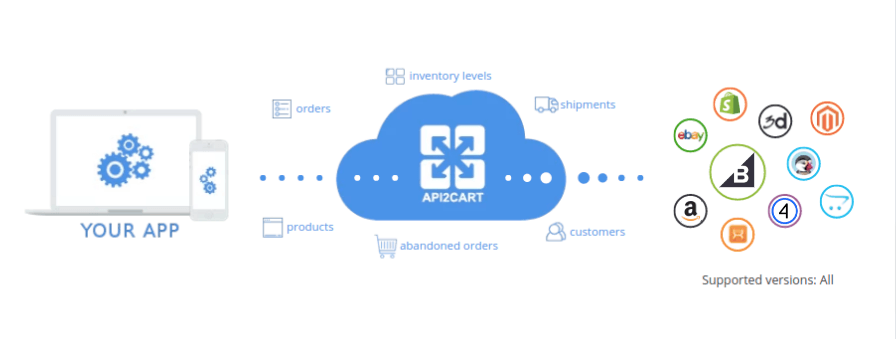
With API2Cart, software vendors can:
- Connect and work with multiple BigCommerce stores
- Retrieve and synchronize supported products, customers, orders, categories, inventory, and other commerce data
- Use unified API methods instead of implementing separate request structures for every supported platform
- Subscribe to supported webhooks to receive event notifications and reduce unnecessary polling
- Extend their software to additional supported eCommerce platforms through the same integration layer
As a result, developers can spend less time implementing platform-specific integration logic. Moreover, API2Cart monitors changes across supported platforms and maintains its connectors, reducing the amount of platform-specific maintenance required from SaaS development teams.

BigCommerce Integration Use Cases via API2Cart
API2Cart supports BigCommerce integration workflows that go beyond basic product and order synchronization. Depending on the methods available for the connected store, SaaS vendors can work with gift cards, wishlists, customer groups, order transactions, and other commerce data through the same unified interface.
Gift Cards
For supported BigCommerce stores, API2Cart provides methods such as cart.giftcard.list, cart.giftcard.add, and cart.giftcard.delete. Therefore, loyalty platforms and promotional software can use these operations to incorporate gift card management into their workflows.
Wishlists
The customer.wishlist.list method allows supported integrations to retrieve customer wishlist data. For example, this information can be used by personalization, customer engagement, and marketing automation software.
Customer Groups
API2Cart provides customer.group.list and customer.group.add for supported BigCommerce connections. These methods can help CRM, B2B, loyalty, and customer management solutions work with customer segmentation data.
Order Transactions
The order.transaction.list method retrieves transaction information associated with orders. As a result, accounting, reconciliation, reporting, and other financial software can incorporate transaction data into downstream workflows.
Method and parameter availability can vary by platform. Therefore, developers should check the BigCommerce-specific API2Cart documentation before implementing a workflow.
BigCommerce REST API v3: Endpoint Reference
BigCommerce uses versioned REST endpoints, with v3 used for many current resources while some operations remain available through v2 endpoints. Therefore, developers should verify the version required for each resource instead of assuming that every request uses the same API version.
Authentication
BigCommerce supports different authentication approaches depending on how an application connects to a store. Server-to-server integrations can use API credentials generated for the store, while applications distributed to multiple merchants use the platform's OAuth flow.
| Method | Typical use case | Authentication |
|---|---|---|
| API account | Server-to-server integrations and private applications | X-Auth-Token: {access_token} |
| OAuth | Apps installed by multiple BigCommerce merchants | OAuth access token obtained during app authorization |
Because authentication requirements depend on the application type, developers should follow the current BigCommerce authentication documentation when configuring credentials and access.
Core Endpoints
The following table summarizes commonly used resources and their endpoint versions:
| Resource | Endpoint | Typical operations |
|---|---|---|
| Products | /v3/catalog/products |
Retrieve, create, update, and delete products |
| Product variants | /v3/catalog/products/{id}/variants |
Manage variants, pricing, and variant data |
| Orders | /v2/orders |
Retrieve orders and manage supported order operations |
| Order products | /v2/orders/{id}/products |
Retrieve line items for an order |
| Customers | /v3/customers |
Create, retrieve, update, and delete customer records |
| Customer addresses | /v3/customers/addresses |
Work with customer address data |
| Inventory | /v3/inventory/items |
Work with inventory data and locations |
| Categories | /v3/catalog/categories |
Manage catalog categories and hierarchy |
| Carts | /v3/carts |
Create and manage carts and line items |
| Channels | /v3/channels |
Work with sales channels and storefront configurations |
| Webhooks | /v3/hooks |
Subscribe to supported store events |
| Shipments | /v2/orders/{id}/shipments |
Create and retrieve order shipments |
In addition, BigCommerce applies rate limits to API requests. Applications should monitor the rate-limit information returned in response headers and implement appropriate retry or backoff logic when necessary. This is especially important for SaaS systems that process large volumes of store data.
Unified Access Through API2Cart
For multi-platform SaaS products, API2Cart maps supported BigCommerce operations to standardized methods. As a result, developers can use the same API2Cart method structure across multiple supported eCommerce integrations.
| API2Cart method | BigCommerce resource |
|---|---|
product.list |
/v3/catalog/products |
order.list |
/v2/orders |
customer.list |
/v3/customers |
product.update |
/v3/catalog/products/{id} |
order.shipment.add |
/v2/orders/{id}/shipments |
For supported methods, parameters, and platform-specific details, see the API2Cart BigCommerce integration documentation.
Conclusion
Building a reliable BigCommerce integration requires developers to manage authentication, platform-specific endpoints, data structures, request limits, and ongoing maintenance. However, SaaS vendors that support multiple eCommerce platforms do not necessarily need to build and maintain every connection separately.
API2Cart provides a unified integration layer for BigCommerce and 80+ other eCommerce integrations. As a result, software vendors can work with supported commerce data through standardized methods while reducing platform-specific development and maintenance.
Explore the API2Cart documentation or create a free account to test BigCommerce integration for your SaaS product.
FAQs
What should a BigCommerce API developer know before building an integration?
A BigCommerce API developer should first identify the resources the application needs to access, such as products, orders, customers, inventory, carts, or shipments. Developers also need to account for authentication, permissions, endpoint versions, pagination, rate limits, and error handling.
In addition, applications should be designed for ongoing maintenance because platform requirements and available API capabilities can change over time.
Where can developers find BigCommerce API examples?
BigCommerce API examples are available in the official BigCommerce developer documentation for platform-specific endpoints. Developers can use these examples to understand request structures, parameters, authentication requirements, and responses for supported resources.
For SaaS products using API2Cart, its documentation provides method-specific examples for working with BigCommerce through a unified interface. Therefore, developers should use the documentation that matches their chosen integration approach.
Can a SaaS application connect multiple BigCommerce stores?
Yes. A SaaS application can support multiple BigCommerce store connections when authentication, permissions, and store-specific data are handled separately for each connection.
For multi-platform software, API2Cart provides a unified integration layer for BigCommerce and other supported eCommerce integrations. As a result, developers can use standardized methods across connected platforms instead of implementing completely separate integration logic for each one.
How does API2Cart simplify BigCommerce integration?
API2Cart provides one unified API for BigCommerce and 80+ other eCommerce integrations. SaaS vendors can use standardized methods to work with supported products, orders, customers, inventory, categories, shipments, and other commerce data.
Moreover, API2Cart maintains platform-specific connectors and provides supported webhooks and unified data structures. This reduces the amount of platform-specific development and maintenance required when software supports multiple eCommerce platforms.