The Shopify shopping cart API is important for eCommerce software providers that need access to Shopify store data. According to BuiltWith, Shopify is used by about 6.97 million live websites, including about 3.9 million websites in the United States.
This makes Shopify integration a valuable feature for SaaS products, multi-channel software, shipping tools, inventory systems, order management platforms, and other eCommerce solutions. However, direct Shopify API integration can require work with authentication, API versions, rate limits, product data, order data, customer data, and ongoing platform changes.
In this article, we explain what the Shopify shopping cart API means, what data software providers can access, which integration challenges to expect, and how API2Cart helps connect your software with Shopify and 80+ supported eCommerce platforms and marketplaces through one API layer.
API Meaning
An API is a set of rules that allows two software systems to communicate with each other. In eCommerce, APIs help software products access store data and use it for their own features.
For example, the Shopify shopping cart API allows third-party software to connect with Shopify and work with store data such as products, orders, customers, categories, shipments, and stock fields where supported.
API requests allow an application to send queries for data or actions. As a result, developers can build features that depend on store data without manual imports or file-based data exchange.
APIs can use different architectural styles. SOAP uses XML-based messages, while REST commonly works with HTTP methods such as GET, POST, PUT, and DELETE. In addition, many modern platforms, including Shopify, also use GraphQL for flexible data access.
What is Shopify Shopping Cart API?
The Shopify shopping cart API allows software providers to access data from Shopify stores and use it inside their applications. This data can support product management, order processing, inventory tasks, shipping workflows, analytics, and reporting.
Shopify provides APIs for developers who need to build apps and integrations. However, Shopify API usage changes over time. Shopify states that the REST Admin API is a legacy API as of October 1, 2024, and that new public apps submitted after April 1, 2025 must be built exclusively with the GraphQL Admin API.
This is important for software providers because Shopify integration is not a one-time task. Your team may need to monitor API versions, supported fields, authentication rules, app requirements, and platform-specific changes.

Why Access to Shopify API Matters for Software Providers
Shopify is one of the most widely used eCommerce platforms. Therefore, software providers that serve online merchants often need Shopify integration to support their customers.
Shopify store data can support many types of eCommerce software. For example, multi-channel systems may need order data from Shopify to help merchants track and process orders. Shipping software may need order and shipment data. Inventory systems may need product and stock fields. Marketing tools may need product and customer data for reports and segmentation.
The most common data entities used by eCommerce software include:
- Products — product names, SKUs, prices, images, variants, and stock-related fields where supported.
- Orders — order IDs, line items, totals, statuses, and fulfillment details.
- Customers — customer profiles, emails, addresses, and purchase data where available.
- Categories — product structure and catalog organization.
- Shipments — shipment records, tracking fields, and carrier data where supported.
Wait!
Before you leave, get our guide on how to simplify Shopify shopping cart API integration and connect with 80+ supported eCommerce platforms and marketplaces through API2Cart.Shopify Shopping Cart API Integration Challenges
Direct Shopify API integration can be useful if your software needs only one platform. However, many eCommerce software providers need to support Shopify together with other platforms and marketplaces.
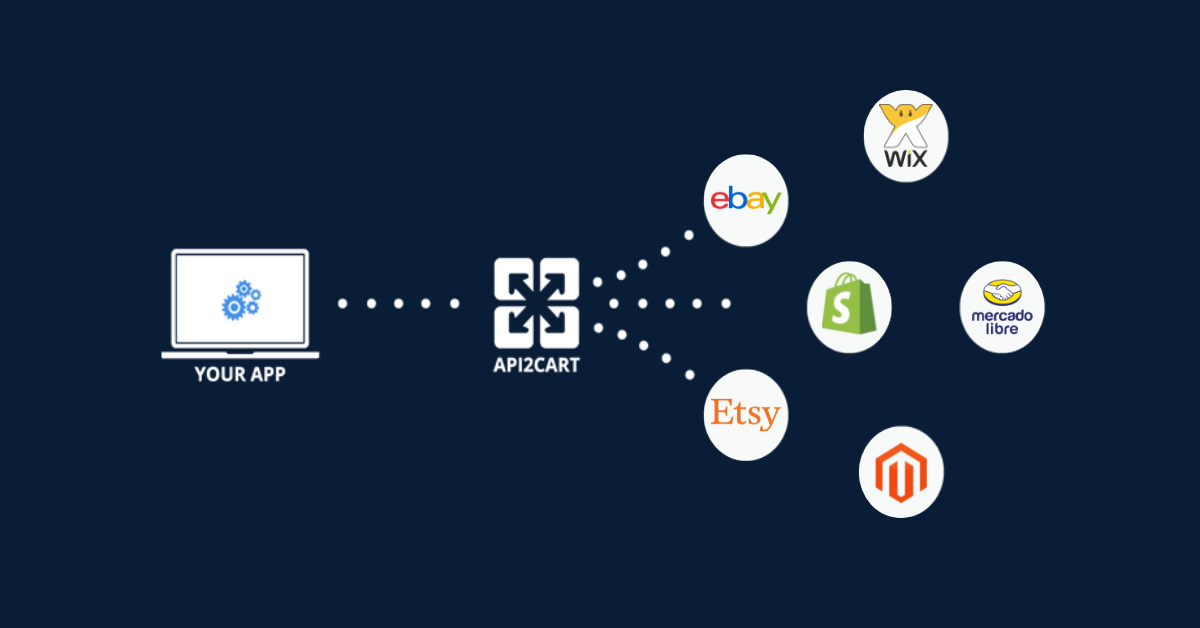
In this case, your development team may need to build and maintain separate integrations for Shopify, WooCommerce, Magento, BigCommerce, Amazon, eBay, Etsy, Wix, and other systems. Each platform can have its own API structure, data model, auth flow, rate limits, and supported methods.
As a result, integration maintenance can become a long-term technical workload. Your team may need to update API logic, map different data fields, handle errors, and test changes for every supported platform.
Shopify Shopping Cart API Example with API2Cart
API2Cart helps software providers access Shopify store data through one API layer. After a Shopify store is connected, your software can use API2Cart methods to work with products, orders, customers, shipments, categories, and other store entities where supported.
For example, the product.list method can help retrieve product data from a connected Shopify store:
{
  "return_code": 0,
  "return_message": "string",
  "pagination": {
    "previous": "string",
    "next": "string",
    "additional_fields": {},
    "custom_fields": {}
  },
  "result": {
    "products_count": 0,
    "product": [
      {
        "id": "string",
        "type": "string",
        "u_model": "string",
        "u_sku": "string",
        "name": "string",
        "description": "string",
        "short_description": "string",
        "price": 0,
        "advanced_price": [
          {
            "id": "string",
            "value": 0,
            "avail": true,
            "group_id": "string",
            "quantity_from": 0,
            "start_time": {
              "value": "string",
              "format": "string",
              "additional_fields": {},
              "custom_fields": {}
            },
            "expire_time": {
              "value": "string",
              "format": "string",
              "additional_fields": {},
              "custom_fields": {}
            },
            "additional_fields": {},
            "custom_fields": {}
          }
        ],
        "cost_price": 0,
        "unit_price": 0,
        "measure_unit": "string",
        "quantity": 0,
        "inventory": [
          {
            "warehouse_id": "string",
            "quantity": 0,
            "in_stock": true,
            "priority": 0,
            "additional_fields": {},
            "custom_fields": {}
          }
        ],
        "group_items": [
          {
            "child_item_id": "string",
            "product_id": "string",
            "default_qty_in_pack": 0,
            "is_qty_in_pack_fixed": true,
            "price": 0,
            "additional_fields": {},
            "custom_fields": {}
          }
        ],
        "u_brand_id": "string",
        "u_brand": "string",
        "categories_ids": [
          "string"
        ],
        "stores_ids": [
          "string"
        ],
        "url": "string",
        "seo_url": "string",
        "meta_title": "string",
        "meta_keywords": "string",
        "meta_description": "string",
        "avail_sale": true,
        "avail_view": true,
        "is_virtual": true,
        "is_downloadable": true,
        "weight": 0,
        "weight_unit": "string",
        "sort_order": 0,
        "in_stock": true,
        "backorders": "string",
        "manage_stock": "string",
        "is_stock_managed": true,
        "on_sale": true,
        "create_at": {
          "value": "string",
          "format": "string",
          "additional_fields": {},
          "custom_fields": {}
        },
        "modified_at": {
          "value": "string",
          "format": "string",
          "additional_fields": {},
          "custom_fields": {}
        },
        "tax_class_id": "string",
        "special_price": {
          "value": 0,
          "avail": true,
          "created_at": {
            "value": "string",
            "format": "string",
            "additional_fields": {},
            "custom_fields": {}
          },
          "modified_at": {
            "value": "string",
            "format": "string",
            "additional_fields": {},
            "custom_fields": {}
          },
          "expired_at": {
            "value": "string",
            "format": "string",
            "additional_fields": {},
            "custom_fields": {}
          },
          "additional_fields": {},
          "custom_fields": {}
        },
        "tier_price": [
          {
            "qty": 0,
            "price": 0,
            "additional_fields": {},
            "custom_fields": {}
          }
        ],
        "group_price": [
          {
            "id": "string",
            "group_id": "string",
            "price": 0,
            "store_id": "string",
            "quantity": 0,
            "start_time": "string",
            "expire_time": "string",
            "additional_fields": {},
            "custom_fields": {}
          }
        ],
        "images": [
          {
            "id": "string",
            "http_path": "string",
            "file_name": "string",
            "mime-type": "string",
            "size": 0,
            "create_at": {
              "value": "string",
              "format": "string",
              "additional_fields": {},
              "custom_fields": {}
            },
            "modified_at": {
              "value": "string",
              "format": "string",
              "additional_fields": {},
              "custom_fields": {}
            },
            "alt": "string",
            "avail": true,
            "sort_order": 0,
            "type": "string",
            "additional_fields": {},
            "custom_fields": {}
          }
        ],
        "product_options": [
          {
            "id": "string",
            "product_option_id": "string",
            "name": "string",
            "description": "string",
            "sort_order": 0,
            "type": "string",
            "required": true,
            "available": true,
            "used_in_combination": true,
            "option_items": [
              {
                "id": "string",
                "product_option_item_id": "string",
                "name": "string",
                "sort_order": 0,
                "price": 0,
                "weight": 0,
                "quantity": 0,
                "type_price": "string",
                "sku": "string",
                "is_default": true,
                "additional_fields": {},
                "custom_fields": {}
              }
            ],
            "additional_fields": {},
            "custom_fields": {}
          }
        ],
        "u_upc": "string",
        "u_mpn": "string",
        "u_gtin": "string",
        "u_isbn": "string",
        "u_ean": "string",
        "related_products_ids": [
          "string"
        ],
        "up_sell_products_ids": [
          "string"
        ],
        "cross_sell_products_ids": [
          "string"
        ],
        "dimensions_unit": "string",
        "width": 0,
        "height": 0,
        "length": 0,
        "discounts": [
          {
            "id": "string",
            "name": "string",
            "modifier_type": "string",
            "value": 0,
            "from_time": "string",
            "to_time": "string",
            "customer_group_ids": "string",
            "sort_order": 0,
            "additional_fields": {},
            "custom_fields": {}
          }
        ],
        "additional_fields": {},
        "custom_fields": {}
      }
    ],
    "additional_fields": {},
    "custom_fields": {}
  },
  "additional_fields": {},
  "custom_fields": {}
}
This request can return product IDs, names, SKUs, prices, images, and stock-related fields where supported. As a result, SaaS providers can use Shopify product data for inventory tools, product management systems, product feed software, order management platforms, or reporting features.
Keep in mind that available methods, parameters, and fields can depend on the connected platform and its API support.
How API2Cart Helps with Shopify Shopping Cart API Integration
API2Cart helps eCommerce software providers connect their solutions with Shopify and 80+ supported eCommerce platforms and marketplaces through one API layer.
Instead of building a separate integration for every platform, your team can use API2Cart to access store data from supported platforms. This can help reduce repeated API work and simplify store data access for your software.
API2Cart provides API methods for working with:
- products and product variants;
- orders and order details;
- customers and customer data;
- categories and product structure;
- shipments and tracking fields;
- stock-related fields where supported.
This makes API2Cart useful for inventory management software, shipping tools, order management systems, PIM solutions, product feed tools, marketplace management platforms, and marketing software.
Connect Your Software to Shopify and Other Supported Platforms
Shopify shopping cart API integration is important for software providers that need access to product, order, customer, shipment, and stock data. However, direct integration with Shopify and other platforms can require ongoing development and maintenance.
API2Cart helps your software connect with Shopify and 80+ supported eCommerce platforms and marketplaces through one API layer. Use it to access store data and build eCommerce features for your customers.
Start your free trial and test Shopify shopping cart API integration with API2Cart.
FAQs
What is Shopify shopping cart API?
Shopify shopping cart API allows software providers to access Shopify store data and use it inside their applications. This data can include products, orders, customers, categories, shipments, and stock fields where supported.
What data can software access through Shopify shopping cart API?
Software can access product data, order data, customer details, categories, shipment data, and stock-related fields where available. For example, this data can support inventory tools, order management systems, shipping software, PIM solutions, and reporting features.
Why is direct Shopify API integration difficult for SaaS providers?
Direct Shopify API integration can require work with authentication, API versions, rate limits, data mapping, and platform updates. In addition, SaaS providers that support several eCommerce platforms may need to build and maintain separate integrations for each platform.
How does API2Cart help with Shopify shopping cart API integration?
API2Cart helps eCommerce software providers connect with Shopify and 80+ supported eCommerce platforms and marketplaces through one API layer. As a result, software can access store data and use it for product, order, customer, shipment, and reporting tasks.