A familiar request lands in the backlog: “Customers want Outlook sync.” It sounds contained at first. Add create event, update event, maybe pull availability, ship it.
Then the actual work shows up. You're not just wiring one endpoint. You're dealing with OAuth, mailbox permissions, recurring series behavior, shared calendars, time zones, retries, and the uncomfortable fact that production integrations fail in ways quickstart guides rarely mention.
For a B2B SaaS product, the Outlook Calendar API usually sits inside a bigger architecture decision. If your product syncs appointments, bookings, dispatch windows, interviews, service calls, or project milestones, Outlook is often only one target among many systems your customers already use. That's why the practical question isn't only “How do I call Microsoft Graph?” It's also “How do I build this so it survives real customers, real tenants, and future integration scope?”
Your Guide to Outlook Calendar API Integration
A typical integration starts with one customer promise. Your application creates a booking. The customer expects that booking to appear in Outlook, reflect reschedules, preserve local time correctly, and disappear when canceled. They also expect shared-team workflows to keep working if assistants, coordinators, or service desks manage calendars on behalf of others.
That's where the modern Outlook Calendar API is useful. It gives you calendar access through Microsoft Graph for the same business mailbox model customers already use in Microsoft 365. You can read, create, update, and delete events, and you can work with calendars in both primary and shared mailboxes through that Graph-based surface, as described in Microsoft's Outlook calendar overview.
What trips teams up isn't the first successful API call. It's everything that follows.
What developers usually underestimate
- Authentication complexity: You're handling a user consent flow, token refresh, and permission scoping before business logic even starts.
- Calendar semantics: A recurring meeting isn't the same object as a single appointment, and exceptions can break naive sync code.
- Operational behavior: A create call can succeed while later lookup behavior becomes the main issue in your sync engine.
- Architecture drift: Today it's Outlook. Next quarter it's more providers, more systems, and more support surface.
Build the integration as a sync system, not as a set of CRUD handlers. That mindset changes your schema, retries, logging, and support playbook.
The teams that move fastest usually separate three concerns early: auth and tenancy, event normalization, and reconciliation. Once those are isolated, the Outlook Calendar API becomes manageable instead of brittle.
Understanding the API Architecture Microsoft Graph
The first thing to get right is naming. When most developers say “Outlook Calendar API” today, they're really talking about calendar resources exposed through Microsoft Graph.
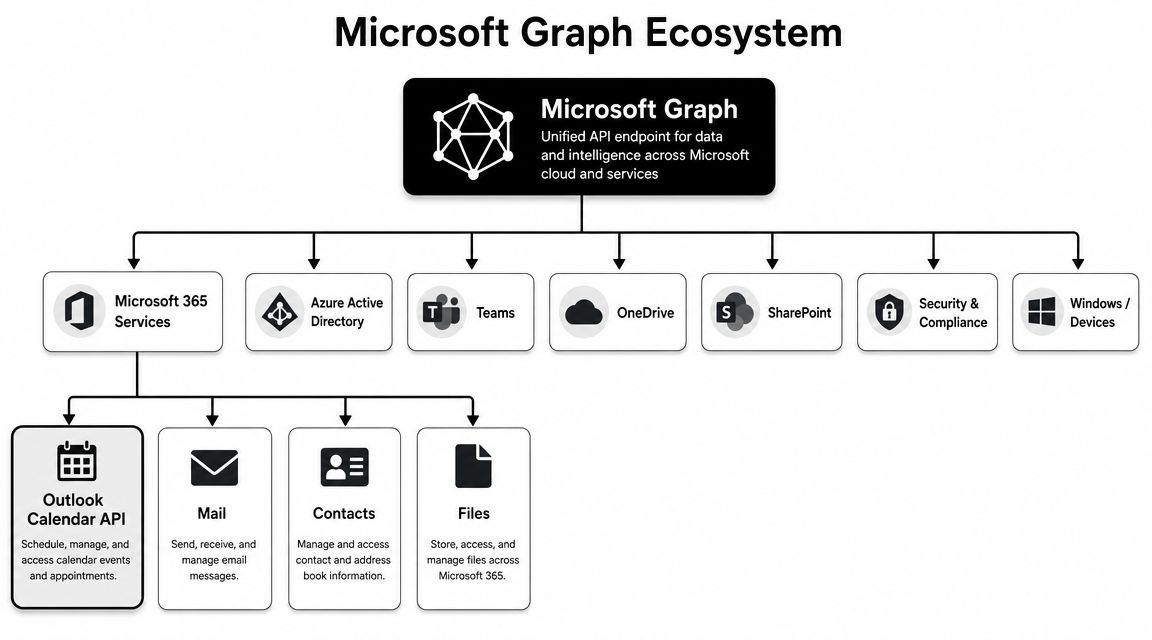
Microsoft describes Graph as the unified API for accessing data in users' primary and shared mailboxes, including calendar data stored in Exchange Online as part of Microsoft 365, in its Outlook calendar API overview. That architectural shift matters because calendar isn't a standalone island anymore. It sits in the same API family as mail and contacts, under one identity and access model.
Why Graph changed the integration model
Older Microsoft integration patterns trained developers to think in service-specific APIs. Graph changed that by giving you a common REST entry point and a shared auth story across Microsoft 365 workloads.
The simplest analogy is a master key. Instead of carrying separate keys for each room, you get one access system that opens multiple doors based on permission. Calendar is one of those doors.
That has practical consequences:
| Architecture choice | What it means for developers |
|---|---|
| Unified identity | You authenticate once against Microsoft identity and use the resulting token for Graph calls allowed by scope |
| Shared mailbox model | Business workflows involving assistants, teams, or shared calendars fit the API model better than a personal-only scheduling API |
| Consistent surface | Calendar, mail, and contacts live in the same platform, which reduces conceptual sprawl across Microsoft 365 integrations |
Why new work should target Graph
If you're building or modernizing now, target Graph first. It's where Microsoft places Outlook calendar access in the current model, and it aligns with how organizations already manage identity, mailboxes, and delegated access.
This also matters if your product touches adjacent Microsoft workflows. A calendar integration often expands into mailbox reading, contact enrichment, or workflow automation later. In that broader Microsoft stack context, DynamicsHub's Power Platform overview is useful because it shows how many teams end up combining Microsoft services rather than consuming them in isolation.
The architectural takeaway
Don't model Outlook calendar integration as “one API endpoint plus auth.” Model it as:
- A tenant-aware Microsoft 365 integration
- A mailbox-scoped event system
- A sync pipeline that can survive change over time
Teams that skip that framing usually end up rewriting their first implementation after the first serious enterprise customer.
Authentication and Permissions Deep Dive
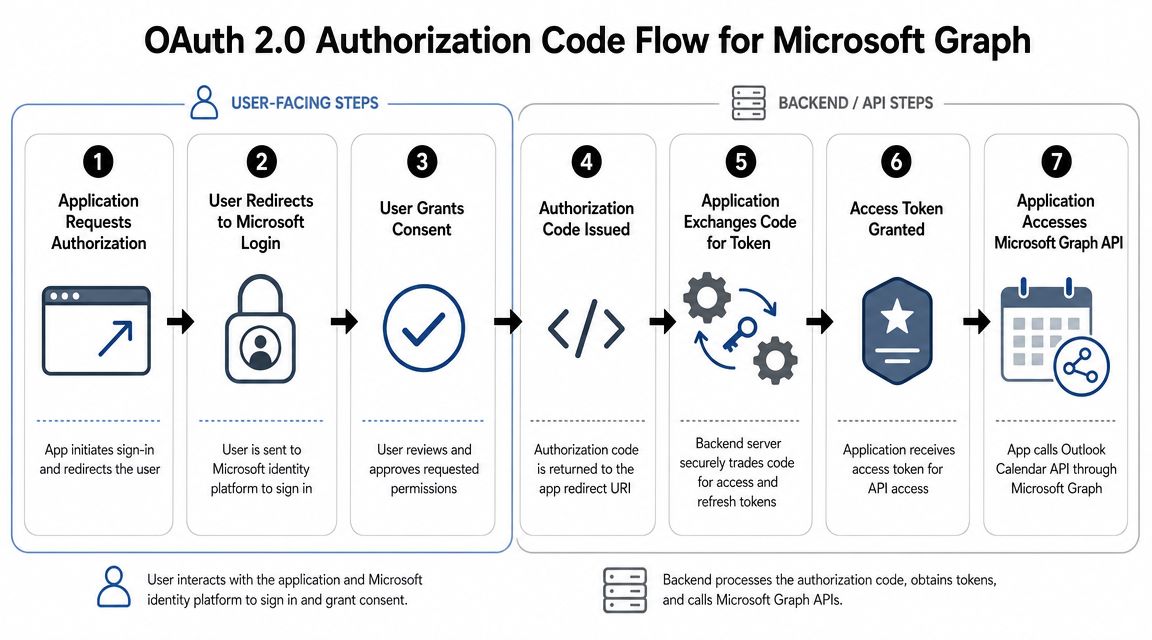
Authentication is where many Outlook integrations stop being “simple.” The Outlook Calendar API uses OAuth 2.0-based authentication through Microsoft Graph. In practice, developers register an application, obtain an authorization code, exchange it for an access token and refresh token, and then send Graph calendar requests with a Bearer token in the Authorization header. A common event endpoint is https://graph.microsoft.com/v1.0/me/events, and the access token typically expires after about one hour, as summarized in this Graph calendar integration breakdown.
The flow that matters in production
For most SaaS products acting on behalf of a user, the important path is the authorization code flow.
A workable sequence looks like this:
- Register the application in the Microsoft identity platform.
- Configure redirect URIs for your web app or callback handler.
- Send the user to Microsoft login and consent with the scopes you need.
- Receive the authorization code at your redirect URI.
- Exchange that code server-side for an access token and refresh token.
- Store tokens securely with tenant and user linkage.
- Use the access token in Bearer auth for Graph calls.
- Refresh tokens before expiry becomes a customer-facing failure.
Practical rule: never let your frontend own the long-term token lifecycle. The browser can start auth, but the backend should control code exchange, token storage, refresh, and outbound Graph calls.
Scopes are product decisions, not just auth settings
The fastest way to create security friction is to ask for more permission than your feature needs. The cleanest integrations request the minimum set, explain why, and map each scope to a feature in your product.
Here's a practical reference:
| Scope | Description | Common Use Case |
|---|---|---|
Calendars.Read |
Read calendar events | Read-only sync, availability views, reminders based on existing events |
Calendars.ReadWrite |
Read and modify calendar events | Booking engines, scheduling assistants, appointment creation and updates |
Calendars.Read.Shared |
Read shared calendars the user can access | Team visibility, assistant workflows, resource and delegated access scenarios |
Delegated versus application permissions
This distinction affects your entire design.
Delegated permissions
Use these when your app acts as the signed-in user. This is the default choice for user-driven SaaS features such as connecting a personal work calendar, showing events, or creating appointments in that user's mailbox.
Delegated access usually maps more naturally to consent and auditing.
Application permissions
Use these when your system acts without an active signed-in user. That can fit service accounts, background processing, or admin-approved tenant-wide automation. It also raises the bar for governance, because broad unattended access can create support and security risk fast.
If your product doesn't strictly need application permissions, don't start there.
What works well
- Store consent metadata alongside tokens, tenant IDs, and mailbox identifiers.
- Refresh proactively rather than waiting for user-facing failures.
- Separate auth errors from API errors in logs and dashboards.
- Fail closed on missing scopes with a clear reconnect path.
What usually fails
- Requesting broad scopes during MVP and never tightening them later.
- Treating token refresh as a side feature instead of a core reliability function.
- Forgetting that one tenant can have different admin consent policies than another.
- Assuming access to a user mailbox automatically means access to shared calendars they care about.
When developers say the Outlook Calendar API is hard, they're often describing permission design, not event JSON.
Essential API Endpoints and Methods
Once auth is stable, the core API surface is straightforward. Most implementations revolve around events and calendars. The key is to keep your request construction boring, predictable, and easy to trace in logs.
Event endpoints you'll use constantly
List events in the signed-in user calendar
Method: GET
Path: /me/events
Use this for a baseline event pull in the primary calendar.
Headers
Authorization: Bearer <access_token>Content-Type: application/json
Sample response
{
  "value": [
    {
      "id": "event-id",
      "subject": "Customer onboarding call",
      "start": {
        "dateTime": "2026-01-15T09:00:00",
        "timeZone": "UTC"
      },
      "end": {
        "dateTime": "2026-01-15T09:30:00",
        "timeZone": "UTC"
      }
    }
  ]
}
Create an event
Method: POST
Path: /me/events
Sample request
{
  "subject": "Implementation review",
  "start": {
    "dateTime": "2026-01-20T13:00:00",
    "timeZone": "UTC"
  },
  "end": {
    "dateTime": "2026-01-20T14:00:00",
    "timeZone": "UTC"
  }
}
Sample response
{
  "id": "new-event-id",
  "subject": "Implementation review",
  "start": {
    "dateTime": "2026-01-20T13:00:00",
    "timeZone": "UTC"
  },
  "end": {
    "dateTime": "2026-01-20T14:00:00",
    "timeZone": "UTC"
  }
}
Update and delete patterns
Update an event
Method: PATCH
Path: /me/events/{event-id}
{
  "subject": "Implementation review rescheduled"
}
Delete an event
Method: DELETE
Path: /me/events/{event-id}
A successful delete generally returns an empty response body. Your app should still record the request ID, mailbox context, and target event identifier for audit and troubleshooting.
Calendar-scoped paths
If you're working in a non-primary calendar or with a specific user mailbox, move to calendar-aware routes such as:
/users/{id}/calendars/{id}/events/users/{id}/calendars/me/calendars
Error handling at the endpoint layer
Don't bury API failures under generic “sync failed” messages. At minimum, log:
- Mailbox context
- Calendar ID
- Event ID
- HTTP status
- Request correlation fields from the response
- Whether the operation was initial write, retry, or reconciliation
That data is what turns an endpoint reference into an operable integration.
Practical SDK Examples in Node Python and C#
Raw HTTP is fine for debugging, but developers often move faster with SDKs once they've stabilized auth. The common first task is creating an event in the user's primary calendar. Keep that path thin. Auth should already be solved before this code runs.
Node.js example
import { Client } from "@microsoft/microsoft-graph-client";

const accessToken = process.env.GRAPH_ACCESS_TOKEN;

const client = Client.init({
  authProvider: (done) => {
    done(null, accessToken);
  }
});

const event = {
  subject: "Customer success check-in",
  body: {
    contentType: "Text",
    content: "Created by backend integration"
  },
  start: {
    dateTime: "2026-02-10T10:00:00",
    timeZone: "UTC"
  },
  end: {
    dateTime: "2026-02-10T10:30:00",
    timeZone: "UTC"
  }
};

const created = await client.api("/me/events").post(event);
console.log(created.id);
Python example
from msgraph import GraphServiceClient

access_token = "YOUR_ACCESS_TOKEN"

client = GraphServiceClient(
    credentials=None,
    scopes=[]
)

client.request_adapter.access_token = access_token

event = {
    "subject": "Customer success check-in",
    "body": {
        "contentType": "Text",
        "content": "Created by backend integration"
    },
    "start": {
        "dateTime": "2026-02-10T10:00:00",
        "timeZone": "UTC"
    },
    "end": {
        "dateTime": "2026-02-10T10:30:00",
        "timeZone": "UTC"
    }
}

created = client.me.events.post(event)
print(created.id)
C# example
using Microsoft.Graph;

var accessToken = Environment.GetEnvironmentVariable("GRAPH_ACCESS_TOKEN");

var graphClient = new GraphServiceClient(
    new DelegateAuthenticationProvider((requestMessage) =>
    {
        requestMessage.Headers.Authorization =
            new System.Net.Http.Headers.AuthenticationHeaderValue("Bearer", accessToken);
        return Task.CompletedTask;
    }));

var newEvent = new Event
{
    Subject = "Customer success check-in",
    Body = new ItemBody
    {
        ContentType = BodyType.Text,
        Content = "Created by backend integration"
    },
    Start = new DateTimeTimeZone
    {
        DateTime = "2026-02-10T10:00:00",
        TimeZone = "UTC"
    },
    End = new DateTimeTimeZone
    {
        DateTime = "2026-02-10T10:30:00",
        TimeZone = "UTC"
    }
};

var created = await graphClient.Me.Events.PostAsync(newEvent);
Console.WriteLine(created.Id);
What these snippets leave out on purpose
These examples are intentionally narrow. Production code still needs:
- Token refresh before request execution
- Structured retries for transient failures
- Idempotency handling in your own app layer
- Post-write verification when business logic depends on the event existing immediately
If your team prefers faster adoption paths for integration tooling, API wrappers, and language-specific setup patterns, the API2Cart SDK overview is a useful reference for how mature SDK documentation reduces integration friction across platforms.
The best SDK code is boring. If your event creation path contains business branching, token logic, retries, and mapping code in one place, split it before you scale it.
Advanced Features for Real-Time Sync
Polling /events on a timer works for prototypes. It doesn't hold up well once customers expect near-real-time updates and your own platform needs to recover from downtime without replaying the entire calendar each time.
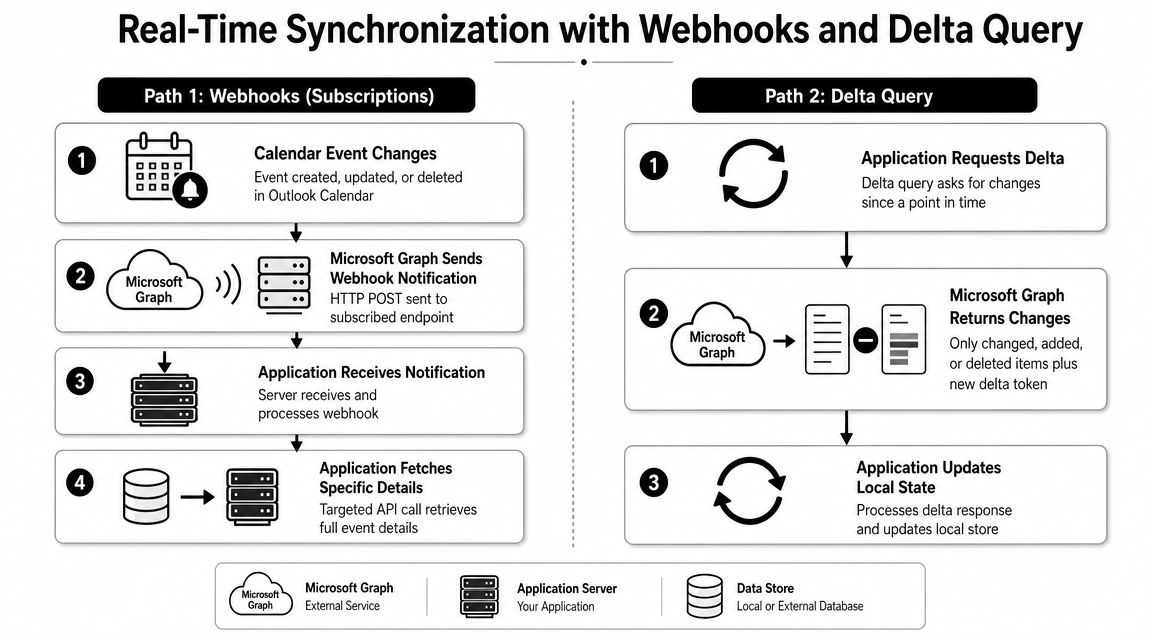
For Outlook calendar integrations, the two patterns that matter most are webhooks and delta queries. They solve different problems, and the strongest sync engines use both intentionally.
Webhooks for fast awareness
A webhook subscription is your “something changed” signal. It's the right fit when your app needs to react quickly to event creation, updates, or deletions.
The operational pattern is usually:
- Subscribe to change notifications.
- Validate the callback endpoint correctly.
- Receive a notification when a calendar item changes.
- Fetch the affected resource details from Graph.
- Apply your own normalization and downstream updates.
The key point is that webhooks tell you that a change happened, not that your local copy is now fully reconciled forever.
A generic webhook integration example from API2Cart is useful here because the same discipline applies across domains: verify notifications, keep handlers fast, and move heavy processing to queues.
Delta queries for state reconciliation
Delta queries solve a different problem. They're for answering: “What changed since the last time I had a good view of this mailbox?”
That makes them a better fit for:
- Catch-up sync after downtime
- Periodic reconciliation
- Detecting changes missed by transient notification failures
- Large-scale sync jobs that can't refetch everything every run
A webhook can wake your system up. A delta process can prove your local state is correct.
Which one should you use
Here's the practical split:
| Need | Better fit |
|---|---|
| Respond quickly to user edits | Webhooks |
| Recover after outages or worker lag | Delta queries |
| Maintain durable sync state | Delta queries |
| Trigger downstream business workflows immediately | Webhooks |
The pattern that works best
Use webhooks as your notification layer and delta queries as your reconciliation layer.
If you only use webhooks, missed notifications become silent data drift. If you only use delta queries, your users notice lag. The combination gives you responsiveness and correctness.
Fast sync and correct sync are not the same thing. Design for both.
One more caution: don't write business logic directly inside webhook handlers. Acknowledge quickly, enqueue work, fetch details in a worker, and let a separate reconciliation job clean up anything the notification path misses.
Handling Complex Calendar Scenarios
Straightforward event sync is only half the job. The hard bugs usually come from recurrence and time zones.
The Outlook Calendar API supports recurring events through a recurrence property in the event payload, and event objects commonly expose structured fields such as id, subject, start, and end, as described in the earlier Graph calendar integration reference. That means the API gives you the structure, but your app still has to decide how to model the series.
Recurring events need series-aware logic
A recurring series isn't just “one event repeated.” In practice, you need to think about at least three concepts:
- Series master: the parent definition of the recurrence
- Occurrence: an instance generated from the pattern
- Exception: a changed instance that no longer matches the original pattern
If your local store flattens everything into independent appointments too early, updates become messy. A change to the master can collide with exception handling, and deletes become ambiguous.
A safer pattern is to store:
- A durable reference to the source series
- Instance-level records for materialized occurrences you need
- Exception markers when a single occurrence diverges
Time zone mistakes create support tickets fast
Most customer-facing “calendar bug” reports aren't API bugs. They're time modeling bugs in the integration layer.
Use explicit timezone values in start and end fields, and avoid assuming your server timezone, your database timezone, and the user's display timezone are interchangeable. They aren't.
Here's the rule set that prevents most failures:
- Store the source timezone context with the event payload you receive or send.
- Preserve local intent for user-scheduled meetings.
- Convert only at controlled boundaries, such as UI display or internal normalization.
- Test DST transitions with recurring meetings, not just one-off events.
A recurring event example
{
  "subject": "Weekly operations review",
  "start": {
    "dateTime": "2026-03-02T09:00:00",
    "timeZone": "Pacific Standard Time"
  },
  "end": {
    "dateTime": "2026-03-02T10:00:00",
    "timeZone": "Pacific Standard Time"
  },
  "recurrence": {
    "pattern": {
      "type": "weekly",
      "interval": 1,
      "daysOfWeek": ["monday"]
    },
    "range": {
      "type": "numbered",
      "numberOfOccurrences": 10,
      "startDate": "2026-03-02"
    }
  }
}
When developers rush this part, they usually over-normalize. Calendar data needs some fidelity left intact, or rescheduling logic becomes guesswork.
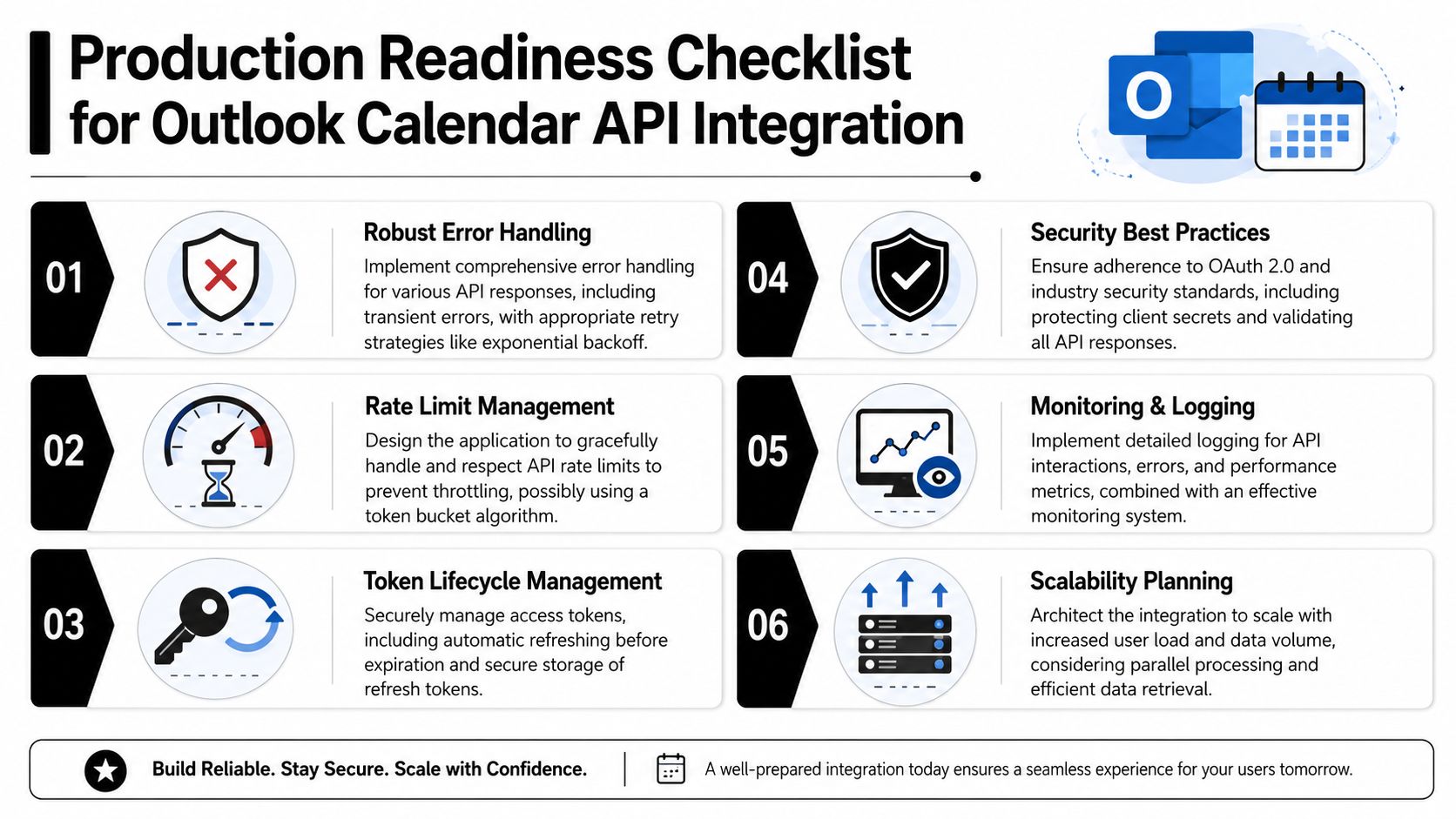
Production Readiness Rate Limits and Errors
A 201 Created response is not the finish line. It's one signal in a longer process, and production-grade Outlook integrations treat it that way.
One under-discussed issue is event identifier stability after create operations or connector changes. Recent user reports describe cases where a create-event flow returns an ID that later can't be found, and community guidance suggests doing a follow-up lookup rather than assuming the returned ID is durable, as discussed in this Zapier community thread about Outlook event ID issues. If your system depends on write-then-read behavior for reminders, cancellation, or bidirectional sync, this matters immediately.
Treat create responses as provisional until verified
If downstream workflow depends on the event being retrievable, add a get-after-write verification step. That can be immediate or queued, depending on your latency budget.
A defensive create pipeline often looks like this:
- Send create request.
- Record the returned identifier and request metadata.
- Attempt follow-up retrieval.
- If retrieval fails, retry under controlled policy.
- Mark the record as pending reconciliation instead of declaring sync complete.
That approach costs a little more engineering. It saves a lot of support time.
A successful write without a successful reconciliation is not a completed sync.
Reliability planning matters because Graph incidents happen
Another weak spot in many implementations is incident handling. Public discussion around Graph calendar behavior shows that calendar-related errors and service disruptions do happen, including attachment failures on known-issues pages and forum reports of Graph errors, 500s, and re-authentication needs affecting some Outlook accounts, as reflected in this Microsoft Answers discussion on Graph calendar issues.
That means your integration needs an actual reliability playbook.
The minimum playbook
Retry logic
Use bounded retries for transient failures. Don't hammer the API with blind loops. Space retries, classify errors, and push uncertain cases into reconciliation queues.
Throttling behavior
Your app should expect rate limiting and back off cleanly. If you want a general refresher on shaping clients around throttled APIs, this API rate limit guide from API2Cart is a practical read because the client-side design principles transfer well.
Monitoring and logs
Track failures by mailbox, tenant, operation type, and sync stage. “Graph failed” is not an actionable signal. “PATCH on shared mailbox event failed during retry after token refresh” is.
Re-auth and account health
Sometimes the issue isn't your code path. It's tenant config, revoked consent, or account-specific state. Build reconnect flows that support support teams, not just end users.
Security and resilience go together
When you store tokens, process callbacks, and move calendar data across queues, you're building part of your app's security perimeter. For a solid practical checklist beyond OAuth mechanics, AppStarter's app security insights are worth reviewing.
What production-ready usually means
- Requests are idempotent from your system's perspective
- Transient failures don't create duplicate appointments
- Event lookups are verified before customer workflows rely on them
- Support can inspect a failed sync without reading source code
- Your system degrades gracefully during API instability
That's the difference between “we integrated Outlook” and “customers trust our Outlook sync.”
The Unified API Advantage When to Use API2Cart
After building one serious integration, teams often realize the actual cost isn't the first connector. It's the portfolio.
Outlook alone demands careful work around auth, event modeling, sync recovery, and production reliability. If your roadmap also includes other calendars, commerce systems, marketplaces, or adjacent platforms, one-off integrations start competing directly with core product work. Engineering ends up maintaining connectors instead of shipping differentiated features.
That's where a unified API approach becomes a strategic architecture choice rather than a shortcut.
When direct Outlook work makes sense
A direct integration is the right call when:
- Outlook is a primary workflow in your product
- You need mailbox-specific behavior and tight control
- Your team is prepared to own long-term connector maintenance
- Calendar sync is a core product capability, not a side feature
When a unified API makes more sense
A unified API becomes attractive when your product needs to connect to many external systems and your team wants one integration contract instead of a growing set of custom adapters.
For integration-focused SaaS teams, that usually means:
- one auth and data access pattern at your application boundary
- less duplicate connector logic
- fewer platform-specific edge cases leaking into product code
- faster expansion into new ecosystems
This is especially relevant for B2B products that already live in a multi-system world, such as order management, inventory, shipping, PIM, ERP, analytics, or automation platforms. In that environment, the engineering question isn't only “Can we integrate Outlook?” It's “What integration surface can we afford to maintain over time?”
The strongest teams choose direct integrations for strategic systems and use unification where breadth matters more than owning every platform nuance by hand.
Outlook Calendar API Frequently Asked Questions
How do I create an event in Outlook Calendar?
Use a POST request to the event collection for the mailbox or calendar you're targeting, typically the user's primary event path in Microsoft Graph. Send a Bearer token, include subject, start, and end, and treat the returned event as something to verify if your workflow depends on immediate follow-up reads.
Should I store the event ID returned on create?
Yes, but don't assume that returned identifier is the end of the story in every production scenario. Store it, then run a verification step if later business logic depends on fetching or mutating that event reliably.
Which permission should I ask for first?
Start with the smallest scope that supports the feature you're shipping. If your app only reads events, don't request write permissions. If you need shared calendar access, design that need explicitly instead of assuming a broad mailbox scope will cover it cleanly.
What's better for sync, webhooks or polling?
For serious sync, webhooks are better for fast awareness of changes, while delta-style reconciliation is better for correctness over time. Basic polling works for prototypes, but it tends to age poorly once customers expect near-real-time updates and outage recovery.
How do I avoid timezone bugs?
Preserve the event's timezone context, don't implicitly coerce everything into server-local assumptions, and test recurring meetings around daylight saving changes. Most timezone issues come from application logic, not from the calendar API itself.
What should my app do on 500 or other transient failures?
Retry carefully, classify the error, and avoid duplicate side effects. If the failed operation was part of a sync workflow, mark the item for reconciliation so your system can repair state later instead of guessing.
Yes. Shared and delegated access often behaves differently from a simple “my own calendar” integration. Model mailbox ownership, calendar ownership, and acting user separately in your logs and internal records.
If your team is tired of building and maintaining one-off integrations across external platforms, API2Cart gives you a faster path with a unified API for broad eCommerce connectivity. It's a strong fit for B2B SaaS vendors that want to reduce connector overhead, launch integrations sooner, and keep engineering focused on product logic instead of platform-by-platform maintenance.