A lot of integration teams start in the same place. A customer asks for one shopping cart connection. The request is reasonable, the API looks clean enough, and the fastest answer is to wire your product directly to that platform and move on.
Then sales asks for the next cart. Support wants better sync visibility. Product wants orders, inventory, refunds, and customer updates to flow both ways. Engineering now owns a growing pile of custom connectors that all solve roughly the same problem in slightly different ways.
That's where point to point integration stops being a quick delivery tactic and starts becoming an architecture decision.
The All-Too-Familiar Integration Spiral
The first direct integration rarely feels risky. A developer adds auth handling, maps a few entities, writes webhook processing, and ships. Everyone sees a customer win. Nobody sees a structural problem yet.
The trouble starts when that first connector becomes the template for every new request. One store platform needs a different auth flow. Another returns orders with edge-case field formats. A marketplace version changes behavior. A merchant turns on a setting that breaks your assumptions. Your team now supports a portfolio of one-off pipelines, each with its own quirks.
Why teams fall into it
Point to point integration is the natural default because it connects two applications directly. No shared abstraction. No intermediary layer. Just system A talking to system B.
That simplicity is real. It's also temporary.
Modern organizations operate in environments that are already crowded with software. One industry summary says enterprises use an average of 897 applications, yet only 29% are integrated, leaving 71% disconnected and creating major silos, according to SnapLogic's integration overview.
For an eCommerce SaaS vendor, those silos show up as merchant complaints you already know well:
- Order delays: A customer expects order data to appear instantly, but one connector polls differently than another.
- Inventory mismatches: Your team maps stock fields one way for one platform and another way elsewhere.
- Support escalations: A merchant reports “sync failed,” and your developer has to inspect a connector-specific path instead of one shared integration layer.
Practical rule: If every new customer integration starts with copying an old connector and changing endpoint details, your architecture is already drifting into maintenance-first mode.
What makes this painful for product teams
The hidden problem isn't only code volume. It's fragmentation of effort. Your best engineers spend time learning another external API's oddities instead of improving your own product.
That's why the integration spiral feels so familiar. Each new direct connection looks justified on its own. Taken together, they turn your roadmap into a queue of connector work, bug triage, and compatibility fixes.
Understanding Point to Point Integration Architecture
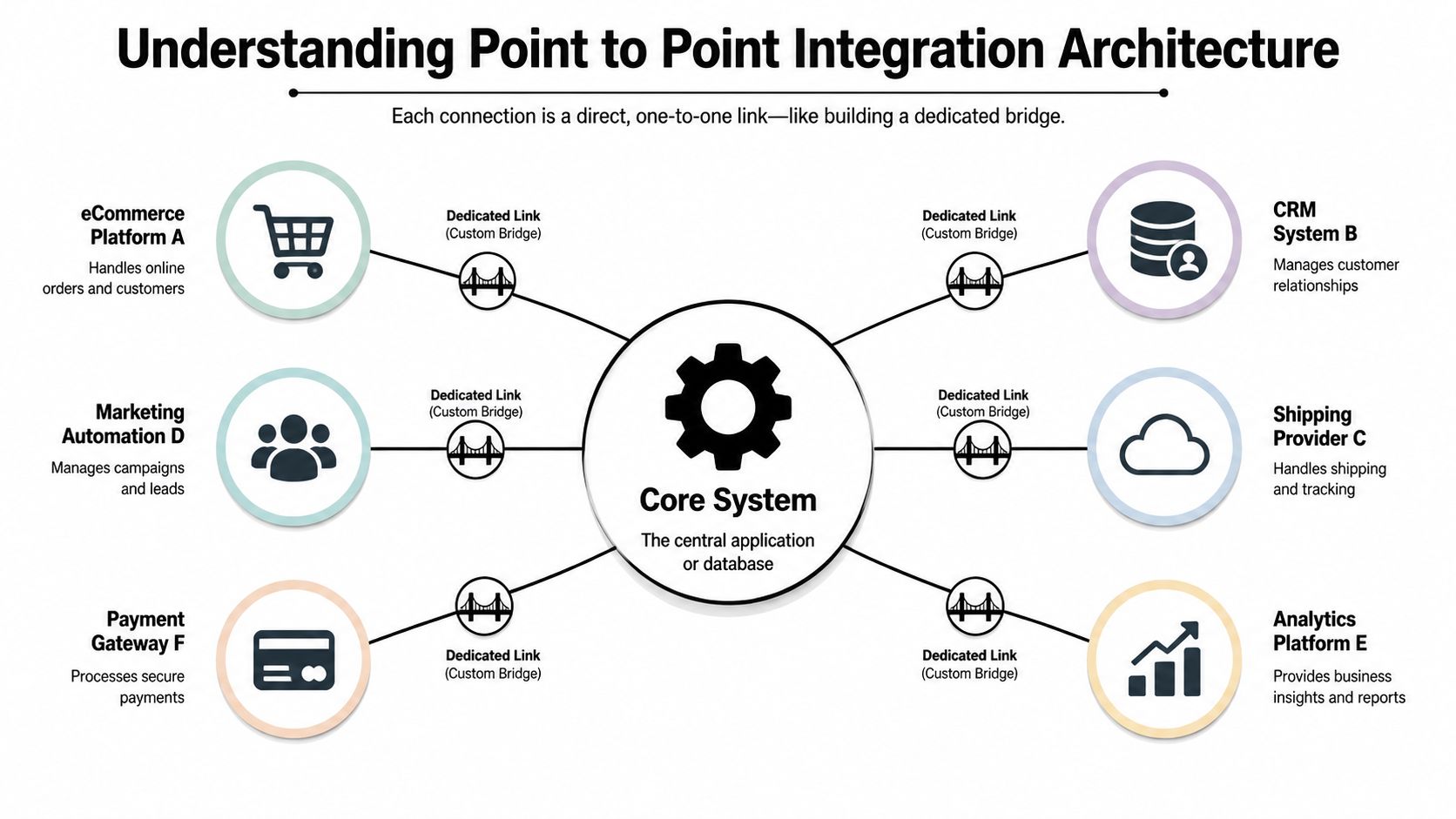
Point to point integration is easiest to understand if you think of it as building a separate private bridge between every pair of islands. If two islands need to exchange traffic, you build one dedicated bridge. If a third island joins, you build more bridges. Nothing is shared unless you explicitly create it.
That's why the model feels fast at the beginning. There's no platform layer to design. A developer can focus on one connection and get data moving quickly.
What each direct connection actually contains
A point to point integration is never just an endpoint call. In practice, every connector usually includes its own set of moving parts:
- Authentication handling: Tokens, credentials, refresh logic, and permission scope.
- Field mapping: Products, orders, inventory, shipments, customers, taxes, and status values rarely line up exactly.
- Transport logic: Webhooks, polling, retries, pagination, and backoff behavior.
- Operational rules: Logging, alerting, dead-letter handling, and connector-specific troubleshooting.
Even when two platforms support similar business objects, the implementation details differ enough that teams end up maintaining bespoke logic per connection.
Why complexity rises faster than expected
The architectural problem isn't linear growth. In a direct-connections model, the number of possible links expands toward n(n-1)/2 as systems are added, which increases change-management overhead, testing complexity, and the failure surface area, as described in Ellucian's guide to common integration terminology.
That formula matters because developers often underestimate what “just a few more integrations” means in operational terms.
A small example makes it obvious:
| Connected systems | What changes for engineering |
|---|---|
| 2 | One direct path to build and maintain |
| 3 | More mappings, more tests, more auth states |
| 5 | Cross-connector inconsistency becomes visible |
| More than a handful | Monitoring, version drift, and support overhead start dominating |
A direct link is simple only in isolation. A portfolio of direct links behaves like a distributed system with no center of gravity.
For eCommerce products, this shows up when one connector handles order edits one way, another handles partial fulfillment differently, and a third exposes customer fields with a structure your core model never anticipated. The architecture doesn't fail because the concept is wrong. It fails because every new connection brings another custom boundary to defend.
The True Cost of Seemingly Simple Integrations
The appeal of point to point integration is easy to understand. Direct system-to-system communication can be fast, and for a single integration the build path is usually straightforward. You control the code, you shape the payloads, and you don't need to normalize everything on day one.
That's the short-term view. The long-term view is much less forgiving.
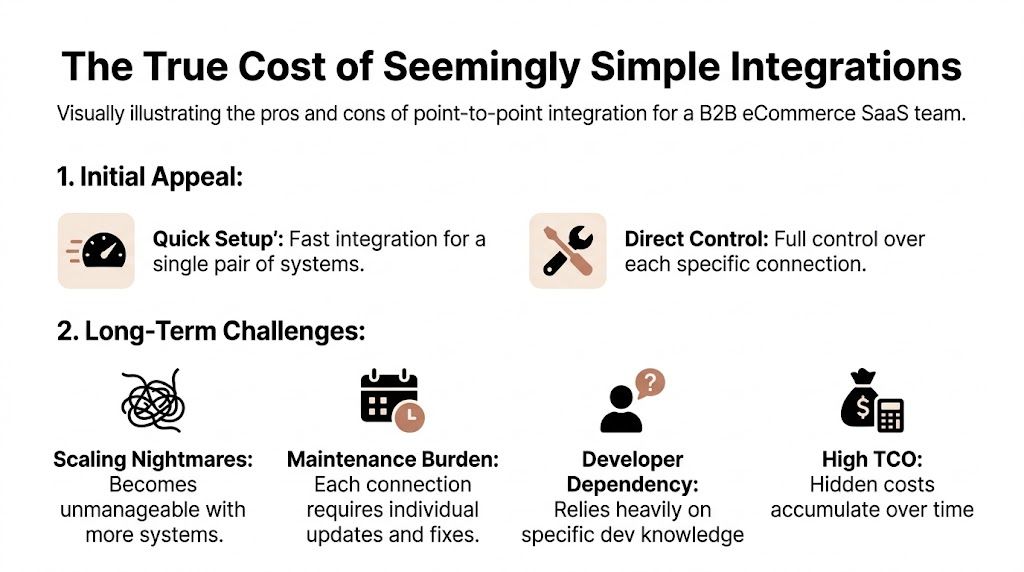
Initial appeal
Direct integrations can absolutely make sense when the scope is tightly bounded.
- Fast first delivery: A team can connect one product to one external platform without building a broader framework.
- Tight control: You can tune the exact request flow, transformation logic, and error handling for one merchant use case.
- Low latency: Data often moves quickly because the path is direct.
That's why teams choose this pattern in the first place.
Where the real bill arrives
The cost doesn't show up during the first build. It shows up later, when every connection needs separate care. Industry guidance is consistent on this point: point to point integration can deliver fast, low-latency data transfer, but every connection must be individually maintained, updated, and secured, creating rising technical overhead and governance challenges, as noted in Integrate.io's review of P2P trade-offs.
For developers, that overhead usually lands in four places:
- Break-fix work: External APIs change. A small schema update or auth change can disable one path while the rest of your platform appears healthy.
- Security drift: One connector uses one auth pattern, another uses a different one, and hardening standards become inconsistent.
- Support friction: Your support team can't use one playbook. Every failure path has its own diagnostics.
- Roadmap tax: Engineers keep returning to old connectors instead of shipping product capabilities customers notice.
The operational parallel most teams miss
This problem isn't unique to integrations. It's similar to any manual process that looks cheap until exception handling piles up. A useful example is the true cost of manual order screening, where repetitive checks seem manageable until volume and edge cases turn them into a sustained operational drag.
The same pattern applies here. Direct connectors feel efficient while count and variance stay low. Once both increase, maintenance becomes the job.
The hidden cost of point to point integration is not writing the connector. It's owning that connector for as long as customers depend on it.
If you're trying to evaluate this economically, a practical starting point is to compare build effort with expected lifetime maintenance and support burden. This is the right lens for assessing the cost of shopping cart API integration when your product roadmap depends on supporting more than one platform.
When to Abandon the Point to Point Model
The right question isn't whether point to point integration is bad. It isn't. The right question is when it stops making business sense.
For a single strategic connector, direct integration can still be rational. If one merchant segment depends on one platform, and your team is willing to own bespoke logic, direct build can be the shortest path to revenue.
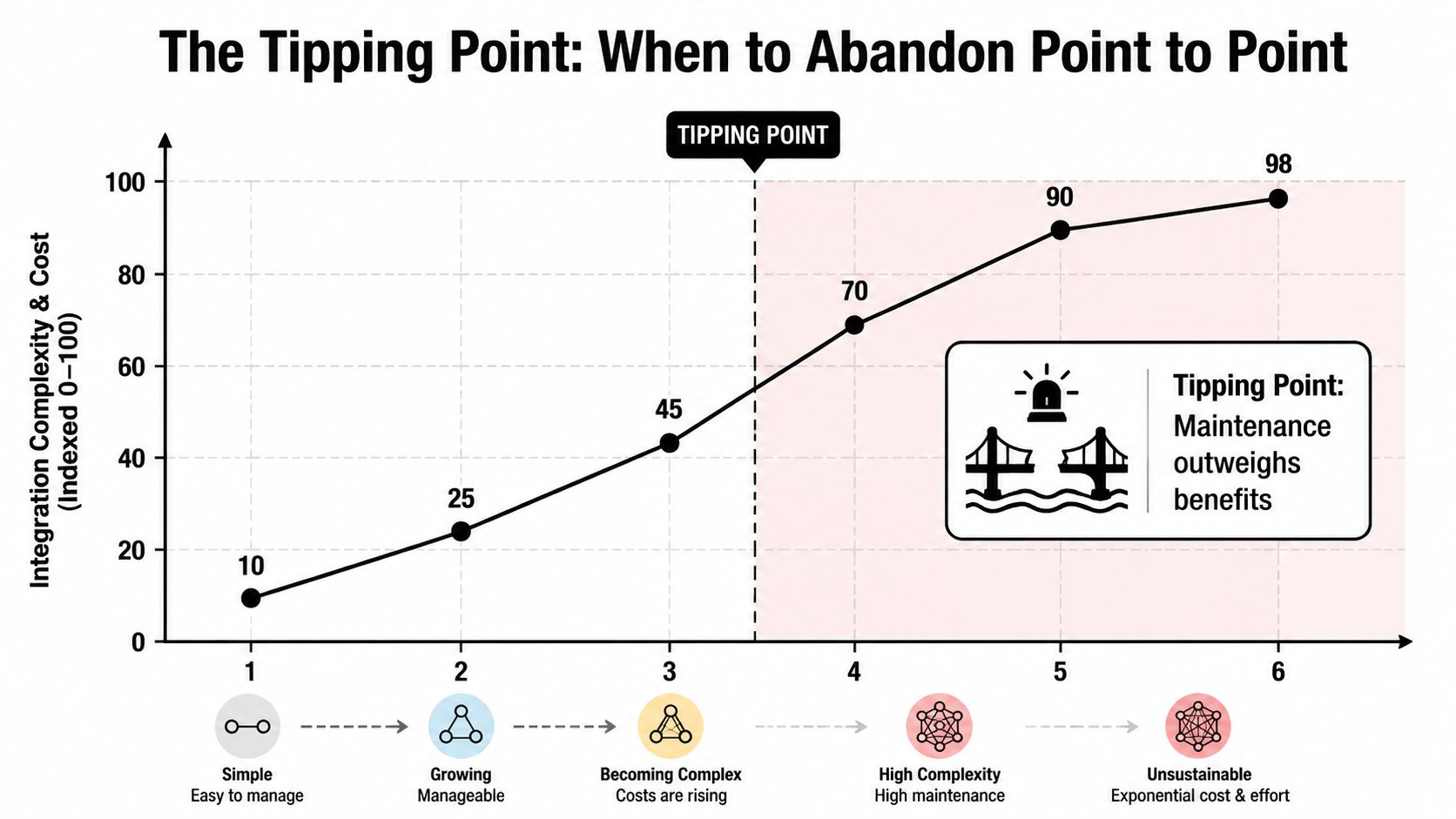
The tipping point in practice
The model breaks when your engineering team is no longer building “an integration.” It is operating an integration estate.
One industry analysis puts it well: point-to-point can be the fastest path to market for a narrowly scoped, high-value integration, but its viability drops quickly as the number of required connections grows and the long-tail cost of supporting many carts and marketplaces takes over, according to Burq's discussion of P2P viability.
A useful decision framework looks like this:
| Situation | Direct P2P still works | Time to change |
|---|---|---|
| One high-value platform | Yes | Not urgent |
| A few integrations with stable scope | Sometimes | Watch maintenance closely |
| Multiple carts, marketplaces, and merchant variations | Rarely | Start planning migration |
| New connector requests are routine | No | Shift to a shared integration model |
Signals your team has crossed the line
You've likely passed the tipping point if these conditions sound familiar:
- New integration work starts with old connector code. Reuse is happening through duplication, not through a shared abstraction.
- Bug triage is connector-specific. The team needs platform-by-platform expertise to resolve incidents.
- Merchant onboarding depends on engineering. Small configuration differences trigger code changes or manual support.
- Feature launches stall across connectors. A new product capability requires separate implementation for every platform you support.
That's the uneconomic moment. Not because each individual connector is impossible to support, but because the cumulative support obligation starts crowding out product development.
A practical threshold for eCommerce SaaS teams
If your product strategy depends on broad ecosystem coverage, the pivot should happen before your connector count becomes the product's real center of gravity. For most integration developers, the warning sign is simple: once every new platform means rebuilding the same auth, mapping, monitoring, and exception logic in another flavor, the architecture is already charging you rent.
Comparing P2P with Middleware and Unified APIs
Direct integrations, middleware, and unified APIs solve different problems. They're not interchangeable, and teams usually get into trouble when they treat them as if they are.
For an integration developer, the useful comparison isn't abstract architecture purity. It's day-to-day effort. How much code do you own, how much complexity do you centralize, and how quickly can you support the next platform request without creating another maintenance branch?
The practical differences
Modern P2P often relies on REST APIs and custom logic, but direct coupling means a schema change or rate-limit issue can break a specific path and force teams to build retry logic and monitoring for every connection, as described in Workato's summary of point-to-point drawbacks.
Middleware improves control and centralization. It helps when you need orchestration, routing, and internal policy enforcement across many systems. But it also introduces its own layer to design and operate. For many eCommerce SaaS teams, that can be more platform than they require.
Unified APIs sit in a narrower but very useful place. They reduce external API fragmentation by giving developers one normalized interface for a specific domain such as commerce data.
Integration Architecture Comparison
| Metric | Point-to-Point | Middleware/ESB | Unified API (e.g., API2Cart) |
|---|---|---|---|
| Initial build effort | Low for one connector | Higher upfront | Moderate once, then reused |
| Ongoing maintenance | High per connection | Centralized but platform-heavy | Lower external API maintenance burden |
| Scalability | Weak as connector count rises | Strong internally | Strong for domain-specific external integrations |
| Developer experience | Fragmented by platform | Powerful but more complex | Consistent across supported platforms |
| Time to market for new integrations | Slows with each new platform | Depends on platform setup | Faster when the target platform is already covered |
Which model fits which job
Use direct integration when the connection is narrow, strategic, and unlikely to multiply.
Use middleware when your core challenge is broad internal orchestration and process control across many business systems.
Use a unified API when your product must connect to many external platforms that expose similar business objects but different implementation details.
That's also why finance and CRM teams often look for ways to optimize QuickBooks and HubSpot through a more standardized integration approach instead of stitching together isolated sync paths. The same logic applies in commerce. When your product needs repeatable connector coverage, a normalized interface beats bespoke repetition.
A more detailed architectural lens is the trade-off between a domain-focused unified layer and a broader embedded integration stack, which is exactly the decision explored in this comparison of unified API vs embedded iPaaS.
Accelerate Development with a Unified eCommerce API
For eCommerce SaaS teams, the cleanest way out of connector sprawl is to stop treating every cart or marketplace as a fresh engineering project.
A unified eCommerce API gives your team one integration surface for common commerce entities such as orders, products, inventory, customers, shipments, and categories. Instead of learning a different external model every time, developers work against one contract and let the abstraction layer handle platform-specific differences underneath.

What changes for the developer
The big win is not that integration work disappears. It's that the work becomes reusable.
With a unified API, your team can focus on:
- One domain model: You build your order import, inventory sync, or shipment update flow once against a normalized structure.
- One auth pattern: Your application handles one integration style instead of juggling connector-by-connector variations.
- One operational playbook: Monitoring, logs, retries, and exception handling become more consistent.
That shift matters most when your team supports merchant-facing workflows such as order import automation, catalog sync, listing updates, and multichannel inventory updates.
Where API2Cart fits
For this use case, API2Cart provides a unified eCommerce API that lets B2B software vendors connect to 80+ shopping carts and marketplaces through a single integration layer, with 100+ API methods for orders, products, customers, shipments, inventory, and catalog workflows. For an integration developer, that means one implementation path instead of building and maintaining separate direct connectors across the same commerce domain.
That's especially useful when your roadmap includes multiple store platforms, ongoing platform variance, and merchant-specific onboarding needs. The abstraction doesn't remove commerce complexity, but it does move repeated connector work out of your application code.
Build custom business logic where your product is unique. Standardize the connector layer wherever the external platforms are mostly variations of the same core entities.
Why this speeds execution
Teams usually feel the benefit in three places:
- Faster roadmap movement: New platform coverage doesn't require another greenfield connector.
- Lower integration fatigue: Developers spend less time on repetitive API plumbing.
- Simpler staffing: If you're evaluating hiring for API development projects, a unified layer reduces the amount of niche platform-specific knowledge every engineer must carry.
If you want a product-level view of this model, this overview of a unified API for eCommerce connectivity captures the underlying approach: centralize the repetitive integration work so your team can keep attention on product features, merchant workflows, and reliability.
Your Integration Strategy Verdict
Point to point integration still has a place. If you need one highly specific connection, the business case is clear, and the lifecycle is limited, direct build can be the right tool. It gives you full control and a short path to delivery.
That's not the reality for most B2B eCommerce SaaS products.
If your growth depends on supporting many carts, marketplaces, and merchant environments, direct connectors become a constraint. You start with integration work as a feature. You end with integration work as an operating burden. The issue isn't only maintenance cost. It's the steady diversion of engineering time away from the capabilities customers buy your product for.
Use this model when
- Choose point to point integration when you have a narrow, high-value use case and you're comfortable owning custom logic long term.
- Choose a centralized integration approach when platform coverage is a product requirement, not an exception.
- Choose a unified commerce API strategy early when repeatability matters more than bespoke connector control.
The practical recommendation
Organizations frequently wait too long to make the shift. They keep adding connectors because each request looks individually reasonable. By the time the architecture problem is obvious, the support burden is already embedded in onboarding, QA, incident response, and roadmap planning.
The better move is earlier consolidation. Once your product needs repeatable commerce connectivity, treat integration as a shared capability rather than a sequence of custom projects.
That decision keeps your developers focused on workflow quality, data accuracy, merchant experience, and product differentiation. It also gives your business a cleaner path to expand platform coverage without rebuilding the same connector logic over and over.
If you're deciding whether to keep building direct connectors or move to a shared commerce integration layer, the fastest way to validate the trade-off is to test one real workflow. Start a free trial with API2Cart and see how your order, product, customer, or inventory sync behaves when you integrate once instead of repeating the same build for every platform.