BigCommerce API integration enables eCommerce software providers to connect their solutions with BigCommerce stores and work with essential commerce data. For SaaS vendors developing order management, inventory, shipping, ERP, PIM, or other eCommerce systems, this connectivity can be critical for supporting merchants that rely on BigCommerce.
The scale of commerce processed through the platform makes this integration increasingly relevant. According to Commerce's 2025 financial results, its platform facilitated $31.7 billion in Gross Merchandise Volume (GMV) in 2025, up 12% year over year. Moreover, total annual revenue run-rate reached $359.8 million by March 31, 2026, according to the company's Q1 2026 results.
For software vendors, however, supporting BigCommerce involves more than establishing a basic API connection. Applications may need to retrieve orders, synchronize products and inventory, manage customer data, process shipments, use webhooks, and adapt to API changes. Therefore, a reliable integration strategy must account for both current functionality and ongoing maintenance.
In this guide, we explain how BigCommerce API integration works, which API capabilities are available, and what challenges developers should consider. We will also explore how eCommerce software providers can simplify integration and maintain scalable connectivity as their platform coverage grows.
What Is BigCommerce and Why Does It Matter for API Integration?
BigCommerce is a SaaS eCommerce platform that enables businesses to build and manage online stores. It provides functionality for product and catalog management, orders, customers, payments, shipping, inventory, promotions, and other core commerce operations.
For eCommerce software providers, however, BigCommerce is important not only as a storefront platform. Its APIs allow external applications to exchange commerce data with merchants' stores. As a result, ERP, PIM, OMS, WMS, shipping, inventory management, and other SaaS solutions can extend their functionality through BigCommerce API integration.

BigCommerce supports businesses across different markets and commerce models. Therefore, software vendors that serve BigCommerce merchants may need reliable access to products, orders, customers, inventory, shipments, and other store data. The exact capabilities depend on the APIs and resources involved in each integration use case.
BigCommerce API Overview for Integration
BigCommerce provides APIs that allow developers to connect external applications with store data and commerce functionality. These APIs support integrations for products, orders, customers, inventory, shipments, channels, and other resources. Therefore, understanding the available API architecture is an important part of planning a reliable BigCommerce API integration.
Key capabilities and technical characteristics include:
- REST APIs. BigCommerce provides REST endpoints for working with core commerce resources. Developers can use standard HTTP methods such as GET, POST, PUT, and DELETE depending on the resource and operation.
- JSON data exchange. REST API requests and responses commonly use JSON, which makes commerce data straightforward to process within external applications.
- API authentication. BigCommerce uses access tokens and API account credentials to authorize requests. Apps distributed to multiple stores can use OAuth workflows to obtain store-specific access.
- GraphQL APIs. BigCommerce also provides GraphQL capabilities for specific use cases. They allow applications to request selected fields and related data through structured queries.
- Webhooks. Applications can subscribe to supported store events instead of repeatedly polling for every change. For example, webhooks can help trigger workflows when orders, products, customers, or other supported resources change.
- API versioning and resource-specific capabilities. BigCommerce functionality is distributed across different APIs and versions. Therefore, developers need to check the requirements and supported operations for the resources used by their integration.
Developers can explore available resources, authentication requirements, and current API functionality in the official BigCommerce developer documentation.
Benefits of BigCommerce API Integration for Software Vendors
For B2B eCommerce software providers, BigCommerce API integration creates a data connection between their application and merchants' stores. The business value depends on the software category and the commerce workflows it needs to support.
- Order management. OMS, ERP, fulfillment, and shipping solutions can retrieve BigCommerce order data and use it within their operational workflows.
- Product and catalog management. PIM, ERP, and multichannel systems can work with product information, variants, categories, prices, and other supported catalog data.
- Inventory synchronization. Inventory management, WMS, and multichannel applications can exchange stock information with connected BigCommerce stores and support automated inventory workflows.
- Customer data integration. CRM, marketing automation, loyalty, and other SaaS applications can use supported customer data to power their features.
- Event-driven automation. Supported BigCommerce webhooks can notify applications about store events, reducing the need to rely entirely on scheduled polling.
- Broader platform coverage. Supporting BigCommerce allows eCommerce software vendors to serve merchants that use the platform alongside customers operating on other shopping carts and marketplaces.
However, these capabilities also create an ongoing technical responsibility. Developers need to manage authentication, API changes, data mappings, platform-specific behavior, and integration maintenance. The challenge becomes greater when a SaaS product supports BigCommerce together with many other eCommerce platforms.
Key Challenges of BigCommerce API Integration
A BigCommerce API integration involves more than connecting an application to several endpoints. Software vendors need to account for authentication, data models, API-specific behavior, and ongoing platform changes. Moreover, the complexity increases when the same SaaS product supports multiple eCommerce platforms.
- Different APIs and versions. BigCommerce functionality is distributed across different API resources and versions. Developers need to identify the appropriate endpoints and adapt their integration when platform requirements change.
- Platform-specific data mapping. Products, variants, customers, orders, addresses, brands, transactions, and other entities may not match the internal data model of a SaaS application. Therefore, developers need mapping and transformation logic to keep data consistent.
- Authentication and permissions. Applications must manage credentials, access tokens, and appropriate API scopes. Incorrect permissions can prevent an integration from accessing or modifying required store data.
- API rate limits. BigCommerce applies rate limits to API requests. High-volume applications need to monitor available quota, handle rate-limit responses, and design request workflows efficiently.
- Webhook and synchronization logic. Webhooks can support event-driven workflows, but applications still need reliable processing, error handling, retries, and reconciliation mechanisms. This becomes especially important for orders, inventory, and other frequently changing data.
- Ongoing integration maintenance. API versions, endpoints, fields, and platform behavior can evolve. As a result, software vendors need to monitor changes, test their integrations, and update their implementation when necessary.
These challenges become more resource-intensive when a software vendor maintains separate integrations with BigCommerce and other shopping platforms. Consequently, the integration architecture itself can become a significant part of ongoing product development and maintenance.
How API2Cart Simplifies BigCommerce API Integration
API2Cart simplifies BigCommerce API integration by providing a unified API for BigCommerce and 80+ supported eCommerce platforms and marketplaces. Instead of developing and maintaining a separate connection for every platform, software vendors can use one integration layer to access commerce data across their supported ecosystem.
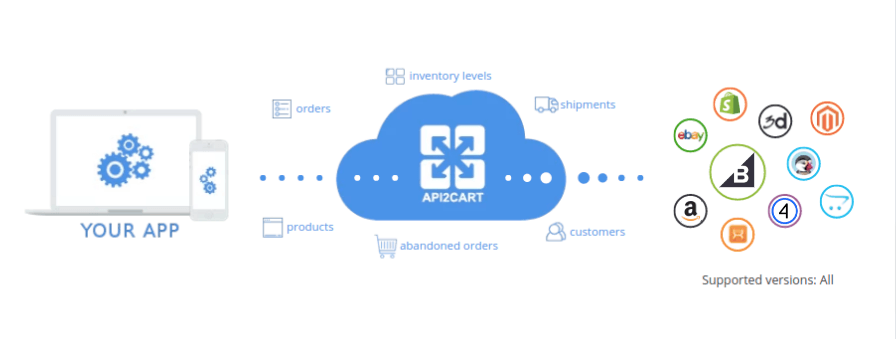
Through API2Cart, ERP, PIM, OMS, WMS, shipping, inventory management, and other eCommerce software can connect with BigCommerce stores and work with supported store data. Depending on the required workflow, applications can retrieve and manage products, orders, customers, inventory, shipments, categories, and other commerce entities.
Build BigCommerce Workflows Through One Unified API
For example, an order management system can retrieve orders from connected BigCommerce stores and process them within its own workflow. An inventory solution can use product and stock data to keep quantities synchronized. Likewise, a PIM or multichannel application can work with product information without building its entire integration architecture specifically around BigCommerce.
API2Cart also supports webhooks for event-driven workflows. For supported BigCommerce events, software can receive notifications about changes such as new orders instead of relying only on repeated API polling. As a result, applications can react to important store events and automate downstream processes more efficiently.
The unified approach becomes especially valuable when a SaaS product needs to support BigCommerce alongside Shopify, WooCommerce, Magento, and other platforms. Developers can work with standardized API2Cart methods while API2Cart handles much of the platform-specific integration layer behind them.
Explore the API2Cart API documentation to see available methods and supported eCommerce data operations.
BigCommerce API Integration Use Cases with API2Cart
Beyond common operations with products, orders, customers, and inventory, API2Cart supports additional methods that help software vendors build more specialized BigCommerce workflows. These capabilities allow SaaS providers to extend their BigCommerce API integration according to the functionality their customers need.
Gift Card Management
API2Cart provides methods for working with BigCommerce gift cards, including adding, retrieving, and deleting gift cards. For example, software can create a gift card for a specified amount and use related operations to manage existing gift cards.
This functionality can support loyalty, promotional, and customer engagement software. For example, applications can incorporate gift cards into holiday campaigns, rewards programs, or other promotional workflows.
Customer Wishlist Data
The customer.wishlist.list method allows software to retrieve products from a customer's BigCommerce wishlist. This data can be useful for marketing automation, personalization, CRM, and customer engagement solutions.
For example, software can use wishlist information as one of the signals for customer segmentation or targeted campaigns. However, the exact workflow depends on the functionality and permissions available for the connected store.
Customer Group Management
API2Cart also provides methods for working with customer groups. Software can use supported operations to retrieve customer groups and, where available, create or manage group-related data.
This functionality is particularly relevant to B2B, loyalty, pricing, and customer management solutions. Customer groups can help software distinguish between different customer segments and support workflows related to pricing tiers, promotions, or account management.
Order Transaction Data
The order.transaction.list method retrieves transaction information associated with orders. This capability can support accounting, ERP, payment reconciliation, analytics, and other applications that need access to transaction-level commerce data.
For example, software providers can use transaction data together with order information to support reconciliation and financial reporting workflows.
BigCommerce API Integration Example: Retrieving Order Transactions
Consider an accounting, ERP, or payment reconciliation solution that needs transaction data from a connected BigCommerce store. Instead of building separate BigCommerce-specific logic throughout the application, the software can retrieve this data through API2Cart.
For example, the order.transaction.list method allows software providers to retrieve transaction information associated with a specific order. This can support reconciliation, accounting, analytics, and financial reporting workflows.
{
  "return_code": 0,
  "return_message": "string",
  "pagination": {
    "previous": "string",
    "next": "string",
    "additional_fields": {},
    "custom_fields": {}
  },
  "result": {
    "transactions_count": 0,
    "transactions": [
      {
        "id": "string",
        "transaction_id": "string",
        "order_id": "string",
        "parent_id": "string",
        "description": "string",
        "status": "string",
        "gateway": "string",
        "reference_number": "string",
        "currency": "string",
        "amount": 0,
        "created_time": {
          "value": "string",
          "format": "string",
          "additional_fields": {},
          "custom_fields": {}
        },
        "settlement_currency": "string",
        "settlement_amount": 0,
        "settlement_created_time": {
          "value": "string",
          "format": "string",
          "additional_fields": {},
          "custom_fields": {}
        },
        "card_brand": "string",
        "card_bin": "string",
        "card_last_four": "string",
        "avs_street_resp_code": "string",
        "avs_postal_resp_code": "string",
        "avs_message": "string",
        "cvv_code": "string",
        "cvv_message": "string",
        "is_test_mode": true,
        "additional_fields": {},
        "custom_fields": {}
      }
    ],
    "additional_fields": {},
    "custom_fields": {}
  },
  "additional_fields": {},
  "custom_fields": {}
}
The application can then process the returned transaction data within its own workflow. In addition, the same unified API approach can be used across other supported eCommerce platforms, which helps reduce platform-specific development effort.
You can review the supported parameters and response structure in the API2Cart order.transaction.list documentation for BigCommerce.
Keeping BigCommerce Integrations Compatible as APIs Evolve
Building an integration is only the first step. BigCommerce continues to evolve its APIs, which means software vendors also need to maintain compatibility with platform changes.
API2Cart handles this work at the unified integration layer. In 2026, for example, API2Cart continued migrating BigCommerce functionality to current V3 API endpoints. The updates covered areas such as customers, customer addresses, brands, webhooks, and order transactions.
For software vendors, this reduces the amount of platform-specific maintenance required inside their own products. Instead of adapting every part of their application directly to BigCommerce API changes, development teams can continue working through API2Cart's unified interface.
Conclusion: Build and Maintain BigCommerce Integrations More Efficiently
A reliable BigCommerce API integration can give eCommerce software access to products, orders, customers, inventory, transactions, and other data required for automated commerce workflows. However, developers also need to manage authentication, data mapping, rate limits, webhooks, API changes, and ongoing maintenance.
API2Cart provides a unified integration layer for BigCommerce and 80+ supported eCommerce platforms and marketplaces. As a result, ERP, PIM, OMS, WMS, shipping, inventory management, and other SaaS providers can expand their platform coverage without building every integration from scratch.
With one API, development teams can focus more resources on their core product while API2Cart handles much of the platform-specific connectivity behind it.
Ready to connect your software with BigCommerce and other eCommerce platforms? Create your API2Cart account for free and start exploring the unified API.
BigCommerce API Integration FAQs
How does BigCommerce API integration work?
BigCommerce API integration connects an external application with a BigCommerce store so the systems can exchange commerce data. Depending on the use case, software can work with products, orders, customers, inventory, shipments, transactions, and other supported resources. Developers also need to handle authentication, permissions, data mapping, rate limits, and synchronization logic.
What data can software access through the BigCommerce API?
BigCommerce provides APIs for working with resources such as products, orders, customers, inventory, shipments, brands, and other commerce data. It also supports webhooks for various store events and GraphQL capabilities for specific use cases. The exact data and operations available depend on the API, resource, permissions, and integration scenario.
What are the main challenges of integrating with the BigCommerce API?
Common challenges include authentication and permissions, API rate limits, platform-specific data mapping, webhook processing, and synchronization logic. Developers also need to monitor API changes and maintain compatibility as BigCommerce evolves. These requirements can become more complex when a SaaS product supports BigCommerce together with multiple other eCommerce platforms.
How can API2Cart simplify BigCommerce API integration?
API2Cart provides a unified API for BigCommerce and 80+ supported eCommerce platforms and marketplaces. Software vendors can use one integration layer to work with supported products, orders, customers, inventory, shipments, and other commerce data. This approach helps ERP, PIM, OMS, WMS, shipping, inventory management, and other SaaS providers reduce the need to build and maintain separate platform-specific integrations.