Editorial update (August 2026): Magento product naming and version support, synchronization behavior, and platform coverage were updated.
eCommerce is one of today's primary and most efficient ways to buy things. From the perspective of sellers, ordering and buying online may seem simple and straightforward. As a merchant, things are a little more complex than that, so many of them want to have some kind of ERP system to help them operate their business.
ERP software usually includes development, product planning, manufacturing, marketing, sales, user interface, and application. It is a true virtual office assistant packed into a single bundle.
As an ERP solution provider, you should consider integrating your ERP system with an eCommerce platform, since there are many benefits for you and for your clients. Merchants will be able to cut down on manual work managing orders, inventory, products, and customer and shipping data, boosting productivity.
In this article, we will show you why it is important for you as an ERP provider to integrate your system with the Magento eCommerce platform, one of the most widely used shopping platforms among store owners.
Why Magento Integration is a Must-Have for Your ERP System?
Magento's current product family consists of Adobe Commerce and Magento Open Source. Magento 1 is no longer a supported Adobe release line, so an ERP integration project should identify the merchant's exact edition and supported version before implementation.
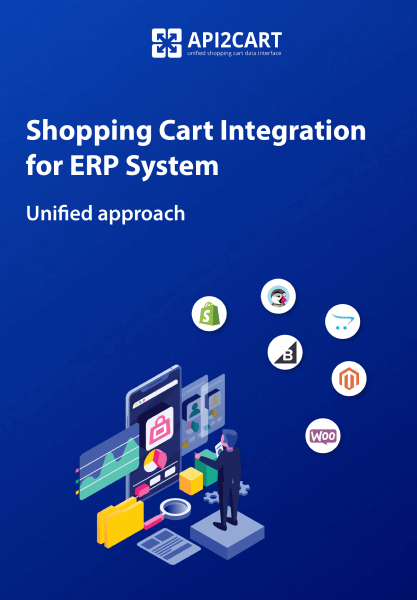
Shopping Platform Integration for ERP Systems
Explore how to develop the integration with multiple shopping solutions easily.
Integrating an ERP with Adobe Commerce or Magento Open Source can reduce duplicate data entry and connect order, customer, inventory, and shipment workflows. The actual efficiency gain depends on the selected data flows, update frequency, error handling, and implementation quality.
An ERP integration can retrieve sales and inventory changes from the store and send supported updates back to it. Data is not inherently instantaneous: latency depends on polling schedules, available webhooks, queue processing, platform limits, and retry logic.
What is the Easiest Way of Developing Magento Integration with an ERP System?
You should also be aware that Magento integration with an ERP system is very challenging. Integrating an eCommerce platform with an ERP system takes considerable time and expertise. Here are the main reasons why this integration is so difficult:
- It is genuinely difficult to find developers with specialized web programming skills and technical know-how
- Several technical problems can be encountered while developing integration with the Magento platform, including issues related to sending information to Magento, inaccuracies in its API documentation, and reindexing trouble
- After implementation, each integration needs updates and maintenance, which involves additional costs
- Building integration from scratch is a time-consuming process
Magento integrations can be complex because of product types, custom attributes, extensions, store views, version differences, and platform-specific API behavior. Evaluate the required API coverage and data mappings before choosing between a direct connector and a unified API.
API2Cart provides one integration interface for 80+ supported shopping carts and marketplaces, including Adobe Commerce, Magento Open Source, Shopify, WooCommerce, BigCommerce, OpenCart, and PrestaShop. Confirm the required methods and parameters for each platform in the current documentation.
A unified integration can reduce the number of separate connectors an ERP vendor has to build and maintain. Review the current pricing and request a 14-day trial to validate the required workflows.