A lot of integration work starts the same way. Product says the request is simple. Add one more commerce platform, support a new marketplace, pull orders, sync inventory, ship it this quarter.
Then engineering opens the docs and finds three different customer concepts, two authentication patterns, inconsistent pagination, partial webhook coverage, and a pricing model that changes depending on whether the buyer is a consumer or a company account. That’s usually the moment when “simple integration” turns into architecture work.
For teams building OMS, WMS, ERP, PIM, shipping, analytics, or multichannel software, choosing an api integration company isn’t just about connector count. It’s about whether the provider understands the difference between B2C commerce APIs built for fast consumer transactions and B2B commerce APIs built around account structure, negotiated terms, and approval workflows. Those differences shape your data model, your retries, your auth layer, your support burden, and your roadmap.
The 'Simple' Integration Request That Isn't
A developer gets asked to connect a SaaS product to a new platform. The first estimate is often based on the happy path. Fetch products. Import orders. Update shipment status. Done.
That estimate usually collapses after the first real store goes live.

Why the request looks smaller than it is
A consumer storefront and a wholesale portal can both expose endpoints named orders, products, and customers. That naming symmetry tricks teams into assuming the integration shape is similar.
It usually isn't.
A B2C order is commonly a single shopper, one checkout session, one payment event, and one shipping destination. A B2B order may start as a quote, move through approval, reference a company account, include tax handling rules, and settle on invoice terms instead of immediate card payment.
Where development time actually goes
Most of the work isn't in the first successful API call. It’s in normalization.
You have to decide:
- How to map identities: Is the actor an individual customer, a buyer attached to a company, or both?
- How to represent pricing: Is there one public price, or does each account have its own catalog and discount rules?
- How to process order state: Does “placed” mean paid, approved, or merely submitted for review?
- How to recover from failures: Can you replay safely, or will duplicate writes create accounting or fulfillment problems?
Practical rule: If the commerce platform supports business accounts, assume the order model is carrying business process, not just cart data.
That gap is one reason the market around API management keeps expanding. The global API Management Market was valued at $7.1 billion in 2025 and is projected to reach $58.7 billion by 2034, with a CAGR of 26.5%, reflecting rising demand for unified API connectivity across platforms and systems, according to Custom Market Insights on the API management market.
The technical issue isn’t that B2B APIs are worse and B2C APIs are cleaner. They solve different business problems. If your team treats them as interchangeable, your integration layer becomes a pile of exceptions.
Core Business Requirements Driving API Differences
Before comparing endpoints, it helps to compare the businesses behind them.
Here’s the practical split many teams run into early.
| Area | B2C eCommerce | B2B eCommerce |
|---|---|---|
| Buyer identity | Individual shopper | Company account with multiple users |
| Pricing | Public or segmented retail pricing | Contract pricing, negotiated terms, account-specific catalogs |
| Checkout | Fast self-service purchase | Approval chains, quotes, purchase orders, payment terms |
| Fulfillment | Direct-to-consumer shipping | Split shipments, warehouse rules, account delivery constraints |
| Access control | Basic customer auth | Role-based access by buyer, approver, procurement, admin |
| Data sync pressure | High event volume and fast storefront changes | More workflow complexity and stricter account logic |
B2C favors speed and low-friction flow
In B2C, the platform is usually optimized for conversion. Public catalog. Immediate checkout. Promotions. Guest sessions. Fast order confirmation.
That has clear API consequences. The integration layer often needs to support storefront freshness, cart or order events, payment confirmation, shipment updates, and promotional metadata without slowing down the buying path.
For developers, the complexity is operational. Large numbers of comparatively straightforward transactions. Lots of reads. Sudden traffic bursts. Tight expectations around latency.
B2B favors control and account structure
B2B APIs are often modeling an organization, not just a buyer. One company can have many users, and each user may have a role that changes what they can see, approve, or purchase.
The product catalog may also vary by account. The same SKU might be visible to one buyer, hidden from another, and priced differently under a contract. Checkout can involve internal approval or a quote before an order exists.
That’s why a generic “customer sync” often breaks down. In a B2B integration, you may need to sync:
- company account records
- account users
- buyer roles
- payment terms
- purchase order references
- account-specific product visibility
For teams that want a business-side explanation of this divide, API2Cart has a concise overview of the basic differences between B2B and B2C.
The API usually mirrors the business operating model. If the business sells through negotiated relationships, the API will expose that complexity somewhere.
Why a general connector strategy often fails
A broad iPaaS tool can be useful when applications have stable schemas and generic workflows. eCommerce is less forgiving.
Commerce platforms differ in how they treat variant products, taxes, fulfillment states, inventory, and identities. Once B2B requirements appear, those differences move from inconvenient to structural. An api integration company that already understands commerce semantics saves time because the hard part isn’t transport. It’s domain translation.
Detailed API Comparison of Data Models and Workflows
The most expensive mistakes happen at the model layer. Teams connect endpoints before they define what an object means across platforms.
That works for a prototype. It fails in production.
In 2025, 83% of enterprises utilize APIs to maximize ROI on digital assets, and the global data integration market is projected to surpass $47.60 billion by 2034, according to Cazoomi’s 2025 integration statistics roundup. For eCommerce software vendors, that makes model discipline a product issue, not just an engineering preference.
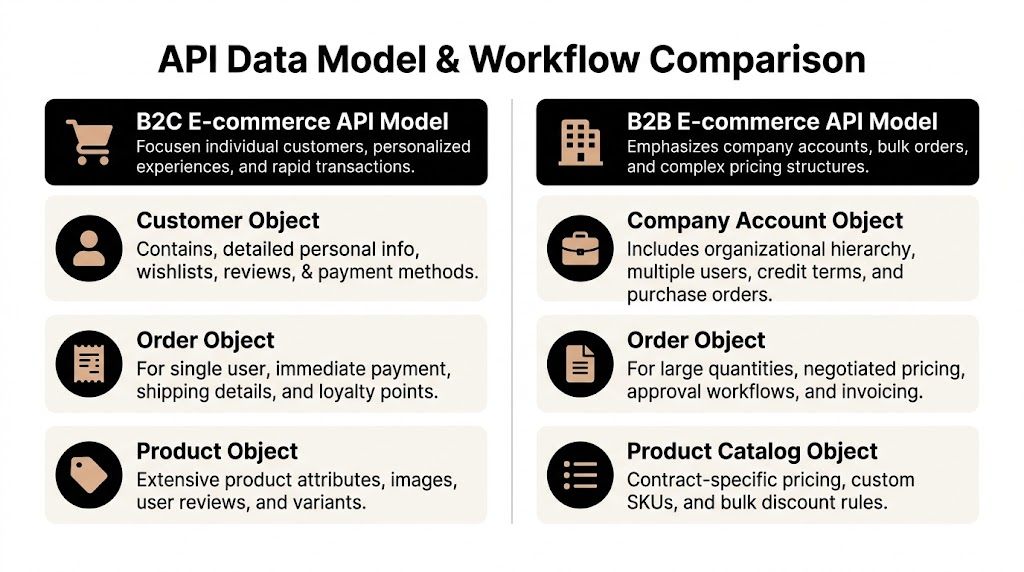
Customer versus company account
A typical B2C customer object is relatively direct. It usually centers on one person.
{
  "customer_id": "c_1024",
  "email": "[email protected]",
  "first_name": "Ana",
  "last_name": "Lee",
  "default_address": {...},
  "marketing_opt_in": true
}
A B2B identity structure tends to split account ownership from user access.
{
  "company_id": "acct_501",
  "company_name": "Northwind Supply",
  "payment_terms": "invoice",
  "users": [
    {
      "user_id": "u_1",
      "role": "buyer"
    },
    {
      "user_id": "u_2",
      "role": "approver"
    }
  ]
}
Those shapes imply different downstream logic.
What that changes in your app
If your product is an OMS or ERP connector, a B2C sync can usually attach orders to a customer record. In B2B, you often need a hierarchy:
- Account entity: The legal or billing organization
- User entity: The person acting within that account
- Role mapping: Permission to submit, approve, or manage
- Commercial terms: Credit, tax rules, or PO requirements
If you flatten this too early, reporting, permissions, and reconciliation become messy.
Product catalog versus account-specific catalog
A B2C product API often assumes broad visibility. One catalog. Maybe customer segmentation. Usually one primary product truth with variants and merchandising data.
A B2B API may expose products through account scope. Catalog access can depend on contract, region, distributor relationship, or business unit. Price isn’t always an attribute of the product. Sometimes it’s a result of the account context.
That changes sync design in a few ways:
- Caching gets harder: You can’t assume one universal product payload.
- Search indexing changes: The same SKU may resolve differently per account.
- Price updates need context: A flat
pricefield may be misleading or wrong.
Order object versus order process
B2C orders often represent a completed purchase event. The object can usually be consumed as the beginning of fulfillment.
B2B orders are often the output of a process. A buyer submits. Someone approves. The system converts a quote or PO to an order. Finance applies terms. Fulfillment starts later.
Here’s the practical difference.
B2C flow
- shopper checks out
- payment is captured or authorized
- order is created
- shipment follows
B2B flow
- buyer assembles order or quote
- internal approval may be required
- purchase order reference may be attached
- order may be created after commercial validation
- invoice or account terms govern settlement
- shipment follows approved release
If your integration starts fulfillment immediately on every new B2B order event, you can automate the wrong business action.
B2C integrations often rely on straightforward merchant authorization and customer-level actions where needed. The bigger challenge is usually token handling across many stores.
B2B systems add another layer. The integration may need to preserve role boundaries and tenant isolation. A buyer should not see approver-only actions. One company’s data should never leak into another’s account context.
For developers, that means:
- Store-level auth isn't enough: You may also need account context and role context.
- Background jobs need guardrails: Bulk sync jobs must maintain tenant separation.
- Auditability matters more: It should be clear which actor triggered which write.
Webhooks versus polling across workflow maturity
B2C platforms usually work well with event-driven processing for orders, inventory, and shipments. That reduces lag and infrastructure churn.
B2B workflows are often less tidy. Some state changes happen through custom approval or ERP-linked processes where webhook coverage is incomplete or inconsistent. Teams often need a hybrid pattern: consume webhooks where reliable, poll list endpoints where the workflow can change outside the normal event stream.
A reliable workflow design pattern
- Use webhooks for high-signal events such as order creation and shipment updates where available.
- Use scheduled polling for edge states, partial updates, and systems with limited event depth.
- Store external revision markers so your sync engine can reconcile changes safely.
- Separate ingestion from processing so retries don’t duplicate downstream actions.
Field normalization is where an api integration company earns its keep
The hard problem is not calling GET /orders. The hard problem is making order data from many commerce platforms behave predictably inside your product.
That usually means defining a canonical model for:
- orders
- line items
- prices
- tax
- customer and account identity
- fulfillment
- shipment tracking
- inventory state
A specialized api integration company matters because eCommerce fields look familiar while behaving differently. “Status,” “available,” “customer,” and “price” are common examples. The label matches. The business meaning doesn’t.
Scaling and Performance A Tale of Two Architectures
B2C and B2B integrations can both fail under load, but they usually fail for different reasons.
B2C systems tend to be read-heavy and bursty. Product pages, search, cart calculations, and inventory checks can spike quickly during campaigns or seasonal peaks. B2B traffic is often steadier at the user level, but the operations are heavier. Bulk catalog updates, account-specific price retrieval, report generation, and large order imports put pressure on processing and persistence layers.
The scaling pattern is not the same
For B2C, the architecture usually needs aggressive caching, efficient fan-out, and strong queue handling for event spikes. You optimize to avoid bottlenecks during sudden concurrency.
For B2B, the harder part is often long-running work. Large writes. Deep validation. Multi-step state transitions. The system may not have massive front-end traffic, but a few large account operations can saturate workers or lock resources if the integration design is naive.
Benchmarks from GigaOm show that elite API gateways can achieve over 50,000 transactions per second with sub-30ms latency, while others perform at a much lower level. For high-volume commerce workloads, 99.9% uptime and low P99 latency are critical, as summarized in GigaOm’s API and microservices management benchmark.
A commerce integration rarely breaks because one request was slow. It breaks because latency piles up across retries, queues, and dependent services.
Security pressure differs too
In B2C, the focus is often consumer data protection, consent handling, and keeping account and payment-adjacent flows tightly controlled.
In B2B, tenant segregation and authorization depth become central. One bug in account scoping can expose negotiated pricing or order history to the wrong company. That’s not a cosmetic bug. It’s a trust and contract problem.
Useful design habits include:
- Isolate tenant context early: Don’t let downstream jobs infer tenant from weak metadata.
- Separate read and write paths: It reduces accidental privilege expansion.
- Track rate limit behavior: A lot of instability starts with poor backoff and retry design.
If your team is dealing with aggressive throttling or burst control in adjacent AI or API workloads, the tactics in this guide on mastering OpenAI API rate limit challenges are worth reading. The platform differs, but the engineering lessons around retries, queue shaping, and graceful degradation transfer well.
The Integration Challenge The Hidden Costs of Building In-House
In-house integrations usually look cheaper in the planning spreadsheet than they do in the backlog.
The first version ships. Then the actual work begins. Platform API changes. Merchants connect stores with odd configurations. One marketplace lags on webhook delivery. Another changes a field type. A third introduces a new auth flow. Suddenly your core product team is spending its best time on compatibility work.
The maintenance burden is the real bill
Many teams underestimate the cost. Not initial development. Ongoing care.
According to Apideck’s analysis of API integration tools, engineering teams can spend 30-50% of their time maintaining fragile integrations because of API drift and platform-specific changes. The same source notes 25.9% CAGR in the API platform market, which reflects how many companies are trying to move this burden off internal teams.
That burden shows up as recurring work:
- Version tracking: Platform changelogs become mandatory reading.
- Schema adaptation: New required fields or enum changes break assumptions.
- Support escalations: Merchant-specific edge cases turn into urgent tickets.
- Regression testing: Every connector update risks side effects elsewhere.
Why this hurts product velocity
If you’re building a shipping platform, your advantage isn't “we patch connector breakage fast.” It’s your actual product logic. Rate shopping. Exception handling. Warehouse workflows. Analytics. Customer experience.
When integration maintenance consumes senior engineering time, roadmap quality drops. Teams postpone differentiating features because they’re busy restoring baseline compatibility. API2Cart’s article on the cost of shopping cart API integration is useful reading if you’re trying to make that trade-off visible inside the business.
Internal connector ownership sounds strategic until every sprint starts with “what broke this week?”
Generic tooling still leaves domain work on your team
A broad middleware layer can reduce plumbing. It doesn’t automatically solve commerce-specific normalization.
Your team still has to deal with product variants, partial shipments, order state translation, inventory semantics, and account-specific business rules. That’s why many developer teams eventually stop asking “can we build it?” and start asking “should we keep owning all of it?”
An api integration company earns attention at that point because the problem has shifted from implementation to focus. The question becomes how much of your roadmap should be devoted to maintaining someone else’s API surface.
The Solution A Unified API from a Specialized Integration Company
A practical way to reduce connector sprawl is to put a commerce-specific abstraction layer between your product and the platforms you need to support.
That’s where a unified API model fits.

What the model changes
Instead of building separate integrations for every platform, the development team integrates once against a standardized set of methods and normalized entities. The abstraction layer handles platform differences, auth variation, field mapping challenges, and many upstream API changes.
One example is API2Cart, which gives B2B software vendors a unified API for 80+ shopping carts and marketplaces, with 100+ API methods for orders, products, customers, shipments, and related store data. In practice, that means a team building OMS, PIM, shipping, ERP, or analytics software can work through one integration surface instead of maintaining one-off connectors for Shopify, Magento, WooCommerce, Amazon, eBay, Walmart, and others. The model can also lower integration costs by up to 9x, based on the product information provided by the publisher.
For teams comparing approaches, it also helps to review adjacent integration capabilities in other ecosystems. Not because the domains are identical, but because it sharpens the evaluation criteria: abstraction depth, documentation quality, operational controls, and support for real production workflows.
Why this works better for developers
The value isn’t just fewer connectors. It’s fewer custom decisions.
A unified API can standardize common actions such as:
- retrieving orders across multiple platform types
- updating product or inventory data
- syncing shipments and tracking details
- using webhooks where supported and polling where needed
That reduces the amount of platform-specific branching in your application code. Your internal services can target one canonical contract instead of carrying many adapter paths.
What to evaluate in a specialized provider
An api integration company still needs real operational discipline. You’re not outsourcing complexity. You’re deciding where that complexity should live.
According to F5’s guidance on API strategy metrics, successful API programs track 12+ KPIs across operational, adoption, and product health. That includes metrics such as requests per minute, error rates below 1%, developer productivity, and API consumption behavior.
Useful evaluation questions include:
- How stable is the normalized schema? Frequent changes move pain from platform APIs to the abstraction layer.
- How are platform updates handled? You want upstream changes absorbed without forcing constant application rewrites.
- What are the observability tools? Logs, request tracing, and changelogs matter in production.
- How does sync work? Webhooks plus polling flexibility is often more realistic than either approach alone.
A unified model won’t erase every edge case. B2B account logic and marketplace quirks still need design attention. But it gives your team a narrower, more stable surface to build against. That’s usually the difference between scaling integrations as a product capability and drowning in them as a maintenance function.
For a concise overview of the model itself, API2Cart has a short explainer on the unified API approach.
Getting Started Your Integration Roadmap with API2Cart
If you’re evaluating a commerce integration path, keep the first phase narrow. The goal is to validate the model, not boil the ocean.
Start with one workflow that matters
Pick the workflow that creates immediate product value. Usually that’s one of these:
- Order import for OMS, ERP, and fulfillment tools
- Inventory sync for multichannel and warehouse products
- Product data access for PIM, analytics, and merchandising software
Don’t start with every entity. Start with the flow your customers will notice first.
Map your canonical model before coding adapters
Write down how your application defines orders, products, customers, shipments, and inventory. Then compare those definitions to the unified fields and methods you’ll consume.
This sounds basic, but it prevents the most common integration mistake. Teams write transport code before they define semantic mapping.
Build your internal model first. Connectors should adapt to it, not quietly redesign it.
Use a proof of concept to test ugly cases
A good proof of concept should test more than a successful read call. Include:
- Status translation: Make sure external order states map cleanly to your workflow.
- Partial data: Confirm your app behaves well when optional fields are missing.
- Sync recovery: Test retries, duplicate event handling, and date-based polling.
- Write operations: Validate update behavior for shipments, inventory, or products.
For B2B-heavy products, also test account structure, user roles, and any approval-related data you need to preserve.
Treat documentation and support as part of the product
When developers choose an api integration company, docs quality matters almost as much as endpoint coverage. You want clear method definitions, changelog visibility, SDK support, and responsive technical help when a merchant store behaves oddly.
A short validation cycle works best. Identify target platforms, build the proof of concept, test against real store behavior, and then decide whether the abstraction matches your roadmap.
If your team needs to connect commerce software to many carts and marketplaces without maintaining a separate connector for each one, API2Cart is a practical option to evaluate. Start with the free trial for a proof of concept, then book a demo if you need to validate more complex B2B account logic, marketplace sync flows, or high-volume order and inventory scenarios.