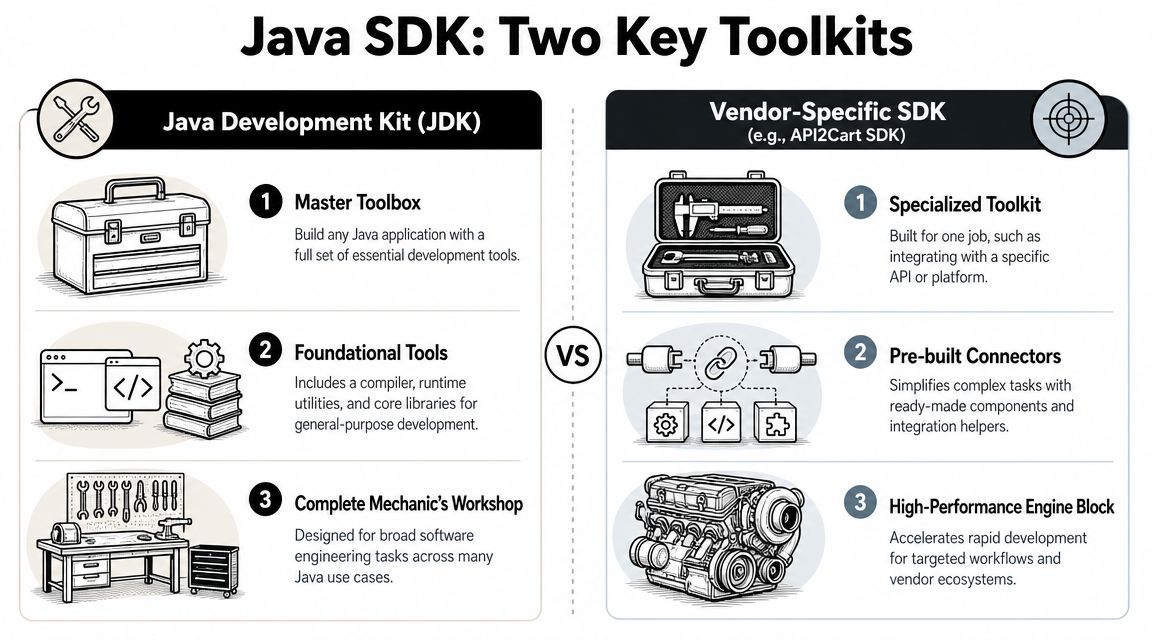
If you’re an integration developer working with Java, the term "SDK" can be a bit of a moving target. It often refers to two completely different toolkits. The first is the essential Java Development Kit (JDK), which you need to build basically any Java application. The second is a vendor-specific SDK, a specialized toolkit designed for a single purpose, like API integration.
For an integration developer, knowing the difference is key. One is your workshop; the other is a pre-built engine ready to drop into your project and accelerate your integration roadmap.
The Foundation: Java Development Kit (JDK)
When developers talk about a "Java SDK," nine times out of ten they really mean the Java Development Kit (JDK). This is the master toolbox for any Java developer. Think of it as your complete workshop, packed with a compiler, debugger, core libraries, and the Java Runtime Environment (JRE) to run the code you write.
The term "SDK" does have a little history here. Back in 1998, with the release of Java 1.2, the platform was briefly rebranded as "Java 2," and the JDK was called the "Software Development Kit" or SDK. While the name quickly reverted to JDK, the old term stuck around in some circles, causing a bit of confusion that lingers even today.
The Accelerator: Vendor-Specific SDKs
For modern integration projects, the more impactful tool is the vendor-specific SDK. This is a pre-packaged toolkit from a company, like API2Cart, designed to do one thing exceptionally well: connect your application to an external API.
While the JDK provides the raw materials to build anything, a vendor SDK gives you a high-performance, purpose-built component that solves a specific problem right out of the box.
This distinction is crucial for B2B SaaS developers. Instead of building and maintaining dozens of individual connections to various eCommerce platforms from scratch, you can use a single SDK. It hands you ready-made methods for authentication, data retrieval, and error handling, which dramatically cuts down development time. A provider like API2Cart, for example, offers an SDK that unifies connections to over 80 eCommerce platforms, allowing your team to focus on core features instead of getting bogged down in the complex plumbing of API integrations.
For a deeper look at how these tools relate, check out our guide on the distinctions between an SDK and an API.
Java Acronyms Explained: SDK vs. JDK vs. JRE
To clear things up, let's quickly break down the most common acronyms you'll encounter as an integration developer in the Java world. It's easy to get them mixed up, but each has a distinct role.
| Term | Full Name | Primary Purpose | Analogy |
|---|---|---|---|
| SDK | Software Development Kit | A collection of tools for a specific platform or service. Can be a general JDK or a vendor-specific toolkit. | A complete toolkit. Could be a general mechanic's set or a specialized kit for a specific car model. |
| JDK | Java Development Kit | Contains everything needed to create and run Java applications (compiler, debugger, JRE). | A full auto shop with tools to build, test, and repair cars, plus an engine to run them. |
| JRE | Java Runtime Environment | Contains only what's needed to run existing Java applications (JVM, core libraries). | The car's engine and fuel system. You can drive the car, but you can't build or fix it. |
In short, you need the JDK to build Java apps. Your users only need the JRE to run them. And a vendor SDK like API2Cart's helps you connect those apps to other services without reinventing the wheel.
Choosing and Installing the Right Java SDK
Alright, we've covered the difference between a foundational Java Development Kit (JDK) and a vendor-specific SDK. So, which JDK should you actually use for your project? This might seem like a small technical choice, but for any developer building a B2B SaaS product, it has huge implications for licensing, long-term support, and the overall stability of your application.
The Java ecosystem isn't a one-size-fits-all world anymore. You have several major distributions to choose from, each with its own set of rules. For commercial software, the main takeaway is this: your choice of JDK is less about features and more about managing long-term operational risk.
Evaluating Java SDK Distributions
When you're building a commercial product, you absolutely have to pay attention to the license that comes with your JDK. The modern Java landscape is defined by its release schedules and distribution choices. For instance, Oracle now offers two different JDK builds: the proprietary Oracle JDK and the free Oracle OpenJDK.
While the Oracle JDK is fine for development and testing, using it in production requires a paid license. This is a critical detail. For a B2B SaaS company, using the wrong build could lead to serious compliance headaches and unexpected costs down the road. In contrast, Oracle's OpenJDK build is free to use in any environment, including production.
Thankfully, there are several other popular and completely free OpenJDK distributions you can rely on:
- Amazon Corretto: A production-ready distribution with long-term support, backed by Amazon.
- Adoptium Temurin: A community-driven project (formerly AdoptOpenJDK) that provides robust, enterprise-grade JDKs.
- Microsoft Build of OpenJDK: Microsoft's free and long-term supported distribution of OpenJDK.
Key Factors for Your Decision
Your choice of a Java SDK should come down to your business goals and technical needs. Before you download anything, run through this simple checklist.
For an integration developer, the best JDK is the one you never have to think about. It should be compliant, secure, and receive timely updates without causing disruption. Stability is the most important feature.
Consider these factors:
- Licensing: Is it free for commercial use in production? For most SaaS businesses, this is a non-negotiable starting point.
- Long-Term Support (LTS): Does the provider offer security patches and updates for several years? Sticking with LTS versions (like Java 11, 17, or 21) saves you from the headache of frequent, forced upgrades.
- Security Update Cadence: How quickly are patches released for critical vulnerabilities? Fast security updates are crucial for protecting your application and your customers' data.
- Platform Availability: Is the SDK available for all the operating systems your team uses for development and deployment (Windows, macOS, Linux)?
By carefully weighing these points, you can pick a Java SDK that gives you a stable and legally compliant foundation for your integration projects. These principles are also helpful when evaluating vendor-specific toolkits, and you can see more examples of SDKs to understand the variety available.
Why Vendor SDKs Are Essential for API Integration
When you need to connect your software to an external API, you’re at a crossroads. As an integration developer, you can either build every connection from the ground up with raw HTTP requests, or you can use a specialized Software Development Kit (SDK) provided by an API vendor.
Going the raw HTTP route gives you absolute control, but it also forces you to reinvent the wheel. You'll spend countless hours on low-level plumbing—things like authentication, request formatting, and error parsing—instead of building features that actually matter to your customers. For any modern B2B SaaS company, that’s a trade-off you just can't afford. This is where a vendor SDK proves its worth, acting as a buffer that hides the raw complexity of direct API communication.
Accelerate Development and Reduce Complexity
Imagine you’re an integration developer tasked with connecting your inventory management software to dozens of different eCommerce platforms. Without an SDK, you're on the hook for handling the unique authentication flow, endpoint structure, and data model for every single one. You'd have to write custom code to manage API keys, deal with OAuth token generation, handle token refreshes, and format every request header just right. It’s tedious, repetitive, and a minefield for potential errors.
A well-designed SDK, like the one from API2Cart, handles all of this heavy lifting for you. It provides a unified API, so instead of writing hundreds of lines of boilerplate code for each platform, you typically just provide your credentials to the SDK and make a simple method call that works across all supported platforms.
The real value of an SDK isn't just that it wraps API calls. It's that it packages up best practices, pre-solves common integration headaches, and lets your developers focus on business logic instead of memorizing HTTP status codes.
This boost in speed can be a huge advantage. For an integration developer, using a vendor SDK can mean the difference between launching a new connection in a few weeks versus several months. With API2Cart, this means you can offer integrations with platforms like Shopify, Magento, and WooCommerce using a single, consistent codebase.
Get Built-in Reliability and Maintenance
The benefits don't stop once the initial integration is built. A vendor SDK delivers ongoing value by taking care of maintenance and reliability. APIs are constantly evolving—endpoints get deprecated, authentication methods are updated, and new features are added all the time.
An SDK makes a developer’s life much easier by managing this chaos for you:
- Error Handling: A good SDK gives you pre-built, easy-to-understand exceptions for common API errors. This saves you from having to parse cryptic server responses on your own.
- Pagination: It automatically handles fetching large sets of data across multiple pages, turning what would be a complex, multi-request loop into a single, straightforward function call.
- Updates and Maintenance: When a platform changes its API, the SDK vendor (like API2Cart) updates the SDK. Your team simply updates the dependency to the latest version, inheriting all the fixes without having to re-engineer your own code.
This essentially outsources a huge chunk of your maintenance burden. Your team is shielded from the constant changes happening with the underlying APIs, which allows you to build a more stable and scalable product. Think of the SDK as a high-strength, prefabricated steel girder; it lets you focus on building the bridge—your application—not on forging every last nut and bolt yourself.
Using a Java SDK for eCommerce Integration
It’s one thing to talk about theory, but the real magic happens when you see a specialized Java SDK in action. For any integration developer, the goal is always the same: build reliable connections, faster. A vendor SDK is your most direct route, especially in the tangled world of eCommerce where every platform speaks its own unique dialect.
Let's walk through how a tool like the API2Cart Java SDK can take a mountain of complex integration work and shrink it down to a few manageable steps. This isn't just about shaving off development time; it’s about crushing bugs early and building a product that’s easier to maintain and scale from day one.

Adding the SDK as a Dependency
First things first, you need to get the tools into your project. Thankfully, with modern build automation tools like Maven or Gradle, this is incredibly straightforward. You just need to declare the API2Cart SDK as a dependency in your project’s configuration file.
For Maven, you’d pop this snippet into your pom.xml:
<dependency>
    <groupId>com.api2cart</groupId>
    <artifactId>api2cart-java-sdk</artifactId>
    <version>1.0.0</version>
</dependency>
If you're using Gradle, the process is just as clean in your build.gradle file:
implementation 'com.api2cart:api2cart-java-sdk:1.0.0'
Once your build tool syncs up, all the SDK's classes and methods are immediately available in your project. This one simple step saves you from the headache of manually downloading JAR files, untangling dependencies, or battling library conflicts.
Authenticating and Fetching Data
With the SDK installed, you can get right to the good stuff. Let's say you need to pull a list of recent orders from a newly connected Shopify store. Doing this from scratch would involve a messy dance of raw HTTP requests, header management, and tedious JSON parsing.
With the API2Cart Java SDK, the entire process becomes clean and intuitive. First, you create a client instance and hand it your API key. The SDK takes care of all the authentication grunt work behind the scenes.
// Import the necessary classes from the SDK
import com.api2cart.sdk.client.Client;
import com.api2cart.sdk.model.Order;

// Create a client instance with your API key
Client client = new Client("YOUR_API_KEY");
From there, fetching a list of orders is just a single method call.
// Fetch a list of orders from a specific store
String storeId = "your_connected_store_id";
List<Order> orders = client.order.list(storeId);

// Now you can easily loop through the orders
for (Order order : orders) {
    System.out.println("Order ID: " + order.getId() + ", Status: " + order.getStatus());
}
The true power here is abstraction. The
client.order.list()method works the exact same way whether you're talking to Shopify, WooCommerce, Magento, or any of the 80+ platforms supported by API2Cart. The SDK and its unified API handle all the platform-specific quirks for you.
This simple example cuts to the core of the value. What would have been hundreds of lines of brittle, platform-specific code is now just a handful of readable, maintainable lines. This lets your team focus on actually using the order data, not on the painful process of getting it. That, in a nutshell, is the essential role of a well-built SDK in Java for modern integration development.
Building Resilient Integrations with an SDK
A successful integration isn't just about making that first API call work. It's about building a connection that stays reliable day in and day out, especially as you scale. For any developer working on integrations, this means planning for failure and engineering for a quick recovery. This is exactly where a well-built SDK becomes your most valuable partner, handling the defensive, messy code so you can stay focused on your app's core features.
Think of it like this: a powerful SDK, like the one from API2Cart, has these resilience features built right in. This saves you from the headache of reinventing the wheel and engineering complex, error-prone solutions from the ground up. It’s the difference between keeping a fire extinguisher handy and having a fully automated sprinkler system—one is a reactive tool, while the other is a built-in safety net.

Graceful Error and Limit Handling
When you decide to interact directly with an API using raw HTTP requests, you're signing up for a lot of responsibility. You have to gracefully handle every possible API-specific error and meticulously respect rate limits. If you accidentally send too many requests too fast, you risk getting temporarily blocked, which can grind your entire service to a halt.
A well-designed SDK, such as the one offered by API2Cart, comes with built-in mechanisms to manage this complexity for you, right out of the box.
- Automatic Retry Logic: If a request fails because of a temporary network blip or a rate limit hit, the SDK can be configured to wait a moment and then try again automatically.
- Exponential Backoff: A smart SDK takes this a step further. Instead of just retrying, it will progressively increase the delay between retries (e.g., wait 1 second, then 2, then 4). This is a polite way to respect the API's limits and dramatically increases the chance of success without hammering the server.
- Clear Error Abstractions: The SDK does the hard work of translating vague HTTP status codes (like a
503 Service Unavailable) into clear, specific exceptions that your code can easily catch and respond to.
These features aren't just nice-to-haves; they're essential for building a production-ready integration that can withstand the small but inevitable storms of network communication. You can read more on the benefits an SDK provides for your API and see just how much it can streamline development.
Strategies for Efficient Data Sync
Keeping your application's data aligned with an external platform is a constant challenge, but it boils down to having a solid strategy. The two main approaches are polling (periodically asking for updates) and webhooks (receiving updates as they happen), and a good SDK will support both. With API2Cart, for example, an integration developer can pick the method that makes the most sense for their use case, whether that's checking for new orders every few minutes or getting instant notifications when inventory levels change.
Java SDKs have stayed relevant for so long because they are tailor-made for large-scale, cross-platform software delivery, which is a perfect match for integration-heavy products. Modern SDKs in Java are increasingly packaging operational best practices—like upsert support, streaming reads, and automatic batching—not just simple API wrappers. For businesses like API2Cart that unify dozens of commerce platforms through a single API, Java SDKs can drastically speed up client library development by providing standardized tools to handle complex APIs.
To get a broader perspective on how SDKs facilitate the flow of data between different software systems, this practical software integration guide is a great resource.
Frequently Asked Questions About Java SDKs
When you're an integration developer, you're always weighing your options for connecting your app to external services. The choice between building everything from scratch with raw HTTP calls and using a vendor's Java SDK usually boils down to speed, reliability, and the long-term cost of maintenance.
Let's dig into some of the most common questions that pop up when developers are deciding whether a specialized SDK is the right move for their next B2B SaaS project.
Can I Use Multiple Vendor SDKs in the Same Java Project?
Yes, absolutely. In fact, it's pretty much standard practice for an integration developer. Think about it—a modern SaaS application is rarely a monolith. It’s more like a finely tuned machine built from several best-in-class components. For instance, you might use the API2Cart SDK for eCommerce data, another for cloud storage, and a third for payment processing, all within the same Java project.
Build tools like Maven and Gradle are designed for exactly this scenario. They make managing different dependencies straightforward. The key is just making sure each SDK is well-built and self-contained to avoid messy library conflicts. This modular approach lets you pick the best tool for each job without compromise.
What Happens When a Platform API Changes?
This is where using a vendor SDK really pays off for an integration developer. APIs aren't set in stone. They evolve, endpoints get deprecated, and authentication methods get updated. If you build your integrations with raw HTTP calls, your team is on the hook for monitoring every platform you support and scrambling to fix things every time they change.
A vendor SDK acts as a shield against this chaos. The SDK provider, like API2Cart, takes on the full responsibility of updating the SDK to handle those underlying API changes. All your team has to do is update the SDK dependency to the latest version.
Instead of your engineers constantly putting out fires, they can focus on what they do best: building new features for your product. The SDK vendor absorbs the maintenance headache, saving you an incredible amount of reactive work.
Is There a Performance Cost to Using an SDK?
In theory, any layer of abstraction adds a tiny bit of overhead. But in the real world of API integrations, this "cost" is so small it’s practically irrelevant for an integration developer. Any milliseconds spent running code within the SDK are a drop in the ocean compared to the time you'll spend waiting for a network response from the remote API server.
What's more, a well-optimized SDK from a provider like API2Cart can actually perform better than a custom-built solution. These SDKs often come packed with performance boosters like efficient connection pooling, optimized data parsing, and smart request batching—complex features that often get skipped in homegrown integrations.
How Does an SDK Like API2Cart's Handle Different Platforms?
This is the real magic of a unified API for an integration developer. The API2Cart Java SDK gives you a single, consistent set of methods—like order.list() or product.add()—that works exactly the same across every platform it supports. You write your code once, and you're done.
Behind the curtain, the API2Cart infrastructure works like a universal translator. It takes your simple, standardized request and converts it into the specific, and often quirky, format required by Shopify, WooCommerce, Magento, or any other shopping cart. This abstraction is what it's all about. Your application code stays clean, simple, and totally platform-agnostic, which drastically simplifies both initial development and all the maintenance that comes after.
API2Cart provides a unified API to connect your software to over 80 eCommerce platforms and marketplaces. Accelerate your integration roadmap and reduce development costs with our ready-made SDKs and dedicated support for integration developers. To see how you can connect to dozens of platforms in weeks, not years, start your free 14-day trial.