Supply chain visibility is the ability to track products, inventory, shipments, and the data behind them end to end across sourcing, production, transit, warehousing, and delivery. Yet only 6% of businesses achieved full end-to-end visibility, while 62% still reported limited visibility.
A common association with "visibility" is dashboards. Developers should hear "integration layer." If your SaaS product serves merchants, operators, or fulfillment teams, what is supply chain visibility in practice? It's the system that turns fragmented commerce, inventory, shipping, and partner data into one operational view that people can trust.
That sounds straightforward until you look at the stack. Orders originate in storefronts and marketplaces. Inventory changes inside commerce platforms, warehouse systems, and manual adjustments. Shipment events come from carriers or fulfillment partners. Returns and cancellations show up somewhere else. Each platform has its own schema, auth model, rate limits, and event behavior. The visibility problem starts long before analytics. It starts with getting consistent data out of disconnected systems.
For B2B SaaS vendors, that changes the product conversation. Visibility isn't a reporting add-on. It's often the core reason a merchant adopts an OMS, shipping app, WMS connector, inventory platform, or operations dashboard in the first place. If your product can't normalize commerce events fast enough, users will still be reconciling orders in spreadsheets.
The operational stakes are clear. A widely cited industry summary notes that only a small minority of companies have reached full visibility, while 57% of supply chain professionals identified insufficient visibility as their biggest operational challenge in 2025, according to SAP's supply chain visibility overview. That gap exists because visibility depends on integrated data across multiple parties, not because teams haven't bought enough dashboards.
If you work on integrations for merchant-facing SaaS, it helps to think of SCV as a maturity model for connected commerce. The commerce side of that evolution is covered well in this guide to supply chain evolution. The important engineering lesson is simpler: if the ingestion layer is weak, every downstream feature becomes unreliable. Your alerts fire late. Your inventory sync drifts. Your ETAs become guesses. Your users stop trusting the product.
Introduction Beyond the Buzzword
Visibility is a data model, not a screen
Supply chain visibility gets oversimplified because the visible part is the dashboard. The hard part is the data contract underneath it.
A useful definition comes from the operational view of SCV itself: it is the ability to track and monitor products, inventory, and shipments end to end across sourcing, production, transit, warehousing, and delivery, with real-time data supporting faster decisions and response. For a development team, that means building a system that can ingest, normalize, reconcile, and serve state changes from many sources without losing context.
A merchant doesn't care whether an item is delayed because an order API updated late, a warehouse record used a different SKU key, or a shipment event arrived in a different format. They care that your SaaS product showed the wrong status. That's why the data integration layer is the bottleneck.
Practical rule: If two connected systems can't agree on order identity, SKU identity, or fulfillment state, you don't have visibility. You have partial telemetry.
Why fragmented merchant ecosystems make SCV hard
B2B SaaS teams serving eCommerce merchants face a specific version of the visibility problem. Data lives across storefronts, marketplaces, ERP modules, warehouse tools, fulfillment providers, and shipping services. Some systems push updates. Others require polling. Some expose rich line-item fulfillment detail. Others only expose final status.
That fragmentation creates four common failure modes:
- Status mismatch: An order is marked paid in one system but not released for fulfillment in another.
- Inventory drift: Available quantity differs across channels because reservations, returns, or warehouse adjustments haven't synced.
- Tracking gaps: Shipment records exist, but tracking numbers or milestone events arrive late or in inconsistent formats.
- Partner blind spots: External operators hold part of the truth, but your application receives only snapshots.
The result is familiar to developers. Support teams ask why stock is wrong. Product teams ask for a real-time dashboard. Engineering discovers the core issue is inconsistent event capture and weak normalization.
What developers should optimize first
The first design question isn't "What dashboard do we need?" It's "What operational entities must remain consistent across systems?" In merchant SaaS, that usually means order, product, inventory, customer, shipment, and fulfillment objects, plus timestamps and source metadata.
A clean integration architecture usually does three things well:
- Normalizes entities into a stable internal model.
- Captures changes through webhooks where possible and polling where necessary.
- Preserves provenance so teams know which source produced which state.
Build that first, and visibility features become feasible. Skip it, and every feature request turns into exception handling.
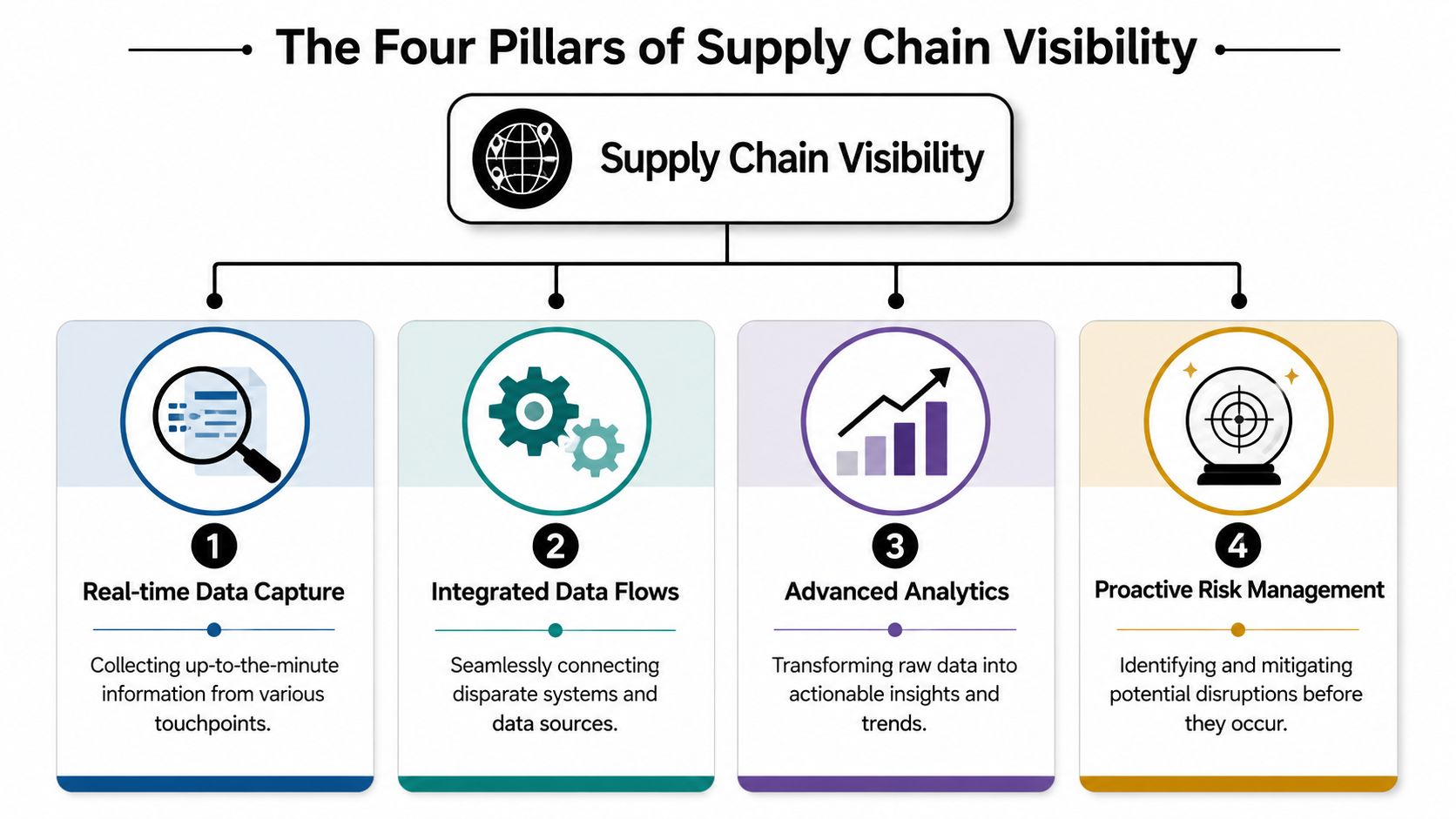
The Four Pillars of Supply Chain Visibility
Supply chain visibility isn't one metric on one screen. It's an end-to-end data model that consolidates order, inventory, shipment, and production visibility so teams can track components from raw materials through fulfillment in near real time, as described in Slimstock's explanation of supply chain visibility.
Order visibility
Order visibility starts at creation and ends only when the order is fulfilled, returned, canceled, or closed. For a SaaS product, this means more than fetching an order list.
You need the fields that explain order state transitions:
- Order identifiers: platform order ID, external reference, source channel
- Financial state: authorized, paid, refunded, partially refunded
- Fulfillment state: unfulfilled, partially fulfilled, fulfilled, canceled
- Line detail: SKU, quantity, price, tax, discount, warehouse allocation
- Timestamp history: created, updated, paid, shipped, delivered when available
If you're building an OMS, returns tool, or merchant operations dashboard, visibility is the starting point. Teams need to answer basic questions fast: Has the order been released? Is it waiting on stock? Did the warehouse fulfill the full quantity or only part of it?
Inventory visibility
Inventory visibility is where many SaaS products either become indispensable or become noisy. Merchants don't need abstract "stock intelligence." They need reliable quantity by location and channel.
At the API level, developers usually need:
- Available quantity
- On-hand quantity
- Reserved quantity
- Location or warehouse ID
- SKU or variant mapping
- Last updated timestamp
This looks simple until channel semantics diverge. One source may expose sellable stock. Another may expose physical stock. Another may subtract pending orders only after a warehouse pick event. Your product has to reconcile those differences before showing "real-time inventory."
When inventory logic isn't normalized, every downstream promise breaks. Replenishment advice, oversell protection, order routing, and availability messaging all depend on it.
Shipment visibility
Shipment visibility is the part most users notice because it's customer-facing. But the developer requirement is broader than tracking links.
Good shipment visibility needs:
- Shipment ID and order association
- Carrier and service level
- Tracking number
- Package contents or line-item fulfillment mapping
- Shipment status milestones
- Delivery exceptions and update timestamps
For merchant SaaS, shipment visibility supports customer support, proactive alerts, and internal exception queues. If a package ships but the order record doesn't reflect it, the problem isn't logistics. It's missing linkage between fulfillment and shipment events.
Partner visibility
This pillar is often neglected because the data doesn't sit inside the merchant's direct stack. Yet partner visibility is where many blind spots begin.
A practical implementation usually includes:
- Supplier acknowledgments
- 3PL fulfillment events
- Warehouse receipts
- Backorder or substitution status
- Inbound and outbound milestone updates
- Data freshness indicators
As external partners often control critical events, your product should expose not only the partner event itself, but whether that event is recent, partial, or still awaiting confirmation.
For developers, the lesson is simple. Visibility improves when each pillar uses a shared identity model and a consistent event timeline. Without that, users see four disconnected feeds instead of one operational truth.
Why SCV Matters for B2B SaaS Developers
The product case for SCV is no longer niche. One market estimate valued the global supply chain visibility software market at USD 1.92 billion in 2024 and projects USD 15.93 billion by 2033 with a 26.45% CAGR. The same industry summary says 82% of supply chain organizations increased IT spending in 2025, prioritizing visibility and automation tools, according to Vizion's market trends overview.

Visibility changes product value
If you build software for merchants, visibility features often determine whether your product becomes a system of action or just a reporting layer.
An inventory product becomes more useful when it can reconcile stock across channels and locations with enough freshness to prevent bad decisions. A shipping product becomes more useful when it doesn't just print labels, but also tracks movement and exceptions. An OMS becomes more useful when users can see where an order is stuck without checking multiple systems.
That matters for retention. Teams keep paying for products they can operate from.
Where SCV shows up in merchant-facing SaaS
Different product categories express SCV differently:
- Order management software: operators need order, payment, fulfillment, and exception status in one place.
- Warehouse-connected apps: teams need quantity by location, pick status, and receipt updates.
- Shipping and post-purchase tools: support needs tracking events tied back to the original order and shipment records.
- Analytics platforms: reporting only works when upstream commerce and fulfillment records are consistent.
- ERP and operational middleware: finance and operations need clean handoff between commercial events and physical movement.
The pattern is the same. Users don't buy visibility as an abstract concept. They buy fewer blind spots in the workflow they already own.
Why developers should care early
Many teams wait too long to design for SCV. They ship an initial feature on top of whatever APIs they can reach fastest, then try to add cross-system visibility later. That's expensive because the wrong data model gets baked into the product.
Build for event consistency early. Retrofitting identity mapping, state reconciliation, and freshness tracking after launch is slower than adding the first integration correctly.
The developer opportunity isn't just "add a dashboard." It's to make your product the place where a merchant can trust operational state. That's a strong position for any B2B SaaS vendor.
The Technology Stack Powering Modern Visibility
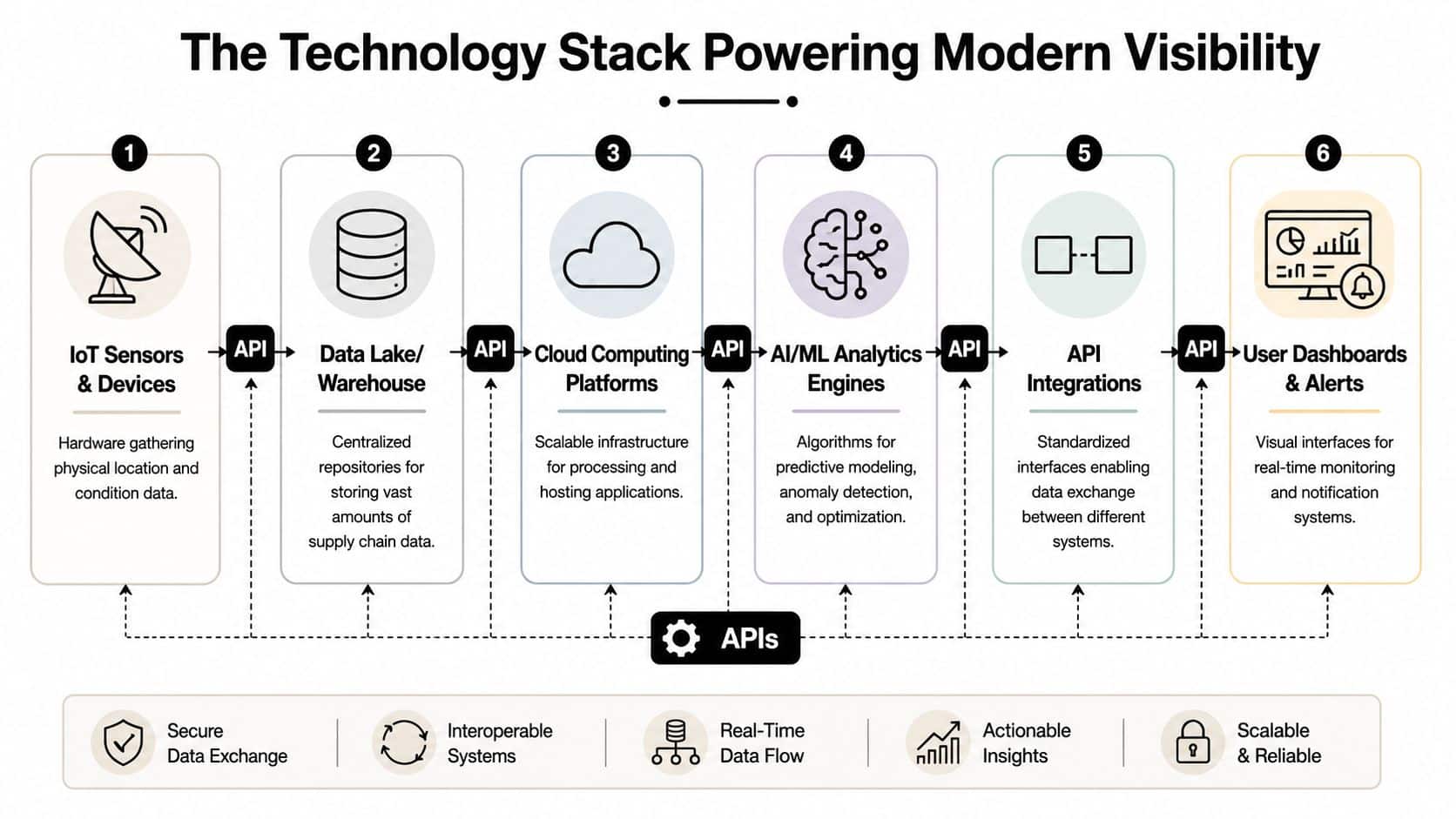
Modern SCV works when several layers cooperate. Sensors and scanners capture physical events. APIs expose system events. Storage keeps historical context. Analytics convert state changes into alerts and forecasts. The dashboard is the last mile, not the foundation.
A practical benchmark for SCV is real-time or near real-time event capture through IoT, RFID, GPS, scanners, and automated data-sharing with suppliers and carriers. That architecture improves detection of bottlenecks, shortages, and shipment delays, as outlined in NetSuite's supply chain visibility resource.
The stack from capture to action
A clean mental model for developers looks like this:
Capture layer
Barcode scans, GPS pings, RFID reads, carrier events, and commerce platform updates create raw operational signals.Integration layer
APIs, webhooks, polling jobs, and transformation services pull those signals into a shared structure.Storage layer
Event stores, operational databases, or warehouses retain current state and history.Decision layer
Rules engines, alerting systems, and predictive models identify exceptions and likely outcomes.Presentation layer
Dashboards, automations, notifications, and customer-facing status pages expose the result.
For merchant SaaS, the integration layer is the choke point. If data isn't captured consistently there, every other layer becomes noisy.
Why APIs sit at the center
Developers often talk about AI, dashboards, or control towers before they solve the problem of access. But APIs are what make supply chain data usable.
They do three jobs that matter:
- System access: expose orders, catalog, inventory, fulfillment, and shipment data from external platforms
- State transfer: move updates into your own internal model
- Operational triggering: enable workflows when an order changes, inventory falls, or a shipment status updates
This is also where data quality starts. If upstream source data is sparse, delayed, or inconsistently mapped, no analytics layer can fix it cleanly. Teams working on predictive or automated features should treat schema discipline as part of model readiness. A good primer on that mindset is this guide to AI training data quality.
The warehouse and partner edge
The warehouse side of visibility deserves special attention because it bridges digital intent and physical execution. Orders become picks. Picks become packs. Packs become shipments. That handoff needs structured integration, not manual reconciliation.
If your roadmap includes warehouse workflows, this warehouse management system integration guide is useful context for the operational side of those connections.
A strong stack doesn't try to make every source identical. It accepts that sources differ, then normalizes just enough to support reliable action.
The Integration Challenge and The Unified API Solution
Most SCV projects don't fail because the dashboard is ugly. They fail because the underlying connections are expensive to build and harder to maintain than teams expect.
One-by-one integrations create drag fast. Every commerce platform or marketplace has different object names, pagination behavior, auth patterns, webhook coverage, error models, and release cycles. Even when two sources both expose orders or products, the field semantics rarely line up cleanly. Your team ends up writing the same translation logic again and again.
The problem gets worse when your product needs near real-time data. Now you aren't just fetching records. You're dealing with retries, idempotency, deduplication, late-arriving events, and version changes that can imperceptibly break mappings.
Governance is the part teams underestimate
The harder question in SCV isn't "Can we ingest data?" It's "Can we trust it enough to automate decisions?"
That concern is getting sharper as teams push beyond reporting. Industry commentary summarized by OpenText notes that 42% of supply chain organizations were planning AI initiatives in 2024, while success depends on reconciling inconsistent, multi-source data from ERP, CRM, IoT, and partner systems in OpenText's supply chain visibility overview. Better visibility can increase operational complexity if quality, alignment, and exception handling aren't solved first.
For developers, that means a usable SCV layer needs more than connectors. It needs:
- Canonical entities: one stable internal model for orders, products, inventory, and shipments
- Source-aware mapping: preserve where each record came from and when it changed
- Freshness logic: know whether "current" means seconds old, minutes old, or a stale snapshot
- Conflict handling: define what wins when two systems disagree
- Observable pipelines: log failures, retries, dropped events, and schema mismatches
If your SaaS product automates replenishment, routing, or exception handling, data confidence matters as much as data coverage.
DIY versus unified API
A unified API approach changes the economics. Instead of building and maintaining many platform-specific connectors, the team integrates once to a normalized interface and then maps business logic at the product layer.
That model is especially useful in merchant ecosystems where the same workflow must operate across many storefront and marketplace sources. API2Cart is one example of this pattern. It provides a unified commerce API for orders, products, customers, shipments, and inventory across many platforms. For SCV use cases, that helps teams reduce schema variance and speed up event ingestion through one integration surface. The broader architectural concept is covered in this overview of unified APIs.
| Metric | DIY (One-by-One Integrations) | Unified API (via API2Cart) |
|---|---|---|
| Initial development | Separate connector per platform | One connector to a normalized API |
| Schema management | Platform-specific mapping in each integration | Shared data model with translation handled centrally |
| Maintenance burden | Repeated updates when platforms change | Most platform drift absorbed behind one interface |
| Time to add channels | New build cycle for each source | Faster rollout where the source is already supported |
| Webhook strategy | Varies by platform and often needs custom handling | More consistent integration pattern where supported |
| Team focus | Connector upkeep consumes roadmap time | More time for product logic and user-facing workflows |
There are still trade-offs. Unified APIs don't eliminate all complexity. You still need your own internal data model, error handling, and source-specific edge-case logic. But they move repetitive connector work out of your core roadmap.
A practical note on hard-to-reach data
Some teams also need to collect structured data from web environments that don't expose a suitable application interface for secondary workflows such as catalog enrichment, public listing monitoring, or operational checks. In those narrower situations, a specialized data extraction API can complement your main integration architecture. It shouldn't replace transactional integrations, but it can support adjacent data collection where direct system connectivity isn't available.
For most B2B SaaS vendors, the key decision is simple. Do you want your engineers spending the next quarter maintaining connectors, or building the visibility workflows customers pay for?
Activating Supply Chain Visibility in Your SaaS
Start small, but start on the right layer. The fastest path to SCV is not to model the entire supply chain at once. It's to pick one user-visible workflow that depends on integrated state and make it reliable.
Step one picks the right use case
Choose the feature where visibility removes the most operational friction for your users.
Common first candidates include:
- Multi-channel inventory sync: useful when merchants oversell or struggle with stock consistency
- Unified order status tracking: useful when support teams need one answer across several sales channels
- Shipment exception monitoring: useful when fulfillment and support need early warning on delays
- Location-aware stock views: useful when warehouse routing or transfer decisions depend on current quantities
The right first feature is usually the one users already manage manually.
Step two scopes the data contract
Before you write UI code, define the minimum entity model behind the feature.
That usually means documenting:
- Core objects: order, line item, product, inventory record, shipment, fulfillment event
- Identity rules: how SKUs, order IDs, and location IDs map across systems
- Freshness expectations: which updates must be event-driven and which can be polled
- Conflict rules: what happens when sources disagree
- Audit fields: source system, source ID, timestamps, and sync status
Many roadmaps either accelerate or stall at this juncture. If the contract is vague, the implementation becomes exception-driven.
Step three chooses the integration path
Once the use case and data model are clear, evaluate whether building direct connectors is strategic for your team. In many merchant-facing SaaS products, it isn't. The integration layer is necessary, but it usually isn't the product differentiator.
A unified API can be the practical first move because it lets the team validate the workflow, test data freshness, and iterate on user experience without committing months to connector maintenance.
Ship one trusted visibility workflow first. Users will ask for the next one once they believe your data.
From there, expand methodically. Add observability to sync jobs. Track stale records. Expose confidence indicators in the UI. Treat visibility as an operational capability your product earns over time.
If you're building merchant-facing software and need order, inventory, shipment, and catalog data from many commerce platforms through one integration layer, API2Cart is worth evaluating. Review the docs, test the trial, and see whether a unified API shortens your path from connector work to usable supply chain visibility features.