Supported Marketplaces and eCommerce Platforms
With a unified API provided by API2Cart, you can easily develop an integration with marketplaces and various shopping platforms at once
Supported marketplaces




Supported platforms









Supported platforms









Integration With Marketplaces For B2B eCommerce Software Solutions

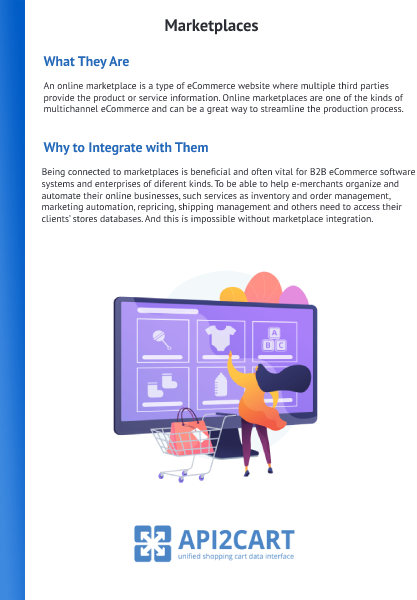
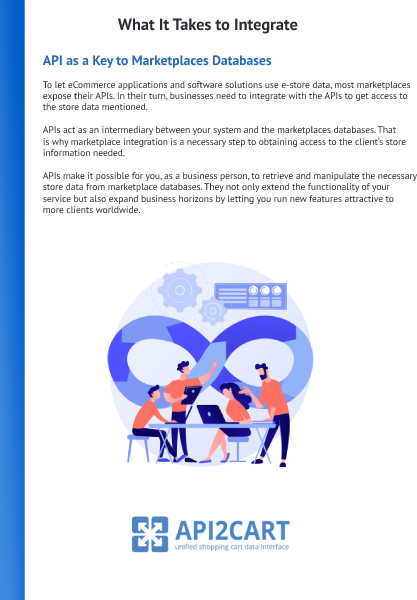
Download the 'Marketplace Integration for Your Business' guide and discover all the needed steps for the development of the smooth connection with popular marketplaces like Amazon, eBay, etc. in a short period of time with minimum efforts from your side.
How does API2Cart help
API2Cart has everything for easy integration with marketplaces and shopping platforms
- Integrate your software with 60+ eCommerce platforms
- Get and synchronize information on orders, products, categories
- Get a list of order statuses and shipments
- Use the received store data according to your business purposes
Why API2Cart


Ready to integrate with marketplaces?
Find out how we can help your business connect with more than 40 eCommerce platforms and marketplaces
Schedule a call Start nowFAQs
Why is marketplace integration critical for modern eCommerce software?
First of all, marketplace integration allows eCommerce software to centralize orders, products, and customer data from multiple sales channels. Moreover, as marketplaces like Amazon, eBay, and Walmart continue to dominate online sales, software without marketplace connectivity quickly loses relevance. As a result, unified integration helps SaaS providers scale faster and reduce operational complexity. For a deeper overview of this approach, you can explore the Marketplace API integration guide.
How does API2Cart simplify integration with multiple marketplaces at once?
Instead of building separate connectors for each marketplace, API2Cart provides a single API to work with orders, products, customers, and inventory across 60+ platforms. Consequently, development teams implement one integration and reuse it for all supported marketplaces and eCommerce platforms. In addition, API2Cart handles platform-specific API changes, which significantly reduces long-term maintenance costs. This approach is especially valuable for operational use cases such as support and order handling, as described in the eCommerce call center integration use case.
What types of store data can be synchronized through marketplace integration?
Typically, marketplace integration enables software to retrieve and sync key entities such as orders, products, customers, shipments, and inventory levels. Furthermore, this data can be updated in real time, ensuring consistency across all connected sales channels. As a result, SaaS products can support automation scenarios like order routing, stock synchronization, and customer support workflows. This unified data access is one of the core advantages of using an API-driven marketplace integration strategy.
Who benefits most from easy marketplace integration via a unified API?
Primarily, this approach benefits SaaS providers building order management, shipping, inventory, analytics, and multichannel solutions. Additionally, agencies and service platforms gain the ability to onboard new merchants faster without custom development per marketplace. Ultimately, a unified marketplace integration enables faster time-to-market while keeping integrations stable as platforms evolve.