Your product team keeps saying “we need ARaaS support” as if it's just another integration checkbox. Then the tickets land on your side, and the true complexity appears. You don't need a finance glossary. You need a reliable way to pull order, customer, product, and payment context from messy commerce systems, map it into an invoice-to-cash workflow, and keep everything synchronized when the source data changes after the invoice is already out.
That's why accounts receivable as a service matters to integration developers. The hard part usually isn't rendering an invoice PDF or sending a reminder email. The hard part is building a data pipeline that doesn't break when one merchant edits an order after shipment, another uses custom payment terms, and a third has incomplete customer records across multiple stores.
What Is ARaaS and Why Should a Developer Care
A common implementation pattern looks simple in planning and messy in production. An ARaaS provider can create invoices and run collections logic, but it still depends on source systems to supply the order state, customer identity, tax context, and post-purchase changes that determine whether a receivable is even valid.

Accounts receivable is the amount a business is owed for delivered goods or services, typically recorded as a current asset. For engineering teams, that accounting definition is just the starting point. ARaaS matters because it externalizes the invoice-to-cash workflow into an integration surface your application has to feed, monitor, and correct when upstream data changes.
In practice, ARaaS is a state machine with financial consequences. It ingests commercial events, applies billing rules, creates receivables, tracks payment status, routes exceptions, and updates account history. If your product serves merchants, marketplaces, or multi-store sellers, the hard problem is not invoice rendering. It is keeping billing records aligned with the commerce systems where orders, refunds, customer profiles, and product details reside.
That is why developer ownership shows up early.
A finance team can define terms, escalation rules, and collection policy. Engineering still has to connect the ARaaS platform to the systems that hold the facts:
- Order data: line items, discounts, tax amounts, shipping charges, fulfillment milestones, and source order IDs
- Customer data: billing contacts, company names, legal entities, credit terms, tax identifiers, and channel-specific account references
- Change events: cancellations, returns, partial refunds, split shipments, disputes, and edits made after invoice creation
If any of those inputs drift, the downstream workflow breaks in predictable ways. Invoices go out with stale totals. Payment matching fails because external references changed. Collection notices target the wrong contact or the wrong balance.
A broken AR process usually starts with a broken data contract.
A unified commerce API offers a solution. Instead of building and maintaining separate integrations for each cart, marketplace, or store platform, developers can use API2Cart to fetch normalized order, customer, and product data from disparate sources and pass it into the ARaaS workflow in a consistent format. That shortens the build phase, reduces mapping errors, and lowers the cost of supporting merchants that run more than one storefront.
A solid implementation usually does four things:
- Captures billable events from commerce systems at the right point in the order lifecycle
- Transforms source records into invoice-ready objects with stable IDs and predictable field mappings
- Reconciles payments and adjustments against open receivables, including partial and exception cases
- Pushes financial status back into the rest of the SaaS stack so support, operations, and reporting systems see the same outcome
Developers affect receivables performance indirectly but materially. Sync latency, idempotency, retry logic, and change detection all influence whether the finance workflow stays accurate over time. Teams evaluating architecture options often pair the ARaaS discussion with broader accounting system design, including Renn's guide to online accounting, because the integration boundary matters as much as the billing rules.
For an integration developer, ARaaS is not a finance feature sitting at the edge of the product. It is a data synchronization and workflow automation problem that reaches into orders, customers, payments, returns, and reporting. If those inputs come from fragmented commerce systems, API2Cart can remove a large part of the connector work and let the team focus on billing logic instead of source-specific plumbing.
The Core Architecture of an ARaaS Platform
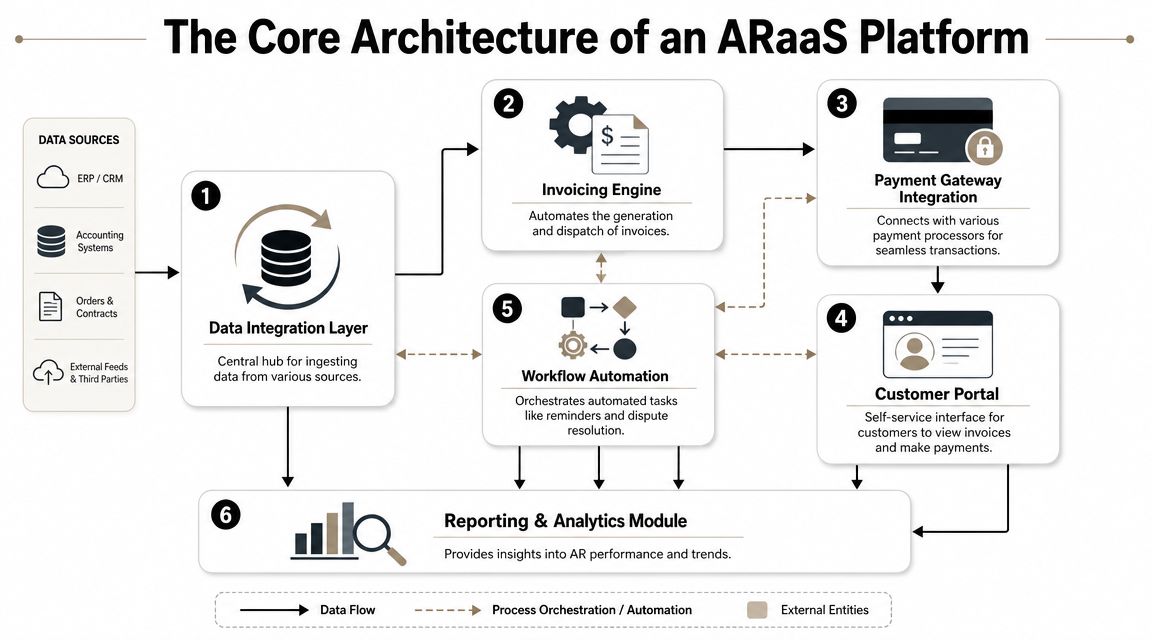
Most ARaaS platforms look simple from the outside. Inside, they're a chain of tightly coupled services that have to preserve financial accuracy while reacting to ongoing transaction changes.
The functional modules
At minimum, you're dealing with these components:
| Component | What it owns | Typical developer concern |
|---|---|---|
| Invoicing engine | Invoice creation, numbering, tax and term rules | Idempotency and source-to-invoice mapping |
| Collections workflow manager | Reminder schedules, overdue routing, escalation | Trigger timing and communication preferences |
| Payment reconciliation module | Matching payments to open invoices | Partial payments, remittance parsing, exception queues |
| Reporting API | AR status, aging, operational KPIs | Consistent event history and queryable states |
The highest-value advantage in ARaaS comes from automating the full invoice-to-cash chain: invoice generation from upstream ERP or order data, electronic invoice delivery, payment matching against open invoices, and posting settlement status back to the ledger. It works best when the system can ingest structured sales-order data and apply customer-specific rules, as outlined in this AR automation explanation.
The data model you actually need
Developers should think in terms of a few canonical entities:
- Customer
- billing identity
- payment terms
- tax metadata
- communication preferences
- Invoice
- source order reference
- issue date
- due date
- currency
- balance status
- LineItem
- SKU or service code
- quantity
- unit price
- tax treatment
- discount allocation
- Payment
- amount received
- payment date
- remittance reference
- allocation result
- Dispute or exception
- reason code
- owning team
- resolution state
A common mistake is treating the invoice as the only meaningful record. In production, the invoice is just one stateful view of several upstream facts. If your source order changes after invoicing, you need a policy for credit memo creation, invoice regeneration, or exception routing. If you skip that design step, your AR layer drifts away from the commerce layer.
Model the lifecycle as a state machine
The cleanest implementation is an explicit state machine:
- DRAFT
- APPROVED
- SENT
- PARTIALLY_PAID
- PAID
- OVERDUE
- IN_DISPUTE
- IN_COLLECTIONS
- VOIDED
Practical rule: Never infer financial state from a single field if you can persist explicit transitions with timestamps.
That audit trail matters for support, reconciliation, and reporting. It also helps when product teams ask for “just one more workflow” after launch.
For teams building adjacent finance features, Renn's guide to online accounting is useful because it frames how accounting systems expect clean, structured transaction data rather than storefront-shaped payloads. That distinction is exactly where many AR integrations fail.
Unlocking ARaaS with Unified eCommerce Data
An ARaaS integration usually fails before invoice logic fails. It fails when the service cannot get a stable view of orders, customers, refunds, shipments, and product details from the merchant's commerce stack.
The integration problem is upstream data variance
Two merchants can sell the same product and expose completely different data. One platform returns tax per line item. Another gives only order-level totals. One mutates the original order after fulfillment. Another emits separate refund and shipment records that must be reconciled before the AR layer can produce the right invoice, credit, or dunning action.
For developers, the hard part is not rendering an invoice PDF or sending a reminder email. The hard part is turning inconsistent commerce payloads into a dependable finance input.
Three failure modes show up repeatedly:
- Schema drift: the same business object arrives under different fields, nesting, or naming conventions
- Event drift: order, payment, refund, and fulfillment updates arrive out of sequence
- Identity drift: customer, order, SKU, and transaction IDs do not map cleanly across systems
As noted earlier, receivables only work when the underlying transaction record is complete and current. If the commerce data is partial or stale, AR automation starts creating exceptions instead of reducing them.
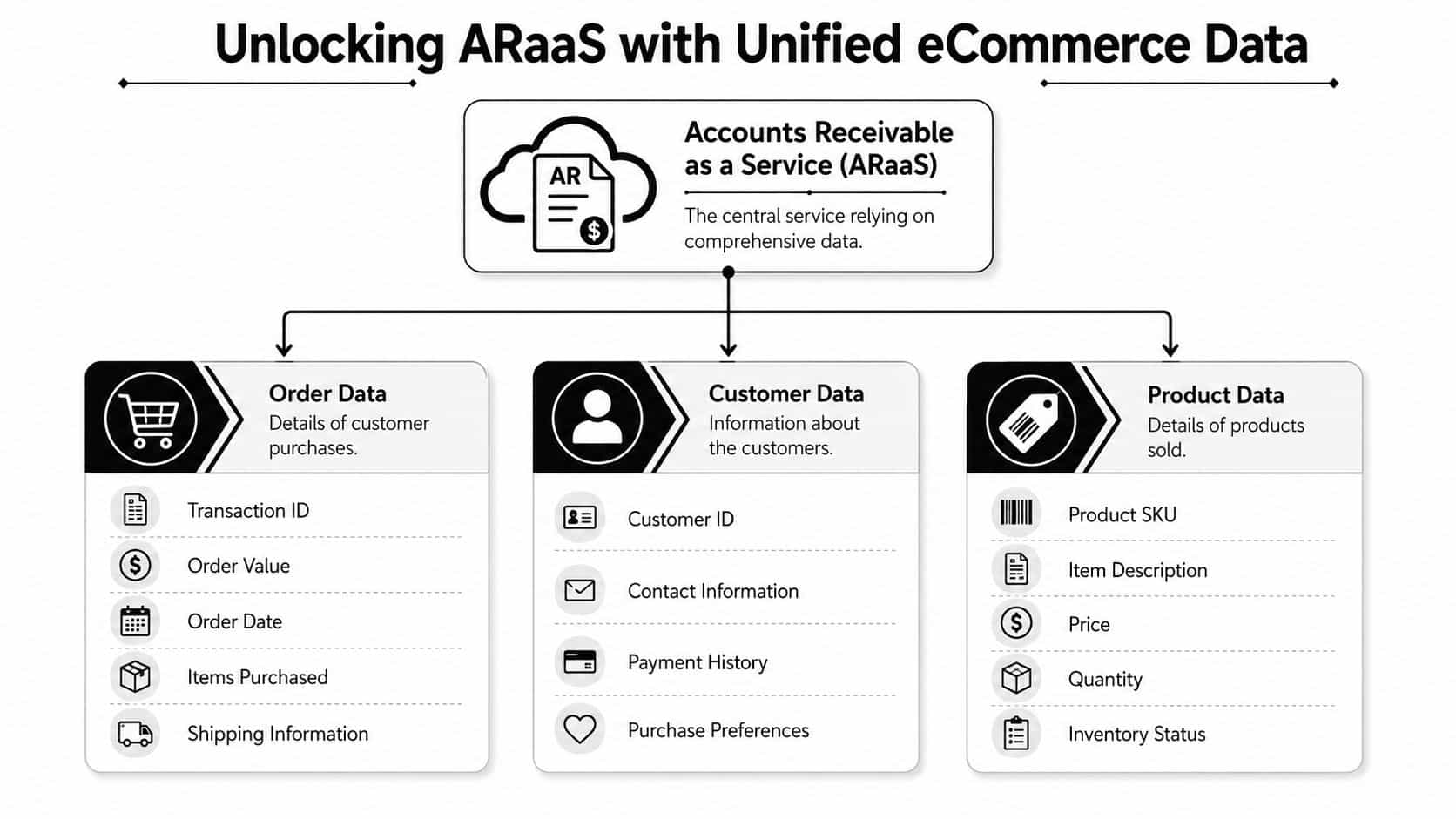
What your AR layer needs from commerce
An AR service needs more than an order total. It needs enough detail to decide what to invoice, when to invoice it, who owes it, and whether a later change should create a credit, a replacement invoice, or a manual review.
That usually means pulling:
- Order data
- external order ID
- order and update timestamps
- line items
- discounts, tax, shipping, and currency details
- fulfillment status
- refund and cancellation records
- Customer data
- billing contact
- legal or company name
- payment terms, if present
- customer references used across channels
- Product data
- SKU or service code
- description
- price basis
- taxable status
- physical or service classification
Missing fields have predictable consequences. Bad tax detail creates invoice disputes. Weak customer identity breaks account matching. Late refund data leaves the AR platform collecting against an amount the buyer no longer owes.
Why a unified API changes the build plan
The project scope changes the moment you support more than one commerce platform. Your team is no longer building an AR integration. Your team is building and maintaining a connector layer, a normalization layer, and then the AR integration on top of both.
That is why a unified API matters. It gives your service one retrieval model for orders, customers, products, shipments, and related records, even when the merchant stack underneath is mixed. You still need a canonical internal model and clear mapping rules, but you avoid writing platform-specific fetch logic for every new storefront.
API2Cart fits that middleware role. It exposes a unified API across many commerce systems, which lets the ARaaS side fetch upstream records through one contract instead of a growing set of custom connectors. For integration teams, that reduces time spent handling auth differences, endpoint quirks, and field mismatches, and leaves more room for invoice policy, exception handling, and reconciliation design. Teams planning broader finance data flows can apply the same pattern described in this guide to finance system integration between commerce and downstream finance services.
The trade-off is straightforward. A unified connector layer does not remove the need for mapping discipline. It removes a large share of store-specific plumbing. That is usually the difference between a project that scales to many merchants and one that stalls under connector maintenance.
Your ARaaS Integration Roadmap
A clean rollout starts with a rule: don't wire the AR platform directly to every store-specific payload. Put a canonical commerce model in the middle, then map that model into the AR domain. That one decision prevents a lot of downstream rework.
Start with connection and identity
You need two trust boundaries. One for the commerce data source. One for the ARaaS endpoint.
Build your connector service so every merchant connection stores:
- Store identity: merchant ID, external store ID, environment, connection status
- Auth material: token references or encrypted credentials, never plaintext in app logs
- Sync cursor: last successful fetch point for orders, customers, and updates
- Capabilities profile: webhook support, available fields, write-back support
If your team is also planning broader finance workflows, this finance system integration article is a useful reference for thinking about data movement between commerce and accounting-adjacent systems.
Backfill before you automate
Historical sync is where teams either create confidence or chaos. Don't begin with real-time webhooks and hope the baseline catches up later.
Use a staged backfill:
- Pull customers first.
- Pull historical orders by date window.
- Build invoice candidates without sending them.
- Run validation against tax, totals, currency, and payment-term rules.
- Only then enable invoice creation and outbound collections workflows.
A simple pseudocode shape looks like this:
for each connected_store:
  customers = fetch_customers(updated_after=cursor.customer)
  upsert_customers(customers)

  orders = fetch_orders(created_after=cursor.order_start, created_before=cursor.order_end)
  for order in orders:
    canonical = map_order_to_canonical_model(order)
    validation = validate_billable_record(canonical)

    if validation.ok:
      create_or_update_invoice_candidate(canonical)
    else:
      route_to_exception_queue(canonical, validation.errors)
The point isn't the syntax. The point is the sequence. Don't let invalid source data create receivables.
Use real-time updates selectively
Webhooks are useful, but they shouldn't be your only source of truth. Deliveries fail. Payloads arrive out of order. Some platforms emit shallow event data that still requires a follow-up fetch.
Use a hybrid approach:
- Webhook for speed: new orders, order updates, refunds, customer changes
- Polling for recovery: periodic list calls using date filters to catch missed events
- Reconciliation jobs: compare open invoices against recent source changes
Build for replay from the start. If you can't safely reprocess an event, you'll struggle in production.
Map commerce records to invoices deliberately
In this area, financial correctness resides. Your mapper should answer:
| Commerce field | AR target | Notes |
|---|---|---|
| Order ID | External invoice reference | Preserve original identifier |
| Billing customer | Customer record | Resolve duplicates before invoice creation |
| Line items | Invoice lines | Keep discount allocation explicit |
| Tax totals | Tax fields | Don't infer from grand total alone |
| Payment terms | Due date rules | Use customer-specific override when available |
Avoid hidden transformations. If you collapse shipping into product lines or merge discounts into net prices, reconciliation gets harder later.
Write back only final business states
Once a payment is matched and the invoice is settled, write back a clear status to the source stack if the platform supports it. Don't push every intermediate AR event into the commerce system. Most storefronts don't need your entire collections history.
Useful write-backs include:
- invoice paid reference
- settlement date
- external payment or remittance ID
- dispute flag when billing review is required
That gives support, operations, and downstream reporting a consistent answer without overloading the source platform with AR-specific noise.
Measuring the Success of Your Integration
A working integration isn't the same as a valuable integration. If all you report is uptime and response time, stakeholders will treat the project as plumbing. AR work earns attention when engineering can connect implementation choices to receivables outcomes.
The KPIs that matter
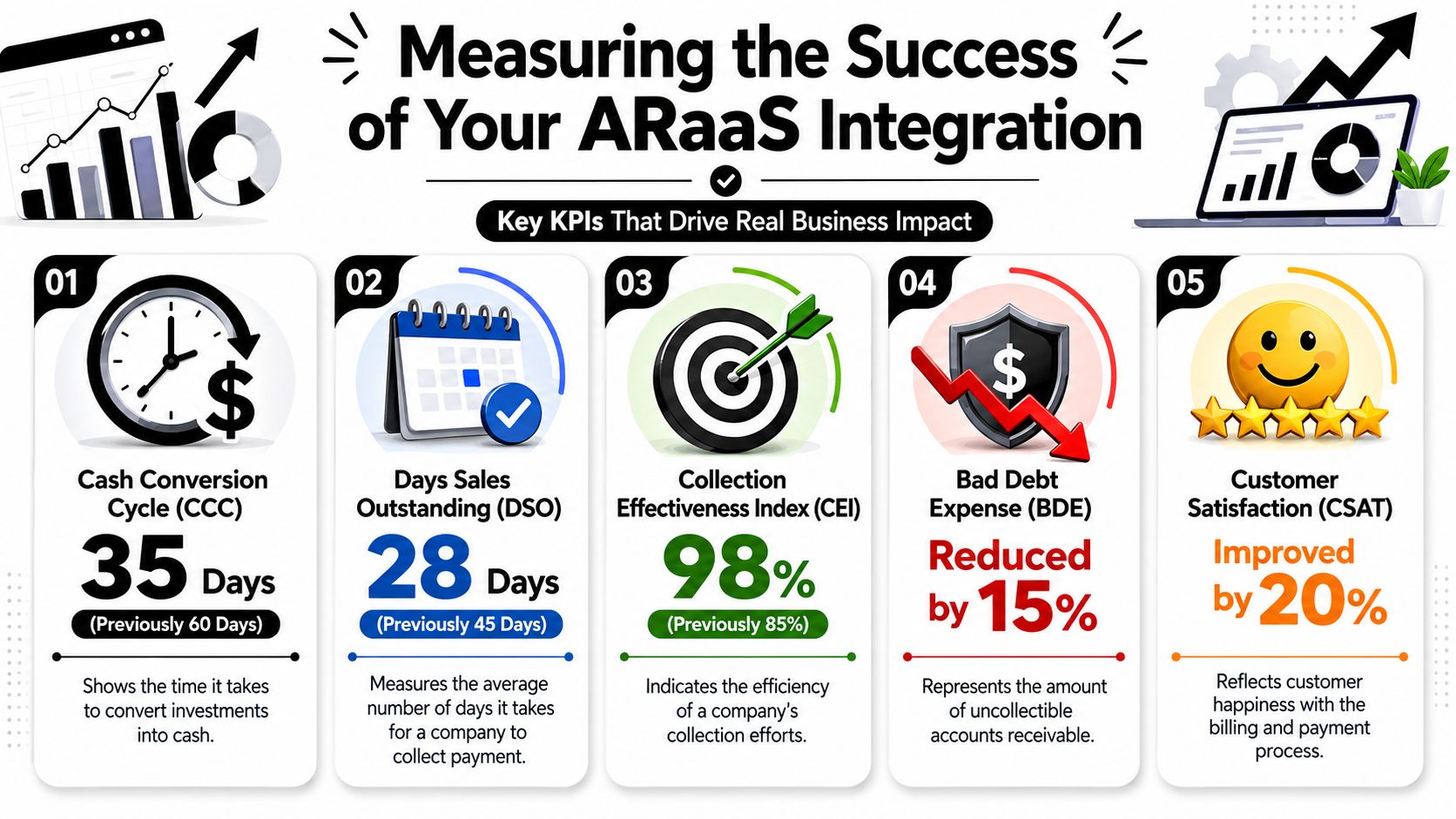
Teams commonly benchmark AR performance with automation rate, match rate, bad-debt ratio, and CEI, because those measures show where delays occur, how much cash is applied automatically, and how much is lost to write-offs, as described in this AR KPI guide.
For developers, that translates into a practical scoreboard:
- Automation rate: How many invoice and payment-handling steps run without manual intervention.
- Match rate: How often incoming payments attach to the correct open invoice automatically.
- CEI: Whether collections operations are converting receivables into cash effectively.
- Bad-debt ratio: Whether process quality is reducing balances that end in write-off.
- Exception volume: How often your integration produces records that require human cleanup.
What engineering controls
You may not own collections policy, but you do control several inputs to those metrics.
| Technical choice | Business effect |
|---|---|
| Better field normalization | Fewer invoice errors and disputes |
| Reliable event replay | Fewer missed invoice or payment updates |
| Strong remittance matching logic | Higher cash application automation |
| Clean customer identity resolution | Fewer duplicate balances |
| Fast write-back of settlement states | Better reporting consistency |
That mapping helps product managers understand why “one more integration detail” isn't just engineering perfectionism.
A simple ROI model without fake precision
You don't need invented percentages to frame the value. Use a directional model:
Return = improved cash visibility + reduced manual reconciliation + fewer billing exceptions
Cost = implementation effort + connector maintenance + platform subscription costs + support overhead
Then validate with before-and-after operational comparisons inside your own environment. If your integration reduces exception queues and improves automatic payment application, the finance team feels it in daily operations even before formal KPI trends stabilize.
Don't promise financial outcomes from architecture alone. Promise cleaner inputs, faster workflows, and measurable operational control.
That's a more credible conversation. It also protects engineering from being blamed for issues caused by bad terms, poor invoice policy, or weak collections governance outside the codebase.
AR integrations handle an uncomfortable mix of data types. Customer identity, billing addresses, invoice detail, payment references, and internal finance metadata often move through the same pipeline. If you don't define data boundaries clearly, your integration becomes both a security risk and a support problem.
Secure the connection layer first
Use modern token-based auth where supported, scope credentials to the minimum required permissions, and isolate store-specific secrets from application logs and developer tooling. Teams that need a practical refresher on auth design can review this overview of authentication in APIs, especially when planning multi-merchant connection flows.
Your baseline checklist should include:
- Encrypted transport: Require current TLS for every external API call.
- Encrypted storage: Protect tokens, identifiers, and sensitive payload fragments at rest.
- Least privilege: Request only the read and write scopes the workflow requires.
- Auditability: Log access and state transitions without exposing secret material.
Limit what enters the AR domain
Not every commerce field belongs in receivables. Pull what the workflow needs, then discard or redact the rest. That discipline helps with privacy obligations and makes troubleshooting easier because your payloads stay focused.
A good working pattern is to split records into three classes:
- Operational fields used for invoice creation and status updates.
- Reference fields used for reconciliation and support.
- Restricted fields that should never persist in your AR integration store unless there's a specific compliance-approved reason.
Compliance starts with data quality
Security controls won't save a workflow that automates bad billing. AR performance depends heavily on upstream controls such as invoice accuracy and dispute management, and major AR challenges include incorrect invoices and weak payment-term communication, as noted in this NetSuite overview of accounts receivable.
That has a direct architectural implication. Your integration should detect and flag root-cause issues before collections begin.
Examples:
- customer missing billing contact
- order total doesn't reconcile with line items
- payment terms absent or inconsistent
- tax treatment incomplete
- post-order edits that invalidate an existing invoice
Security and compliance aren't only about who can access the data. They're also about whether the workflow produces a defensible financial record.
Treat disputes as first-class events
Many teams automate invoice delivery and reminders, then bolt disputes on later. That's backwards. Disputes need a proper object, clear ownership, and an audit trail from the start.
At minimum, persist:
- dispute reason
- source record references
- current owner
- timestamps for creation and resolution
- links to invoice revisions, credits, or supporting notes
That design keeps collections automation from harassing a customer when the underlying issue is a broken upstream order or an unclear term.
Building the Future of Automated Finance
Accounts receivable as a service looks like a finance feature from the outside. In delivery terms, it's a data integration problem with financial consequences. The systems that work aren't the ones with the most polished invoice templates. They're the ones that can pull clean commerce data, preserve state changes, reconcile payments accurately, and route exceptions before they become disputes.
That's why connector strategy matters so much. If your team keeps writing custom integrations for each commerce source, AR delivery slows down and maintenance keeps eating future roadmap time. A unified API approach reduces that surface area and lets engineering spend more time on canonical data models, event reliability, and workflow rules.
There's also a broader skill shift happening. Developers who can connect commerce operations to accounting-adjacent systems are becoming more valuable because businesses want automated order-to-cash flows, not disconnected back-office tools. If you can design a system that translates store activity into dependable receivables operations, you're building infrastructure the business will keep expanding.
For teams thinking beyond receivables alone, optimizing accounting practices is a useful adjacent read because it highlights how structured collaboration and clean financial inputs reduce downstream friction. That same principle applies to AR integrations. Better source data beats more aggressive collections logic almost every time.
If payment operations are also part of your roadmap, this look at B2B payment automation helps frame how receivables workflows connect to the larger payment lifecycle.
The practical takeaway is simple. Treat ARaaS as an integration architecture project, not as a finance plugin. Define your canonical model early, design for replay and exception handling, and keep the commerce-to-finance boundary explicit. That's how you build something finance can trust and support teams can live with.
If you're building finance-adjacent features for merchants, API2Cart can give your team a single way to access order, customer, product, shipment, and related store data across many eCommerce platforms. That makes it easier to prototype ARaaS workflows, reduce connector maintenance, and move faster on invoice-to-cash automation without starting every store integration from scratch.