The market tells you this isn't a side feature anymore. A widely cited estimate values the global accounts receivable automation market at USD 4.79 billion in 2025 and projects USD 12.86 billion by 2033 at a 13.2% CAGR according to Grand View Research's accounts receivable automation market report. For a SaaS team building into commerce workflows, that matters because AR is no longer just finance software. It's an integration surface.
From the developer seat, accounts receivables automation is the controlled movement of commercial events through a messy system chain. An order is created. Customer terms are resolved. An invoice is issued. Payment status changes. Cash is applied. Exceptions get handled. Reporting updates. If any of those handoffs are late, duplicated, or incomplete, the finance logic won't save you.
That's why most AR projects fail in a very familiar way. The product team talks about invoicing and collections. The engineering team gets buried in connectors, schema differences, webhook reliability, and reconciliation edge cases. The feature looks like a finance module from the outside, but under the hood it's a data integration problem with accounting consequences.
Why AR Automation is a Developer Problem Now
The demand is obvious, but the implementation burden lands on engineering. Merchants want faster invoice creation, better payment follow-up, cleaner reconciliation, and fewer manual touches. To deliver that, your product has to pull accurate order, customer, tax, shipment, and payment data from systems that were never designed around one shared AR workflow.
AR logic is downstream of data quality
A lot of teams start by designing reminder templates, invoice screens, or aging dashboards. That's backward. AR automation only works when upstream commerce data arrives in a form your system can trust.
If the order payload misses billing fields, your invoice will be wrong. If refunds arrive late, your collections logic will chase money the merchant no longer expects. If a customer record changes in the store but not in your AR layer, statement delivery starts failing for reasons the finance team can't see.
Practical rule: Treat the commercial event stream as the product. The AR UI is just the surface area.
The real system is a chain, not an app
Best-practice implementations begin with the ERP or accounting system as the invoice source of truth, then connect billing, CRM, payment providers, and bank feeds so invoicing, payment collection, reconciliation, and reporting work end to end, as described in Upflow's overview of AR automation architecture. That design choice matters for developers because it defines where records are created, where state changes are authoritative, and where idempotency has to be enforced.
A practical AR feature usually depends on these inputs:
- Order data: line items, taxes, shipping, discounts, fulfillment state
- Customer data: billing contact, payment terms, company identity, tax fields
- Payment data: authorized, captured, partially paid, refunded, failed
- Accounting references: invoice number, ledger mapping, payment application status
Why commerce makes AR harder
Commerce adds volatility that classic ERP-first receivables systems don't handle well. Orders can split, merge, partially ship, update after placement, or be paid across different methods. In B2B storefronts, the order often comes before the invoice and before final payment terms are confirmed. That means your AR engine has to work off changing transactional data, not a clean static document set.
For developers, the strategic question isn't whether to automate AR. It's whether your product can absorb fragmented commerce data without turning every new platform integration into a custom project.
The Business Case and ROI for Your SaaS
A merchant rarely buys AR automation because they want fewer clicks. They buy it because they want cash to move faster and operations to stop leaking time into follow-up, matching, and cleanup. That's the product story your team needs to support.
Why merchants care
In a study of 500 finance professionals, 100% reported measurable gains from AR automation, and teams that fully embraced automation reported a 40%+ reduction in Days to Pay according to Billtrust's analysis of AR automation ROI. That's not a cosmetic improvement. It changes how merchants think about liquidity, staffing pressure, and collections discipline.
For an eCommerce merchant, the operational wins are usually straightforward:
- Faster invoice-to-payment movement: invoice creation and follow-up happen without waiting for someone to export, reformat, or resend.
- Lower friction in collections: reminders go out on schedule, based on state, instead of when someone remembers.
- Cleaner exception handling: disputes and partial payments stop living in inboxes and spreadsheets.
Why your SaaS should care
Those merchant outcomes become a product advantage for your business.
| SaaS outcome | Why it matters |
|---|---|
| Higher stickiness | Once your product becomes part of billing and cash collection flow, replacement gets much harder. |
| Broader account coverage | AR features pull your app closer to finance, not just operations or commerce teams. |
| Expansion path | Payments, reconciliation, customer portals, and accounting sync become logical extensions. |
A lot of SaaS teams underestimate this. They think AR automation is a niche add-on for larger accounts. In practice, if your product already sits near orders, subscriptions, fulfillment, or inventory, you're one integration layer away from owning a much more valuable workflow.
The trade-off product teams often miss
Adding AR automation raises the reliability standard for your whole platform. When you move from “sync some orders” to “generate financial actions from order data,” small integration flaws become business issues.
If your sync duplicates an order, you don't just create noise. You risk a duplicate invoice.
That's why the business case has to include engineering reality. The ROI isn't just in feature adoption. It's in building the feature on a data layer that won't require constant intervention every time a merchant connects a new commerce stack.
Common AR Automation Architectures for eCommerce
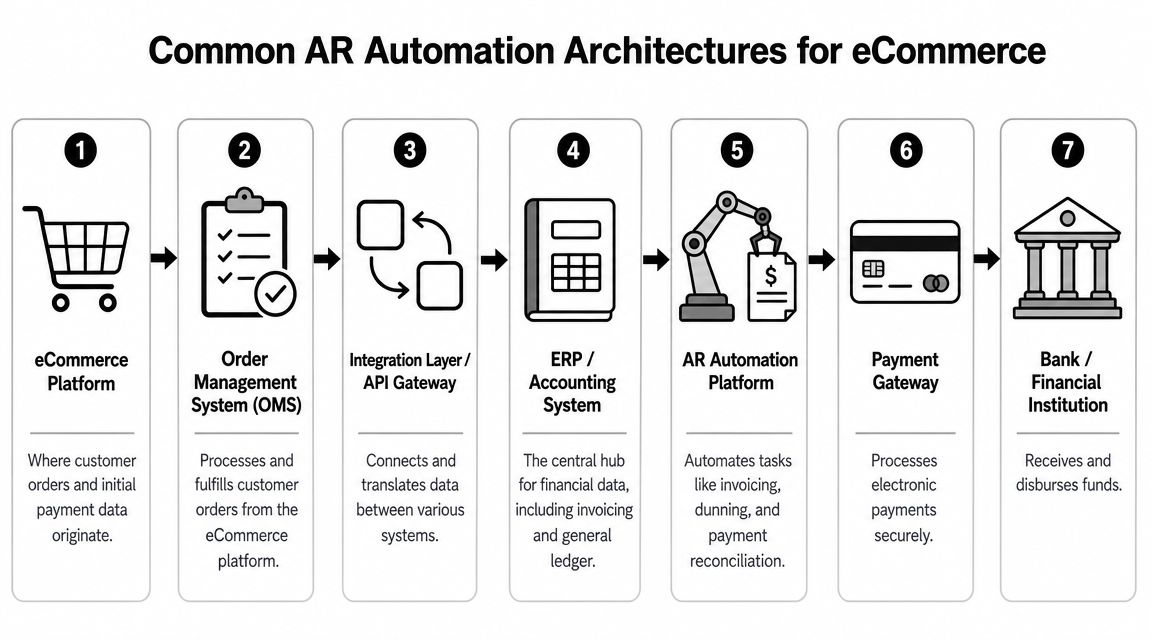
Most modern AR flows look simple on a whiteboard and become complex as soon as you add real store behavior. The safest way to reason about them is as a state machine with multiple event producers, not as a one-way invoice pipeline.
A practical reference flow
At minimum, your architecture has to coordinate commerce data, AR business logic, and accounting state. The invoice source of truth should sit in the ERP or accounting system, while billing, CRM, and eCommerce systems feed the end-to-end loop. That's the implementation pattern described in this overview of eCommerce platform integration approaches.
A common flow looks like this:
Order created in the store
The integration layer receives a new order event or polls for fresh orders within a time window.Order normalized
Your app maps platform-specific fields into an internal schema. Customer, address, line items, taxes, discounts, and payment state all need normalization.Invoice eligibility checked
Not every order should invoice immediately. Some teams invoice on order placement. Others wait for fulfillment, approval, or payment confirmation.Invoice created in accounting
The accounting layer issues the invoice number and becomes the financial source of truth.Customer communication triggered
Statements, reminders, and pay links run from invoice state, not from raw order state.Payment event received
Payment updates arrive from the commerce platform, payment rail, bank feed, or accounting system.Cash applied and reconciled
The system matches payment to invoice, updates customer balance, and closes or flags exceptions.
Where architectures usually break
The fragile spots are almost always the same:
- State ambiguity: order paid in one system, open in another
- Late updates: refund or cancellation arrives after invoice creation
- Identity mismatch: one customer represented differently across store and accounting
- Partial transaction handling: split shipments, deposits, partial captures, credit memos
Here's a simple way to think about ownership.
| Data domain | Best owner |
|---|---|
| Cart and order capture | eCommerce platform |
| Invoice record | ERP or accounting system |
| Reminder cadence | AR workflow layer |
| Final reconciliation status | Accounting plus payment confirmation data |
Relay-race design works better than hub fantasy
Teams often try to make one system the owner of everything. That usually ends badly. A better pattern is a relay race. Each system owns a specific baton handoff, and your integration layer enforces timing, schema consistency, and duplicate protection.
Don't build around the assumption that commerce events arrive complete, ordered, or final. Build around replay, correction, and reprocessing.
That means idempotent handlers, durable event logs, recoverable sync jobs, and explicit source-of-truth rules. Without those, AR automation turns into a reconciliation support queue.
The Hidden Drain of Native eCommerce Integrations
Building direct integrations sounds reasonable at first. One connector for one platform. Then another. Then another because a prospect asks for it, then a marketplace variation, then a custom auth edge case. Pretty soon your AR roadmap is blocked by connector maintenance.
Every platform disagrees on the basics
The hard part isn't calling an API. It's surviving dozens of different interpretations of the same business object.
One platform may expose order totals with tax included. Another separates adjustments. One may treat refunds as nested records. Another publishes them as separate transactions. Customer addresses might be complete, optional, duplicated, or attached to account-level entities instead of order-level records.
That creates work in places product plans rarely account for:
- Schema mapping debt: every platform needs its own translator
- Auth variation: different token models, permission scopes, and store connection flows
- Version churn: upstream API changes can unexpectedly break a stable sync
- Webhook inconsistency: some events are rich, some are sparse, some are delayed
Native connectors turn AR features into support work
The first release is never the expensive part. The expensive part is the long tail.
A merchant reports duplicate invoices only on one platform when edits occur after checkout. Another merchant says customer tax IDs are missing for a subset of orders. A third has payment updates that lag behind fulfillment state. None of those bugs are “AR logic bugs” in the narrow sense. They're integration interpretation bugs, and they drain senior engineering time because they touch money.
The hidden cost of native integrations isn't writing them. It's proving, over and over, that each one still behaves correctly after upstream changes.
Build vs buy is really maintain vs contain
If your product only needs one commerce platform and your customers never deviate, direct integration can be acceptable. That's a narrow scenario. Most B2B SaaS vendors don't live in that world. They need broad store coverage, predictable onboarding, and one internal data contract the AR engine can rely on.
Here's the practical comparison:
| Approach | What you own |
|---|---|
| Native per-platform integrations | Every auth flow, field mapping, version issue, webhook quirk, and support case |
| Unified integration layer | Your canonical schema, business logic, and merchant experience |
That's the core trade-off. Building AR features on top of custom connectors means the eCommerce layer keeps stealing resources from the finance layer you want to improve.
How a Unified API Radically Speeds Up Development
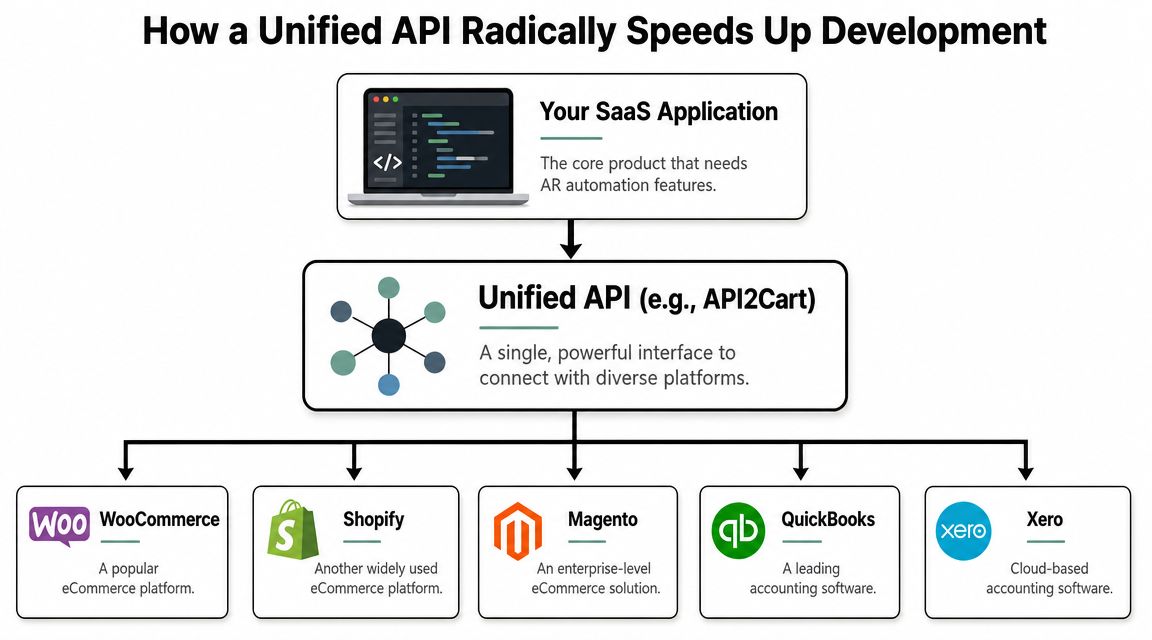
A unified API changes the shape of the project. Instead of teaching your AR engine how every commerce platform behaves, you teach it one normalized interface and keep your domain logic focused on invoices, reminders, and reconciliation.
What abstraction actually buys you
For AR development, the value isn't abstract elegance. It's fewer moving parts in the part of the stack where mistakes become financial errors.
Using a unified API model for commerce connectivity, a team can retrieve common data domains like orders, customers, and products through a stable access pattern instead of writing separate connectors for each platform. That's especially useful when your AR workflow needs to do the same job for every merchant:
- pull new orders within a date range
- fetch customer billing details
- inspect payment state
- react to order updates through webhook events where available
- fall back to polling when real-time events aren't supported
API2Cart fits this model by exposing one API for many shopping carts and marketplaces. For an integration developer, that means the data acquisition layer for orders, customers, and related commerce entities can stay separate from your receivables rules.
A developer-first AR use case
Say you're building invoice automation for merchants who sell on multiple storefronts. Your AR service needs to detect newly eligible orders, map them into your invoice schema, and send them into accounting. With a unified API, the retrieval pattern stays consistent even when the merchant mix changes.
That improves delivery in a few concrete ways:
- Faster onboarding: engineers don't create a new ingestion service for every platform
- Cleaner testing: QA validates your mapping logic against one canonical contract
- Lower blast radius: connector changes are contained in the integration layer, not scattered through AR code
If your roadmap also includes bank debit flows or localized payment collection, the payment side matters too. For teams exploring direct debit orchestration, this SEPA Direct Debit API integration guide is a useful reference for what payment workflow design looks like when mandates, collection timing, and settlement status have to feed back into receivables automation.
What still remains your job
A unified API won't design your accounting model for you. You still need to handle:
Canonical mapping rules
Decide how orders become invoice candidates, how partial payments map, and how credits are represented.State transition logic
Define when reminders start, pause, resume, and stop.Reconciliation safeguards
Protect against duplicate invoice creation, replayed webhooks, and delayed updates.
A unified API removes connector sprawl. It doesn't remove the need for disciplined source-of-truth design.
That's the right separation of concerns. Let the integration layer normalize commerce connectivity. Keep your engineering effort focused on receivables behavior your customers will pay for.
Integration Best Practices and Key KPIs
Once the connectivity layer is stable, implementation quality comes down to discipline. AR automation fails less from missing features than from sloppy boundary decisions. The teams that do this well are obsessive about mapping, replay safety, and auditability.
Map for accounting, not for display
The internal schema should represent what accounting and collections need, not what the storefront happened to send. That means every imported order should be transformed into a durable commercial record with explicit treatment for tax, shipping, discount allocation, payment status, and customer identity.
A few rules help:
- Separate source fields from canonical fields: keep the raw payload for traceability, but don't let downstream logic depend on platform-specific naming.
- Version your mapping logic: when field interpretations change, you need to know which invoices were produced under which mapping rules.
- Treat customer identity carefully: email alone is rarely enough for matching account-level receivables.
For teams planning broader accounting connectivity, this finance system integration reference is useful because it highlights the integration boundary between operational systems and finance systems.
Design for duplicates, delays, and reversals
You should assume the same commercial event can arrive more than once. You should also assume some events arrive out of order.
That leads to a small set of essential engineering patterns:
| Pattern | Why it matters |
|---|---|
| Idempotent invoice creation | Prevents duplicate financial records when events replay |
| Event timestamp plus source checkpointing | Helps recover cleanly after sync interruptions |
| Compensation logic | Lets refunds, cancellations, and credit scenarios reverse prior AR actions safely |
| Audit trail per state change | Gives support and finance teams something defensible to inspect |
Build your first reconciliation dashboard before your first customer-facing dashboard. You'll need it sooner.
Measure outcomes the finance team actually trusts
Teams commonly see 25 to 40 percent improvements in DSO after moving to automated AR workflows, according to Growfin's 2025 guide to efficient AR operations. That makes DSO a natural KPI, but it shouldn't be the only one your product exposes.
Track a mix of business and technical indicators:
- DSO movement: the headline business result
- Invoice creation latency: how quickly eligible orders become invoices
- Auto-application rate: how many payments match without manual work
- Exception queue age: how long unresolved mismatches sit
- Webhook processing failures: whether event-driven sync is reliable
A good AR feature doesn't just automate tasks. It makes failure visible early enough for operators to intervene before finance sees a broken month-end.
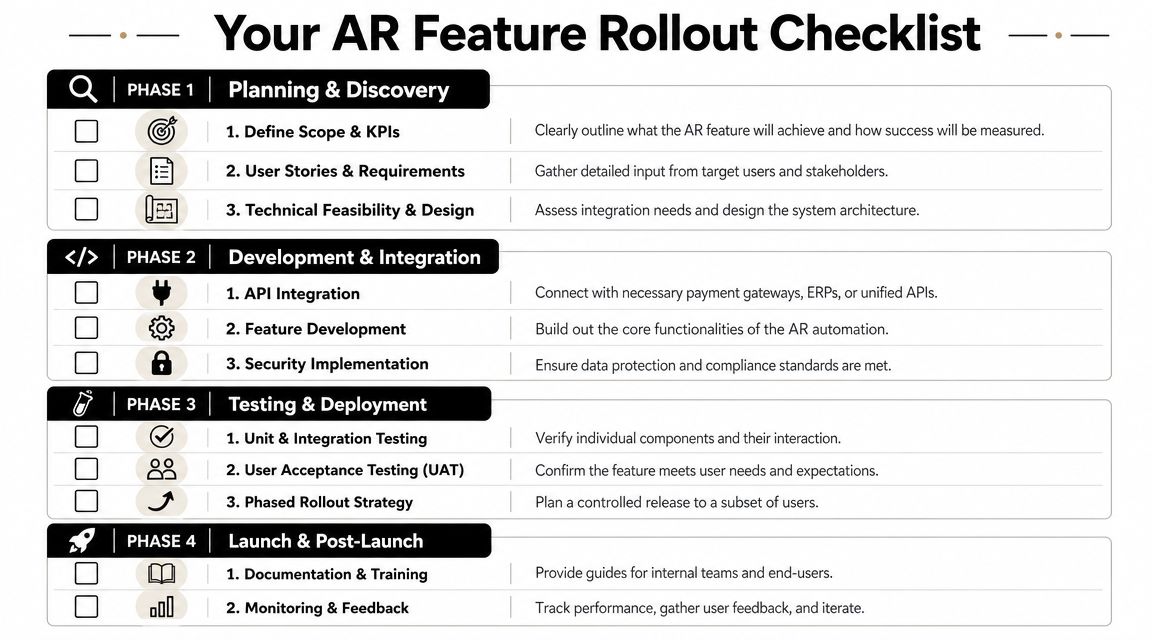
Your AR Feature Rollout Checklist
The rollout should be staged like any financial workflow change. Don't release “AR automation” as one broad promise. Release a narrow, testable operational loop and expand only after data quality and exception handling are stable.
What to do before launch
Start with scope discipline. Pick one trigger path, one invoice creation rule set, and one payment reconciliation path. Don't mix collections automation, dispute workflows, and advanced forecasting into the first release if the integration layer is still being proven.
A practical checklist looks like this:
- Define the source of truth: document where order state, invoice state, and payment state are authoritative.
- Freeze the canonical schema: stop changing field meaning mid-build.
- Create a replay plan: decide how you'll recover missed events and rerun imports safely.
- Write support diagnostics early: merchant support will need transaction-level visibility on day one.
What to validate in pilot
Pilot on merchants with clean operational behavior first. You want signal, not chaos.
Use the pilot to verify:
- Eligibility logic works: the right orders become invoices
- State transitions hold up: paid, partial, refunded, and canceled scenarios don't break downstream actions
- Accounting alignment is clean: finance can trace every invoice back to a commerce event
- Fallback processes exist: when sync fails, staff can recover without manual ledger damage
Questions to ask any integration-layer vendor
Even if you already know you need external connectivity support, vet the partner the same way you'd vet a financial dependency.
Ask for clear answers on:
Coverage and change management
How are platform API changes handled, and how are clients notified?Event support
Are webhooks available where platforms support them, and what's the fallback when they don't?Operational visibility
Can your team inspect request history, failures, and store-level connection health?Security and scaling
How are credentials handled, and what happens as connected merchant volume grows?
The best AR rollout is boring in production. Orders sync, invoices generate, reminders respect state, and accounting can trust what they see. That only happens when the integration layer is treated as core architecture, not setup work.
If you're building accounts receivables automation into a SaaS product, API2Cart is worth evaluating for the commerce data layer. It gives integration teams one API for connecting to many eCommerce platforms, which can simplify order and customer data retrieval while your engineers focus on invoice logic, reconciliation rules, and product behavior.