You're probably dealing with this already. Your app imports product data from multiple commerce platforms, but greater complications start when you touch files. Product images live behind different media models. Order invoices arrive as PDFs in one platform and attachments in another. Merchant-uploaded documents don't follow one naming scheme, one URL pattern, or one permission model.
That's why cloud storage with API matters so much for B2B eCommerce software. It isn't just about where files sit. It's about how your application moves, validates, secures, and serves those files without turning every connector into a custom media project.
For integration developers, the hard part isn't storing a file once. The hard part is building repeatable architecture for product media, order documents, catalog exports, and customer-facing assets across many connected stores. If you don't make storage API-driven from the start, the file layer becomes a maintenance trap.
Why API-Driven Cloud Storage is Critical for eCommerce Apps
A mid-market merchant changes product imagery in one storefront. Your PIM needs the updated image. Your syndication engine needs a normalized copy. Your analytics workflow may need metadata about that asset, and your customer portal may need a public URL with the right permissions. If engineers handle that with ad hoc download scripts and manual file routing, the system won't hold up for long.
That's the business case for cloud storage with API. Storage has already become standard infrastructure. Roughly 94% of enterprises worldwide now use some form of cloud service, and about 60% of corporate data is stored in the cloud, up from around 30% in 2015, according to cloud storage usage statistics. The same source notes that modern cloud storage is accessed programmatically through APIs that let software upload, retrieve, update, and manage data at scale.
The eCommerce file problem isn't just about uploads
In eCommerce SaaS, you rarely work with one file type or one workflow. You're handling:
- Product media such as images, spec sheets, videos, and downloadable manuals
- Operational documents such as packing slips, invoices, return labels, and order PDFs
- Merchant assets such as CSV imports, brand files, and onboarding attachments
- Derived assets such as resized thumbnails, optimized web images, or transformed exports
Each one has a different access pattern. Product images may be public and read-heavy. Invoices may need strict access control. Imports may be temporary and internal-only.
Don't treat all files like “uploads.” In eCommerce systems, each asset type has its own retention, security, and delivery pattern.
Why manual file handling breaks down
The first version of a connector often cheats. It fetches a remote image URL, stores a local copy, and moves on. That's fine for one integration. It becomes brittle when your team supports many carts, marketplaces, and ERP-adjacent workflows.
The failure modes show up quickly:
- Platform-specific media rules create branching logic everywhere.
- Retry and sync behavior gets inconsistent across connectors.
- Access control decisions drift between frontend, backend, and storage.
- Storage costs become hard to predict because nobody modeled read and transfer patterns up front.
When developers move to an API-first storage model, storage becomes part of the application architecture instead of an afterthought. That's the difference between “files attached to records” and “files managed as a system.”
Understanding Core Cloud Storage API Concepts
A useful mental model is a valet key for a warehouse. The warehouse stores everything. The valet key doesn't give full control over the building. It gives limited, intentional access to specific operations. That's what an API does for storage. It lets software interact with data without exposing the whole storage system.

What “with API” actually means
When developers say cloud storage with API, they usually mean a storage service that can be controlled over HTTP. Instead of opening a shared folder manually, your application sends requests to create, read, update, or delete data.
Cloud storage APIs expose object storage via REST or HTTP-style operations, which makes CRUD access programmable and automatable, as explained in this overview of cloud storage APIs. That matters in eCommerce because your app often needs to pull product media, store transformed versions, and serve URLs to downstream systems without managing a traditional filesystem hierarchy.
Object storage versus file storage
Here, many developers get tripped up.
File storage feels like folders on a server. You browse directories and filenames. It's familiar, but it pushes you toward shared-path thinking.
Object storage works differently. Data is stored as objects inside buckets. Each object has content, a key, and metadata. The structure is effectively flat, even if naming conventions make it look folder-like.
That model is a better fit for common eCommerce assets because:
- Unstructured files fit naturally. Images, PDFs, videos, and exports don't need strict filesystem semantics.
- Metadata travels with the object. You can associate content type, cache behavior, tags, or internal identifiers.
- Applications scale more cleanly. You don't spend time managing directory depth, network mounts, or shared disk behavior.
The terms you'll keep seeing
Here's the quick translation layer:
| Term | What it means in practice |
|---|---|
| Bucket | A top-level container for objects |
| Object | A file plus metadata |
| Key | The object's unique name or path-like identifier |
| PUT | Upload or replace an object |
| GET | Retrieve an object |
| DELETE | Remove an object |
| Metadata | Descriptive values stored with the object |
If you're building catalog sync, think in object keys and metadata, not folders and filenames. That shift makes later automation much easier.
For a mid-level developer, the key insight is simple. The API isn't a thin convenience layer on top of storage. The API is the control surface your application uses to move and govern assets.
Common API Patterns for Managing Storage
When you integrate storage into an eCommerce app, the API pattern matters almost as much as the provider. The same file workflow can be simple or painful depending on whether you use raw HTTP, an SDK, browser-direct upload, or a staged backend process.
Raw REST calls give you control
Direct HTTP calls are the clearest way to understand what's happening. They're also useful when you're debugging signatures, headers, permissions, or odd provider behavior.
A simple upload flow usually looks like this:
- Your app generates or receives authorization.
- It sends a PUT or POST request with the file payload.
- The storage service returns object metadata or a location reference.
For an integration developer, raw calls are valuable when you need to inspect exact request behavior. They also help when building language-agnostic middleware.
But they come with friction:
- You manage low-level details such as headers, retries, and request signing.
- You write more boilerplate for multipart uploads and streaming bodies.
- Your code becomes noisier when file operations appear in many services.
If your app also handles event-driven ingestion, Streamkap's streaming API guide is a useful reference for designing request flows that don't fall apart when asset events arrive continuously rather than in batches.
SDKs reduce repetitive work
Official SDKs usually wrap authentication, retries, pagination, object metadata helpers, and multipart transfer support. That makes them a better default for most production services.
A practical split looks like this:
| Pattern | Best use | Trade-off |
|---|---|---|
| Raw REST | Debugging, custom middleware, unusual runtimes | More control, more code |
| SDK | Backend services, routine upload/download logic | Faster development, less protocol visibility |
SDKs also make it easier to implement consistent retry logic and structured error handling. For teams that already juggle many paginated endpoints, understanding API pagination patterns for integrations becomes particularly useful. Storage listings and commerce listings often fail for the same reason: engineers assume they can load everything in one call.
Presigned URLs are great for browser uploads
Presigned URLs solve a common eCommerce problem. A merchant uploads a large product image from the admin UI, but you don't want the binary data to pass through your application server first.
With a presigned flow:
- Your backend authenticates the user.
- Your backend requests a temporary upload URL.
- The browser uploads directly to storage.
- Your app stores the resulting object reference.
This pattern is strong when you need to reduce backend bandwidth and keep your app stateless around uploads.
Use it for:
- product image uploads in merchant dashboards
- bulk asset imports
- brand kit uploads during onboarding
Be careful with validation. If the browser uploads directly, your app still needs rules for file type, file naming, expected size ranges, and post-upload verification.
Multipart upload helps with large assets
Big files fail more often on long-lived connections. Multipart upload addresses that by splitting a large object into parts and then assembling them server-side.
That's useful for:
- long product videos
- catalog archives
- document bundles from enterprise merchants
Practical rule: Use the simplest pattern that matches the file's size, source, and trust boundary. Don't proxy everything through your backend just because it's familiar.
For many eCommerce apps, the winning combination is straightforward. Use SDKs in backend services, presigned URLs for trusted browser uploads, and multipart only when file size or transfer reliability makes it necessary.
How to Evaluate a Cloud Storage API Provider
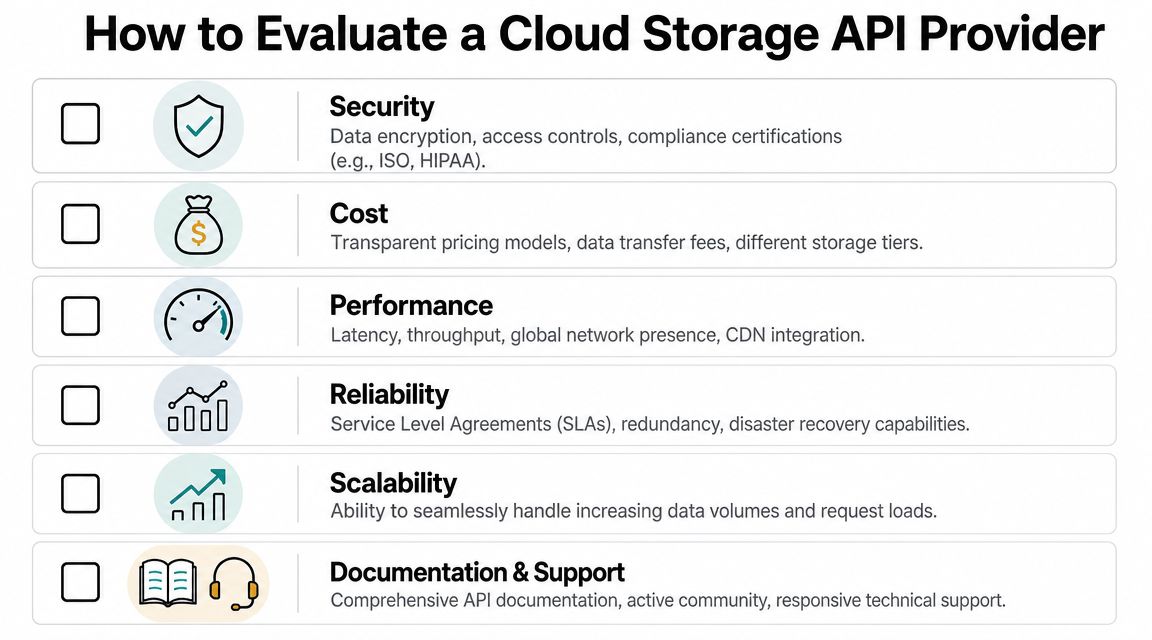
Choosing a provider isn't mostly about whether it can store objects. They all can. The pertinent question is whether its API behavior, pricing model, and operational controls match the way your eCommerce application reads and writes assets.
Start with the workload, not the feature list
A public product image service has different needs than an invoice archive. One needs aggressive caching and easy distribution. The other needs tighter access control, auditability, and predictable retrieval behavior.
When reviewing providers, ask these questions first:
- Read pattern. Are objects mostly written once and read many times?
- Latency sensitivity. Does a customer-facing page depend on the fetch?
- Data geography. Will files be read across regions or by external partners?
- Retention rules. Do assets live forever, or should old versions age out?
If your team needs a broader shortlist, this guide to top cloud providers for SMBs is a practical starting point for framing the provider space before you narrow into storage-specific API evaluation.
Hidden costs are where decisions go wrong
Many developers compare storage pricing by looking at the cost of storing data and stopping there. That's incomplete. In production, your app pays for how often it reads, lists, transfers, and exposes data.
Many guides fail to address hidden costs like egress and transit fees, which can dominate real-world costs in data-sharing workflows, as discussed in this analysis of file storage API evaluation. The same piece notes that understanding total cost of ownership, including API and network charges, is critical for scaled applications.
That matters a lot in eCommerce because apps often perform many small reads:
- a storefront requests image variants
- an OMS fetches document links
- a PIM validates media presence
- a customer portal retrieves downloadable files
Each action may look cheap in isolation. Together, they shape your bill.
A practical evaluation checklist
Use this when your team is reviewing options:
Security model
Can you issue limited access, temporary credentials, and object-level permissions without exposing broad account access?Request economics
Do your common operations rely on lots of GET, PUT, or LIST calls? If yes, model those patterns before choosing.Network path
Will data move frequently between services, regions, or customer environments? If so, network architecture matters as much as storage price.Operational fit
Does the API offer mature tooling, decent error messages, and clean automation paths for CI, batch jobs, and event-driven systems?
A unified abstraction layer can also matter when your team evaluates upstream commerce complexity alongside storage complexity. This overview of a unified API approach for integrations is useful when the bigger architecture question isn't just “which storage API?” but “how many APIs do we really want to maintain at once?”
eCommerce Integration Patterns with Storage APIs
The hardest design choice usually isn't how to upload an object. It's where the complexity should live. In B2B eCommerce software, that decision affects product media sync, order documents, returns, onboarding imports, and every downstream workflow that depends on those files.

Pattern one with direct platform handling
This is the architecture many teams start with. Your app connects directly to each commerce platform, learns its asset model, fetches media URLs or attachments, then writes normalized copies into your own storage layer.
The data flow sounds manageable:
- Pull product or order records from each platform.
- Discover related media or document references.
- Download or mirror the assets.
- Store them in your cloud bucket.
- Map the stored object back to your internal entity model.
The problem is that each connector tends to grow its own exceptions.
One platform may expose image URLs directly. Another may attach media through a separate entity. A third may use different rules for downloadable files versus gallery images. Your storage code stays relatively stable, but the retrieval logic before storage becomes fragmented.
Most storage complexity in eCommerce doesn't come from the bucket. It comes from the source systems that describe the files differently.
This direct pattern still makes sense when:
- you support only a small number of source platforms
- your media model is tightly tied to one platform's behavior
- you need full control over every upstream edge case
But over time, the integration surface gets expensive to maintain.
Pattern two with a unified commerce layer and separate storage control
A cleaner approach splits the problem into two layers.
Layer one handles commerce data normalization.
Layer two handles storage, caching, access, and lifecycle policy.
In this model, your team doesn't let every connector define its own media access contract. Instead, the application works against a single normalized commerce interface for products, orders, and related entities. Once it gets consistent asset references or metadata, it applies the same storage pipeline to all of them.
That's where cloud storage APIs become a real control plane rather than just a file target. Industry guidance describes cloud storage APIs as supporting connections between web applications and provider storage, and enabling access to higher-level services. It also notes that this shift to software-to-software integration enables automation and real-time synchronization for enterprise workloads, which is exactly why this pattern works well in eCommerce integration architecture. See this explanation of cloud storage APIs as an integration control plane.
What this looks like in B2B eCommerce SaaS
Suppose you're building a PIM, OMS, WMS, shipping app, or supplier portal. You probably need some variation of these workflows:
Product media normalization
Ingest merchant images, store originals, generate transformed copies, and attach clean references to your internal catalog model.Order document orchestration
Pull invoice or shipment documents, store them in a protected bucket path, and expose time-limited access to support agents or customers.Bulk import processing
Accept catalog files from merchants, keep the raw object for traceability, process the content asynchronously, and archive or delete according to retention rules.Syndication and export packaging
Gather product assets and data exports into a package that downstream distributors or internal teams can retrieve safely.
When direct integration still wins
A unified layer isn't always the answer. Direct integration can still be better if your product depends on niche platform-specific file behavior that a normalized interface would flatten too much.
Use direct integration when:
- the source platform's media semantics are central to your product
- you need immediate access to low-level fields that abstractions may hide
- your customer base is concentrated on a narrow platform set
Use a unified layer when:
- your roadmap includes many commerce platforms
- your team wants one internal media workflow
- maintenance cost matters more than preserving every source-specific quirk
For most B2B SaaS teams, the second pattern scales better organizationally. It lets the integration team normalize upstream complexity once and lets the storage pipeline stay consistent across all merchants.
Best Practices for Secure and Efficient Integration
Professional teams don't treat storage integration as a side task. They build habits that prevent permission leaks, runaway transfer costs, and debugging nightmares later.

Build around trust boundaries
Never hardcode long-lived credentials into client-side code. Use temporary access methods for browser-based uploads and keep privileged operations on the backend.
For teams refining auth flows across service boundaries, this primer on authentication patterns in REST APIs is a useful companion because storage access is only one part of a larger integration trust model.
Match storage behavior to access patterns
A common mistake is using one storage class and one retrieval pattern for every asset. That's wasteful. Workload-aware API selection matters because intelligent tiering features can move data between hot and cool tiers based on access patterns, which ties API design directly to storage economics, as described in this guide to workload-aware cloud storage choices.
That has direct implications for eCommerce apps:
- Hot assets like storefront images need fast reads and cache-friendly delivery.
- Warm assets like recent invoices need secure but reasonably quick retrieval.
- Cold assets like historical exports can move to cheaper tiers if retrieval latency is acceptable.
Keep the integration boring in production
That's a compliment. Boring systems are predictable.
Use these habits:
- Retry carefully when transient API errors occur, and use exponential backoff instead of immediate loops.
- Validate files early before upload and after retrieval, especially when merchants provide the content.
- Log object references and correlation IDs so support teams can trace asset failures back to a store event or job run.
- Put a CDN in front of public assets so your application and storage API don't absorb every repeated read directly.
Test file workflows the same way you test order workflows. Uploads, permissions, expired links, malformed files, and retry behavior all deserve coverage. This guide to essential API testing for developers is a good refresher if your storage test suite is thinner than your data API tests.
A concrete workflow for product image sync
Here's a clean pattern for a PIM or feed management app:
- Pull product records from the commerce integration layer.
- Extract source image references and expected metadata.
- Download or instruct direct transfer into your storage bucket.
- Validate MIME type, dimensions, and object naming rules.
- Store normalized metadata in your app database.
- Generate public or restricted delivery URLs based on the use case.
- Apply lifecycle rules to stale or replaced assets.
None of this is glamorous. That's why it works.
Your Go-Forward Plan for API-Driven Storage
If you build B2B eCommerce software, cloud storage with API should be part of your application architecture, not a utility you bolt on later. Product images, order PDFs, import files, and generated exports all need clear rules for ingestion, storage, delivery, and retention.
A solid evaluation process is simple:
- Map the asset types your app handles
- Choose patterns by trust boundary such as backend proxy, direct browser upload, or async ingestion
- Model request and transfer behavior before pricing surprises show up
- Separate commerce normalization from storage control
- Standardize logging, retries, validation, and lifecycle rules
Direct storage API integration is powerful, but the primary engineering drain in eCommerce usually sits upstream in cart- and marketplace-specific file handling. The most scalable architecture often uses a major cloud provider for the underlying storage layer and a unified commerce integration layer to normalize upstream asset access before your storage pipeline touches anything.
If your team wants to spend less time maintaining cart-specific media and document connectors, API2Cart is worth a close look. It gives B2B eCommerce vendors a unified way to work with products, orders, customers, and related data across many commerce platforms, so your engineers can keep the storage layer consistent instead of rewriting upstream integration logic for every new connector.