Have questions? Leave your message here or Schedule a quick call with our manager now

Blog

Yuriy Klymyk

Summary: API2Cart eCommerce webhooks deliver real-time HTTP POST notifications to your application when store events occur (new order, product update, customer change). Create webhooks with webhook.create, specifying the entity, action, and your callback URL. For complete implementation details, see the full webhooks documentation. Why eCommerce Webhooks Matter Without eCommerce webhooks, your application must constantly poll for changes. Webhooks provide instant notifications, reducing API usage and ensuring real-time data accuracy. Quick Overview The webhook lifecycle in...

Yuriy Klymyk

Summary: API2Cart connects to 70+ eCommerce platforms using two methods: API-based integration (OAuth/token credentials for Shopify, BigCommerce, eBay, Etsy, Amazon) and bridge-based integration (a small file on the server for Magento, WooCommerce, PrestaShop, OpenCart). Both are managed through the account.cart.add API method. Connecting a B2B application to multiple eCommerce platforms is one of the most complex challenges in software integration. Each platform has its own API protocols, authentication flows, and data access mechanisms. API2Cart solves...

Yuriy Klymyk

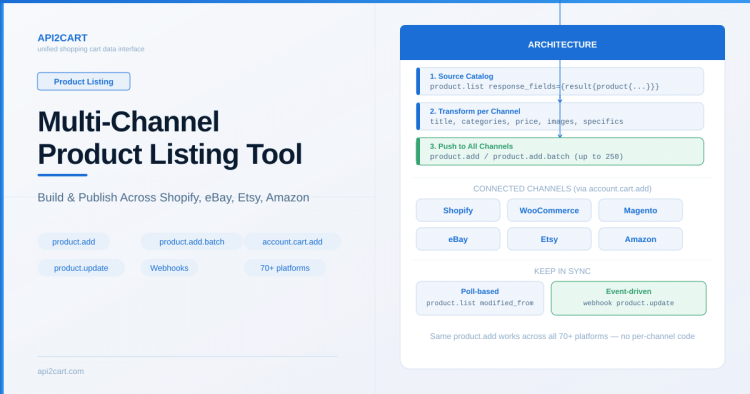
Summary: This article walks through how to build a product listing tool that publishes products to multiple eCommerce platforms simultaneously using API2Cart. It covers reading product data from a source, transforming it for different channels, and using product.add and product.add.batch to create listings across Shopify, WooCommerce, Magento, eBay, Etsy, Amazon, and more. What Is a Multi-Channel Listing Tool? A multi-channel listing tool allows merchants to manage their product catalog in one place and push listings...

Yuriy Klymyk

Summary: API2Cart provides batch methods (product.update.batch, product.add.batch, order.shipment.add.batch) for processing multiple records in one request. Combined with pagination (count + start parameters) and date filters (modified_from), this enables efficient sync for stores with thousands of products. When your application manages hundreds or thousands of products and orders across multiple stores, making individual API calls for each record becomes impractical. API2Cart provides batch operations that let you process multiple records in a single request, dramatically improving...

Yuriy Klymyk

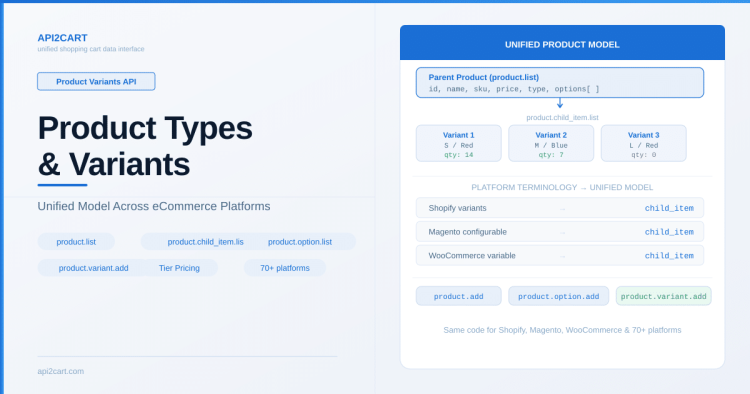
Summary: API2Cart's product variants API provides a unified model for all product types across platforms. This article gives a high-level overview of how different platforms structure products and variants, and links to detailed guides for implementation. The Challenge: Every Platform Structures Products Differently If you build a product sync, PIM, or listing tool, you quickly discover that every eCommerce platform has its own way of organizing products: Shopify — Products with up to 100 variants,...

Yuriy Klymyk

Summary: Use API2Cart’s order.shipment.add method to push tracking numbers to any connected store with a single API call. For bulk fulfillment, use order.shipment.add.batch. The API normalizes carrier names and handles partial fulfillment across all platforms. Adding shipment tracking information to orders is a critical step in fulfillment automation. When integrating with multiple eCommerce platforms, each store has its own rules for how tracking data should be submitted. API2Cart provides a unified approach through the order.shipment.add...

You're probably dealing with some version of this already. An order lands in an eCommerce store. Your app needs to reserve inventory, update a warehouse record, sync the order to an ERP, and maybe trigger shipping logic. One API call succeeds. Another times out. A third returns later with a retry. Now you've got stock reduced in one place, unchanged in another, and a support ticket waiting by morning. That's the distributed transaction problem in...

You're probably dealing with this already. Orders arrive from one store with tax lines nested one way, another store sends discounts as negative adjustments, a third store leaves optional customer fields blank, and inventory updates race in after the catalog changed upstream. Nothing is technically “broken” at first glance, but downstream systems start drifting. Reports don't match the storefront. Fulfillment queues stall. Support asks why duplicate customers keep appearing. That's where data validation automation stops...

Your PM asks for a “simple” CRM sync. Pull customers and orders from storefronts and marketplaces, push them into the CRM, keep everything current, and make support, sales, and marketing all happy. On a whiteboard, that looks like a few arrows. In code, it turns into authentication differences, schema mismatches, missing events, partial updates, retries, duplicate records, and hard questions about who owns each field. That is the core work behind integration CRM systems. The...

Most explanations of what abandoned cart recovery is start with marketing copy. Developers need a different framing. The useful question isn't “how do I remind shoppers?” It's “how do I detect a stalled checkout event across many carts, normalize the data, trigger a follow-up fast enough to matter, and keep that pipeline reliable at scale?” That matters because cart loss isn't a fringe issue. Baymard's aggregated benchmark puts average cart abandonment at 70.22% across 50...

You've probably been handed a project that sounds simple on paper: pull orders and customer data from an external system, push the right records into Salesforce, and keep everything in sync without breaking sales ops. That's where most Salesforce Python work stops being a tutorial exercise and starts becoming integration engineering. The hard parts aren't just making a request and printing JSON. The hard parts are choosing the right API for the workload, handling authentication...

You've probably had this happen. A payment fails, an order sync stalls, or a production deploy finishes, and nobody notices until a customer asks what's going on. The problem usually isn't that the event data doesn't exist. It's that the team doesn't see it at the moment it matters. That's where the question behind Whats a webhook Discord usually comes from. You don't need a full alerting product for every operational event. Sometimes you just...

Vladyslava Vashchynska

When SaaS teams build a product, integrations quickly become one of the hardest parts of the roadmap. Teams usually start with a few direct connections. However, as the product grows, developers need a clearer and more scalable integration approach. Because of this, many teams actively consider platforms like Cyclr API to simplify integration delivery. At the same time, demand for integration platforms continues to rise. For example, the global integration platform (iPaaS) market is valued...

Alona Nemerych

AmeriCommerce is a powerful and robust American eCommerce platform based in Texas that enables merchants to manage multiple online stores, products, and orders from one place. According to statistics, at present, there are 1,174 live stores running on this platform. It was acquired by Cart.com in December 2020. For eCommerce software providers, integrating with AmeriCommerce provides an opportunity to attract more merchants and provide useful features, such as order management, product listing, and real-time update...

Alona Nemerych

Unas is a popular eCommerce platform widely used by merchants in Central and Eastern Europe to build and manage online stores. According to statistics, there are currently 8,516 live stores operating on the UNAS platform. The Unas integration allows software providers to integrate their systems or applications with the Unas platform seamlessly. By establishing this connection, software providers can access and manage store data, such as products, orders, customers, inventory, shipments, and more, in real-time....

Alona Nemerych

Facebook Marketplace has quickly become one of the most powerful sales channels for online merchants, attracting millions of active buyers every month. For eCommerce software providers, the ability to connect their solutions to Facebook Marketplace is no longer just an advantage, it’s a necessity. According to statistics, it has a total user base of 1.2 billion in 2024 and almost 1.1 billion visitors to this marketplace every month, its fame for buying and selling things...

Alona Nemerych

The demand for powerful eCommerce marketplace services continues to grow in 2026, creating new opportunities for SaaS providers building tools like order management systems, shipping solutions, multi-channel software, and PIM platforms. For developers and eCommerce software owners, connecting to these marketplaces isn’t just about adding another integration — it’s about enabling functions that online retailers rely on every day, from product listings and order import to real-time inventory synchronization and shipping updates. However, each marketplace...

Alona Nemerych

Temu integration has become increasingly important for eCommerce software providers as the marketplace continues to expand worldwide. Temu is one of the fastest-growing online marketplaces, with millions of buyers and sellers in more than 22 countries. Its primary market is the United States, where it competes with Amazon and Shein. According to the latest data, Temu has 416.5 million monthly active users worldwide. In addition, Temu’s gross merchandise value reached $70.8 billion in 2024. This...

Anastasia Kholod

We are happy to present an interview with the Vice President of the advanced warehouse management software SphereWMS, Roark Janis. Roark, you have been in the industry for more than 30 years. How have logistics and supply chain management changed over the years? There have...

Anastasia Kholod

Lexy Mayko

Lexy Mayko

Vladyslava Vashchynska

PrestaShop API Integration: A Guide for Developers In the world of eCommerce, seamless integration with platforms like PrestaShop API is essential for streamlining business operations. By leveraging the PrestaShop API documentation, developers can automate tasks like managing product listings, syncing inventory, and processing orders. Integration...

Alona Nemerych

Vladyslava Konoplia

The Crucial Role of eCommerce Data Integration for Software Providers Today, developing reliable eCommerce data integration is important for B2B software providers who want to expand their business and enter additional markets. This connection allows them to work with data from online stores, such as...

Vladyslava Konoplia

Vladyslava Konoplia

Vladyslava Konoplia

Vladyslava Vashchynska